
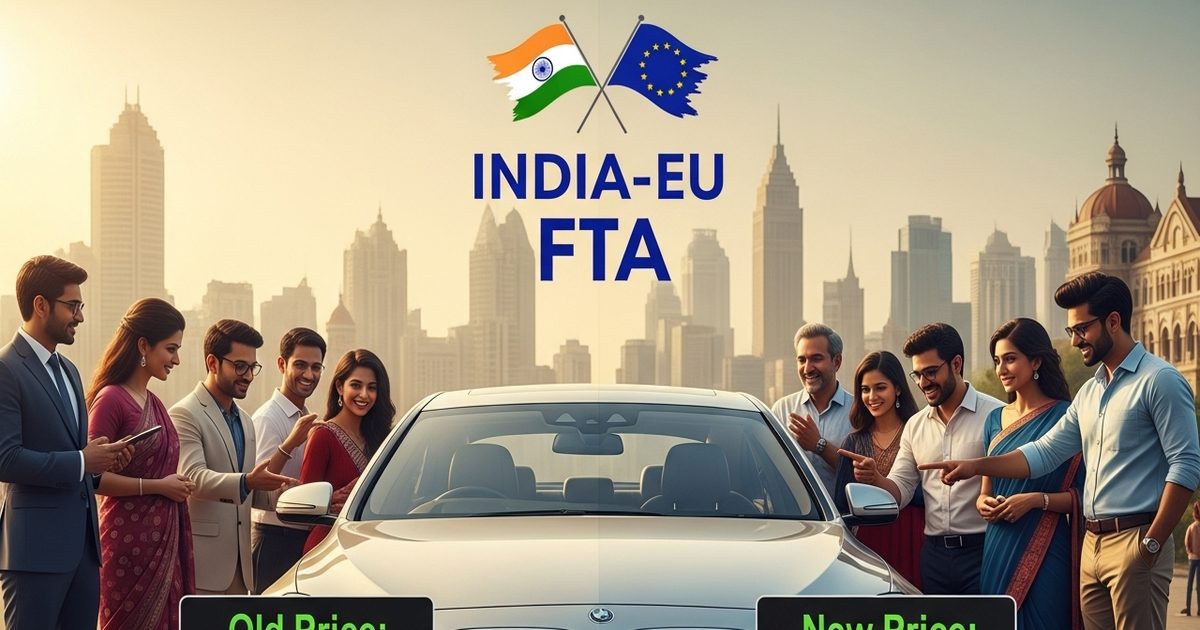
In fact, most of the luxury cars sold in India do not come fully prepared from abroad. More than 90 percent of the cars are assembled in the country. About 51 to 52 thousand luxury vehicles are sold annually, which include brands like Mercedes-Benz, BMW, Jaguar Land Rover and Audi. These companies have plants in Maharashtra and Tamil Nadu, where cars are assembled by importing parts from abroad. The price of these vehicles is often above Rs 1 crore.
Understand CKD vs CBU
These parts are called CKD kit in technical language. About 15 percent import duty and 1.5 percent social welfare surcharge are levied on these, which means the total tax is about 16.5 percent. In contrast, cars that come from outside in completely built condition, called CBU, are taxed heavily, ranging from 70 to 110 percent. In the proposed agreement, there is talk of first bringing the duty on CBU to about 40 percent and later reducing it to 10 percent in a phased manner.
But since most of the luxury cars sold in India are already low-tax CKD models, there seems to be little scope for a major price cut. Santosh Iyer, Managing Director and CEO of Mercedes-Benz India, while talking to Moneycontrol clearly said that this agreement is not expected to have any significant immediate impact on the prices. He said that more than 90 percent of the company's sales are of locally assembled cars and only about 5 percent of the vehicles are completely imported from Europe.
Mercedes, BMW also assemble cars in India
Mercedes assembles its cars at the Chakan plant near Pune and most of the kit comes from Germany. Recently the company started local production of Mercedes-Maybach GLS, which happened for the first time outside America. Due to this, the price of this model reduced by about Rs 42 lakh, i.e. there was a relief of about 13 percent. This example shows that the real role in reducing prices is played by local manufacturing, and not just trade agreements.
BMW also adopts almost the same strategy. Almost 9 out of 10 models of the company are assembled in India only. Hardeep Singh Brar, President and CEO of BMW Group India, believes that there is no possibility of immediate change in prices, but this agreement can be beneficial in the long run. According to him, if the tax on CBU is reduced then the company will be able to launch new international models in India and after assessing the demand, a decision can be taken for further local production.
No relief in prices in near future!
Jaguar Land Rover has also indicated that the trade agreement should not expect any immediate change in the prices of cars assembled in India. The company assembles many Range Rover and Discovery models in Pune and a big plant is about to start near Chennai. Even with the proposed India-UK Free Trade Agreement, the company has not assured customers of price relief in the near future.
You will get benefits if you buy Ferrari, Lamborghini, Porsche
Experts believe that if anyone can benefit the most, it is the supercar brands like Ferrari, Maserati, Lamborghini and Porsche, which fully import their cars. Similarly, ultra luxury brands like Rolls-Royce and Bentley may also benefit from a separate trade agreement in future.
However, there is another big factor here – currency. Market experts say that the weakness of the rupee can eliminate the tax benefits to a great extent. In 2025 alone, the rupee had weakened by about 19 percent against the euro. For this reason, many luxury car companies increased prices in 2025 and early 2026. According to a market expert, the impact of currency may limit the benefits of tax cuts in the coming few years.
Overall, the India-EU Free Trade Agreement may gradually change the direction of the luxury car market, but it is not practical to expect the common customer to get cheaper cars immediately. Real relief may be seen in the long run, when companies enter the market with new strategies.