
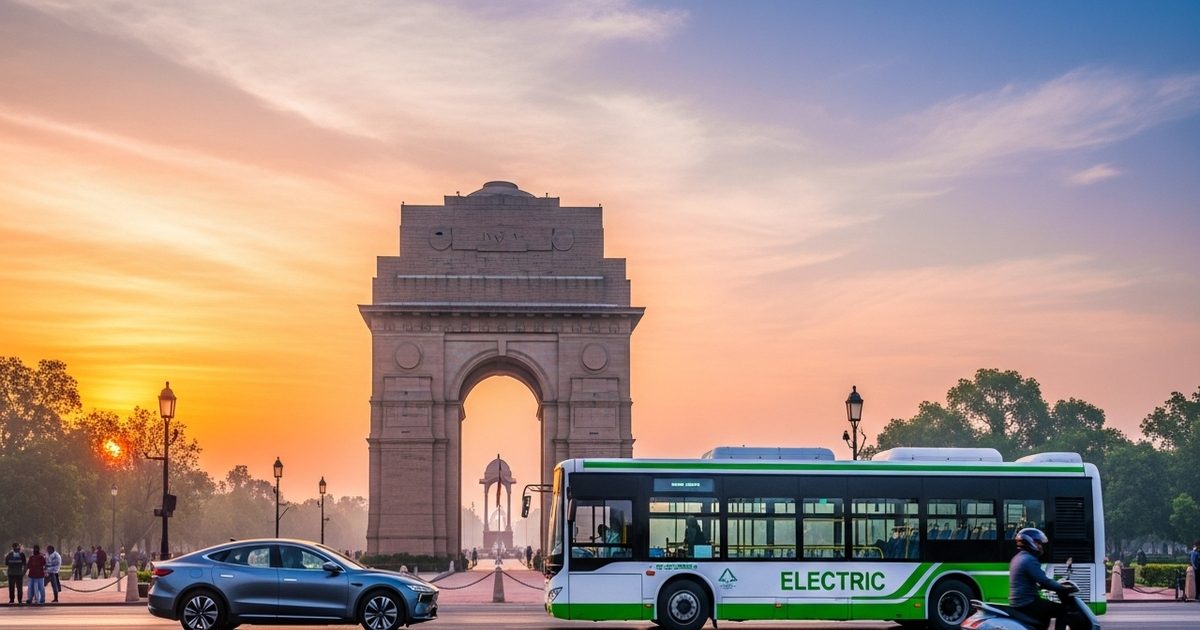
Delhi EV Policy 2.0: Delhi government will spend ₹200 crore for green mobility

Delhi EV Policy 2.0: Delhi government will spend ₹200 crore for green mobility

Last Updated:

Delhi government's new EV Policy 2.0 can prove to be a big game changer for the common people. On scrapping old petrol-diesel vehicle, you will get subsidy of up to ₹ 1 lakh, complete exemption in road tax and many new benefits. If you are thinking of buying a new electric vehicle, then this news is very important for you.

news quickly

Zoom

What benefits will you get in Delhi EV Policy 2.0? Know

Delhi government has presented its green budget for the financial year 2026-27, in which big announcements have been made to promote electric vehicles (EV). In this budget presented by Chief Minister Rekha Gupta, a special provision of Rs 200 crore has been made for Delhi EV Policy 2.0.

The government aims to make Delhi the 'EV capital' of the country as well as implement the world's best and biggest EV policy. This budget is the biggest budget till date regarding EV policy. Let us know what new provisions have been made in EV Policy 2.0. If you live in Delhi, how will you benefit from the new EV policy?

What is there for you in the new EV Policy (EV Policy 2.0)?

The government has allocated Rs 200 crore to speed up the adoption of electric vehicles. Under this new policy, huge subsidy will be given on scrapping old petrol and diesel vehicles. After scrapping a private car with ICE, you will get an incentive of up to Rs 1 lakh on purchasing an electric car worth up to Rs 15 lakh.

This benefit will be for the first 1 lakh buyers. Apart from this, scrappage subsidy of up to ₹10,000 for two-wheeler and ₹25,000 for three-wheeler is proposed. At the same time, all electric vehicles registered in Delhi till March 31, 2030 will continue to get 100% exemption from road tax and registration fees. This discount will be available only on vehicles up to ₹ 30 lakh.

Expansion of Pollution Control Centers (PUC)

To control the increasing pollution and ensure the fitness of vehicles, the government has decided to open additional pollution testing centers and Automated Testing Stations (ATS). 5 new ATS will be installed in major DTC depots like Bawana, Ghazipur and Dwarka. A budget of Rs 50 crore has been kept separately for this, so that there is transparency in checking of vehicles and manual interference is reduced.

Rejuvenation of public transport

Delhi government has set a target of making public transport completely pollution free. The government aims to ensure that all buses plying on Delhi's roads are electric by 2029. The state government has allocated Rs 320 crore for electrification of bus depots and expansion of charging points.

Why is this budget special?

Of the total budget of Rs 1,03,700 crore, about 21% (about Rs 22,236 crore) has been kept for environmental protection and 'green' initiatives. The government has not only focused on purchasing new vehicles, but has also worked on 'scrapage-linked' incentives for battery recycling and scrapping of old vehicles. Auto experts believe that direct subsidy of up to ₹ 1 lakh and road tax waiver will lead to a huge surge in the sales of electric cars in Delhi.
Source link

No road tax, no registration fee, car buyers happy in the new EV policy!

No road tax, no registration fee, car buyers happy in the new EV policy!

Last Updated:

Delhi government is preparing to bring a new EV Policy 2.0, the aim of which is to rapidly promote electric vehicles in the city. Under the proposed policy, emphasis has been laid on increasing subsidy on two-wheeler and four-wheeler electric vehicles, expanding charging infrastructure and removing old polluting vehicles.

news quickly

Zoom

New Delhi. To reduce the increasing air pollution and fuel dependence in Delhi, the government is planning to promote electric mobility rapidly. In this direction, Delhi government is preparing to bring EV Policy 2.0 by further strengthening the existing electric vehicle policy. This new policy will focus on providing more aggressive targets and incentives for large-scale adoption of electric vehicles in the city. The existing electric vehicle policy implemented in 2020 has been extended several times and now its duration has been extended till March 31, 2026. The draft prepared for the new policy is currently in the process of public consultation and review and it is expected that it can be implemented from the financial year 2026.

The biggest goal of the new policy is to rapidly increase the share of electric vehicles in Delhi. According to the draft proposal, a target has been set to make about 95 percent of new vehicle registrations in Delhi by 2027 for electric vehicles. This target is considered to be much more ambitious than the target of 25 percent set in the 2020 policy.

More focus on electric two-wheeler

In the new policy, there is a plan to promote electric two-wheelers the most. According to the proposal, a subsidy of about Rs 21,000 can be given on purchasing an electric two-wheeler. It has also been proposed to increase this incentive to about Rs 30,000 for women buyers. The government aims to increase the number of electric two-wheelers in Delhi to around 12 lakh.

Subsidy on electric cars also

A new plan is also being made to promote electric 4 wheelers. According to the proposal, depending on the battery capacity, an incentive of up to Rs 10,000 per kilowatt hour can be given, the maximum limit of which can be up to Rs 1 lakh per vehicle.

Plan to convert old vehicles into electric

A new proposal in the new policy is to provide incentives for converting old vehicles running on petrol or diesel into electric ones. Under this, it has been suggested to provide assistance up to Rs 50,000 for converting such vehicles into electric ones. This scheme can be implemented initially for a limited number of vehicles.

Other electric vehicles will also be promoted

In the new policy, emphasis has been laid on making three-wheelers, light commercial vehicles and trucks also electric.

  • Incentives for electric three wheelers are likely to continue.
  • Assistance up to Rs 75,000 can be availed on electric light commercial vehicles.
  • Additional incentives are also being considered to promote battery-powered trucks.

Expansion of charging infrastructure

A major part of the new policy is related to strengthening the charging infrastructure. The government is planning to increase charging stations at mohalla level and create fast charging corridors on major roads such as Ring Road and Outer Ring Road. Along with this, a target has also been set to increase the capacity of the battery storage system by 2030.

Scrappage and other benefits

In the new policy, emphasis has also been laid on removing old and more polluting vehicles. Under this, steps like giving scrappage incentive, continuing exemption in road tax and registration fees on new electric vehicles are being considered. There is also a plan to create a dedicated state EV fund, which can provide financial support to these incentives.

About the Author

authoring

Jai Thakur

Jai Thakur has been associated with the world of news since 2018. Working as Senior Sub Editor in News18Hindi since 2022 and is part of the business team. There is interest in news related to business, especially stock market. Apart from this…read more

Source link