
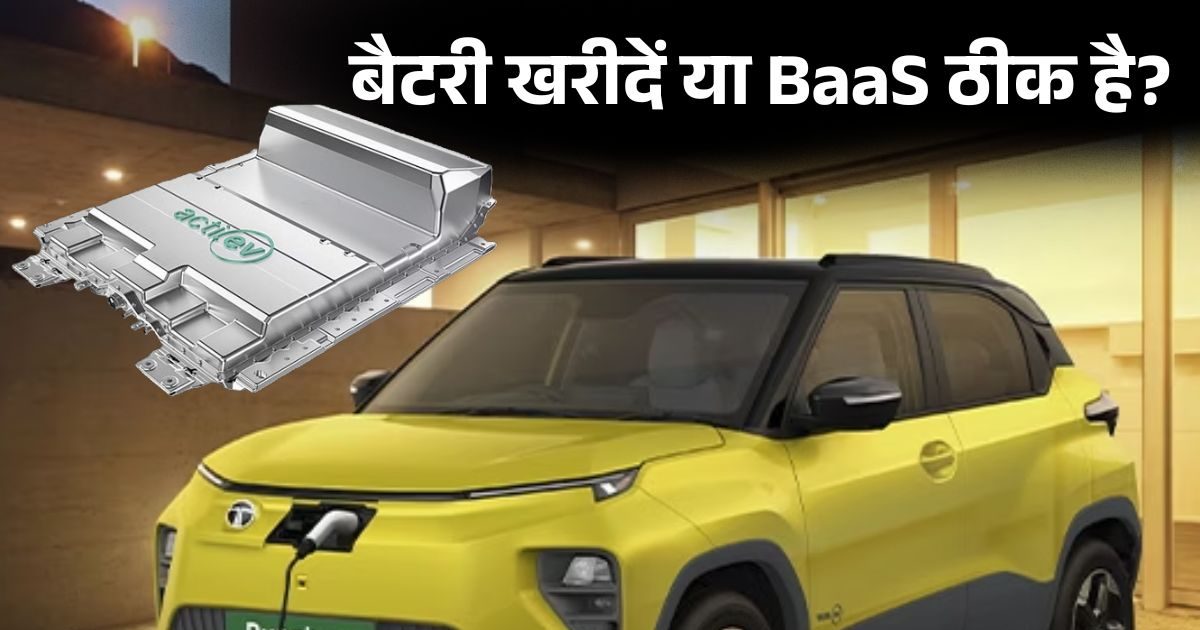
At present, one of the biggest questions arises while buying an electric car. Lease the battery (BaaS) or buy the entire vehicle including battery? This debate has become more heated with the availability of BaaS option in vehicles like Tata Punch EV, MG Windsor EV and Maruti e-Vitara. In BaaS, the upfront cost is reduced by 30-40 percent, but there is a battery fee for every km.
This scheme was first started by MG with Windsor EV. In such a situation, it is very important to know whether it is better to buy the vehicle with battery, or whether it will be more profitable to bring it home with BaaS. Let us understand from realistic calculations of 5 years which option can be better for the average Indian user (12,000 km annually). You will also learn about this scheme.
What is BaaS and how does it work?
In Battery as a Service (BaaS), you buy the car's chassis+motor+features and take the battery on rent. Repair, degradation, replacement and warranty of the battery is the sole responsibility of the company. This has been launched for the first time in Tata Punch EV. MG and Maruti are also running on this model. Talking about benefits, there is low down payment, easy EMI and zero tension on battery. However, on longer journeys or more kilometers the total cost may increase.
Buy or rent batteries?
Now let's look at both the calculations. We have taken the recently launched Punch EV as an example. It is assumed that after purchasing the car, the user will drive it for 12 thousand kilometers every year. In such a situation, whose expenses will be more? The one who buys the battery or the one who rents the battery? Come, let us know.
With BaaS option
- Upfront cost: ₹6.49 lakh
- Battery Rental Fee: ₹2.6 × 60,000 = ₹1.56 lakh
- Electricity expenses: ₹1.5 per km × 60,000 = ₹0.90 lakh (from home charge)
- Maintenance (tyres, brakes, service): ₹0.20 lakh (much less in EV)
- Total cost over 5 years: ₹9.15 lakh (including vehicle price)
Full Ownership
- Upfront cost: ₹9.69 lakh
- Electricity expenses: ₹0.90 lakh
- Maintenance: ₹0.20 lakh
- Total cost in 5 years: ₹10.79 lakh (including vehicle price)
Who is the winner?
BaaS will save ₹1.64 lakh in 5 years. The break-even point is around 1,23,000 km. This means that for someone who drives an average of 12,000 km/year, the fees will be equalized only after 10 years. In 5 years, BaaS clearly wins.
Benefits of BaaS
- Low EMI: The EMI of a car priced at ₹ 6.49 lakh will be ₹ 12-13 thousand/month, while that of a car priced at ₹ 9.69 lakh will be ₹ 18-20 thousand.
- No battery tension: The company will have to worry about degradation, overheating or replacement after 8 years.
- Flexible: If the vehicle runs less, then the fees will also have to be paid less.
- Resale Value: Some financiers give the option to buy the battery after 3-5 years.
Benefits of buying a complete battery
- After 1.23 lakh km, every additional km will be free.
- The battery will remain yours. You will get better price in resale.
- Lifetime warranty (first honor) will be available in 40 kWh variant.
Which is better for whom?
If you are an average user (10,000-15,000 km/year), drive in the city and plan to change your vehicle in 5-7 years, then BaaS would be the best option. Low upfront, low monthly expenses and no battery tension. At the same time, if there is going to be more traffic on the highway. If the car will drive more than 20,000 km/year and you plan to keep it for 8-10 years, then it would be better to buy a car with a full battery.
urgent matter: This calculation is based on the introductory ex-showroom price of Tata Punch EV in February 2026, home charging and average usage. Local taxes, insurance and charging tariffs may vary. Further savings will be possible through solar charging. You should choose the car according to your budget and needs.