
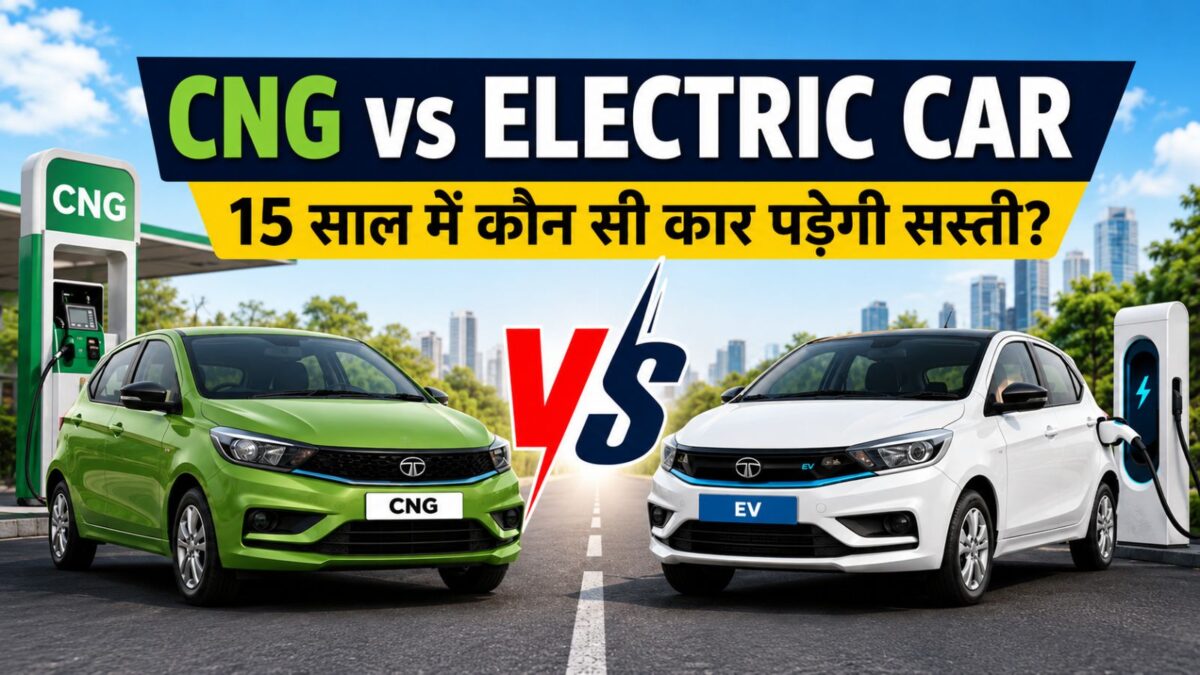
CNG or Electric Car? Which is better for daily up-down? Understand with 15 years of calculation

CNG or Electric Car? Which is better for daily up-down? Understand with 15 years of calculation

CNG vs Electric Car: Whenever it comes to choosing a car with low running cost in the Indian auto market, customers have only two main options. CNG and Electric Vehicle (EV). If you are thinking in terms of the next 15 years i.e. the entire lifecycle of any car, then this decision becomes even more important.

Over a long period of 15 years, it is not just the initial price of the car that matters, but the subsequent big factors like fuel cost, maintenance, battery life and resale value change the game. In this detailed report, we will analyze every aspect which will help you understand which car is going to prove to be the best according to your pocket and needs for the next 15 years.

Upfront Cost

If you compare the CNG and EV versions of the same model in the showroom, you will see a big difference in the starting price of both. For example, in a budget car like Tata Tiago, the electric model (EV) is costlier by about Rs 2 to 3 lakh compared to the CNG model. This initial difference of 15 years of ownership matters a lot, because to buy an EV you have to invest more from day one or take a bigger loan (which will attract interest). However, CNG cars easily fit into the budget.

Running cost: math per kilometer

In the long run, the EV compensates for its initial expensive price with its extremely low running costs. Let us understand the mathematics of both.

  • Electric Car: If you charge the car at home at night, the cost of running an EV is only ₹1 to ₹1.5 per kilometer depending on the electricity rate.
  • CNG Car: The mileage of CNG cars may be excellent, but according to the current CNG prices, its running cost comes to ₹ 3.5 to ₹ 4 per kilometer.

Thus, suppose you drive 15,000 kilometers in a year, then your total running in 15 years will be 2,25,000 kilometers. In such a situation the calculation will be something like this-

  1. Total EV charging cost for 15 years: ₹3,37,500 (at ₹1.5/km)
  2. Total fuel cost for 15 years from CNG: ₹9,00,000 (at ₹4/km)

Direct Benefit: In terms of fuel, EV can give you direct savings of more than ₹ 5.5 lakh in full 15 years.

Maintenance and servicing expenses

A petrol-diesel or CNG car has hundreds of moving parts like engine, oil filter, spark plug, gearbox and clutch, which need regular service. The cost of hydro-testing the CNG kit and engine wear-and-tear increases significantly in 15 years.

In contrast, an electric car does not have a complex engine, nor the hassle of changing engine oil. EVs have only a motor, battery and a single-speed transmission, making routine service very cheap (₹3,000 to ₹4,000 annually).

Battery replacement: the biggest suspense of EV

The thing that can go against an EV in its 15 year journey is its battery life. Car companies usually give a warranty of up to 8 years or 1.6 lakh kilometers on EV batteries. But you may have to replace the battery at least once in a period of 15 years. Currently the cost of changing the battery pack ranges from ₹ 2 lakh to ₹ 4 lakh. Although battery technology is expected to become cheaper in the future, this is still a major expense that CNG cars never incur.

Infra and resale value

The CNG network has become very strong across India, especially on highways and tier-2 cities. You can fill the tank in 5 minutes and set out on a long journey. On the other hand, the EV charging network is growing rapidly, but even today you have to plan for long trips on the highway and fast charging also takes 45-60 minutes.

When you go to sell the car after 15 years, the resale value of a CNG car is expected to be more stable because its engine is easily repaired even if it is old. The resale value of an EV will depend entirely on the health of its battery at that time.

parameters cng car electric car
starting price budget friendly Expensive (premium Rs 2-3 lakh)
Running Cost (Per KM) ₹3.50 to ₹4.00 ₹1.00 to ₹1.50 (home charging)
regular maintenance expenses Mid Level (Engine Oil, Tuning) Very low (no engine oil)
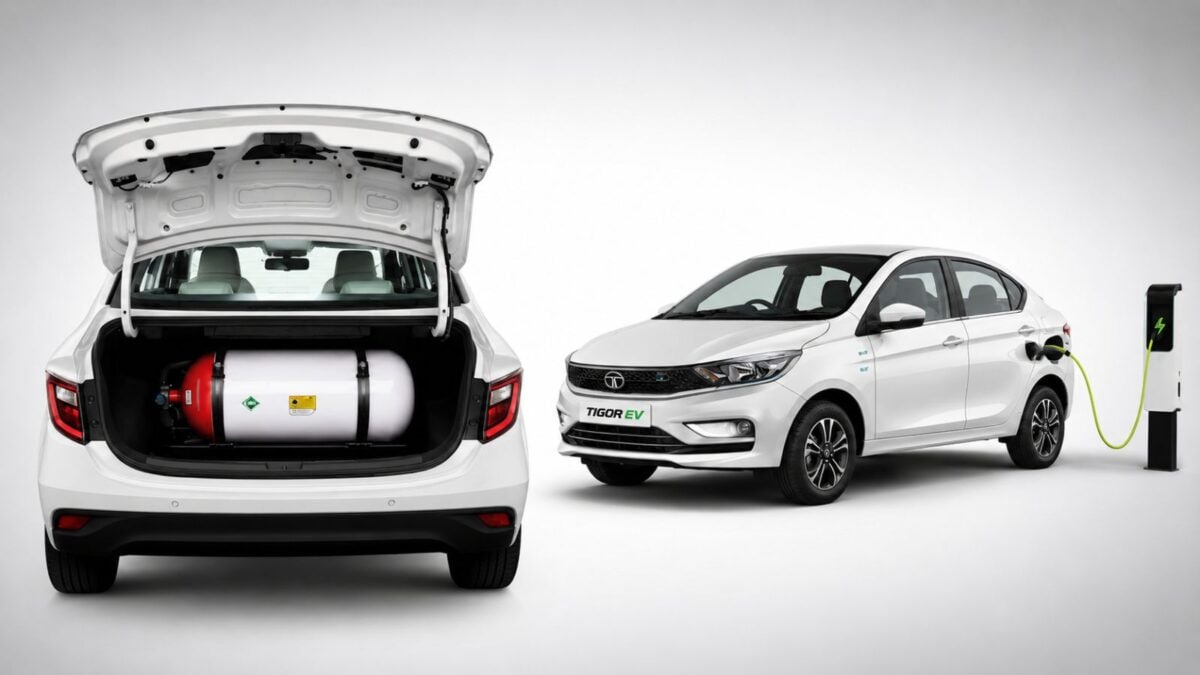
boot space Cylinder takes up space Gets full boot space
long trip Refueling in just 5 minutes Planning of charging station is necessary
risk Engine Overhaul/CNG Kit Test High cost of battery replacement
driving comfort Have to change gears, low torque Automatic, Quick Torque

What is best for you?

Over a long timeframe of 15 years, both the cars offer huge savings compared to petrol, but the choice of 'best' depends on your driving and parking conditions. If your daily running is more than 50-60 km, you mainly drive in city traffic and you have safe personal parking space available at home or office to charge the car, then EV may be best.

In a total of 15 years of running, the EV will give you so much savings in maintenance and fuel costs that you will still be in profit despite the cost of battery replacement. If your budget is limited, your annual running is less than 10,000 km and you often go on long trips, then it is better to choose a CNG car. Because there is no worry about dye in it.
Source link

CNG vs EV Cars: Which one is better to buy for going to office? Understand with 5 year calculation

CNG vs EV Cars: Which one is better to buy for going to office? Understand with 5 year calculation

If you are thinking of buying a new car for 5 years, then this question will definitely be in your mind whether to buy CNG or EV car. Which car will put less burden on the pocket? Initially CNG cars seem quite cheap, but as you drive, the mathematics starts changing. Even though the starting price (Ex-Showroom Price) of electric vehicles may be high, their per kilometer expense and servicing cost is much lower than CNG.

In this article we will talk about every aspect like mileage, daily fuel cost, maintenance and resale value after 5 years. We are presenting before you very clear and honest calculations without any bias, so that you can take the most sensible decision as per your need and running (daily driving).

Calculating running costs

The biggest difference in the cost of CNG and electric cars comes here. Talking about CNG car, today the price of CNG is around ₹ 75 to ₹ 85 per kg. If the car gives a mileage of 20 km/kg, then the cost per kilometer comes to around ₹ 3.75 to ₹ 4.25.

At the same time, the average rate of electricity for charging an electric car at home is ₹ 7 to ₹ 8 per unit. A typical EV takes 30 units of electricity to be fully charged (costs approximately ₹ 240) and covers a range of 250 km. In this way the cost of EV comes to only ₹ 1 to ₹ 1.20 per kilometer.

  • If you travel 50 kilometers daily, the daily expense on CNG will be around ₹200, whereas on EV this expense will be only ₹50-₹60.

Servicing and maintenance expenses

Electric vehicles have less moving parts than CNG vehicles. CNG car has petrol engine only, hence engine oil change, air filter, spark plug, coolant and tuning of CNG kit have to be done. Its maintenance cost in 5 years can range from ₹ 30,000 to ₹ 45,000.

At the same time, in an electric car there is neither engine oil, nor piston, nor the hassle of gearbox. In this, only suspension, brake pads and tires have to be taken care of. Its servicing cost in 5 years does not exceed ₹ 15,000 to ₹ 20,000.

5 years complete mathematics

Let us assume that you drive 50 km every day. According to this, there will be a total running of 18,000 km in 1 year and 90,000 km in 5 years. Let us see what the total expenditure will be-

parameters cng car Electric Car (EV)
Starting price (estimated) ₹8.5 lakh (affordable) ₹11.5 lakh (₹3 lakh expensive)
Cost per km (fuel) ₹4.00 ₹1.10
Fuel cost of 90,000 KM ₹3,60,000 ₹99,000
5 years servicing cost ₹40,000 ₹18,000
Fear of changing the battery does not apply 8 Years/1.6 Lakh KM Warranty
Total Expenses (Car+Running+Service) ₹12,50,000 ₹12,67,000

Which is better for you?

It is clear from the above mathematics that after 5 years and 90,000 kilometers of driving, the total cost of both the cars becomes almost equal. If your budget is limited, your daily running is less than 30-40 km and you want to go on long journeys without worrying about charging (Range Anxiety), then CNG is still the best and safest option for you.

At the same time, if your daily running is 50 to 100 km or more, then EV is a boon for you. As the vehicle ages beyond 5 years, EV will save you lakhs of rupees. Also, it gives you a great and smooth driving experience without noise and hassle of changing gears.

Source link

Petrol vs EV: Which car is best for daily office commuting? Understand with 5 year calculation

Petrol vs EV: Which car is best for daily office commuting? Understand with 5 year calculation

Petrol vs Electric Car: Choosing the right car for daily commute is a big decision for every working person. While petrol prices in the country remain around ₹ 100 per litre, on the other hand, electric vehicles (EVs) are attracting everyone's attention with their promise of low running costs. But is buying an EV really beneficial for everyone?

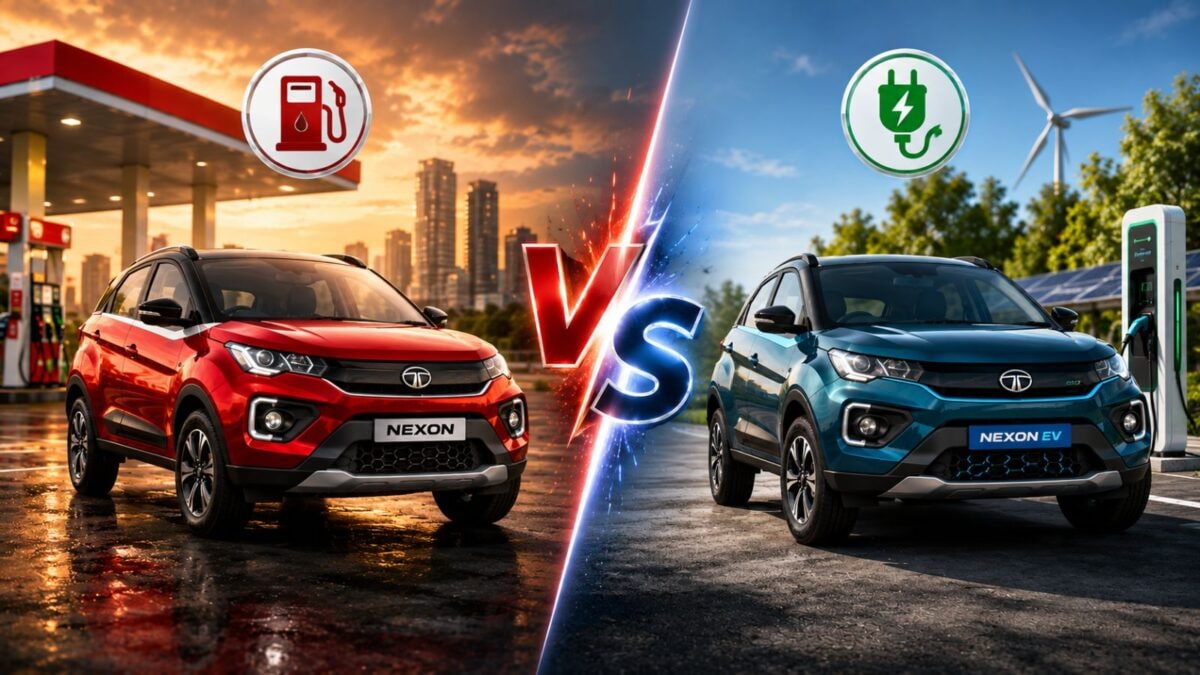
To solve this dilemma, we will understand the complete mathematics of the next 5 years by taking the example of India's most popular compact SUV Tata Nexon and Tata Nexon EV. From this calculation it will become clear to you that which car will be best according to your budget and needs for going to office daily?

Petrol Car vs EV: Daily expense of going to office

Let us assume that your car travels 40 kilometers daily, including the distance from your home to office and weekend travel. According to this, the monthly running of your vehicle will be around 1,200 kilometers and the annual running will be 14,400 kilometers. In 5 years your car will travel a total of 72,000 kilometers.

Tata Nexon Petrol: Its starting on-road price in Delhi starts from around ₹ 8.5 lakh. It gives a mileage of around 14 km/litre in the city. At the rate of ₹100 per liter of petrol, your expenditure on fuel alone in 5 years will be ₹5,14,285.

Tata Nexon EV: The on-road price of its base variant is around ₹ 13.2 lakh. On home charging at the rate of ₹ 8 per unit, this car runs at ₹ 1.1 to ₹ 1.4 per kilometer. In this way, the total cost of charging in 5 years will be only between ₹ 80,000 to ₹ 1,00,000.

5 Year Total Cost of Ownership (TCO)

When buying an EV, you have to pay around ₹4 to ₹4.5 lakh more, which is called 'green premium'. Let us see what is the total cost of ownership including 5 years of service, insurance and fuel/charging-

Type of expenditure (5 year estimate) Tata Nexon Tata Nexon EV
Starting On-Road Price (Approx) ₹8,50,000 ₹13,20,000
Fuel/Charging Cost (72,000 km) ₹5,14,285 ₹96,000
Maintenance and service expenses (5 years) ₹60,000 ₹25,000
Insurance (5 years cumulative) ₹90,000 ₹1,25,000
Total Cost (5 Year TCO) ₹15,14,285 ₹15,66,000

Which car will be best for you?

It is clear from the calculation that if your running is 40 kilometers daily (14,000 km annually), then by the completion of 5 years the total cost of petrol and electric car becomes almost equal.

Electric car is best when: If your daily commute to office is more than 50 kilometers. In this situation, the EV will recover its extra cost (Break-even) in just 3.5 to 4 years and after that your huge savings will start. Also, one can enjoy silent and smooth driving without changing gears in bumper-to-bumper traffic.

Petrol car is best when: If your daily running is less than 20-30 kilometers. In such a situation, it will take 7-8 years to recover the increased price of EV, which will be a loss-making deal. Apart from this, if there is no space for charging setup in your apartment, then petrol car is the most practical option for you.

Source link