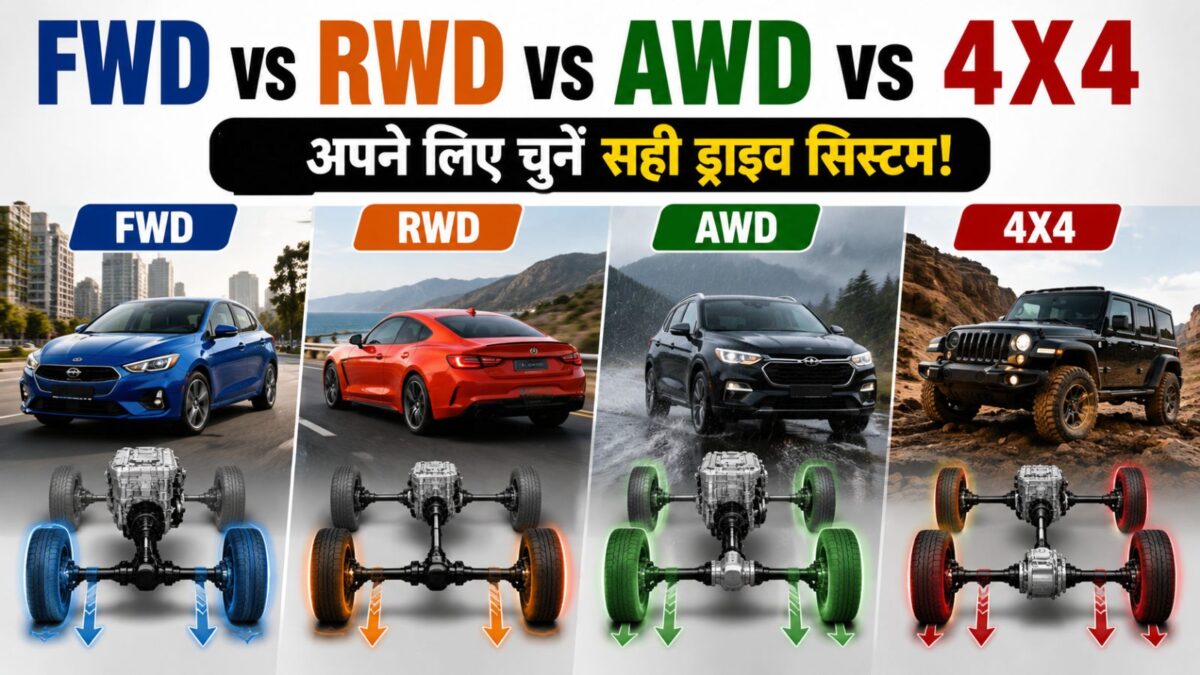
Today's cars come with various drive systems that transmit the engine's power to the wheels. It is important to understand the difference between Front Wheel Drive (FWD), Rear Wheel Drive (RWD), All Wheel Drive (AWD) and 4X4 (Four-Wheel Drive) while purchasing. These systems impact fuel efficiency, traction, handling and off-road capability.
By knowing which one works better on city roads, highways or in bad weather, you can choose the right option as per your need. FWD is generally economical, while 4X4 is strong for speed and off-road. Choosing the right drive system makes a big difference in safety, comfort and performance. Let us know what is the difference between them and which one will be better for you?
Front Wheel Drive (FWD)
In front wheel drive, engine power is supplied only to the front two wheels. This is the most common and cheapest system found in most sedans, hatchbacks and small cars. Benefits include better fuel efficiency, lower weight and good grip in snowy or wet weather as the weight of the engine is at the front. However, there can be understeer in sharp turns and performance suffers under heavy loads. This is the most practical option for city driving and everyday use.
Rear Wheel Drive (RWD)
In rear wheel drive the power goes to the rear wheels. It is quite popular among sports cars, luxury sedans and big cars. It gives better balance and acceleration. Handling while cornering is excellent and the weight distribution of the vehicle is correct. The disadvantage is that traction may be reduced on wet or icy roads and it is a bit expensive to repair. RWD is perfect for long drives and performance lovers, but may seem less efficient for daily city use.
All Wheel Drive (AWD)
In all wheel drive, power is given to all four wheels when needed. This can be full-time or on-demand. Common in SUVs and crossovers, it provides excellent traction in all weather conditions. It works in one pace in rain, snow or light off-road. It is safer than FWD and RWD, but its fuel consumption is slightly higher. Modern AWD systems are computer-controlled, providing smooth performance. This is a great option for families and areas with different climates.
4X4 (Four-Wheel Drive)
4X4 or four-wheel drive is primarily designed for off-road use. In this, the driver can give power to all the wheels manually or automatically and low-range gear is used. This drivetrain is found in SUVs, pickups and adventure vehicles. It is great on bad roads, mud, sand or hilly areas. Heavy weight, low fuel efficiency and expensive maintenance limit its demand. This is best for off-road lovers.
Our advice: The right drive system for you depends on your needs. FWD is economical and adequate for city and highway use. If you like sporty driving then choose RWD. AWD is most practical with different climates and families. 4X4 is essential for off-roading or heavy duty work. While buying, keep in mind the weather of your area, budget and driving style.
The following table lists out the number of SUVs (or SUV-like cars) in a manufacturer’s Indian portfolio along with the number of SUVs with 4WD:
INDIAN SUV MANUFACTURERS WITH 4WD
Manufacturer
# 4WD Vehicles
Total SUVs*
Mahindra
4
8
Maruti Suzuki
2
7
Hyundai
1
5
MG
1
5
Toyota
4
5
Jeep
4
4
Kia
1
2
Skoda
1
2
Volkswagen
1
2
BRANDS WITHOUT 4WD
Tata
0
6
Citroen
0
4
Renault
0
2
Honda
0
1
Nissan
0
1
BYD
0
1
*SUV here is meant to represent cars that are trying to capitalise on the SUV body style craze
Now, let’s look at each manufacturer one by one.
Mahindra — 4/8 SUVs With 4WD (50% Coverage)
Mahindra have the largest number of 4WD cars in their portfolio and Jeep are the only mass market carmaker matching them in this regard. And if you factor in the Scorpio Classic and the Bolero, both of which earlier had a 4WD option, then the count goes up to 6 vehicles for a 75% coverage.
They are cashing in on this SUV craze with the largest number of SUVs on offer. The Thar perfectly sets the stage for the rest of their SUVs to borrow the rugged, go-anywhere personality. Then, having an option of 4WD in 4 of their vehicles makes it worth a look for buyers who absolutely need that capability.
MAHINDRA SUVS
SUVs*
4WD Option
XUV300
❌
XUV400
❌
Thar
✔
Scorpio Classic
❌ (4WD Discontinued)
Scorpio N
✔
XUV700
✔
Bolero
❌ (4WD Discontinued)
Bolero Camper
✔ (Surprised?)
Bolero Neo
❌
Total: 8
4WD: 4/8
Maruti Suzuki — 2/7 SUVs With 4WD (29% Coverage)
Maruti Suzuki are the next in line with 7 SUVs. The Jimny is their halo off-roader but even the Grand Vitara has the option of 4WD with a manual transmission. We’re pretty confident that it is a made-to-order kind of a variant with very limited production because of the scarce demand. But, having that option in the variant lineup helps the Vitara earn that SUV tag. This further spills into their lineup and it’s supposed to help them sell more vehicles with this SUV styling.
While you may laugh at someone expecting 4WD capabilities from a small car like the Ignis, it’s worth noting the Ignis does get the 4WD option in some international markets. So, it has more of those SUV genes in it than other mini SUVs like the Punch, Exter and the now-discontinued KUV100.
MARUTI SUZUKI SUVS
SUVs*
4WD Option
S-Presso
❌
Ignis
No (Not in India)
Fronx
❌
Brezza
❌
Jimny
✔
Grand Vitara
✔
Invicto
❌
Total: 7
4WD: 2/7
Hyundai — 1/5 SUVs With 4WD (20% Coverage)
After the addition of the Exter, Hyundai have 5 SUVs in their Indian portfolio. Only one of these has the option of 4WD. Even though they don’t sell the Tucson in large volumes, having it around gives the other SUVs in their portfolio that SUV character. After all, that’s what the buyers are buying into. And for a leading SUVs seller, the cost of having the Tucson in India is worth it, even if its numbers don’t add up to justify that investment.
HYUNDAI SUVS
SUVs*
4WD Option
Exter
❌
Venue
❌
Creta
❌
Alcazar
❌
Tucson
✔
Total: 5
4WD: 1/5
MG — 1/5 SUVs With 4WD (20% Coverage)
Counting the Hector and Hector Plus as 2 separate SUVs and similarly, considering Astor and ZS as 2 distinct SUVs, we end up with 5 SUVs in MG’s portfolio. While the number of vehicles with 4WD option still remains 1 — exclusive to Gloster — the others still at least have a true SUV to look up to. The 20% overall coverage of 4WD in MG’s SUV portfolio is the same as that of Hyundai.
MG MOTOR SUVS
SUVs*
4WD Option
Astor
❌
Hector
❌
Hector Plus
❌
ZS
❌
Gloster
✔
Total: 5
4WD: 1/5
Toyota — 4/5 SUVs With 4WD (80% Coverage)
Toyota have 5 SUVs (or SUV-like vehicles) in India and 4 of them have the option of 4WD. Even if you ignore the ultra luxury Land Cruiser, they have a 75% coverage of 4WD in their SUV portfolio. In fact, the only car without 4WD is something most people would call an MPV as it borrows the Innova name plate. But, if Maruti Suzuki can dare to call the XL6 an SUV, then the Hycross certainly deserves the SUV tag in my books.
TOYOTA SUVS
SUVs*
4WD Option
Hyryder
✔
Hilux
✔
Fortuner
✔
Hycross
❌
Land Cruiser
✔
Total: 5
4WD: 4/5
Jeep — 4/4 SUVs With 4WD (100% Coverage)
True to their SUV DNA, Jeep are the only SUV manufacturer offering the option of 4WD with every vehicle they sell in India. 4 out of 4 — 100% 4WD coverage and a perfect score. The commitment to making SUVs doesn’t reflect as strongly as in Jeep’s India portfolio.
JEEP SUVS
SUVs*
4WD Option
Compass
✔
Meridian
✔
Wrangler
✔ (Duh!!)
Grand Cherokee
✔
Total: 4
4WD: 4/4
Kia — 1/2 SUVs With 4WD (50% Coverage)
Now, Kia are a tricky one. They have 2 SUVs and 1 electric car in the portfolio with 4WD but it’s not an SUV. Their halo product, the imported EV6 electric, has rear-wheel drive and all-wheel drive options. So, I’d say, they’re still doing much better than the carmakers selling SUVs without showing any expertise with 4WD in India.
KIA SUVS
SUVs*
4WD Option
Sonet
❌
Seltos
❌
EV6 (Not SUV)
✔
Skoda, Volkswagen — 1/2 SUV With 4WD (50% Coverage)
I’m merging Skoda and Volkswagen into one heading as they’re not only part of the same VW Group of companies, but also because their scores are identical. They both have 2 SUVs in their Indian lineup — one for the mass market buyers and one for an elite group of buyers, who, might I add, are an extremely sensible bunch.
This group of buyers sees VW and Skoda’s expensive cars from a different angle. They’re like affordable luxury cars without the premium badge on the nose and an accompanying inflated price tag. From their angle, they aren’t buying expensive cars from mass market brands but luxury cars without the baggage tagging along.
SKODA SUVS
SUVs*
4WD Option
Kushaq
❌
Kodiaq
✔
VOLKSWAGEN SUVS
SUVs*
4WD Option
Taigun
❌
Tiguan
✔
With that little off-topic nugget, let’s come back to the question at hand. They both have one 4WD SUV in their portfolio and one without. That’s a good 4WD coverage considering that they only have 2 SUVs each in India. The presence of the more expensive, larger SUV here lends the smaller one some of that SUV vibe.
Brands WIthout 4WD in Portfolio
Among car manufacturers that don’t have 4WD in any of their vehicles, we have Citroen (4 SUVs), Renault (2 SUVs) and Honda, Nissan, BYD with 1 SUV each.
Here, Citroen have the highest number of SUVs but no 4WD option. However, considering their limited reach in the country (in terms of sales and service outlets) and their age in the Indian market, it’s easy to digest the lack of 4WD cars. The rest of the brands have too few SUVs in their portfolio and not enough volumes to justify having a 4WD in the portfolio.
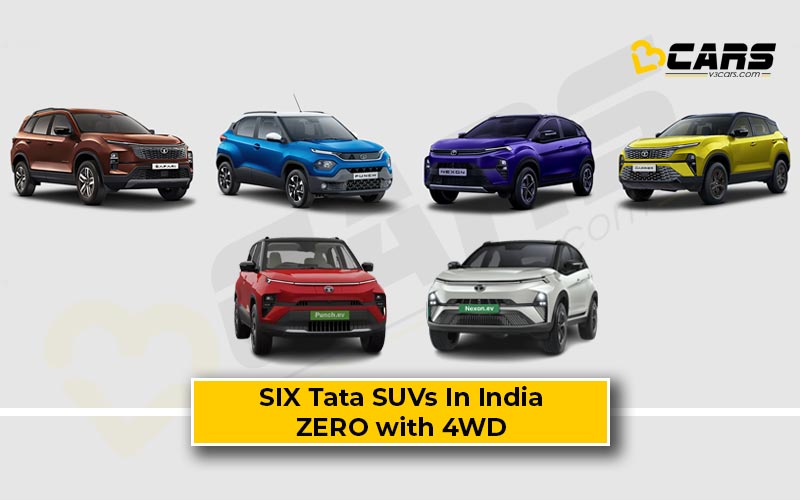
If we count the XUV300 and XUV400 as two separate vehicles, the Astor and the ZS as two separate vehicles, then the Punch-Punch EV and Nexon-Nexon EV should also be considered as distinct vehicles.
TATA SUVs
SUVs*
4WD Option
Punch
❌
Punch EV
❌
Nexon
❌
Nexon EV
❌
Harrier
❌
Safari
❌
Total: 6
4WD: 0/6
With that assumption, Tata Motors end up with a staggering 6 SUVs in their portfolio. NONE of these SUVs have the option of 4WD. They are also preparing the Curvv or Frest for launch in the near future. This is an SUV based on the Nexon’s platform and it’ll compete with the Creta, Seltos, Grand Vitara and other SUVs from the C-segment. Since the Nexon itself only has a front-wheel drive powertrain option, it’s safe to assume that the Curvv/Frest will also support only a front-wheel drivetrain with a petrol/diesel engine.
Thus, soon, they will have 7 SUVs in their portfolio and none of them will have the 4WD or AWD option. This is a startling fact about a major SUV manufacturer in India as they don’t have the 4WD in the portfolio to demonstrate their capabilities. It puts me in a difficult position when I have to refer to their products as SUVs, when literally all of them are nothing more than glorified, oversized hatchbacks.
They don’t have a halo product in the lineup with 4WD to lend the SUV vibe to the rest of their crossovers. While I don’t expect them to have a 100% coverage for 4WD like Jeep (all vehicles have 4WD option), at least having one is not an unreasonable expectation. It becomes even more difficult to digest when you look at Skoda, Volkswagen and Kia. All of these 3 carmakers have at least 1 vehicle with 4WD in their Indian portfolio even though they only have 2 SUVs in their portfolio.
Author’s Conclusion
I sometimes wonder how we went from this:
to:
One of them is about reclaiming your life. With a 4-wheel drive, you probably could do things they didn’t even show in the video. The first ad encourages you to go outdoors and get dirty.
The other one is about indulging in luxuries…which is good too but on a different plane — and — when the features work as intended. Even if they do, the ad feels like it’s pushing you towards laziness as they demonstrate the ability to open the tailgate without using your hands. Now, I wouldn’t mind this with the Harrier, which doesn’t have a reputation to live up to. But in the Safari ad, with the tagline “Reclaim your life”, it feels totally out of sync.
While the old ad only teases a small part of what the car is capable of, the new one pretty much sums up its capabilities. Even in the real world, the Safari is not capable of doing anything the Kia Sonet diesel can’t. In fact, the Sonet diesel does a few things better than the Safari while costing several lakhs less. Once you go into deeper analysis, you’ll find out that the Sonet offers more features. Moreover, the features in Kia cars have a much higher probability that they will work as intended during the ownership.
Am I the only one feeling like the Tata SUVs these days no longer represent what they used to?