
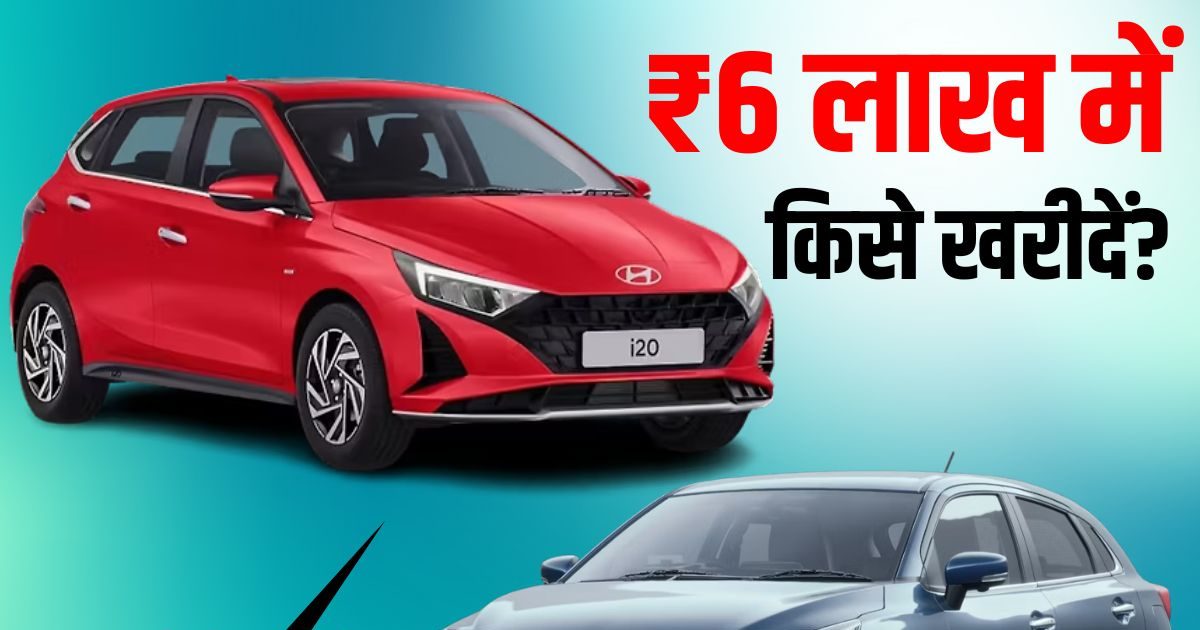
Hyundai i20 vs Maruti Baleno: Customers looking for a balance between an SUV and a sedan turn to the hatchback. Hyundai i20 and Maruti Baleno are the two best options in this segment. Both these cars attract young buyers. Where i20 is known for its stylish appeal and premium feel. Whereas, Baleno is liked for its better mileage and economical maintenance.
The starting ex-showroom price of both the cars is almost the same. Hyundai i20 prices start at Rs 5.99 lakh for the Era petrol manual variant and go up to Rs 10.44 lakh for the top variant Asta Opt IVT Knight. At the same time, the price of Maruti Baleno starts from Rs 5.99 lakh for the Sigma MT variant and reaches Rs 9.10 lakh for the Alpha AMT. Let us look at the design, features, engine and mileage details of both.
design comparison
The i20 looks more sporty and modern in its exterior design. Its length is 3995 mm, width is 1775 mm and height is 1505 mm, while the wheelbase is 2580 mm. It has features like LED headlamps, DRLs, taillights, sunroof (single pane), rear spoiler and alloy wheels. Colors include Fiery Red, Typhoon Silver, Starry Night etc.
Baleno is a little smaller. Its length is 3990 mm, width is 1745 mm, height is 1500 mm and wheelbase is 2520 mm. It has projector headlamps, LED DRLs, fog lamps and chrome grille, but no sunroof. Colors like Pearl Arctic White, Opulent Red, Grandeur Gray are available. The design of i20 is classy and premium, while Baleno looks safe and elegant. The Baleno is slightly ahead in boot space with 318 litres, while the i20 has 311 litres.
Whose interior is better?
The interior of i20 gives a more premium feel. It has leatherette upholstery, leather wrapped steering wheel, digital cluster, ambient lighting, sunglasses holder and glove box cooling. Dual-tone (black/grey) theme. The Baleno features fabric upholstery, leather steering, 4.2-inch digital cluster and dual-tone (black/blue) interiors. Both have 5 seats, front air vents and adjustable headrests. The Baleno is better in space, but the fit-finish and material quality of the i20 is good. There is good leg room and head room in both the rear seats.
Features and safety
The i20 has a 10.25-inch touchscreen, wireless Apple CarPlay/Android Auto, 4 speakers + 2 tweeters + subwoofer, cruise control, voice commands, USB charger (front/rear) and OTA updates. Baleno has 9 inch touchscreen, SmartPlay Pro+, ARKAMYS sound, 4 speakers + 2 tweeters, automatic climate control, heads-up display and remote immobilizer. Both have multifunction steering, keyless entry, rear parking sensors and power windows.
Both have 6 airbags (driver, passenger, side, curtain), ABS, EBD, ESC, rear camera, TPMS, speed alert and engine immobilizer. The i20 has hill assist, impact sensing auto door unlock and a 3-star global NCAP rating. The Baleno comes with brake assist, hill hold, 4-star Bharat NCAP rating and 360 view camera (at the top).
Engine and Mileage
Both have 1.2L petrol engine (1197 cc, 4-cylinder). The i20 produces 82-87 bhp and 114.7 Nm, while the Baleno produces 88-88.5 bhp and 113 Nm. The i20 has an IVT automatic and an optional 1.0L turbo, the Baleno has a 5-speed AMT and a CNG option. Both are FWD, suspension is MacPherson strut front and torsion beam rear. According to ARAI, the i20's mileage is 16-20 kmpl (petrol), while the Baleno's is 22.35-22.94 kmpl (petrol) and 30.61 km/kg (CNG).