
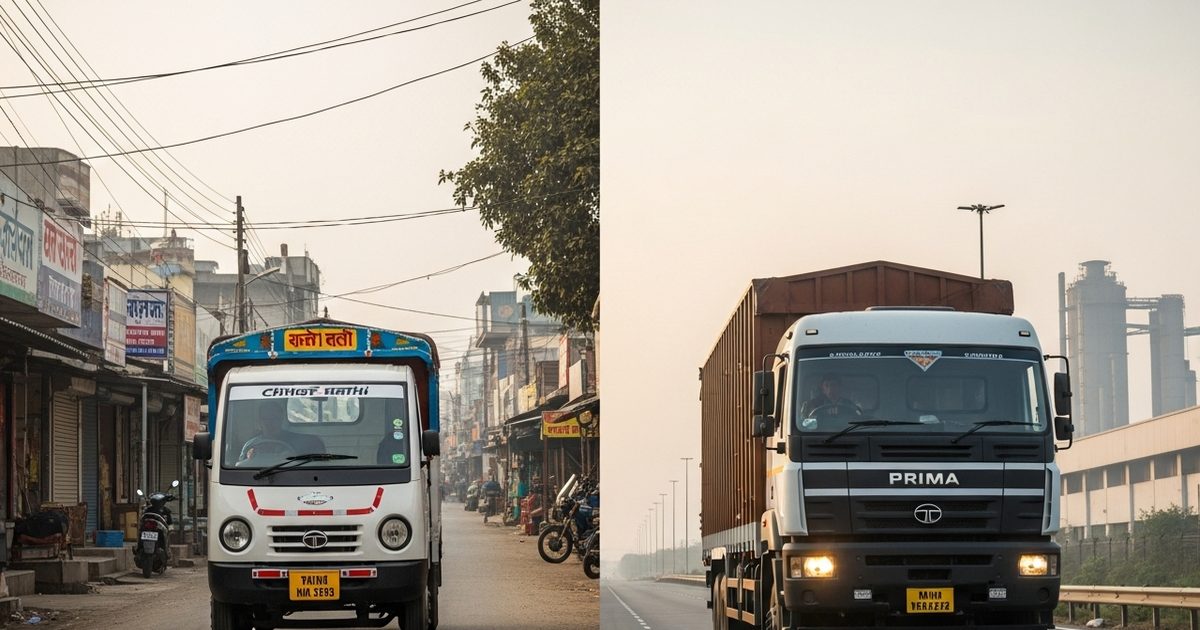
Transport business is a good option in today's time. Due to increasing demand for e-commerce, FMCG, industrial goods and agricultural products, the need for freight transportation is continuously increasing. However, while starting a new business, the biggest question is whether to buy a 'small elephant' i.e. Light Commercial Vehicle (LCV) or a big truck i.e. Heavy Commercial Vehicle (HCV).
Both have their own advantages and disadvantages, which depend on your need, budget, route and market. If you want to start a transport business in the coming days, we will help you. In this article, let us try to know which one will be more profitable to buy between small truck (LCV) and big truck (HCV)?
Little elephant for what?
Small Elephant (LCV) is mainly a vehicle with a payload capacity of 2 to 8 tonnes. Models like Tata Ace, Ashok Leyland Partner or Mahindra are included in this. Their ex-showroom price ranges from around Rs 7 lakh to Rs 15 lakh. On-road price reaches around Rs 8-18 lakh. LCV is perfect for intra-city, local delivery, last-mile and short-medium distance routes.
The advantages are that they can move easily on roads, even in narrow lanes, the driver can easily drive (in many cases an LMV license is sufficient) and maintenance and fuel costs are relatively low. This is a safe option for beginning entrepreneurs or people with small budget. Earnings can be steady from small daily orders, such as e-commerce packages, groceries or local supplies.
Who should buy a big truck?
Large Truck (HCV) has the capacity to carry a payload of more than 16 tonnes. It is suitable for long distance, intercity and heavy industrial cargo (coal, cement, steel etc.). The price of HCV can range from Rs 25 lakh to Rs 65 lakh or more. In this, HMV license is necessary, more training and experience of the driver is also required. The advantage is that the cost per tonne-kilometre is less. The earning potential is higher by carrying more goods in one trip, especially when a good contract is available. But the initial investment is high, fuel expenses are high, toll tax is high and the risk of breakdown also increases.
decision according to budget
If your budget is Rs 15-20 lakh and you are starting a business for the first time, then it would be better to start with LCV. This reduces the risk and gives time to understand the market. Fleet can be increased later. If you have an investment of more than Rs 40 lakh, good contracts and long-distance experience, then HCV can prove beneficial.
Choose as per your need
If you have work in the city or surrounding area then take LCV. If heavy goods have to be transported from factory to factory or at the state level, then HCV will be ideal. Always take full account of route profile, load availability, fuel efficiency and maintenance costs. Also keep in mind permits, insurance and driver availability.
Neither one of them is right or wrong. Success will depend on your planning, market connections and proper use of the vehicle. Many people start with a small elephant and gradually increase their fleet. Take a decision after thoroughly understanding your financial situation and local demand. By choosing the right option, the transport business will not only become sustainable but will also give good profits.