
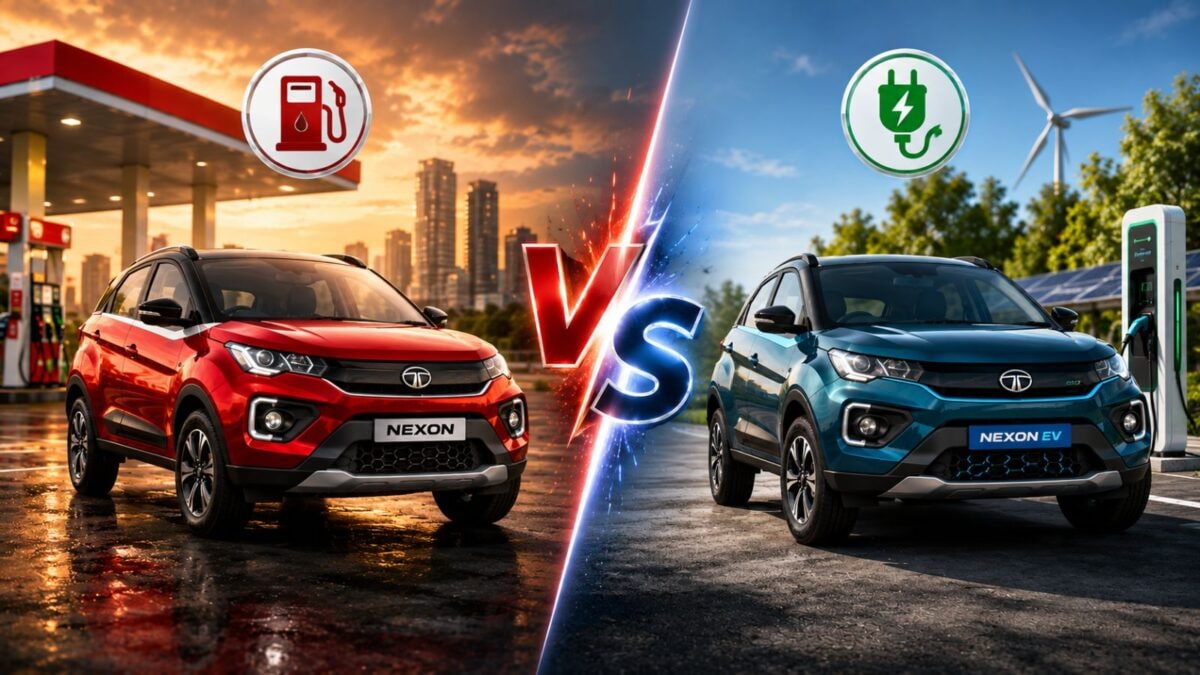
Petrol vs EV: Which car is best for daily office commuting? Understand with 5 year calculation

Petrol vs EV: Which car is best for daily office commuting? Understand with 5 year calculation

Petrol vs Electric Car: Choosing the right car for daily commute is a big decision for every working person. While petrol prices in the country remain around ₹ 100 per litre, on the other hand, electric vehicles (EVs) are attracting everyone's attention with their promise of low running costs. But is buying an EV really beneficial for everyone?

To solve this dilemma, we will understand the complete mathematics of the next 5 years by taking the example of India's most popular compact SUV Tata Nexon and Tata Nexon EV. From this calculation it will become clear to you that which car will be best according to your budget and needs for going to office daily?

Petrol Car vs EV: Daily expense of going to office

Let us assume that your car travels 40 kilometers daily, including the distance from your home to office and weekend travel. According to this, the monthly running of your vehicle will be around 1,200 kilometers and the annual running will be 14,400 kilometers. In 5 years your car will travel a total of 72,000 kilometers.

Tata Nexon Petrol: Its starting on-road price in Delhi starts from around ₹ 8.5 lakh. It gives a mileage of around 14 km/litre in the city. At the rate of ₹100 per liter of petrol, your expenditure on fuel alone in 5 years will be ₹5,14,285.

Tata Nexon EV: The on-road price of its base variant is around ₹ 13.2 lakh. On home charging at the rate of ₹ 8 per unit, this car runs at ₹ 1.1 to ₹ 1.4 per kilometer. In this way, the total cost of charging in 5 years will be only between ₹ 80,000 to ₹ 1,00,000.

5 Year Total Cost of Ownership (TCO)

When buying an EV, you have to pay around ₹4 to ₹4.5 lakh more, which is called 'green premium'. Let us see what is the total cost of ownership including 5 years of service, insurance and fuel/charging-

Type of expenditure (5 year estimate) Tata Nexon Tata Nexon EV
Starting On-Road Price (Approx) ₹8,50,000 ₹13,20,000
Fuel/Charging Cost (72,000 km) ₹5,14,285 ₹96,000
Maintenance and service expenses (5 years) ₹60,000 ₹25,000
Insurance (5 years cumulative) ₹90,000 ₹1,25,000
Total Cost (5 Year TCO) ₹15,14,285 ₹15,66,000

Which car will be best for you?

It is clear from the calculation that if your running is 40 kilometers daily (14,000 km annually), then by the completion of 5 years the total cost of petrol and electric car becomes almost equal.

Electric car is best when: If your daily commute to office is more than 50 kilometers. In this situation, the EV will recover its extra cost (Break-even) in just 3.5 to 4 years and after that your huge savings will start. Also, one can enjoy silent and smooth driving without changing gears in bumper-to-bumper traffic.

Petrol car is best when: If your daily running is less than 20-30 kilometers. In such a situation, it will take 7-8 years to recover the increased price of EV, which will be a loss-making deal. Apart from this, if there is no space for charging setup in your apartment, then petrol car is the most practical option for you.
Source link

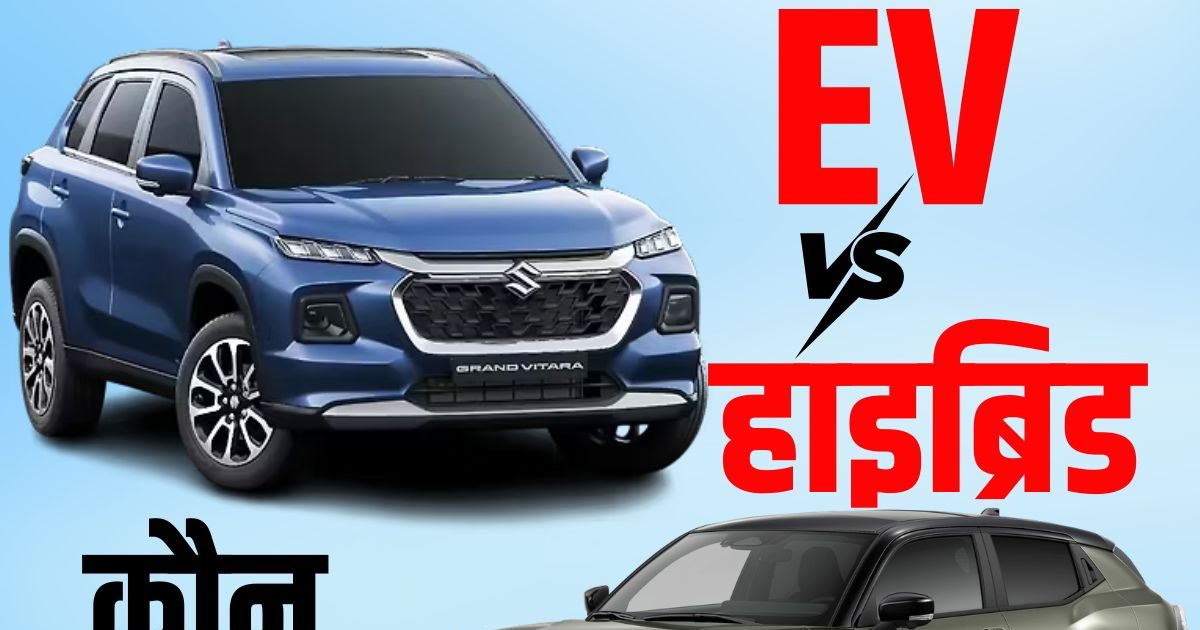
EV vs Hybrid Car: Which one is more profitable to buy? Understand with 5 year calculation

EV vs Hybrid Car: Which one is more profitable to buy? Understand with 5 year calculation

EV vs Hybrid Car: Amidst the ever increasing pollution and skyrocketing prices of petrol and diesel, people have now started turning towards EV and hybrid cars. In such a situation, which one should be chosen between electric vehicles (EV) and hybrid cars? There is a lot of debate regarding this. The cost of running an EV is low, but charging infrastructure is still limited. Whereas, hybrid cars offer a combination of petrol-electric. There is no range anxiety and long drives are easy.

If you are also confused between EV and hybrid cars, then this article of ours is useful for you. Taking Maruti Suzuki's Grand Vitara Strong Hybrid as an example, we will do detailed calculation of 5 years ownership cost. Data is based on latest data (CarWale, CarDekho, ARAI) for April 2026. We will calculate ₹95/litre petrol and domestic electricity at ₹6/unit for normal usage and annual driving of 15,000 km.

hybrid car

The ex-showroom price of Maruti Suzuki Grand Vitara Strong Hybrid ranges from ₹16.63 lakh to ₹19.72 lakh for the Zeta+/Alpha+ variants. On-road prices (including RTO + insurance) in UP go up to around ₹20-22 lakh. Its ARAI claimed mileage is 27.97 kmpl. Real world mileage can be expected to be 23-25 ​​kmpl in the city and 20-22 kmpl on the highway, which is close to an average of 22 kmpl. According to this fuel economy, its 45 liter tank gives 1,000+ km range. Due to Maruti's service network with 8 years of battery warranty, its maintenance cost is on average low.

electric car

The ex-showroom price of Maruti's first electric car E Vitara (Zeta/Alpha 61 kWh) ranges from ₹ 17.49 lakh to ₹ 19.79 lakh. Its on-road price in UP ranges from around ₹19.5 to ₹22 lakh. It can be purchased at almost the same or slightly lower price than the Grand Vitara Hybrid. The ARAI claimed range of the e-Vitara is 543 km and battery consumption in real world efficiency can be expected to be 6-7 km/kWh. Its running cost with domestic charging comes to around ₹ 1.12/km.

5 Year Calculation (75,000 km total)

Let us assume that the estimated on-road price of both the cars is ₹21 lakh (mid variant). Other expenses (insurance, tyres, service) remain almost the same, but there is a big difference in running costs. Let us understand this from a table-

parameters Grand Vitara Maruti e-Vitara Savings in EV
on road price ₹21 lakh ₹21 lakh Equal
Running Cost/KM ₹4.32 (₹95 petrol/22 kmpl) ₹1.12 (depending on electricity rate) ₹3.20 lakh
5 year expenses (75,000 km) ₹3.24 lakh ₹84 thousand ₹2.40 lakh
Maintenance (5 years) ₹25,000 – 30,000 ₹15,000 – 20,000 ₹10 thousand
Total expenses for 5 years ₹3.55 lakh ₹1.00 lakh ₹2.55 lakh
Average cost per KM ₹4.73 ₹1.33 quite cheap

Where will EV win?

The running cost of an electric car (e-Vitara) is cheaper by ₹ 2.4-2.5 lakh in 5 years. Silent drive, quick torque, zero tailpipe emissions. Solar charging at home can be done more cheaply, but finding a charging station on a long highway drive is a bit of a challenge. The charging network is continuously increasing with time, but it still remains a challenge in rural areas.

Power of Hybrid (Grand Vitara)

There is no range anxiety regarding this. Petrol pump is found every 200-300 km. Good in both city and highway. Due to the small battery, performance does not drop in cold weather or long drives. Maruti's service network is strong across the country and the resale value will also be good after 5 years.

Our advice: If 70% of your driving is in the city, charging is available at home and you drive 15,000+ km annually, then an EV is going to be a better option. If you have a lot of highway trips, don't have to worry about charging and live in a small town/village, then Grand Vitara Strong Hybrid is a better option. The 5-year math leans towards EV, but as per practicality, hybrid is a better option.

Source link