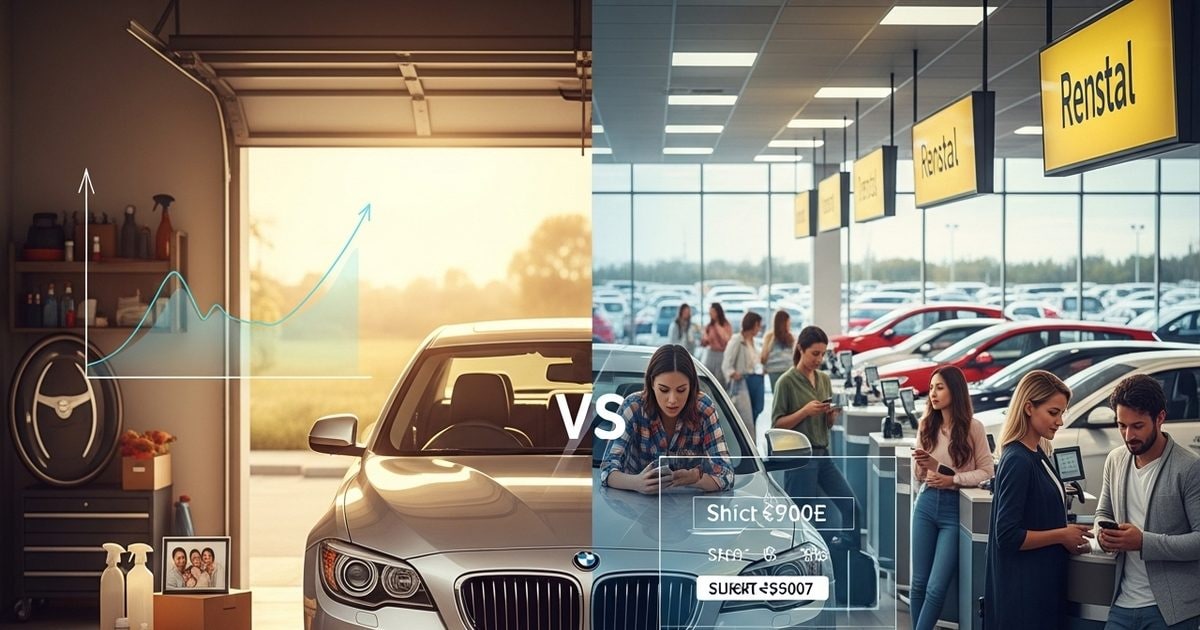

Is it better to buy a car or take it on rent? Understand with 5 year calculation

Is it better to buy a car or take it on rent? Understand with 5 year calculation

Buying or renting a car is a big decision for a middle class family. Due to traffic, parking problems, rising inflation and vehicle prices, this question rotates in everyone's mind. The on-road price of a popular mid-size SUV like Hyundai Creta ranges from Rs 12 lakh to Rs 23 lakh in Delhi-NCR.

Buying involves the burden of down payment, long EMI, insurance, maintenance and depreciation. Whereas in renting or leasing, the monthly rent is fixed, which often includes maintenance and insurance, but this can prove to be expensive in the long run. Let us try to know whether it is right to buy a new car or it can be taken on rent.

5 year calculation

Looking at detailed calculations, the decision depends on your annual driving, budget, tax slab and future planning. Lease is more convenient for young professionals or those who drive short distances, while buying is cheaper for families who plan to keep the car for a long time. Ola, Uber or monthly subscription is fine for short term, but in the long term it is important to compare both the options. Thousands of rupees can be saved every month by making smart choices.

purchase cost

Suppose you are choosing Hyundai Creta petrol variant, whose on-road price in your city is around Rs 15 lakh. The calculation has been done assuming annual driving of 15,000 kilometers, petrol at Rs 100 per liter and mileage 15 km per litre.

Let us assume that at the time of purchase, the down payment has to be Rs 3 lakh (20 percent). The remaining loan of Rs 12 lakh is taken for 5 years at 8.5 to 9 percent annual interest rate. Monthly EMI comes around Rs 24,500 to Rs 25,000. In this way, the total EMI payment in 5 years will be around Rs 14.7 to 15 lakh, of which the interest portion is Rs 2.7 to 3 lakh. The total purchase cost including down payment reaches Rs 17.7 to 18 lakh.

Running expenses include fuel expenses of Rs 5 lakh for 5 years, maintenance of Rs 75,000 (average annual cost of Rs 15,000) and insurance of Rs 1.25 lakh (average average of Rs 25,000 annually). In this way the total outflow becomes around Rs 24 to 25 lakh. After 5 years, the resale value of the vehicle will be around Rs 7 to 8 lakh, because Creta keeps its resale value well. Net expenditure reduces to Rs 16.5 to 17.5 lakh. When you buy, the car becomes your own, you get freedom of customization and there is no limit on kilometers.

Lease or Rent Calculation

In case of lease or rent option, the monthly rent (in Ayvens or other companies) is around Rs 25,000 to 28,000 per month, which includes maintenance and insurance. The total rent for 60 months is around Rs 15 to 16.5 lakh. If we add the fuel cost of Rs 5 lakh, the total expenditure reaches Rs 20 to 21.5 lakh. There is no resale value here and the car has to be returned to the company after the expiry of the period. Kilometer limit is also fixed, which imposes additional charges if driven more.

Buying for 5 years is usually cheaper by Rs 2 to 4 lakh. If you are in the 30 per cent tax bracket and take a corporate lease, the tax savings on lease (up to 30 per cent on rent) make this option more attractive, bringing down the net expense by Rs 14 to 15 lakh. However, buying for personal use proves to be better in most cases.

If you drive less than 10,000 kilometers a year, like to change your vehicle every 3-4 years or want to maintain liquidity, then lease or rent is an easier option. Considering the traffic and parking problems in Delhi-NCR, short term rental is also good, but it becomes expensive in the long run.

parameters Buying a car Rent
ownership rights You have your own asset. Is an asset of the company.
Maintenance your responsibility. Company's responsibility.
Flexibility Difficult to change models. You can change the car whenever you want.
Benefit Inexpensive option for long term (7-10 years). Better for short term (2-3 years).

Our advice: The decision depends on your income, driving pattern and future plans. If you have a lot of driving, plan to keep it for 7-10 years and have the ability to afford capital, then it would be a good buy. Lease is better for flexibility and less capital. Do your calculations by checking EMI calculator, lease quotation and interest rates. Taking the right decision will not only save money but will also reduce stress.

Source link

Calculate the real cost of petrol and servicing for 5 years in this easy way

Calculate the real cost of petrol and servicing for 5 years in this easy way

Car Ownership Cost: Buying a new car is like a dream for many families, but most people take the decision just by looking at the showroom price. Actually the true cost of the car comes out in the next 5 years. Including petrol, servicing, insurance and other expenses, this can be much more than the showroom price. It is important to understand the ownership cost, so that the budget does not get spoiled and there are no regrets.

In this article, we will explain in an easy way how you can calculate the correct mathematics of petrol, servicing and insurance for the next 5 years. Understand with some simple steps and examples how important is not just the ex-showroom price but also the running cost. With proper planning you can save thousands of rupees. Know the complete method.

Calculation of Ownership Cost

While buying a new car, most buyers focus on ex-showroom price, EMI and on-road costs. But full accounting of ownership costs is often missed. Ownership cost includes fuel (petrol/diesel), regular servicing, insurance premium, wear and tear parts like tyre-brake, parking, toll and depreciation.

The average car owner in India drives 10,000 to 15,000 kilometers annually. In cities like Delhi this average is around 12,000 km. If you drive more, expenses increase; even if you drive less, fixed costs like insurance and servicing remain constant.

fuel cost

The first and biggest expense is of petrol. The average price of petrol in India in 2026 is around ₹ 95 to ₹ 105 per liter. This varies according to the city. In Delhi it is around ₹ 94-95, while in Mumbai it is more than ₹ 103. Suppose your car's mileage is 15 km/litre and you drive 12,000 km annually.

So the annual consumption in liters will be: 12,000 ÷ 15 = 800 litres. Assuming ₹100 per litre, the annual petrol expenditure will be ₹80,000. In 5 years it will reach close to ₹ 4,00,000. If the mileage is 12 km/litre and the price is ₹ 105, then this figure can go up to ₹ 5,25,000. City traffic, AC usage and driving style may reduce mileage by 2-4 km/litre, so do real world testing. The easy formula for petrol calculation is-

  • Annual km ÷ mileage × petrol rate = annual fuel cost

Multiply it by 5 for 5 years. Also estimate the increase in the price of petrol in the future. In the last years it has increased by 5-10% annually. Choosing CNG or electric variants can reduce these expenses significantly, but before buying the vehicle, also look at the starting price and charging infrastructure.

Servicing and Maintenance

The second important expense is that of servicing and maintenance. In new cars, many services are free for the first 2 years or 20,000-30,000 km. After that, service is required every 10,000 or 15,000 km. For example, the 5-year maintenance cost of a Hyundai Creta petrol could be around ₹20,000-25,000, while that of a Tata Nexon could be around ₹30,000-40,000. In hatchbacks like Maruti Swift, it can be even less, up to ₹ 15,000-25,000. This includes engine oil, filter, brake pads, air filter and labor charges.

Service interval in India is usually 10,000 km or 12 months (whichever is earlier). On average there can be 8-10 services in 5 years. The cost of each service varies from ₹ 3,000 to ₹ 8,000 depending on the model. Apart from this, the expenses of unpredictable repairs like tyre, battery, clutch or suspension also add up. Good servicing increases the life of the car and keeps the resale value good. Always get it done from an authorized service center of the brand, because getting service done from a non-authorized place during warranty may lead to claim rejection.

insurance expenses

The third big expense is that of insurance. Comprehensive insurance on a new car is expensive in the first year. Depending on the model and value, it can range from ₹ 10,000 to ₹ 25,000. Third party insurance is fixed by IRDAI. Up to 1000 cc ₹2,094 and up to 1000-1500 cc ₹3,416 and above ₹7,897 annually. Comprehensive adds own damage cover, zero depreciation add-on etc. From the second year onwards, No Claim Bonus (NCB) can start from 20% and go up to 50%, thereby reducing the premium.

5 year's hefty ownership cost

Let us assume that you have purchased a hatchback, sedan or an SUV worth around Rs 8 lakh. In this way the cost for 5 years can be approximately Rs.

  • On Road Price: ₹8 Lakh
  • Petrol cost (12,000 km/year, 15 kmpl, ₹100/litre): ₹4,00,000
  • Servicing + Maintenance: ₹30,000-50,000
  • Insurance: ₹80,000-1,20,000
  • Total Running Cost: ₹5,10,000 to ₹6,00,000 (except showroom price)

Apart from this, also add road tax, parking, toll and depreciation (40-50% value loss in 5 years). Overall, the actual cost of the car in 5 years can be 60-80% more than the showroom price.

How to do math right?

  1. Determine your annual driving distance.
  2. Consider the ARAI mileage of the car to be 10-20% less than in the real world.
  3. Check local petrol rates.
  4. Calculate the maintenance cost from the manufacturer's website or service calculator.
  5. Get premium quotes from insurance comparison sites.
  6. Use an online TCO (Total Cost of Ownership) calculator.

Source link