
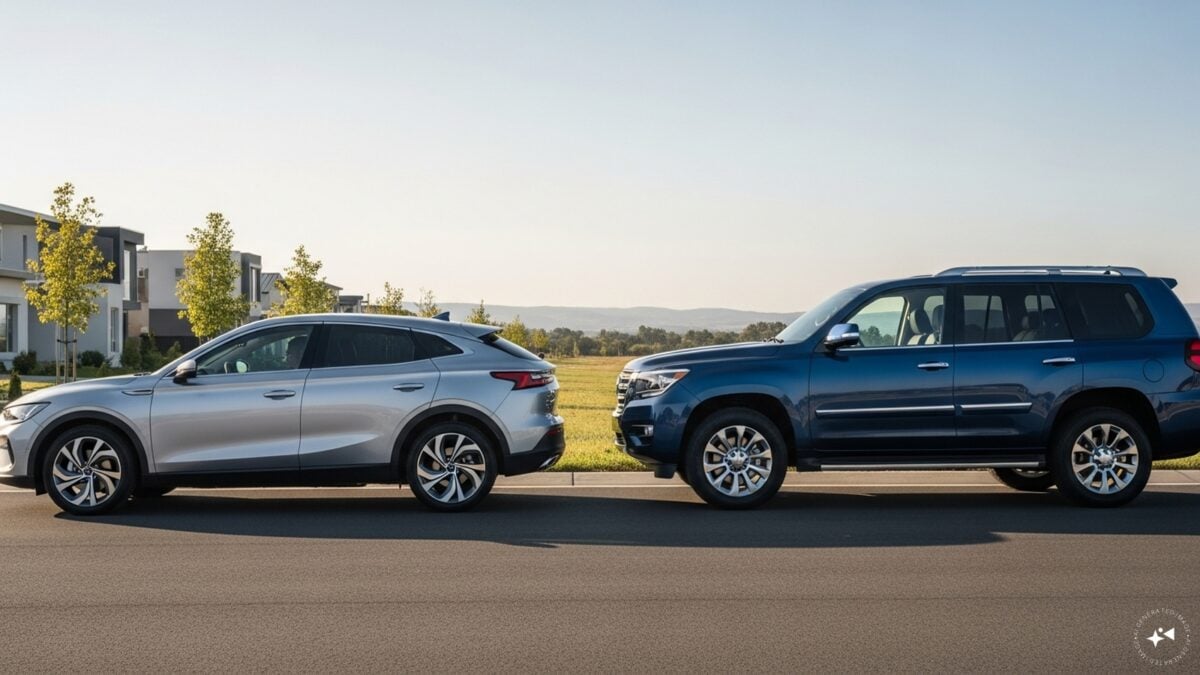
Compact SUV vs Big SUV: Which is best according to family, budget and parking? Know

Compact SUV vs Big SUV: Which is best according to family, budget and parking? Know

In today's time, whenever someone thinks of buying a new car, the first thought that comes to his mind is SUV (Sport Utility Vehicle). Due to high seating position, powerful looks and ability to move easily even on bad roads, the SUV craze is at its peak in India.

However, the real confusion starts when you have to choose between a small SUV (Compact/Sub-compact SUV) and a large SUV (Full-size/Mid-size SUV). Both have their advantages and disadvantages. Let us understand in very simple language which SUV will be perfect for you according to your family, budget and parking space.

1. Mathematics of budget

Buying a car always starts with the budget. Not only the cost of buying a car, but also the cost of running it matters. If your budget is between ₹ 8 lakh to ₹ 15 lakh, then a small SUV is best for you. Their engines are generally small (1.0L to 1.5L), due to which they give excellent mileage (15-20 km/litre).

Their insurance and maintenance costs are also less. Large SUVs usually start from ₹18 lakh and go up to ₹35-40 lakh or above. Due to larger engines, their mileage is less (10-14 km/litre) and the cost of servicing and parts is also much higher than that of small vehicles.

2. Parking and Traffic

Finding parking in big cities of India is like winning a war. Before choosing a vehicle, measure the size of the parking space of your home and office. The length of a small SUV is around 4 meters. They are very easy to maneuver in narrow streets, maneuver in heavy traffic and fit into small parking spaces.

The length of a large SUV is more than 4.5 meters. A good amount of experience is required to operate them. If your house has a narrow street or limited parking space, then a big SUV can become a daily headache for you.

3. Family size and comfort (space)

How many members are there in your family and how you use the vehicle, this is the biggest factor. The small 5-seater SUV is perfect for a small family of 4 to 5 members. In this, the front and rear passengers get good legroom and there is also a decent boot space (dicky) for weekend trips.

If you have a joint family or you often go on long trips with friends, then only a big SUV will be useful for you. Its third row is best for children or short journeys. Also, its heavy suspension provides a very comfortable ride during long distance journeys. See quick comparison table-

factor compact suv big suv
seating capacity 5 seater 6 to 7 seater
estimated budget ₹8 lakh to ₹15 lakh ₹18 Lakh to ₹40 Lakh+
mileage more (economical) low (heavy engine)
parking and traffic very easy a little difficult
travel comfort Best for city driving Best for highway and long trips

Final Verdict: If you mostly drive in city traffic, have a small family, less parking space and you want to enjoy the luxury of an SUV at a lower cost, then a smaller car is better. If you have a large family, you often take long trips on the highway, you need to carry heavy luggage (boot space) and budget and parking are not an issue, then you can choose a bigger car.
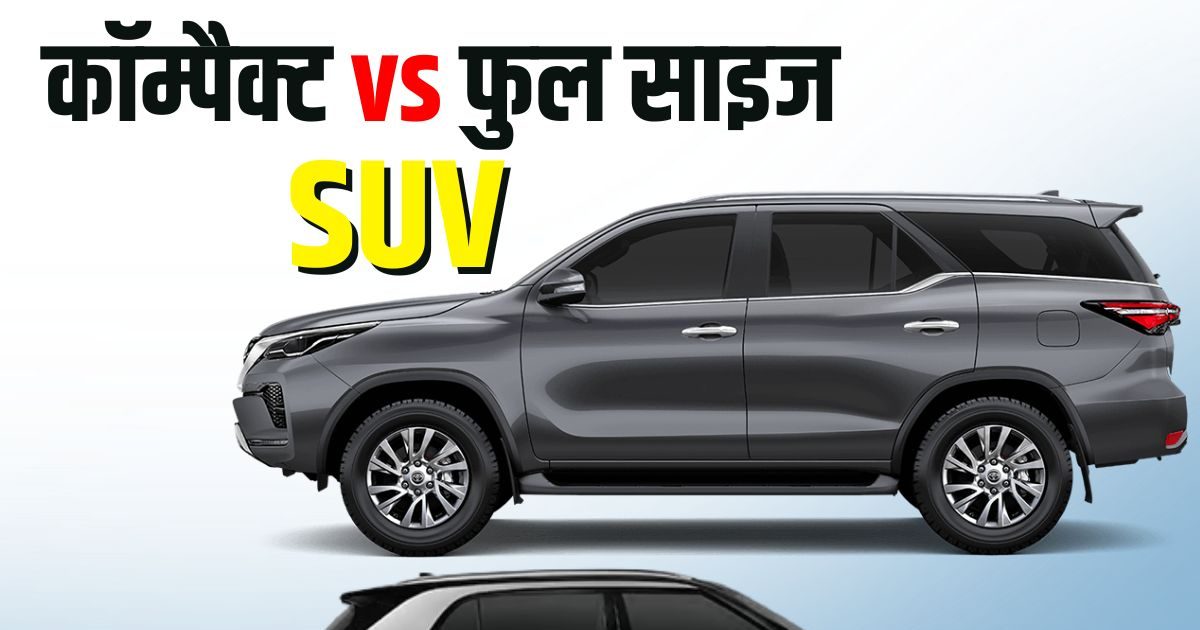
Source link

Before buying a new SUV, understand which size is right for you.

Before buying a new SUV, understand which size is right for you.

Compact SUV vs Full-Size SUV: The craze for SUVs in India is increasing with time. The SUV segment is set to account for 65% of total car sales by 2026. Middle class families are now saying goodbye to hatchbacks and compact sedans and turning to SUVs, as these are the best options to meet their needs of high ground clearance, commanding driving position and family space.

In such a situation, the question is whether a compact SUV (like Hyundai Creta, Kia Seltos, Tata Nexon) is better or a full-size SUV (like Toyota Fortuner, Mahindra Scorpio N)? Narrow lanes of Indian roads, hours-long traffic jams, potholes, highways and the budget of the middle class. Keeping all this in mind, which one would be more profitable to buy? Let us know.

What is the difference between the two?

First of all let's understand both the categories. The length of compact SUVs usually ranges between 4 meters to 4.4 meters. For example, Hyundai Creta (length 4.33 meters), whose ex-showroom price starts from Rs 10.79 lakh and goes up to Rs 20.20 lakh. Kia Seltos, Volkswagen Taigun, Tata Sierra and Mahindra XUV 3XO also fall in this category.

Their ground clearance is 190-200 mm, which is enough for the rough roads of the city and the unpaved roads of the village. Mileage is also available up to 18-22 kmpl. These are 5-seaters, but come with ample boot space for the family (up to 433 litres) and features like panoramic sunroof, ventilated seats, 360° camera and ADAS.

On the other hand, the length of a full-size SUV is more than 4.6 meters. For example, Toyota Fortuner (4.79 m), whose price ranges from Rs 34.16 lakh to Rs 49.59 lakh. Their ground clearance is up to 225 mm, which is better for driving in water or off-road in heavy rain. A 7 seater option is available in these, which is attractive for large families (5-7 members). But the mileage is only 10-12 kmpl. The petrol variant gives a mileage of less than 10 kmpl.

Who is right for the city?

Traffic jam of 2-3 hours is a common problem in cities like Delhi, Mumbai, Bengaluru or Lucknow. Narrow streets, crowd of two-wheelers and shortage of parking. Here the compact SUV moves easily. Their turning radius is small (5.2-5.5 meters) and parking is also easy.

Models like Creta or Seltos can be fitted even in small spaces and society parking. Whereas a big SUV like Fortuner is difficult to maneuver, doesn't get parking spots and feels slow in traffic. Its real-world mileage in the city drops to 8-10 kmpl, which is a burden on the middle class pockets.

Calculating running costs

Running cost is the biggest factor for a middle class family. Insurance of a compact SUV like Creta is Rs 40-50 thousand per year and servicing is Rs 8-10 thousand per service. The total ownership cost in 5 years is around Rs 15-20 lakh. Yes, the insurance of an SUV like Fortuner is above Rs 1 lakh, servicing is expensive and parts like tire-brake are also quite expensive.

For a middle class family (monthly income 1-2 lakh) the EMI of Fortuner itself becomes 60-70 thousand, whereas Creta can be purchased at an installment of 20-25 thousand. Resale value of both is good, but compact SUV is in more demand in the market.

Which is more comfortable?

Talking about family comfort, it is ahead in the full-size SUV space. Children can sit comfortably in the third row of Fortuner or Scorpio N. Due to better suspension, there is less fatigue in long drives on the highway. But in everyday life, compact SUVs are a better option for school drop, office commute and weekend shopping. Small SUVs are a more profitable deal for a family of 5 members.

Full-size SUVs dominate on the highway and long journeys. Stability at 100-120 kmph, power (Fortuner 200+ bhp) and 4×4 option make them special, but 80% of driving in India happens in cities and nearby highways. Both have high ground clearance to avoid potholes, but the compact SUV's lighter weight (1.4-1.6 tonnes) and better mileage make it practical.

Which one makes sense to buy?

If we look at the trends of 2025-26, the compact SUV segment is growing rapidly. From sub-compacts like Tata Punch, Hyundai Venue to Creta, this is the new dream of the middle class. Whereas full-size SUV is for premium buyers. Due to inflation, price of petrol and diesel and introduction of electric vehicles, the focus on running costs has increased.

Compact SUV is a better option for Indian roads, traffic and middle class family. It comes in the budget, is comfortable in the city, has good mileage and fulfills the family needs. If you have a family of 7, do a lot of highway driving or are into off-roading, consider a full-size (Scorpio N or Fortuner). If you want to save money, then compact SUV will also do a good job at a low price.

Source link