Buying EV in Delhi? If you don't follow these 5 steps, your subsidy will get stuck.

Buying EV in Delhi? If you don't follow these 5 steps, your subsidy will get stuck.

Last Updated:

Delhi Government's new EV Policy 2026 has been implemented, under which you will get the benefit of subsidy, 100% road tax and registration fee exemption, as well as scrappage incentive on purchasing electric vehicles. But to avail these facilities, some important online processes will have to be completed within the stipulated time. Know the complete step-by-step process and important rules from creation of RC to receipt of subsidy in bank account through DBT.

news quickly

Zoom

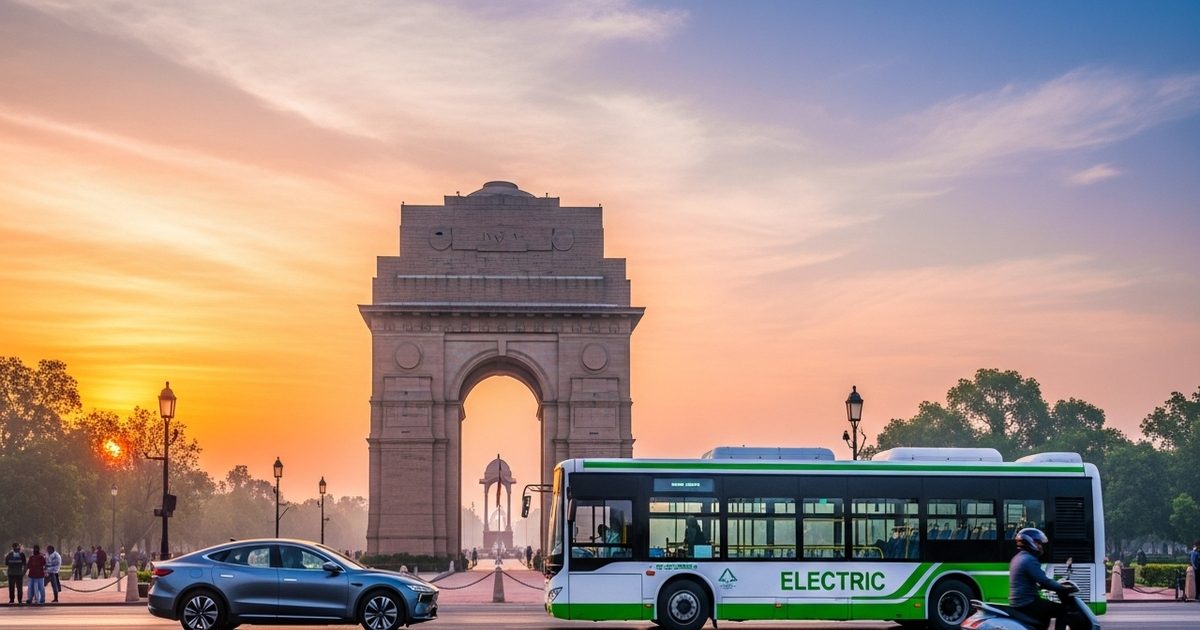
Know the step-by-step process to avail benefits in Delhi EV Policy. (AI image)

Delhi EV Policy 2026 It has become effective from this month and will run till March 2030. The government has planned to invest about ₹15,000 crore for this, which also includes developing more than 30,000 EV charging points. The policy has provisions like incentives during purchase, complete exemption in road tax and registration fees, incentives on scrapping of old vehicles and ban on ICE vehicles in a phase-wise manner.

The policy also aims to achieve 95 percent EV registration by 2027 and stop registration of new petrol/CNG two-wheelers from 2028. Incentives will be given through Direct Benefit Transfer (DBT) through a dedicated online portal, which is good for both transparency and ease. Let us know which steps can be followed while buying a new electric vehicle in Delhi to avail full benefit of subsidy.

Select eligible model

Before booking a new electric vehicle, please confirm with the dealer whether the model you are purchasing is approved by the Model Approval Committee of Delhi Government or not. According to government rules, it is mandatory for the dealer to inform the customer about subsidy eligibility at the time of booking. Keep in mind that only 'pure electric' vehicles are eligible for subsidy, there is no exemption for hybrid vehicles.

Generate RC of the vehicle

After purchasing the vehicle, it will be registered by the Transport Department. Car buyers will get 100% exemption on road tax and registration fees here. Your time begins as soon as the Registration Certificate (RC) of your vehicle is officially generated. The government has set a strict time limit for claiming subsidy.

Register on online portal in 30 days

Within 30 days of the vehicle's RC being generated, you will have to register yourself by visiting the new dedicated EV Incentive Portal of Delhi Government. Unlike the old policy, now the dealer will not fill the form for you, it will be the entire responsibility of the vehicle owner.

Claim subsidy by uploading documents

After logging in to the portal, fill in the details of your vehicle (RC number, chassis number etc.). If you had an old BS-IV or older vehicle which you have scrapped, then also upload its valid 'Scrapping Certificate' to get scrappage incentive of up to ₹ 1 lakh. Along with this, enter the correct information of your Aadhar card and bank account (cancelled cheque/passbook).

Verification and money transfer

The application submitted by you will be scrutinized by the Transport Department and Public Financial Management System (PFMS). The entire process is transparent and if all the documents are found to be in order, the subsidy amount will be credited directly into your Aadhaar-linked bank account (through DBT) within 60 days from the date of application.

urgent matter: If you avail any financial subsidy or incentive under the Delhi EV Policy 2026, you will not be able to obtain a 'No Objection Certificate' (NOC) to transfer or re-register that vehicle outside Delhi for the next 3 years from the date of purchase. The government will keep a lock-in period of 3 years on it.

About the Author

authoring

Ram Mohan MishraSenior Sub Editor

Ram Mohan Mishra, working as Senior Sub-Editor at News18 Hindi, is active in digital media since 2021 and is currently handling the Auto Desk. They provide car and bike related information in an easy, clear and reliable manner.read more

Source link

The people of Delhi are crazy! You will get benefit of up to ₹ 1 lakh on buying a new car

The people of Delhi are crazy! You will get benefit of up to ₹ 1 lakh on buying a new car

Last Updated:

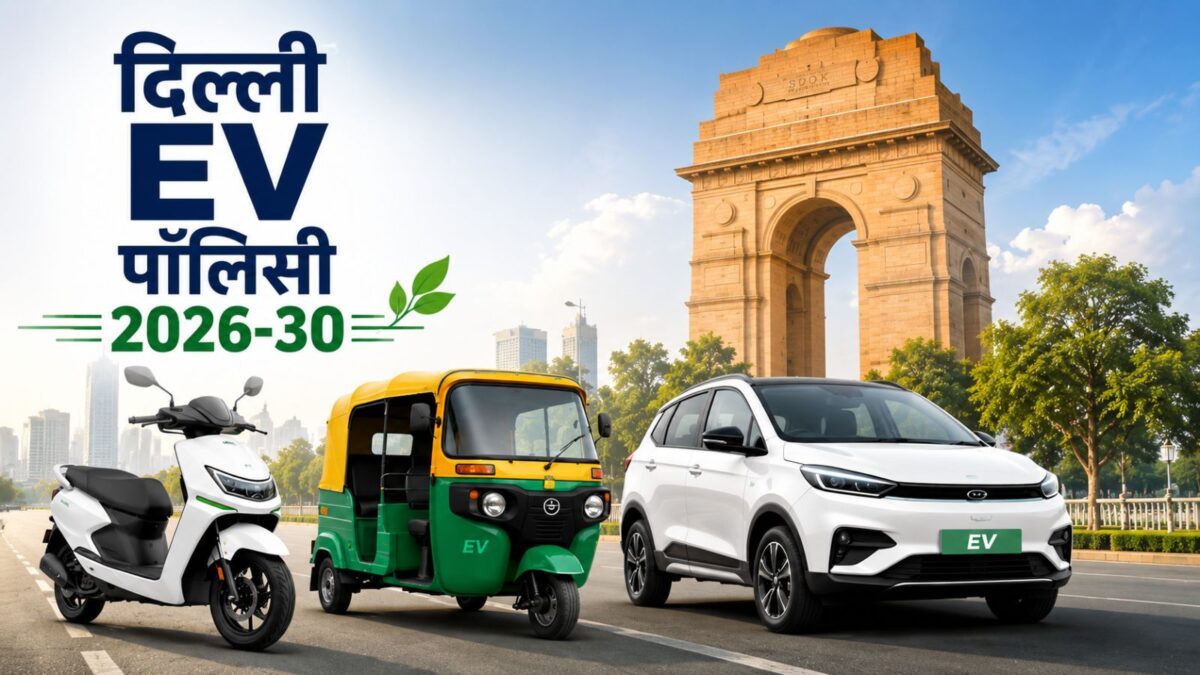
The draft of Delhi Government's new EV Policy 2026-30 has brought many big benefits for the common people. Proposals like subsidy of up to ₹ 30,000 on electric two-wheelers, scrapping incentive of ₹ 1 lakh on four-wheelers and 100% exemption in road tax are under discussion. Along with this, major rules which will be implemented from 2027 and 2028 have also come to the fore. Know what effect this new policy will have on you.

news immediately

Zoom

Know what has been offered in the new EV policy.

Delhi government has released the draft of the new EV Policy 2026-30 to reduce pollution and promote electric vehicles. Under this policy, electric two-wheeler buyers will get Rs 30,000 subsidy in the first year, three-wheeler buyers will get Rs 50,000 subsidy. Also, scrapping incentive of Rs 1 lakh will be given to BS-IV four-wheeler owners.

According to the policy, only electric autos will be registered from January 2027 and only electric two-wheelers will be new registered from April 2028. This policy is a big step towards improving the air quality of Delhi and reducing vehicle pollution (which causes about 23% of pollution in the capital).

Push EV Cell

The government aims to increase the share of EVs in new vehicles and to phase out old polluting vehicles. Subsidy will be given through Direct Benefit Transfer (DBT). The buyer should be a resident of Delhi and the vehicle should be registered in Delhi only. You will also get 100% rebate in road tax and registration fees on purchasing EV (on EVs up to Rs 30 lakh, till March 2030).

How much subsidy on two-wheeler?

The subsidy for two-wheelers has been decided on the basis of battery capacity (kWh). Rs 10,000 per kWh in the first year, maximum Rs 30,000. This will be limited to Rs 20,000 in the second year and Rs 10,000 in the third year. For three-wheeler (L5M), subsidy of Rs 50,000 (first year), Rs 40,000 (second) and Rs 30,000 (third year) will be available. There will be huge incentives for electric goods vehicles also.

Scraping incentive will also be available

Scrapping incentive will be available on scrapping old BS-IV or older Delhi registered vehicles and purchasing a new EV. Rs 10,000 on two-wheeler, Rs 25,000 on three-wheeler, Rs 1 lakh on four-wheeler and up to Rs 50,000 on goods vehicle. A new EV will have to be purchased within six months of scrapping. This model will encourage the adoption of EV along with the removal of old vehicles.

The policy also includes expansion of charging infrastructure, swappable battery stations, financing facilities and single window clearance. The target of 30% EV fleet in school buses has been set by 2030. The government estimates that this will lead to a major reduction in vehicle pollution and Delhi will move towards clean air.

who said what?

Rekha Gupta, Chief Minister

  • Cabinet approves new EV policy.
  • After the approval of LG, it will be implemented from July 1, 2026.
  • The policy will remain effective till 31 March 2030.
  • About ₹7,000 crore will be spent on the policy.
  • Exemption in road tax and registration fee on pure EV.
  • No subsidy to hybrid vehicles.
  • No cap on EV purchase, benefits even on more than one vehicle.

Niharika, Transport Commissioner

  • Incentives up to ₹30,000 on two-wheelers, ₹50,000 on autos and up to ₹1 lakh on N1 e-trucks.
  • Additional incentive on scrapping of old vehicles.
  • From January 1, 2027, new three-wheelers and N1 trucks will be registered only as EVs.
  • From April 1, 2028, new two-wheelers will be registered only as EVs.
  • 23,000 EV charging points will be installed during the policy period.
  • The school bus fleet will be converted to EV in a phased manner.
  • The focus of the policy is to reduce pollution caused by commercial vehicles.

Ashish Sood, Electricity Minister

  • As EVs increase, power infrastructure will be expanded.

Dr. Pankaj Singh, Transport Minister

  • The interests of Delhiites have been fully taken care of in the EV policy.
  • Appeal to people to adopt EV policy.

Manjinder Singh Sirsa, Environment Minister

  • The new EV policy will be a big step towards reducing pollution.
  • The policy has been prepared on the basis of scientific studies.
  • The policy is expected to significantly reduce Delhi's pollution levels.

About the Author

authoring

Ram Mohan MishraSenior Sub Editor

Ram Mohan Mishra, working as Senior Sub-Editor at News18 Hindi, is active in digital media since 2021 and is currently handling the Auto Desk. They provide car and bike related information in an easy, clear and reliable manner.read more


Source link

Delhi EV Policy 2.0: Delhi government will spend ₹200 crore for green mobility

Delhi EV Policy 2.0: Delhi government will spend ₹200 crore for green mobility

Last Updated:

Delhi government's new EV Policy 2.0 can prove to be a big game changer for the common people. On scrapping old petrol-diesel vehicle, you will get subsidy of up to ₹ 1 lakh, complete exemption in road tax and many new benefits. If you are thinking of buying a new electric vehicle, then this news is very important for you.

news quickly

Zoom

What benefits will you get in Delhi EV Policy 2.0? Know

Delhi government has presented its green budget for the financial year 2026-27, in which big announcements have been made to promote electric vehicles (EV). In this budget presented by Chief Minister Rekha Gupta, a special provision of Rs 200 crore has been made for Delhi EV Policy 2.0.

The government aims to make Delhi the 'EV capital' of the country as well as implement the world's best and biggest EV policy. This budget is the biggest budget till date regarding EV policy. Let us know what new provisions have been made in EV Policy 2.0. If you live in Delhi, how will you benefit from the new EV policy?

What is there for you in the new EV Policy (EV Policy 2.0)?

The government has allocated Rs 200 crore to speed up the adoption of electric vehicles. Under this new policy, huge subsidy will be given on scrapping old petrol and diesel vehicles. After scrapping a private car with ICE, you will get an incentive of up to Rs 1 lakh on purchasing an electric car worth up to Rs 15 lakh.

This benefit will be for the first 1 lakh buyers. Apart from this, scrappage subsidy of up to ₹10,000 for two-wheeler and ₹25,000 for three-wheeler is proposed. At the same time, all electric vehicles registered in Delhi till March 31, 2030 will continue to get 100% exemption from road tax and registration fees. This discount will be available only on vehicles up to ₹ 30 lakh.

Expansion of Pollution Control Centers (PUC)

To control the increasing pollution and ensure the fitness of vehicles, the government has decided to open additional pollution testing centers and Automated Testing Stations (ATS). 5 new ATS will be installed in major DTC depots like Bawana, Ghazipur and Dwarka. A budget of Rs 50 crore has been kept separately for this, so that there is transparency in checking of vehicles and manual interference is reduced.

Rejuvenation of public transport

Delhi government has set a target of making public transport completely pollution free. The government aims to ensure that all buses plying on Delhi's roads are electric by 2029. The state government has allocated Rs 320 crore for electrification of bus depots and expansion of charging points.

Why is this budget special?

Of the total budget of Rs 1,03,700 crore, about 21% (about Rs 22,236 crore) has been kept for environmental protection and 'green' initiatives. The government has not only focused on purchasing new vehicles, but has also worked on 'scrapage-linked' incentives for battery recycling and scrapping of old vehicles. Auto experts believe that direct subsidy of up to ₹ 1 lakh and road tax waiver will lead to a huge surge in the sales of electric cars in Delhi.

Source link

Buying EV in Delhi will be easy! Preparation to make charging stations mandatory at showrooms

Buying EV in Delhi will be easy! Preparation to make charging stations mandatory at showrooms

Last Updated:

Big steps can be taken to promote EV in Delhi. According to reports, under the new EV Policy 2026, it may be mandatory to install charging stations at every auto showroom. If this is implemented, then the biggest worry of EV buyers can be removed. Know the complete possible plan.

news quickly

Zoom

Delhi government can ask to install charging stations at all EV showrooms.

State governments are continuously working on new policies to promote EV. According to a recent report, the Delhi government may ask automobile companies to install EV charging stations at their vehicle showrooms. However, this is still a proposed policy and the final decision regarding it is yet to be taken, but if it is implemented then a big change will be seen in the EV sector.

This new policy can potentially be announced during the budget session on March 24, 2026. Under this proposed Delhi Electric Vehicle Policy, all vehicle manufacturers (OEMs) operating in the city will be asked to install at least one public charging station at each of their dealerships or showrooms.

What is the future plan?

According to a report by Indian Express, this policy will remain effective from the date of issue of notification till March 31, 2030, unless it is extended or amended. The main objective is to achieve 30 percent penetration of electric vehicles in Delhi by 2030. At present, people are hesitant in buying EVs due to lack of charging infrastructure. In such a situation, the main objective of this policy is to create a strong charging network.

Range anxiety is the biggest obstacle

In fact, the biggest challenge in EV adoption has been the lack of charging infrastructure. People are reluctant to buy electric vehicles especially in small cities and on highways due to lack of charging stations. In such a situation, if every auto company provides charging facility at its showroom, then this problem can be reduced to a great extent. With this, EV users will easily get charging points within the city and their range anxiety will also reduce.

Who will benefit?

This proposal will have a direct impact on common customers. Firstly, the confidence of those buying an electric car or scooter will increase, as they will know that charging facilities are easily available. Second, it will become easier and more convenient for new buyers to adopt EVs. Especially for first-time EV buyers who are worried about charging, this can prove to be a big relief.

Will auto companies get it?

This new policy will bring both challenges and opportunities for auto companies also. They will have to invest in installing charging stations at their showrooms, which may increase the initial cost. However, this will help companies in attracting customers and may increase EV sales. Companies which have a strong charging network will be able to move ahead in the competition.

Source link