People with how much salary should buy Tata Sierra EV, know

People with how much salary should buy Tata Sierra EV, know

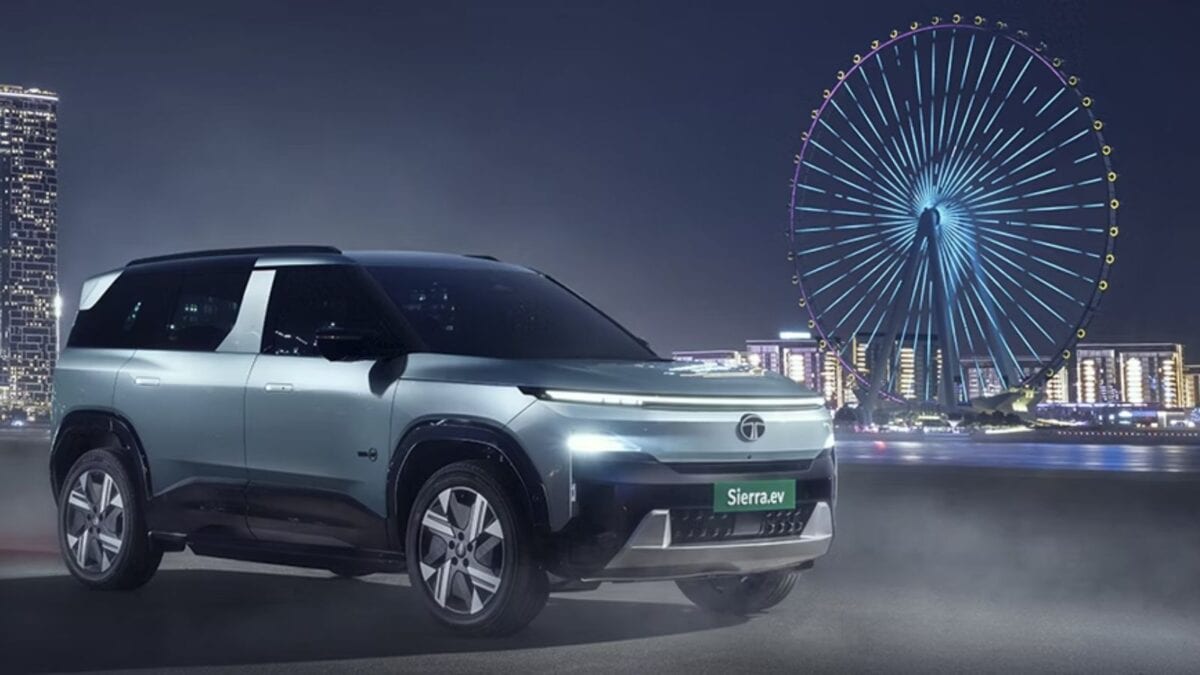
Tata Sierra has been launched in the Indian car market after a long wait. The company has started the starting ex-showroom price of this 5-seater electric SUV from ₹ 18,79,000. At the same time, the ex-showroom price of the top-spec variant full of QWD and modern features goes up to ₹ 25,99,000.

If you are planning to buy this EV in the coming days and have not been able to make a budget yet, then this article will be useful for you. In this article, we have brought details of Sierra EV from on-road price to EMI. We will also take a look at the battery, motor and other details.

Tata Sierra EV On-Road Price

If you are planning to buy this electric SUV in the country's capital, then you are going to get bumper savings. After the recently released Delhi EV Policy 2026, those buying EVs worth ₹ 30 lakh or less will get complete exemption in RTO charges. In this way, you will be able to buy it in Delhi at an on-road price of only ₹ 19,75,875. This includes insurance amount of Rs 78,085 and TCS charge of Rs 18,790, which you can withdraw later while filing ITR.

Tata Sierra EV Down Payment & EMI Details

If you make a down payment of Rs 5 lakh to bring this electric SUV home, then you will have to apply for a car loan on the remaining Rs 14,75,875. If your monthly income is good and your credit score is in good condition, then you will easily get this loan at an interest rate of 10 percent.

Let us assume that you will get this car loan for 5 years. In this way, at 10 percent interest rate, you can repay your car loan by paying a total of 60 EMIs of Rs 31,358. In this way you will pay total installment of Rs 18,81,479. If Rs 5 lakh down payment is added, its price will be Rs 23,81,479 (after interest and EMI).

how much interest will go

As we calculated, by paying a down payment of Rs 5 lakh, we will take a car loan on Rs 14,75,875 at 10 percent interest rate for a total of 5 years, so in this way we will have to pay a total interest of Rs 4,05,604 in 60 monthly installments.

Design and features

Sierra EV is a modern electric SUV, which is built on the Acti.ev+ platform. Upright bonnet, split LED headlamps, blank grille, flush door handles, dual-tone roof and dual-tone alloy wheels give it a premium look.

Its cabin has a triple-screen dashboard (instrument cluster, infotainment and passenger screen), panoramic sunroof, ventilated powered front seats, JBL 12-speaker sound system (Dolby Atmos) and premium materials. The 5-seater cabin is spacious.

Features include L2+ ADAS, 360° camera, voice assisted sunroof, auto park assist, V2L/V2V charging and boost mode. For safety, it has been provided with 6 airbags, ESP, strong body structure and advanced ADAS features. It is expected to get full 5-stars in BNCAP also.

Battery, Motor and Range

It is sold with 63 kWh and 75 kWh LFP battery options. RWD gets 238 PS power and QWD gets 313 PS power. It can accelerate from 0-100 km/h in just 5.8 seconds. MIDC range is up to 565-665 km. 120 kW DC fast charging adds 263 KM range in 15 minutes.

Our advice: Before buying an electric car, check once at your home whether an EV charger can be installed there. Apart from this, if you are planning to buy it on EMI, then first raise at least Rs 5-7 lakh and then also keep in mind that a good amount from your monthly income will go towards paying its EMI. Our advice is that if you earn Rs 1,00,000 per month and are not already paying any big loan installments, then you can buy it on EMI.
Source link

45% Indian homes unsafe for EV charging! The report revealed the dangers of fire and overload.

45% Indian homes unsafe for EV charging! The report revealed the dangers of fire and overload.

A new report has raised concerns amid the rapid pace of promotion of electric vehicles (EV) in India. According to the report, about 45 percent of the houses in the country need to improve the electricity infrastructure for safe EV charging. Despite home charging being the main method for EV users, many homes lack adequate electrical load, proper wiring and safety equipment. This can cause problems like fire, circuit overload and battery damage.

The report says that only 55 percent of potential EV buyers have charging facilities at home. In this report released by AEEE and Kazam, data from more than 80,000 residential charger installations has been analyzed. Along with the policy of EV adoption, it has been advised to take immediate steps to make homes EV-ready, so that the net-zero target can be achieved.

What about research?

The joint report 'The Net-Zero Transition Starts at Home: Enabling EV-Ready Residences in India' by AEEE and EV charging platform Kazam revealed that charging facilities are unevenly available in independent houses, apartments, settlements and rented houses in tier-1, tier-2 and tier-3 cities across the country. Many homes rely on outdated electrical systems, which are not suitable for EV charging.

potential risk

Unofficial charging from a normal socket, extension cable or shared connection can result in fire hazards, electrical faults, equipment problems, voltage fluctuations, wiring overheating and local power outages. This will reduce the reliability of charging and the EV battery may deteriorate quickly. This challenge is even more acute in older homes, apartment complexes and informal settlements, where there is a lack of parking and retrofit guidelines.

Recommendations and Solutions

The report sets minimum standards to make homes EV-ready. These include adequate permissible electrical load, dedicated charging circuit, compliant wiring and earthing, properly installed chargers, rated MCBs, earth-leakage protection and certified EV sub-meter. Also, emphasis has been laid on the need to create a national framework that integrates building codes, electric safety standards and EV charging guidelines. This will increase security and address concerns like cost of upgrades.

This report has come with the new EV policy of the Delhi government, which includes the decision to stop new registration of petrol-CNG three-wheelers from 2027 and petrol two-wheelers from 2028. EV-related electricity consumption is projected to increase from 0.2 percent in 2024 to nearly 6 percent by 2035. Therefore the infrastructure needs to be strong.

Source link

EV buyers rejoice! Will get incentive up to ₹ 30,000

EV buyers rejoice! Will get incentive up to ₹ 30,000

Delhi government is preparing the draft of Electric Vehicle Policy 2026 to control vehicle pollution and rapid adoption of electric vehicles (EV). In this, year-wise incentives will be given to electric two-wheeler and auto-rickshaw buyers. Special 'Pink e-Permit' and 'Rainbow Permit' categories for women and transgenders may also be included.

The current EV policy was brought in 2020 and extended several times. It will expire on 31 March 2026. The new policy may remain effective till 2030. Let us know what can be changed in the new EV policy. According to the information, after the policy is announced, the Transport Department will send the final draft to the Cabinet. After getting approval, it can be announced in the budget session starting from March 16.

target to reduce emissions

Talking about the figures, two-wheelers constitute about 67 percent of the total vehicles in Delhi and vehicle emissions contribute about 23 percent of air pollution in winter. The main goal of this policy is to convert 58 lakh two-wheelers into electric ones. For this, major incentives have been kept in the first three years.

Who will get how much benefit?

Electric two-wheelers (ex-showroom price up to Rs 2.25 lakh) will get an incentive of Rs 10,000 per kilowatt-hour (maximum Rs 30,000) in the first year. In the second year it will be Rs 6,600 per kilowatt-hour (maximum Rs 20,000) and in the third year it will be Rs 3,300 per kilowatt-hour (maximum Rs 10,000). For electric auto-rickshaw, an incentive of Rs 50 thousand will be given in the first year, Rs 40 thousand in the second year and Rs 30 thousand in the third year. There will be no limit on the number of buyers in these three years.

The objective behind this is to encourage a large number of people to buy electric bikes and autos in the first year itself. More than one lakh two-wheelers have been registered in Delhi so far this year, whereas last year there were more than five lakh. The goal is to completely convert the two-wheeler and auto fleet into EVs by 2030.

Special exemption for women and transgenders

Special incentives will be given under 'Pink e-Permit' and 'Rainbow Permit' category for the empowerment of women and transgender drivers. The government will strengthen last-mile connectivity by training them. It will be mandatory for the permit holder to drive the vehicle himself; it cannot be given on lease. Some relaxation will be given in case of pregnancy. The process of priority allotment of auto-rickshaws will start from April 1 and will continue for the first nine months.

Public charging and battery swapping points will also increase

The policy has a provision to increase the number of public charging and battery swapping points from the current 9,000 to 36,000. Incentives have also been kept for electric trucks (N1 category). E-cars will get 100 percent exemption in road tax and registration fees till March 31, 2030 for vehicles with ex-factory value up to Rs 30 lakh. Vehicles above this will not be able to get this benefit.

The new EV policy aims to develop extensive charging networks, battery recycling, servicing chains and improve air quality. The incentives will be linked to the PM e-Drive Scheme of the Central Government. Also, let us tell you that the information given above has been collected on the basis of draft and possibilities. These benefits have not been officially confirmed yet.

Source link

As new policy nears implementation, Delhi gets ready for its next EV phase

As new policy nears implementation, Delhi gets ready for its next EV phase

  • Delhi is set to bring out a new EV policy in the next financial year, which will focus on subsidies, charging expansion and incentives for scrapping old petrol and diesel vehicles.

The upcoming policy focuses on fiscal incentives, rapid expansion of charging infrastructure and encouraging removal of older, high-emission vehicles from the roads.

Chief Minister Rekha Gupta on Saturday said the Delhi government is preparing to introduce a new electric vehicle (EV) policy, the implementation of which is expected from the next financial year.

The Chief Minister said the policy framework has been completed and is designed to address rising pollution levels while strengthening the capital's transport system. He pointed out that vehicular emissions account for a significant portion of PM2.5 and PM10 pollution in Delhi, and the shift to electric mobility could help reduce this impact.

Incentives, infrastructure and exit plan for old vehicles

The upcoming policy focuses on fiscal incentives, rapid expansion of charging infrastructure and encouraging removal of older, high-emission vehicles from the roads. Gupta said the subsidy will be used to reduce the cost gap between internal combustion engine vehicles and EVs. He also said that Delhi has already removed road tax and registration charges on EV purchases.

As part of the policy, the government plans to introduce additional incentives for vehicle scrappage. Owners who scrap old petrol or diesel vehicles will be eligible for financial benefits when purchasing electric vehicles, with an aim to accelerate the phasing out of polluting vehicles.

Also read: Delhi pollution curbs explained: Which vehicles are allowed to enter the city)

How the government plans to implement the changes

Gupta said automakers have been asked to align production and supply with demand and maintain reasonable pricing. The government is also consulting power distribution companies, vehicle manufacturers and authorized scrap dealers. Once finalized, the draft policy will be released for public consultation to gather feedback from residents.

On charging infrastructure, the Chief Minister said the plan includes installing public chargers not only at prime locations but also close to residential areas. Provisions for battery exchange and proper disposal of used batteries are also part of the framework. He said that consumers will be given enough time to transition to electric vehicles.

Check out Upcoming EV Cars in India, Upcoming EV Bikes in India.

First publication date: 21 Dec 2025, 12:49 PM IST

Source link