
Will Mahindra's car be spoiled by E20 petrol? The company itself told the whole truth

Will Mahindra's car be spoiled by E20 petrol? The company itself told the whole truth

Last Updated:

Can E20 petrol harm the engine of your Mahindra car? For the first time, the company has clarified its position in detail on this question. Mahindra says that all its petrol vehicles are safe on E20 fuel, while models manufactured after April 1, 2025 have been specially optimized for this. What changes can be felt in old models and how much will be the impact on mileage, read the full report.

news quickly

Zoom

Mahindra has given an official statement regarding E20 fuel.

Mahindra & Mahindra has given a clear answer to the questions being raised regarding E20 fuel and said that all the petrol vehicles of the company can run safely on E20 fuel. The company has given this information through official social media post and customer care email. However, models manufactured after April 1, 2025 have been specially calibrated for E20, which will provide better acceleration and fuel efficiency.

There is concern among many vehicle owners amid the promotion of E20 petrol (20% ethanol blend). Mahindra has confirmed that older models (manufactured before April 1, 2025) are also completely safe on E20, but they may experience slight differences in performance or mileage. This statement has come at a time when many videos regarding E20 are going viral on social media.

Mahindra's official statement

In response to a customer's query, Mahindra said through customer care email, 'Mahindra engines are in full compliance with the current gasoline standards and all our vehicles can be safely run on E20 fuel.' This statement is bigger than the company's official tweet, which only mentioned E20-compliant vehicles.

These vehicles are out of danger

The company clarified that the vehicles launched in the market after April 1, 2025 have been specially calibrated for E20 fuel. In this, acceleration and fuel efficiency have been optimized. At the same time, owners of vehicles manufactured before this may experience some performance problems (like slightly less acceleration or mileage), but there will be no harm to the engine. This difference also depends on the driving style.

Mileage has decreased!

E20 has slightly less energy than E10, due to which there may be a slight reduction in mileage. This was also accepted by Mahindra and many other companies (Maruti, Toyota, Hyundai, Hero) in the recent government press conference. Toyota had blamed the viral Innova Hycross issue on bad fuel rather than E20.

This clarification from Mahindra is important amid the ongoing debate regarding E20. The government is promoting E20 as an eco-friendly option, while auto companies are continuously increasing communications to reassure owners of older vehicles. Mahindra stressed that all the vehicles have been tested on E20 and there was no significant impact on their performance.

About the Author

authoring

Ram Mohan MishraSenior Sub Editor

Ram Mohan Mishra, working as Senior Sub-Editor at News18 Hindi, is active in digital media since 2021 and is currently handling the Auto Desk. They provide car and bike related information in an easy, clear and reliable manner.read more

Source link

10 big rumors spread about E20 Petrol! Know what is the whole truth

10 big rumors spread about E20 Petrol! Know what is the whole truth

Last Updated:

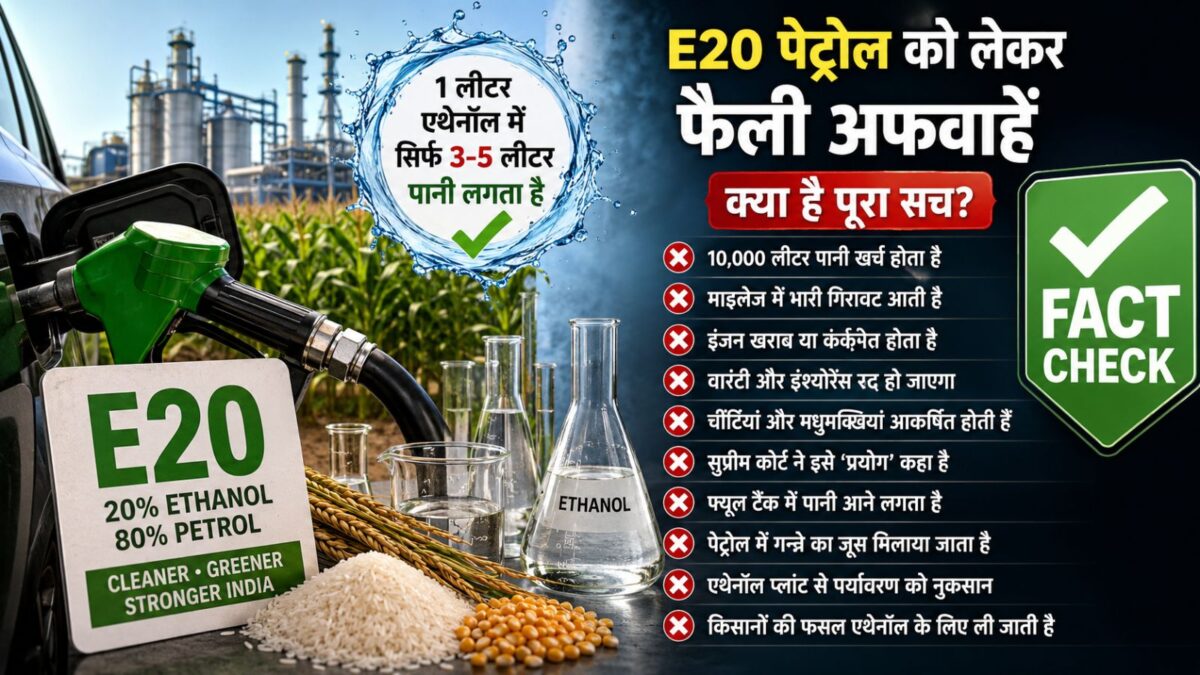
Many claims related to water, engine damage, mileage, warranty and farmers have been going viral on social media regarding E20 petrol. But government documents, clarifications from ARAI, SIAM and oil companies present a different picture of these claims. After all, which things are true and which are just rumours? In this report, read the fact check of 10 big myths related to E20 in simple language and know what is the reality.

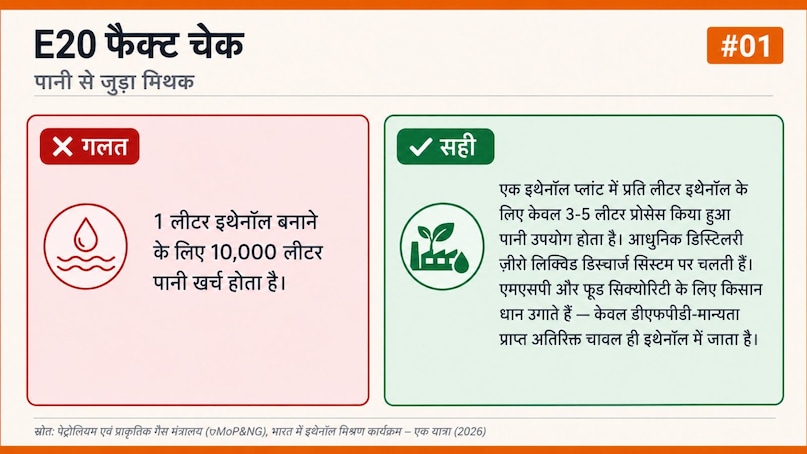
Myth of water consumption (myth of 10,000 litres): It is being claimed on social media that 10,000 liters of water is consumed to make 1 liter of ethanol, which is completely wrong. The reality is that only 3 to 5 liters of water is used per liter in the ethanol plant. Farmers grow paddy and wheat not for ethanol, but for government procurement (MSP). The surplus rice and maize left after national food security is used for ethanol. (AI image)

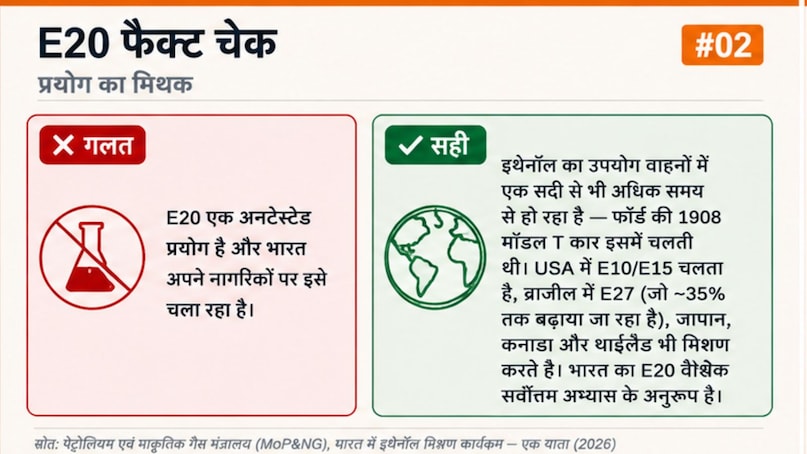
Claim of untested experiment: The claim that E20 is a risky experiment being conducted on the citizens of India is false. Ethanol has been in use around the world for more than a century, and even a 1908 Ford Model T could run on it. E10 is standard fuel in America and E27 is mandatory in Brazil. India's E20 program is completely in line with global standards. (AI image)

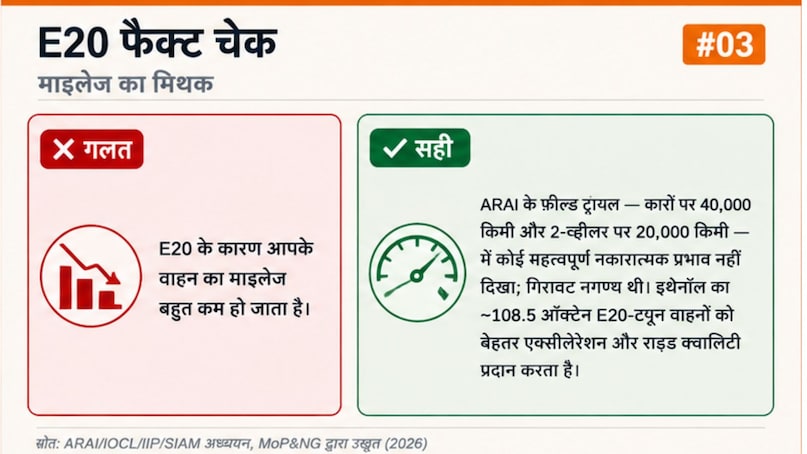
Rumor of huge drop in mileage: The claim that E20 reduces the mileage of vehicles drastically is misleading. ARAI's rigorous tests of 40,000 km on cars and 20,000 km on two-wheelers showed no significant negative impact on mileage. In contrast, ethanol's higher octane (108.5 RON) gives vehicles better acceleration and ride quality. (AI image)

Add News18 as
Preferred Source on Google

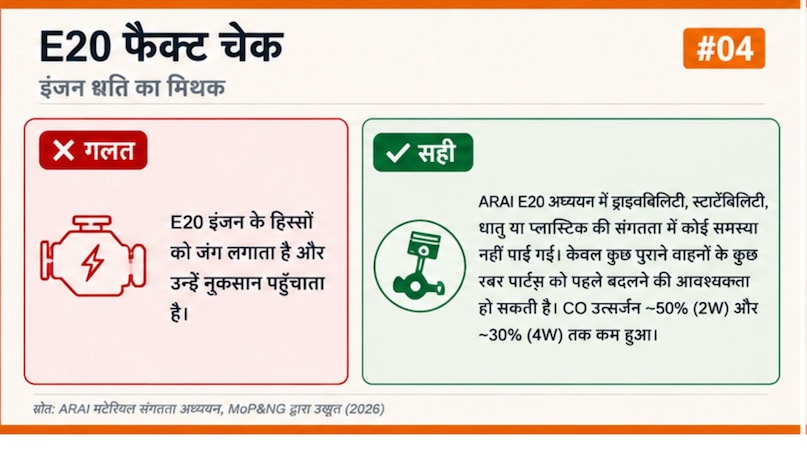
Fear of engine damage and corrosion: The claim on social media that E20 damages engine parts is wrong. A special study by ARAI conducted by the government found that there is no problem in the vehicles' drivability, starting or metal and plastic compatibility. Only in some old vehicles the rubber parts may need to be replaced a little more frequently. Also, this results in a huge reduction in pollution. (AI image)

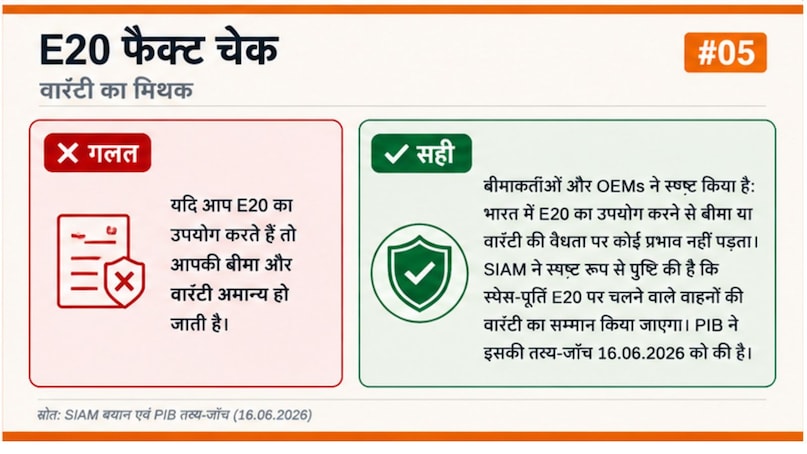
Rumor of cancellation of insurance and warranty: This claim is completely false that car companies will refuse to give warranty or insurance claim if E20 fuel is used. SIAM and vehicle manufacturers have clarified that the use of E20 fuel with prescribed standards will not affect warranty or insurance. PIB Fact Check had also refuted this misleading news on 16 June 2026. (AI image)

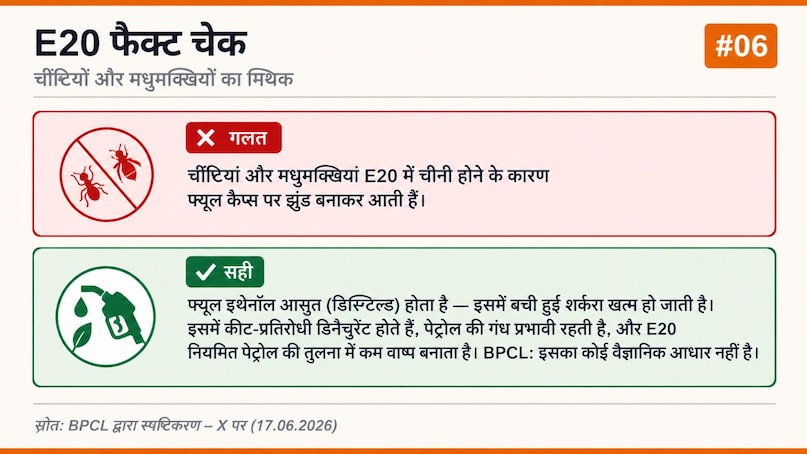
Ants and bees on the fuel cap: The claim that ants and bees are attracted to the petrol tank due to the sugar in E20 is completely scientifically baseless. According to BPCL's investigation, the remaining sugar is completely destroyed in the distillation process of making ethanol. Ethanol contains denaturants which keep insects away and the smell of petrol dominates. (AI image)

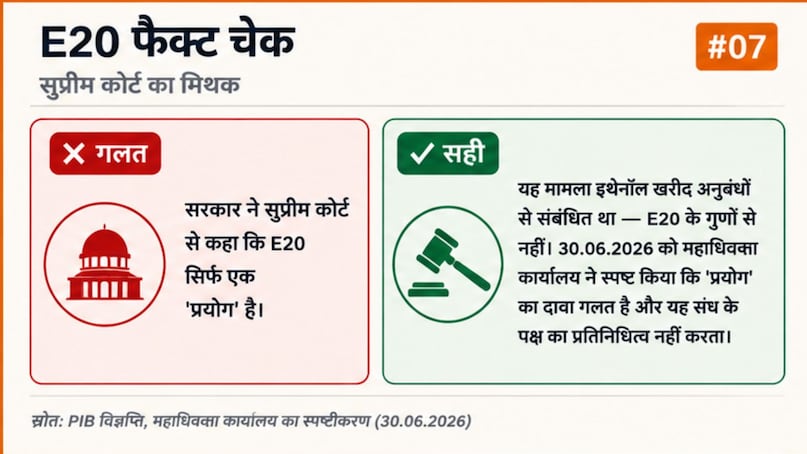
The lie of the government calling it an 'experiment' in the Supreme Court: The claim that the government has told the Supreme Court that E20 is an 'experiment' to be reviewed next year is false. Actually, that court case was only related to ethanol purchase contracts and allocation process. The Attorney General's Office clarified on June 30, 2026 that the government has never called E20 an 'experiment' in court. (AI image)

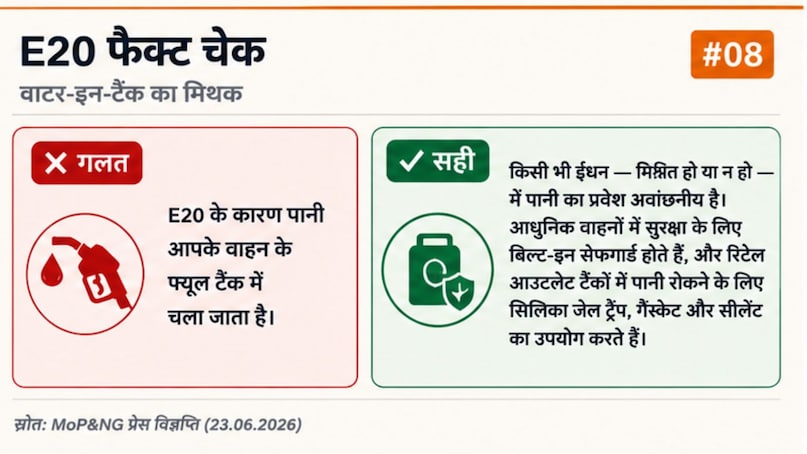
Problem of water getting into the fuel tank: The claim that E20 fuel causes water to accumulate in the tanks of vehicles is wrong. According to the Ministry of Petroleum (MoP&NG), it is wrong to add water to any fuel. The underground tanks of modern vehicles and petrol pumps have elaborate safety measures like silica gel traps, special gaskets and sealants to prevent water from entering. (AI image)

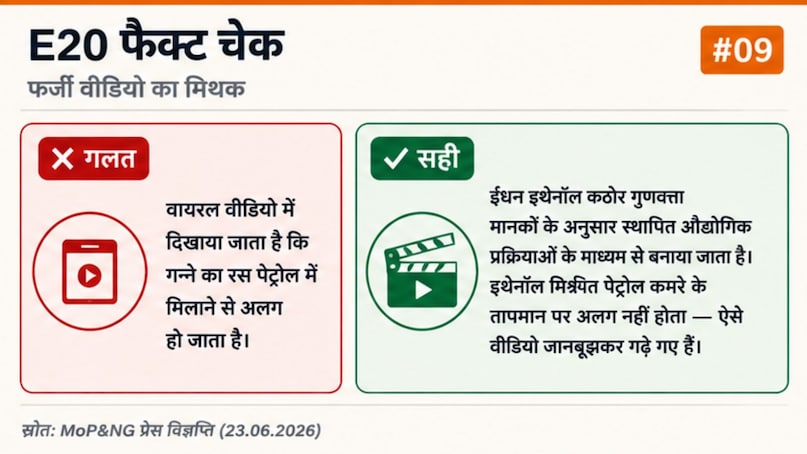
Fake videos of mixing sugarcane juice in petrol: The videos going viral on social media are completely fake and misleading, in which sugarcane juice is directly mixed in petrol and the petrol is shown separating. The Petroleum Ministry has clarified that the ethanol found in fuel is prepared under strict industrial standards. Ethanol mixed petrol never separates at normal temperatures. (AI image)

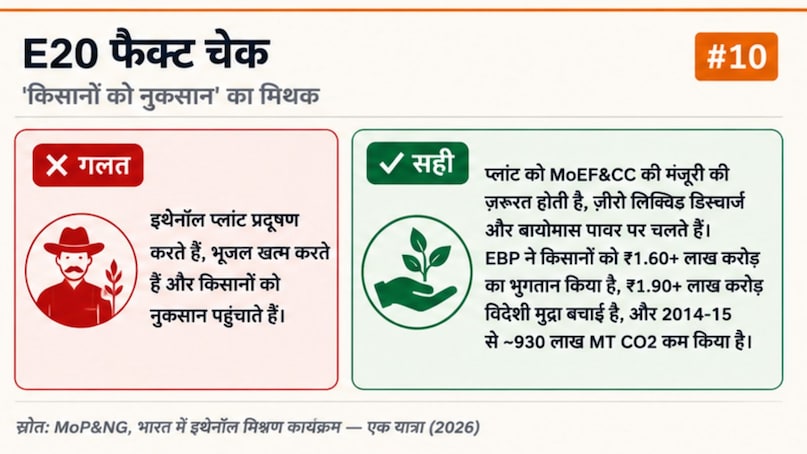
Myth that ethanol plants harm the environment and farmers: The claim that ethanol plants harm the environment is false. Modern plants run on Zero Liquid Discharge (ZLD) technology and have to obtain stringent environmental clearances. Through this program, the country has saved more than Rs 1.90 lakh crore of foreign exchange and more than Rs 1.60 lakh crore has been paid to the farmers. (AI image)

Click here to add News18 Hindi as your favorite news source on Google.

Source link