
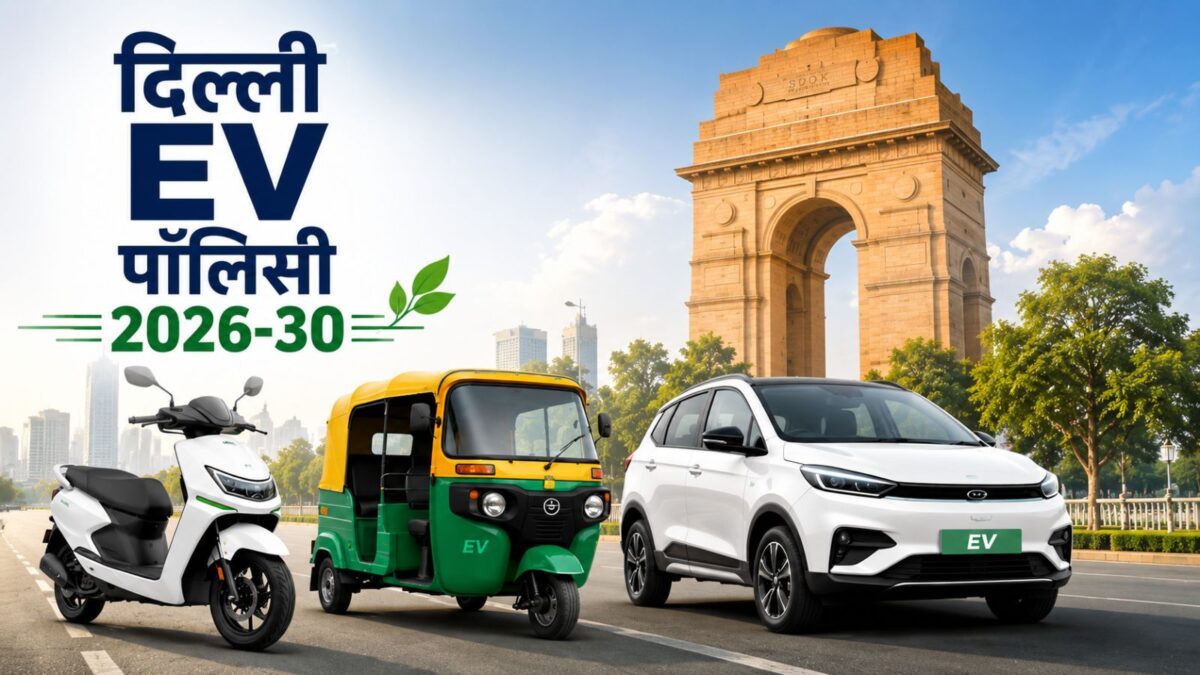
The people of Delhi are crazy! You will get benefit of up to ₹ 1 lakh on buying a new car

The people of Delhi are crazy! You will get benefit of up to ₹ 1 lakh on buying a new car

Last Updated:

The draft of Delhi Government's new EV Policy 2026-30 has brought many big benefits for the common people. Proposals like subsidy of up to ₹ 30,000 on electric two-wheelers, scrapping incentive of ₹ 1 lakh on four-wheelers and 100% exemption in road tax are under discussion. Along with this, major rules which will be implemented from 2027 and 2028 have also come to the fore. Know what effect this new policy will have on you.

news immediately

Zoom

Know what has been offered in the new EV policy.

Delhi government has released the draft of the new EV Policy 2026-30 to reduce pollution and promote electric vehicles. Under this policy, electric two-wheeler buyers will get Rs 30,000 subsidy in the first year, three-wheeler buyers will get Rs 50,000 subsidy. Also, scrapping incentive of Rs 1 lakh will be given to BS-IV four-wheeler owners.

According to the policy, only electric autos will be registered from January 2027 and only electric two-wheelers will be new registered from April 2028. This policy is a big step towards improving the air quality of Delhi and reducing vehicle pollution (which causes about 23% of pollution in the capital).

Push EV Cell

The government aims to increase the share of EVs in new vehicles and to phase out old polluting vehicles. Subsidy will be given through Direct Benefit Transfer (DBT). The buyer should be a resident of Delhi and the vehicle should be registered in Delhi only. You will also get 100% rebate in road tax and registration fees on purchasing EV (on EVs up to Rs 30 lakh, till March 2030).

How much subsidy on two-wheeler?

The subsidy for two-wheelers has been decided on the basis of battery capacity (kWh). Rs 10,000 per kWh in the first year, maximum Rs 30,000. This will be limited to Rs 20,000 in the second year and Rs 10,000 in the third year. For three-wheeler (L5M), subsidy of Rs 50,000 (first year), Rs 40,000 (second) and Rs 30,000 (third year) will be available. There will be huge incentives for electric goods vehicles also.

Scraping incentive will also be available

Scrapping incentive will be available on scrapping old BS-IV or older Delhi registered vehicles and purchasing a new EV. Rs 10,000 on two-wheeler, Rs 25,000 on three-wheeler, Rs 1 lakh on four-wheeler and up to Rs 50,000 on goods vehicle. A new EV will have to be purchased within six months of scrapping. This model will encourage the adoption of EV along with the removal of old vehicles.

The policy also includes expansion of charging infrastructure, swappable battery stations, financing facilities and single window clearance. The target of 30% EV fleet in school buses has been set by 2030. The government estimates that this will lead to a major reduction in vehicle pollution and Delhi will move towards clean air.

who said what?

Rekha Gupta, Chief Minister

  • Cabinet approves new EV policy.
  • After the approval of LG, it will be implemented from July 1, 2026.
  • The policy will remain effective till 31 March 2030.
  • About ₹7,000 crore will be spent on the policy.
  • Exemption in road tax and registration fee on pure EV.
  • No subsidy to hybrid vehicles.
  • No cap on EV purchase, benefits even on more than one vehicle.

Niharika, Transport Commissioner

  • Incentives up to ₹30,000 on two-wheelers, ₹50,000 on autos and up to ₹1 lakh on N1 e-trucks.
  • Additional incentive on scrapping of old vehicles.
  • From January 1, 2027, new three-wheelers and N1 trucks will be registered only as EVs.
  • From April 1, 2028, new two-wheelers will be registered only as EVs.
  • 23,000 EV charging points will be installed during the policy period.
  • The school bus fleet will be converted to EV in a phased manner.
  • The focus of the policy is to reduce pollution caused by commercial vehicles.

Ashish Sood, Electricity Minister

  • As EVs increase, power infrastructure will be expanded.

Dr. Pankaj Singh, Transport Minister

  • The interests of Delhiites have been fully taken care of in the EV policy.
  • Appeal to people to adopt EV policy.

Manjinder Singh Sirsa, Environment Minister

  • The new EV policy will be a big step towards reducing pollution.
  • The policy has been prepared on the basis of scientific studies.
  • The policy is expected to significantly reduce Delhi's pollution levels.

About the Author

authoring

Ram Mohan MishraSenior Sub Editor

Ram Mohan Mishra, working as Senior Sub-Editor at News18 Hindi, is active in digital media since 2021 and is currently handling the Auto Desk. They provide car and bike related information in an easy, clear and reliable manner.read more

Source link

You are stuck with petrol and diesel, while electric vehicles are being sold at a rapid rate.

You are stuck with petrol and diesel, while electric vehicles are being sold at a rapid rate.

If you are still entangled in the mathematics of rising prices of petrol and diesel, calculating the mileage or making rounds of the fuel station every week, then just wait! A large population of the country has now moved beyond this problem. Just when you are thinking of standing in petrol pump queues, the footfall of customers at Electric Vehicle (EV) showrooms is increasing.

A silent but very fast revolution is going on in the Indian automobile market. Data is witness that the confidence of Indian customers is now rapidly shifting from traditional fuel to 'green mobility'. If you are planning to buy a car in the coming days and you want to know why your next car should be an electric car, then this article of ours is useful for you.

EV sales are breaking records

If you look at the recent data of Federation of Automobile Dealers Association (FADA) and Government Vehicle Portal, the speed of EV will surprise you. The figures are as follows-

  • Huge jump in annual growth: The total sales of electric vehicles in India have registered an annual growth of about 35% to 40% over the previous financial years.
  • Dominance of two-wheelers: The youth and middle class of the country have taken charge of the EV revolution. The share of electric two-wheelers (scooters and bikes) alone in the total electric vehicle sales is more than 55%. Companies like Ola, Ather, TVS and Bajaj are selling thousands of units every month.
  • Revolution in the three-wheeler segment: The game has completely changed in the commercial segment. More than 50% of the total three-wheelers (auto rickshaws and loaders) sold in the country have now become electric. The entire structure of local transport and delivery is shifting to electricity.
  • Speed ​​in car market also: Thanks to companies like Tata Motors, MG and Mahindra, sales of electric cars have also seen a growth of up to 90% annually.

Why are people leaving petrol and diesel and choosing EV?

What happened that people suddenly started saying 'bye-bye' to petrol and diesel? There are some very concrete and practical reasons behind this. Come, let us try to know these also one by one-

1. Huge savings on pocket: While the average cost of driving a petrol car is Rs 7 to 9 per kilometer, an electric car runs for only Rs 1 to 1.5 per kilometer. In two-wheelers this cost is even less (about 25 to 30 paise per kilometer).

2. No maintenance hassles: A conventional engine has hundreds of moving parts. This includes things like engine oil, filter, spark plug, gearbox. There is no hassle in EV. No engine, no oil change, i.e. almost zero maintenance cost.

3. Increasing Range and Infrastructure: Earlier people were afraid what would happen if the battery ran out. But now the vehicles are giving a range of 150 to 500 kilometers in a single charge. Also, a network of charging stations has been spread from the highway to the society.

The future is EV!

Experts believe that the Indian auto market has now reached the turning point from where return is not possible. The government's FAME scheme, PLI scheme and tax exemptions given by state governments have doubled this pace. So next time you think of buying a car or bike, don't just look at petrol and diesel variants. The market trend is clear. The world is changing and vehicles are no longer being charged at petrol pumps but at home plug points.

Source link

Bajaj launched brand new electric auto, long range to earn heaven

Bajaj launched brand new electric auto, long range to earn heaven

Last updated:

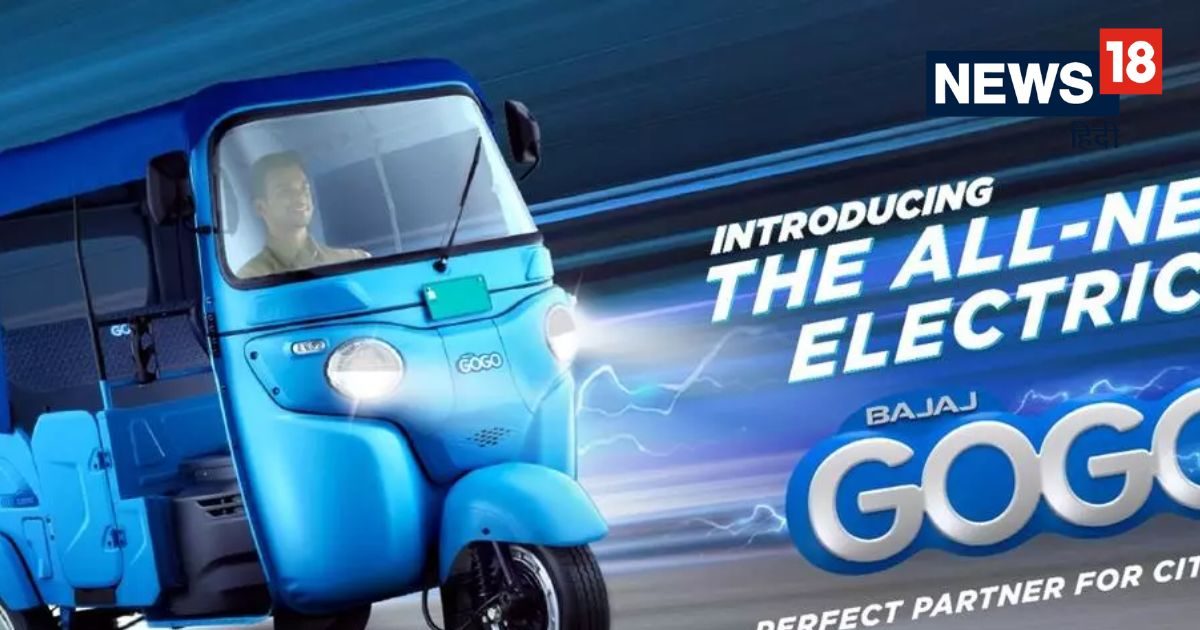
Bajaj Auto Limited has launched the new electric brand Bajaj Gogo, which comes with a 251 km range and 2-speed automatic transmission. The P5009 and P7012 models are priced at Rs 3,26,797 and Rs 3,83,004 respectively.

This auto of Bajaj is going to get a long range in single charge.

Highlights

  • Bajaj launched the new electric brand Bajaj Gogo.
  • Bajaj Gogo range 251 km and 2-speed automatic transmission.
  • The price of both models is Rs 3,26,797 and Rs 3,83,004 respectively.

New Delhi. Bajaj Auto Ltd has launched its all new electric brand Bajaja Gogo. Under this brand, the company will bring electric three wheelers products. These products will launch the company in both passenger and cargo segments. Bajaj Gogo claims a segment-lead range of up to 251 km once charged. It also provides a 2-speed automatic transmission of the industry, which is designed to increase both efficiency and gradability in different areas.

The company has currently launched 2 passenger models-P5009, priced at Rs 3,26,797 (ex-showroom, Delhi) and P7012, Rs 3,83,004 (ex-showroom, Delhi). Booking for this is now open at all Bajaj Auto dealerships in India. The brand will also introduce cargo variants in the near future. Talking about the features, the new lineup includes 3 variants: P5009, P5012, and P7012, where 'P' reflects passenger models, shows '50' and '70' shape and category, and '09' and '12' and '12', respectively, reflect batteries.

Bajaj Gogo is equipped with several first-in-segment features, including auto hazard and anti-roll detection, LED lights and hill hold assist for additional safety. Customers can also choose the option of TECPAC, which offers additional safety features like remote immobilization and reverse assist.

Speaking about the launch, Samardeep Subaband, president of Bajaj Auto Limited's Intra City Business Unit, said, “Bajaj Gogo range will stand new standard in the e-auto segment. Range up to 251 km, many segment-first features will be available. Bajaj Gogo offers a complete solution to drivers who want to maximize earnings and reduce downtime.

homeauto

Bajaj launched brand new electric auto, long range to earn heaven

Source link