Will E20 petrol damage the car engine? Must read for BS3 and BS4 car owners

Will E20 petrol damage the car engine? Must read for BS3 and BS4 car owners

After the widespread use of E20 petrol (20% ethanol blended) started in India, the debate in the automobile world has intensified. Many videos and posts on social media are claiming that the engines of old cars will get damaged, there will be a huge drop in mileage and the fuel system will get damaged. But are these claims true? The answer is – it is not completely correct, but some problems have definitely arisen!

The purpose of E20 is to reduce oil imports, increase farmers' income and reduce pollution. Ethanol acts as an oxygenate, which keeps the combustion clean. However, questions are being raised on the compatibility of the fuel system in pre-2022 (especially pre-BS4) vehicles. In this article we will try to know the whole truth on the basis of scientific facts, engineering principles and workshop experience.

What is ethanol and why is it added to fuel?

Ethanol is an alcohol mainly produced from sugarcane or corn. The main reason for mixing it in petrol is to increase oxygen, which helps in better combustion of the fuel. This reduces harmful emissions and reduces dependence on fossil fuels.

Ethanol is preferred in motorsport because it has a higher octane rating, lower combustion temperatures and easier tuning. E10 was being used in India for a long time, now E20 has become standard.

How does the engine work?

Every engine has a perfect air-fuel ratio (AFR). For pure petrol (E0) it is 14.7:1. For pure ethanol it is about 9:1. The AFR changes in the E20 blend, causing the ECU to slightly increase the amount of fuel. If the ECU does not adjust, the engine may lean (run on less fuel), causing temperatures to rise. But modern vehicles are capable of dealing with this problem.

BS4 or newer petrol cars have closed-loop fueling, oxygen sensors and an ECU that can adjust the injector pulse. Most ECUs make fuel corrections up to ±20%. E20 comes easily in this range. For example, in Brazil, E25-E27 have been running in common cars for years without any major problems.

BS4 standard had already made preparations for E10. Features ethanol-resistant hoses, seals and pumps. Headroom is always kept in engineering, so most BS4+ cars can be considered safe for E20.

Is 20% more fuel injected than E20?

no way. Pure ethanol contains about 34% less energy than petrol. E20 requires 6-7% more fuel than E0 (only 2-3% more than E10). The ECU handles this easily. The claims of 30-50% mileage drop are simply wrong. The actual decline may be around 2-3%.

Myth of Melting Rubber Fuel Line

Ethanol can affect old natural rubber or cheap hoses. But after 2010, most companies use resistant materials like FKM or NBR. BS4 has strengthened these changes. Due to engineering tolerances, E20 or even E30 is safe in most cases, unless your car is an older carbureted car.

Problem of clogged injectors

Deposits build up slowly in the injectors. These can malfunction due to bad fuel, short drives or carelessness. E20 also has a cleaning effect, which dissolves varnish and carbon. It works the same way as expensive fuel system cleaners. In poorly maintained vehicles, old deposits can loosen and cause temporary problems, but in regularly maintained vehicles this is beneficial.

Water separation: the real problem

Ethanol is hygroscopic, that is, it absorbs moisture. Phase separation in E20 can occur at 0.4% water, but it takes 3-5 weeks. This problem can occur in an unused, humid and empty vehicle. Fuel keeps circulating in daily running vehicles, hence the problem is less.

What problems can arise?

  • Slight 2-3% drop in mileage.
  • Slight problem in cold start in very cold weather.

The case of BS3 and carbureted cars

The material in BS3 vehicles is less tolerant. Hoses, seals and pumps can wear out rapidly over a long period of time. Carbureted engines run lean due to fixed jets, which can cause hesitation, poor starting and overheating. There is a high risk of corrosion in storage.

What to do BS3 Honors?

  1. Install ethanol-resistant hoses/seals (FKM/NBR).
  2. Richer re-jet the carb.
  3. Check/replace pump diaphragm and seals.
  4. Use stabilizer in storage, do not keep E20 for long periods.
  5. Clean jets/injectors regularly.
  6. Keep an eye on drivability.

Source link

10 big rumors spread about E20 Petrol! Know what is the whole truth

10 big rumors spread about E20 Petrol! Know what is the whole truth

Last Updated:

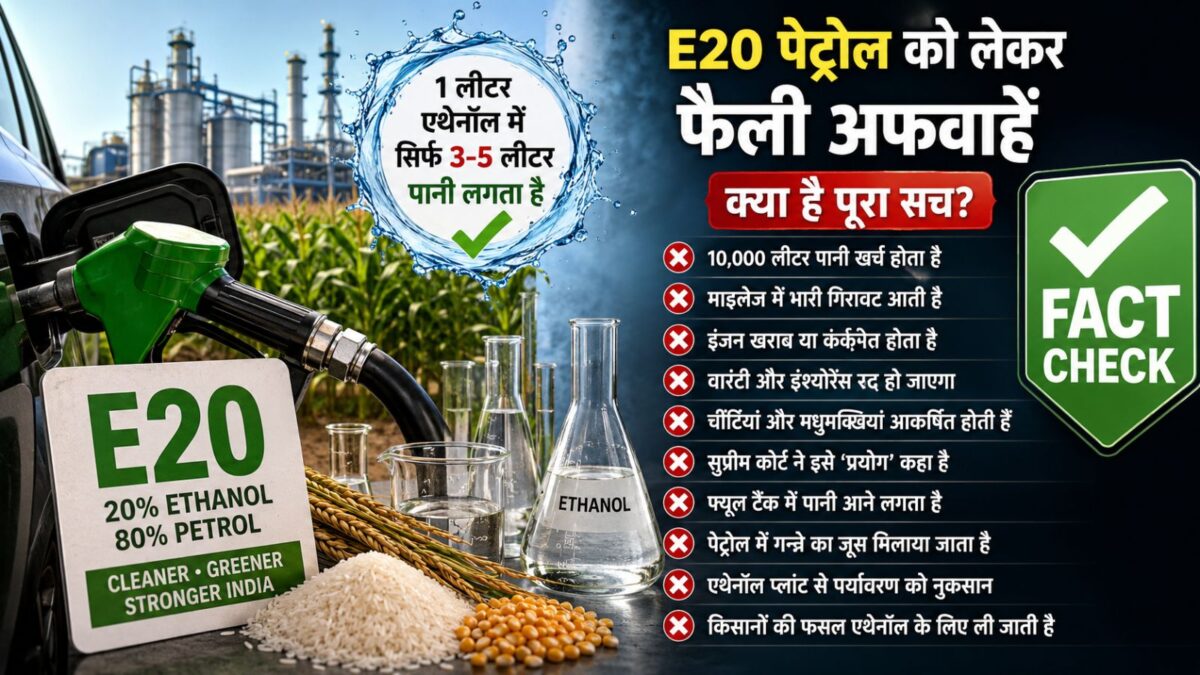
Many claims related to water, engine damage, mileage, warranty and farmers have been going viral on social media regarding E20 petrol. But government documents, clarifications from ARAI, SIAM and oil companies present a different picture of these claims. After all, which things are true and which are just rumours? In this report, read the fact check of 10 big myths related to E20 in simple language and know what is the reality.

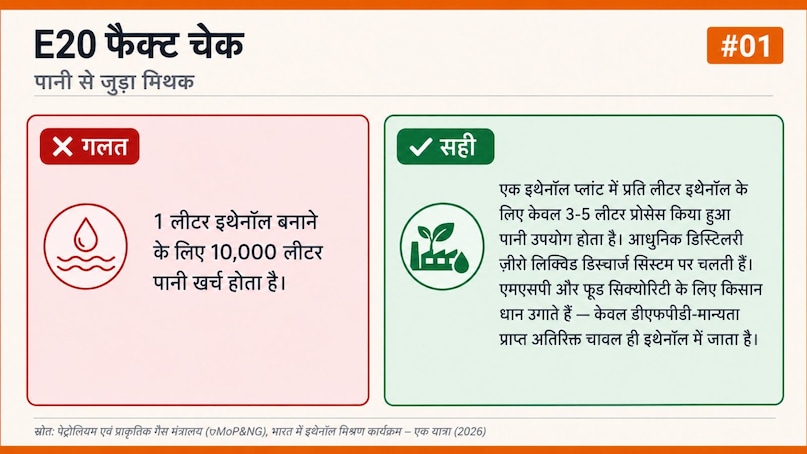
Myth of water consumption (myth of 10,000 litres): It is being claimed on social media that 10,000 liters of water is consumed to make 1 liter of ethanol, which is completely wrong. The reality is that only 3 to 5 liters of water is used per liter in the ethanol plant. Farmers grow paddy and wheat not for ethanol, but for government procurement (MSP). The surplus rice and maize left after national food security is used for ethanol. (AI image)

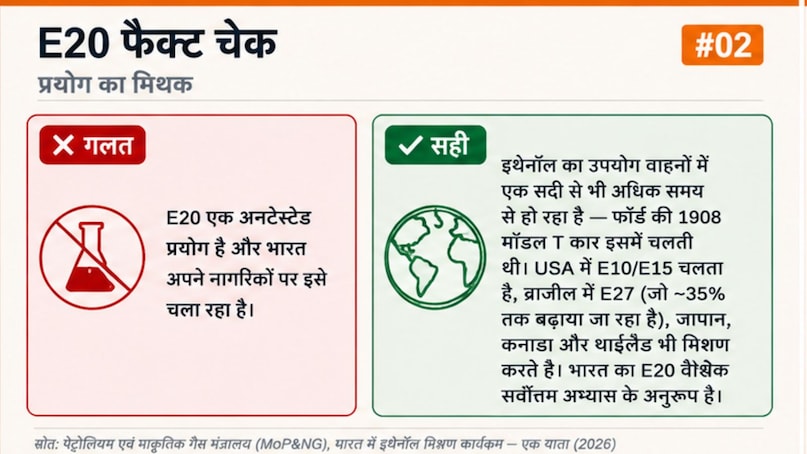
Claim of untested experiment: The claim that E20 is a risky experiment being conducted on the citizens of India is false. Ethanol has been in use around the world for more than a century, and even a 1908 Ford Model T could run on it. E10 is standard fuel in America and E27 is mandatory in Brazil. India's E20 program is completely in line with global standards. (AI image)

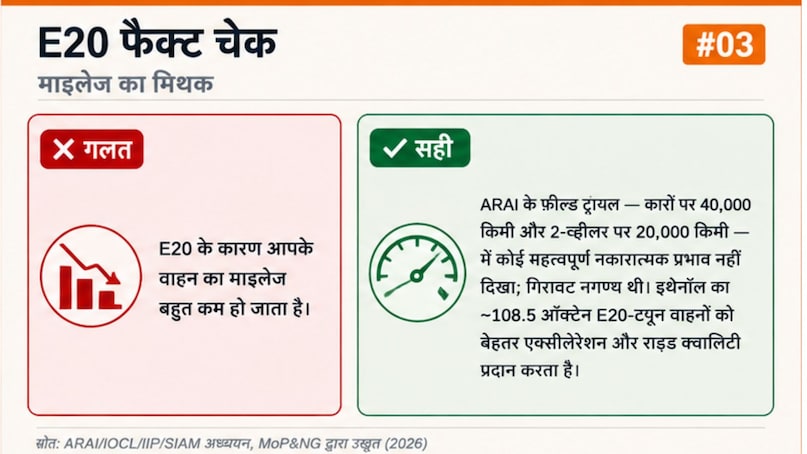
Rumor of huge drop in mileage: The claim that E20 reduces the mileage of vehicles drastically is misleading. ARAI's rigorous tests of 40,000 km on cars and 20,000 km on two-wheelers showed no significant negative impact on mileage. In contrast, ethanol's higher octane (108.5 RON) gives vehicles better acceleration and ride quality. (AI image)

Add News18 as
Preferred Source on Google

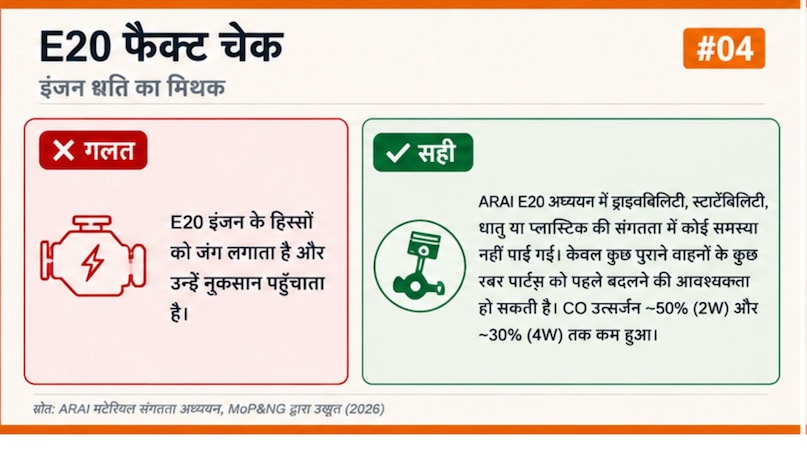
Fear of engine damage and corrosion: The claim on social media that E20 damages engine parts is wrong. A special study by ARAI conducted by the government found that there is no problem in the vehicles' drivability, starting or metal and plastic compatibility. Only in some old vehicles the rubber parts may need to be replaced a little more frequently. Also, this results in a huge reduction in pollution. (AI image)

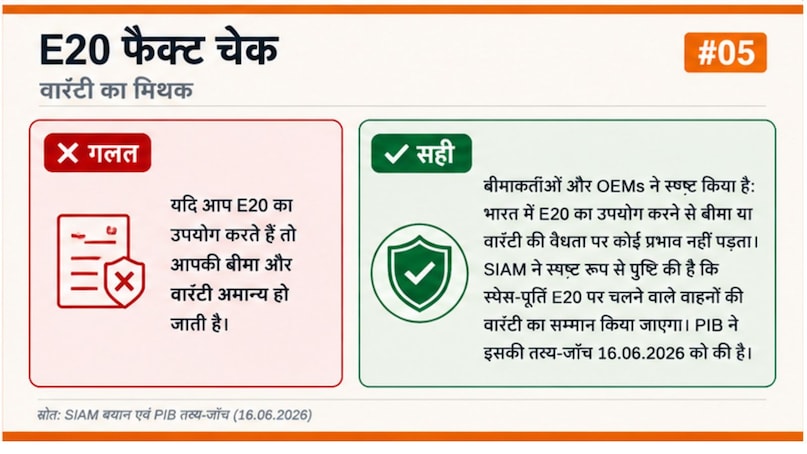
Rumor of cancellation of insurance and warranty: This claim is completely false that car companies will refuse to give warranty or insurance claim if E20 fuel is used. SIAM and vehicle manufacturers have clarified that the use of E20 fuel with prescribed standards will not affect warranty or insurance. PIB Fact Check had also refuted this misleading news on 16 June 2026. (AI image)

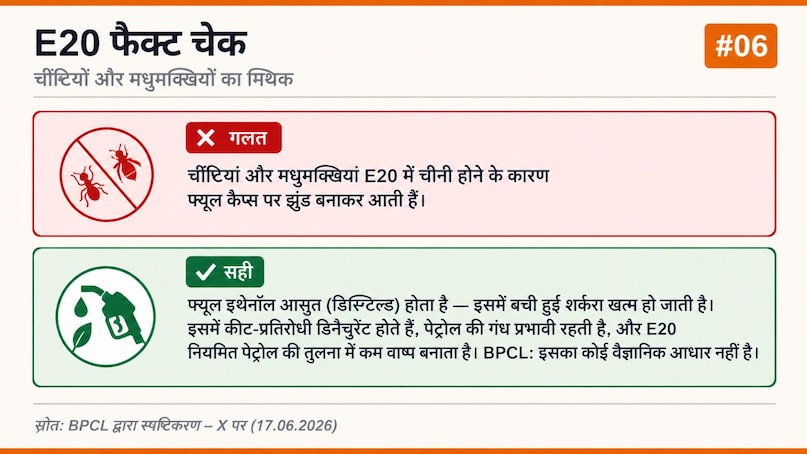
Ants and bees on the fuel cap: The claim that ants and bees are attracted to the petrol tank due to the sugar in E20 is completely scientifically baseless. According to BPCL's investigation, the remaining sugar is completely destroyed in the distillation process of making ethanol. Ethanol contains denaturants which keep insects away and the smell of petrol dominates. (AI image)

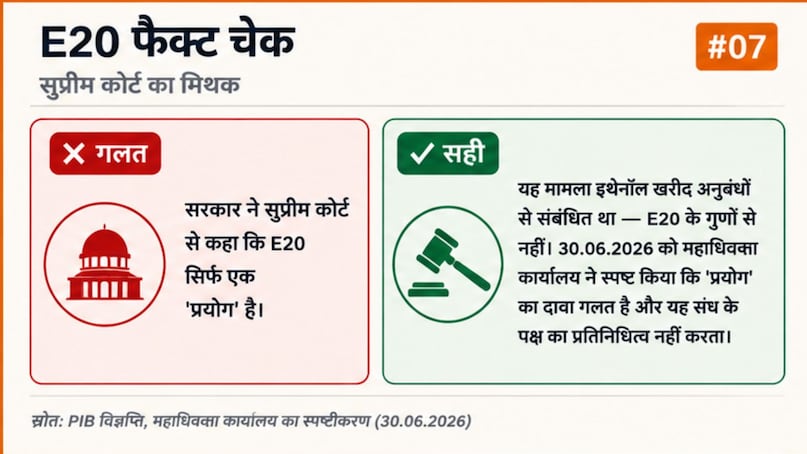
The lie of the government calling it an 'experiment' in the Supreme Court: The claim that the government has told the Supreme Court that E20 is an 'experiment' to be reviewed next year is false. Actually, that court case was only related to ethanol purchase contracts and allocation process. The Attorney General's Office clarified on June 30, 2026 that the government has never called E20 an 'experiment' in court. (AI image)

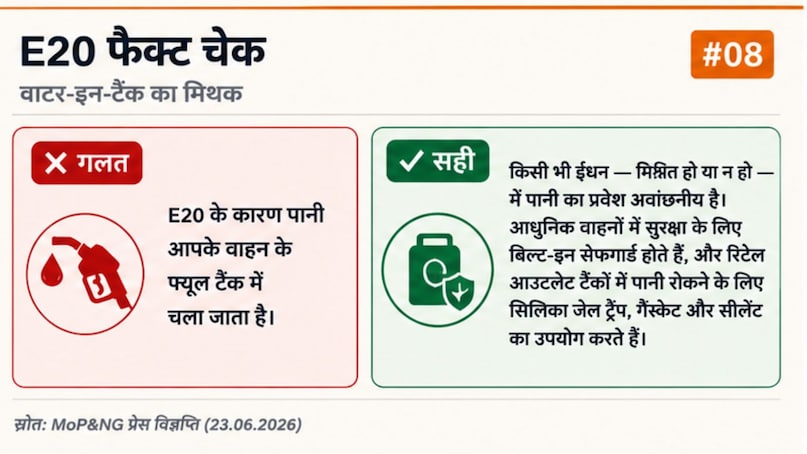
Problem of water getting into the fuel tank: The claim that E20 fuel causes water to accumulate in the tanks of vehicles is wrong. According to the Ministry of Petroleum (MoP&NG), it is wrong to add water to any fuel. The underground tanks of modern vehicles and petrol pumps have elaborate safety measures like silica gel traps, special gaskets and sealants to prevent water from entering. (AI image)

Fake videos of mixing sugarcane juice in petrol: The videos going viral on social media are completely fake and misleading, in which sugarcane juice is directly mixed in petrol and the petrol is shown separating. The Petroleum Ministry has clarified that the ethanol found in fuel is prepared under strict industrial standards. Ethanol mixed petrol never separates at normal temperatures. (AI image)

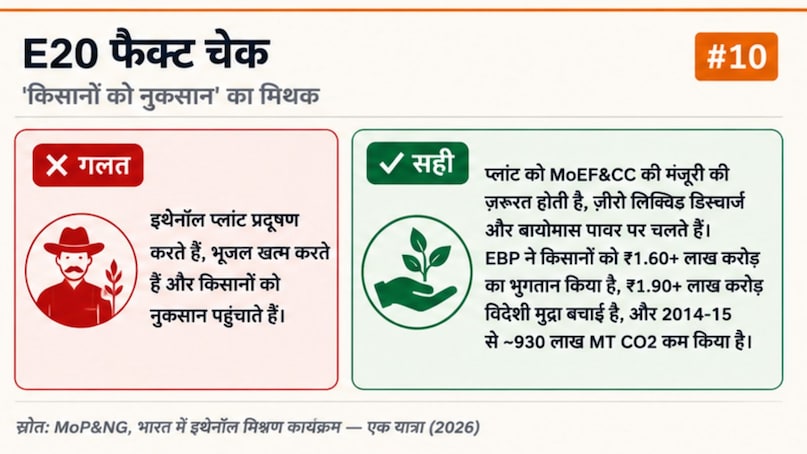
Myth that ethanol plants harm the environment and farmers: The claim that ethanol plants harm the environment is false. Modern plants run on Zero Liquid Discharge (ZLD) technology and have to obtain stringent environmental clearances. Through this program, the country has saved more than Rs 1.90 lakh crore of foreign exchange and more than Rs 1.60 lakh crore has been paid to the farmers. (AI image)

Click here to add News18 Hindi as your favorite news source on Google.

Source link