Now you won't have to take a permit! Government gave big relief to these drivers

Now you won't have to take a permit! Government gave big relief to these drivers

Last Updated:

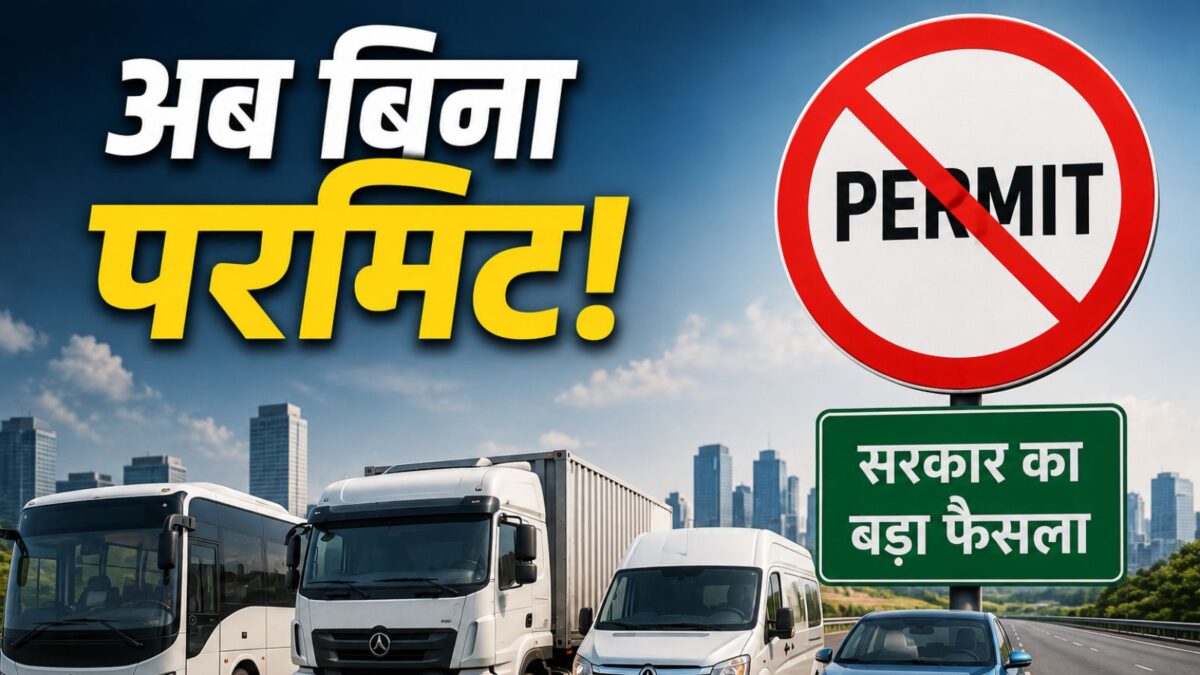
The Central Government has given big relief to commercial vehicles running on electric and alternative fuels. The government has extended the permit exemption period for Electric Vehicles (EVs) by one year. Also, now commercial vehicles running on ethanol, methanol and hydrogen will also be able to avail this facility. However, this exemption is not for private car owners.

news quickly

Zoom

If you have an electric or other car for personal use, then there will be no change in your rules due to this decision. (AI)

New Delhi. If you drive electric taxi, bus, truck or other commercial vehicles then there is good news for you. The Central Government has extended the permit exemption applicable for such vehicles by one more year. Not only this, now this facility will not be limited to electric vehicles only. Commercial vehicles running on alternative fuels like ethanol, methanol and hydrogen will also benefit from this. The government believes that if rules are made easier for less polluting vehicles, people will adopt them faster. This will increase the use of clean fuel in the transportation sector and will also reduce operating costs.

Many types of commercial vehicles in the country require National Permit or All India Tourist Permit to operate in different states. For these permits, formalities like application, documents and fees have to be completed. To promote green mobility, the government has exempted electric and now other alternative fuel commercial vehicles from the requirement of these permits. This means that operators of these vehicles will not need to obtain permits in many cases, which will save both time and expense.

Which vehicles will get the benefit?

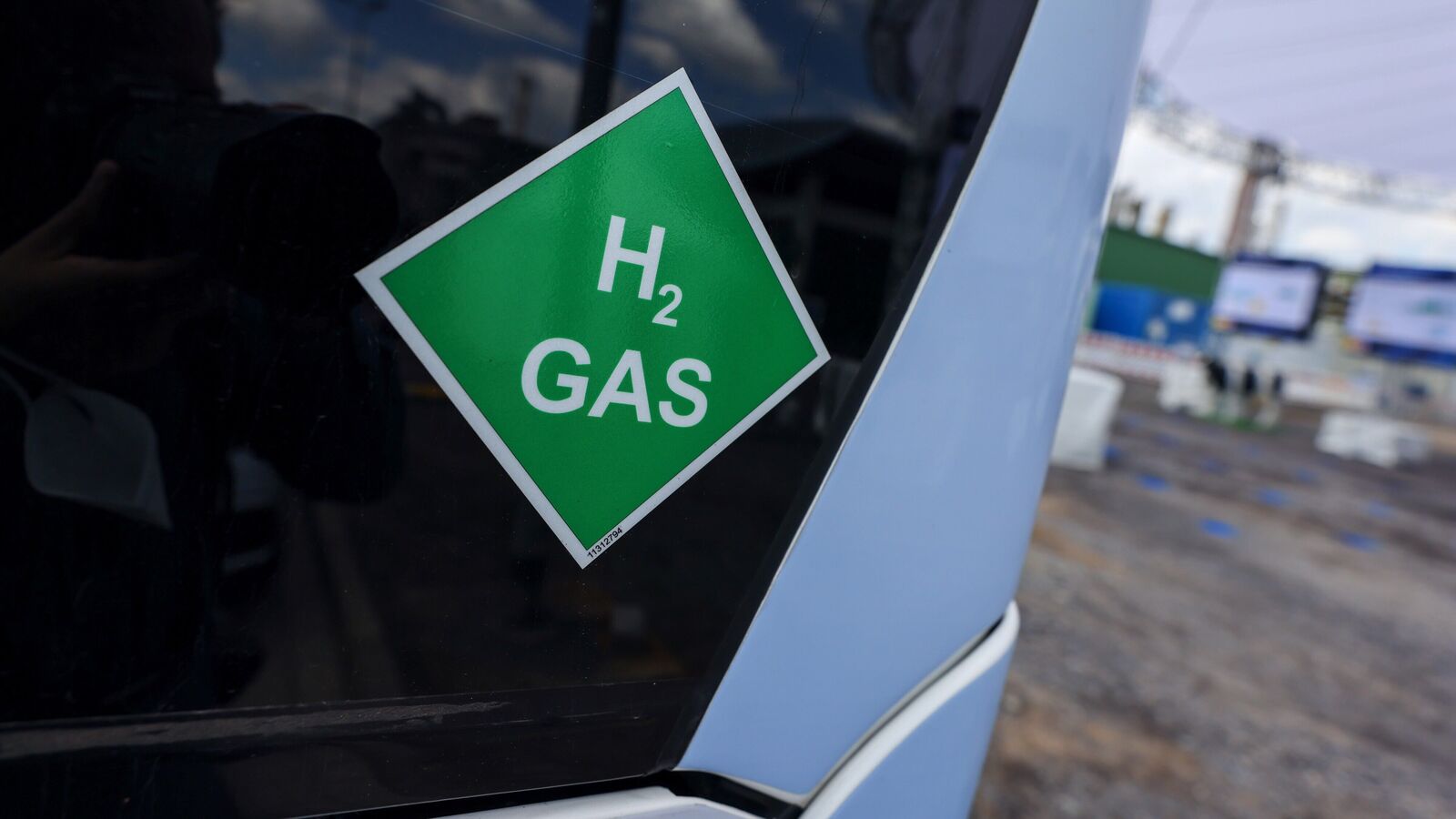
Under the new decision of the government, apart from electric vehicles, commercial passenger vehicles and goods vehicles running on ethanol, methanol and hydrogen will also come under the ambit of this exemption. Taxi operators, bus companies, logistics companies, transporters and owners of goods vehicles can benefit from this.

Will your personal car also be able to drive without a permit?

If you have an electric or other car for personal use, then there will be no change in your rules due to this decision. Actually, this exemption is only for vehicles used for commercial use. Private cars did not require such commercial permits earlier also, so this decision will not have any impact on them.

What is the purpose of the government?

The government has been continuously emphasizing on promoting electric mobility and alternative fuels for the last few years. Its objective is to reduce dependence on petrol and diesel, reduce pollution and promote clean transportation. The government believes that if processes like permits become easier, then transport companies will rapidly adopt electric, ethanol, methanol and hydrogen based vehicles. This can reduce the costs of the logistics sector and will also benefit the environment.

For how long will this discount be available?

The government has extended the period of this permit exemption by one year. That means at present this system will remain in force till July 2027. During this period, eligible commercial vehicles will be able to operate under the prescribed rules even without obtaining the relevant permit.

About the Author

authoring

Jai ThakurSenior-Sub Editor

I am Jai Thakur, serving as Senior Sub-Editor at News18 Hindi. My main job is to convey complex business news to people in simple language. Be it the movement of the stock market, the impact of the country's economy…read more

Source link

If you have to buy a car, then wait a little! 8 new vehicles are going to be launched in the next 3 months

If you have to buy a car, then wait a little! 8 new vehicles are going to be launched in the next 3 months

Last updated:

In 2025, the discussion of Mahindra Thar, Maruti Victoris, Tata Punch facelift, Tata Sierra Ev, Hyundai Venue, Skoda Octavia RS, Volkswagen Tyron, MG MAJSTER is fast.

If you have to buy a car, then wait a little! 8 models are going to be launched in 3 months
New Delhi. 2025 The year of a major change for the Indian automotive industry has been the year of a major change – from the growing inclination towards the green mobility of the buyers to the latest GST reforms, which pushed the market in a new direction. As soon as we are entering the last four months of the year, the discussion about the new car launch is intensifying. This may be the right time to wait a little and buy a car wisely. Why? Because at least 8 new cars and SUVs are ready to hit the streets before the end of 2025.

The updated Mahindra Thar will be available for sale in the coming weeks. The SUV will borrow several design elements and features from Thar Rocks, while its current engine-gierbox will retain the setup. Maruti Victoris has started arriving at the showroom before the announcement of its official price. This is the first Maruti Suzuki with Level-2 ADAS feature and is the safest offer so far, which has achieved 5 stars in India NCAP. The SUV will come with three engine options-petrol mild hybrid, strong hybrid and petrol-CNG.

  • The Tata Punch facelift will debut with the micro design change and feature upgrade in October. After this, Tata Sierra EV will come in November, which is expected to share EV's Poetrain.
  • Next-Jen Hyundai Venue will achieve significant changes inside and out, while the existing engine will maintain options. Skoda will re-introduce its performance-oriented Octavia RS sedan with 265bhp, 2.0L Turbo Petrol Engine. Imported through the CBU route, its estimated price will be around Rs 50 lakh (ex-showroom).
  • Folkswagen can introduce Tyrone Premium 7-seater SUV by the end of 2025. However, the official timeline has not been confirmed.
  • MG performed the Masester SUV at this year's India Mobility Show. While it was initially planned for 2025 launch, the car manufacturer has not announced the launch date yet.
Click here to add News18 Hindi as your favorite news source on Google.
homeauto

If you have to buy a car, then wait a little! 8 models are going to be launched in 3 months

Source link

Diesel-petrol cars disappearing, the secret of electric cars will be on the road, shocking report revealed

Diesel-petrol cars disappearing, the secret of electric cars will be on the road, shocking report revealed

Last updated:

Sales of electric vehicles in India have crossed 4.1 million units in 2023-2024. According to the IESA report, by 2030 2.8 crore electric vehicles will be on the roads. The government is giving subsidy.

By 2023, the roads can be around 3 crore electric vehicles.

Highlights

  • 4.1 million electric vehicles were sold in India in 2023-24.
  • There will be 2.8 crore electric vehicles in India by 2030.
  • The government is giving subsidy on electric vehicles.

New Delhi. India's automobile market has changed rapidly in the last few years. The big reason for this is that the market inclination towards electric mobility. In these years, there has been a significant increase in the number of electric vehicles. According to experts, this sequence is not going to stop, but it is going to grow further in the future. The government is also trying to promote electric mobility in the country and hence the government also offers many types of subsidies. Now recently a report has come out about the increasing trend of green mobility in India. Let's know about this report.

India Energy Storage Alliance (IESA) has released a report in this regard. IESA is a leading body of this industry that focuses on e-mobility, energy storage and hydrogen. According to the IESA report, in FY 2023-2024, India's total EV cell has crossed 4.1 million units and the future market is positive for sale, which is inspired by increasing environmental awareness, customer interest, development in battery industry and easily available EV charging infrastructure. By 2030, the number of electric vehicles on the road can be up to 2 crore 80 lakhs.

IESA said, “It is estimated that an annual cell will have 83 percent e-2 wheeler, 10 percent e-4 wheelers and trucks, buses like bus, will contribute 7 % to 3 wheeler sales.” With rapid growth, demand and supply, rising consumer demand and charging infrastructure development, India is continuously moving forward in its deakarbonization journey. IESA President (Interim) Vinayak Walimbe said that a lot of growth has been seen in India, which has seen a lot of growth in power in India, which has seen a lot TWH has reached (7 percent growth compared to last year).

Production will have to be increased
According to the IESA report, India's total capacity needs to increase from 466 GW to 900 GW by 2032 in January 2025. This includes 500 GW Renewable Sources, Wind, and others (by 165 GW capacity in January 2025). The scheme serves as a blueprint to accelerate EV charging infrastructure to meet future EV charging demand and increase charging stations by 2030 to about 100,000.

homeauto

'Diesel-petrol cars are disappearing, the secret of electric cars will be on the road'

Source link

Future of our transport will be on green hydrogen: Hardeep Singh Puri

Future of our transport will be on green hydrogen: Hardeep Singh Puri

Under this initiative, Indian Oil Corporation (IOCL) has embarked on a meticulously designed program to conduct operational trials of 15 Fuel Cell buses powered by Green hydrogen.

These trials will encompass designated routes in Delhi, Haryana, and Uttar Pradesh. The project’s inaugural moment saw the launch of the first set of two fuel cell buses from India Gate. This program is the first of its kind in India to dispense green hydrogen at 350 bar pressure for operating fuel cell buses.

Furthermore, Indian Oil has established a cutting-edge dispensing facility at its research and development (R&D) campus in Faridabad. This facility can refuel green hydrogen produced through electrolysis using solar photovoltaic panels.

According to SM Vaidya, Chairman of Indian Oil, the launch of these two buses signifies the commencement of a comprehensive assessment of the performance and durability of this new technology. The trial period, spanning more than 3 lakh kilometres across all buses, will generate vital data that will serve as a national repository.

This repository is expected to play a pivotal role in shaping the future of zero-emission mobility in India, powered by green hydrogen. In his address, Hardeep Singh Puri emphasized, the Indian government’s commitment to clean and green energy. Hardeep Singh Puri said, “The Future of our transport will be on green hydrogen”.

BMW is among the automakers who have been working on hydrogen fuel cell technology over the last few years, as hydrogen could be a potential green and clean fuel for future cars.

India’s endeavours in the realm of low-carbon development, including emerging fuels like hydrogen and biofuels, are central to these efforts. Puri said, “India has one of the largest synchronous grids in the world, capable of handling intermittent renewable energy and we have achieved ‘One Nation-One Grid-One Frequency’.”

India, with its extensive synchronous grid capable of handling intermittent renewable energy, is poised to be a global champion in hydrogen production and exports. “We have recently witnessed the launch of the world’s first Bharat Stage 6 (BS 6) (Stage II) Electrified Flex Fuel vehicle prototype that encompasses both the flex fuel engine as well as an electric powertrain that offers higher use of ethanol combined with better fuel efficiencies. With Industry and Government collaboration, India is on its way to becoming a global hub for cleaner technologies and achieving self-reliance in energy soon”, Puri said.

Hydrogen, hailed as the fuel of the future, holds immense potential in helping India achieve its decarbonization targets. The global demand for hydrogen is projected to surge four to seven times by 2050, reaching 500-800 million tonnes. Domestically, demand is set to quadruple, from the current 6 million tonnes to 25-28 million tonnes by 2050.

The Ministry of Petroleum and Natural Gas is actively driving initiatives related to green hydrogen, including production and utilization in refineries, hydrogen blending in natural gas pipelines, localization of electrolyzer-based technologies, and promoting bio-pathways for green hydrogen production.

Fuel cells, the heart of these green hydrogen-powered buses, employ hydrogen and air to generate electricity for propulsion.

These buses are environmentally friendly, with the only byproduct being water, offering a stark contrast to conventional buses running on diesel and petrol.

Fuel cells are also highly efficient compared to internal combustion engines. Fuel cells boast an electrical efficiency of 55-60 per cent, a notable improvement over the thermal efficiency of 25 per cent for conventional internal combustion engines.

These buses are set to achieve a remarkable fuel economy of around 12 km per kilogram of hydrogen, compared to 2.5-3 km per litre for diesel buses.

Hardeep Singh Puri commended IOCL and Tata Motors for their collaborative efforts in developing indigenous solutions for fuel cells and hydrogen infrastructure for heavy-duty buses in passenger transport applications.

Puri stated, “I would like to congratulate the IOCL team for undertaking this collaborative approach along with Tata Motors for the development of indigenous solutions pertaining to Fuel Cell and hydrogen infrastructure in the country, for heavy-duty buses for passenger transport application. I am sure that the ecosystem developed through efforts like these can integrate a larger economy with the energy sector”.

He stressed that this green hydrogen-powered bus initiative could potentially transform India into a net exporter of clean hydrogen energy and set a global precedent in technology transfer and green hydrogen production.

The initiative has plans to soon operate an additional 15 fuel cell buses in the National Capital Region (NCR). Minister Puri expressed his commitment to closely monitoring this project, highlighting its importance on the national stage and its potential to revolutionize city transport in India.

India’s foray into green hydrogen technology signifies a significant stride toward achieving energy self-reliance and global leadership in the realm of sustainable energy solutions.

First Published Date: 25 Sep 2023, 17:11 PM IST


Source link