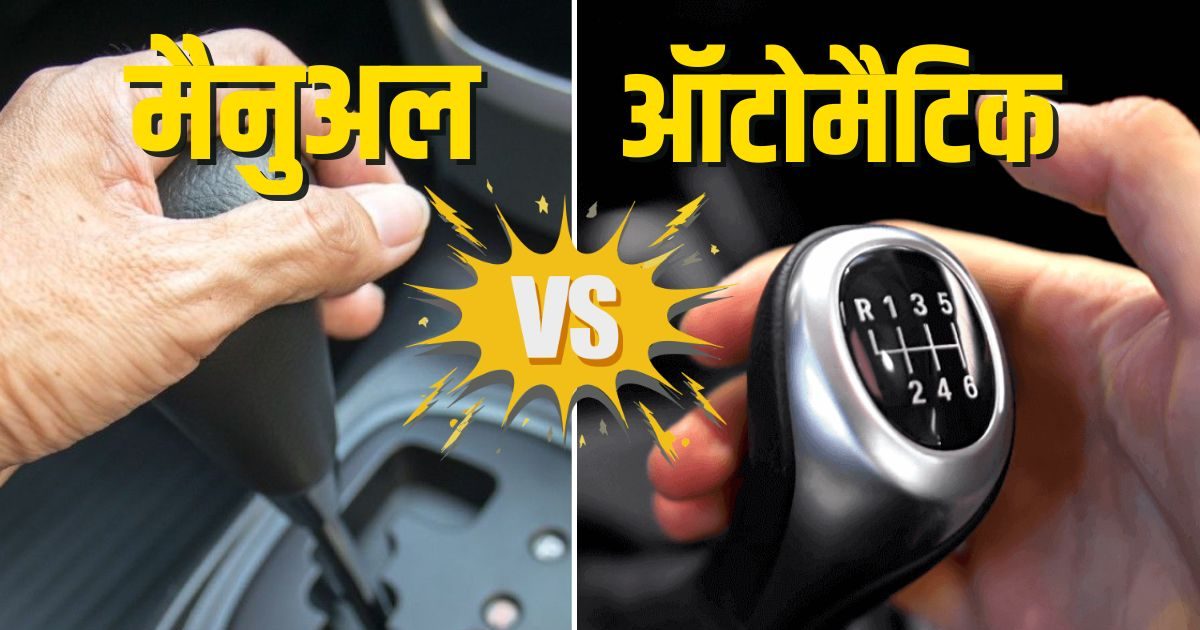
Manual vs Automatic Car: The decision to buy a car has always been a dilemma between heart and mind, especially when it comes to choosing between manual and automatic transmission. It is very important to know which car will prove to be the wisest deal for you for daily commute. The increasing traffic and heavy jams on Indian roads have made this debate even more interesting.
While manual cars are known for their excellent mileage and low starting price, automatic cars provide unmatched comfort in bumper-to-bumper traffic by freeing the driver from the hassle of changing gears and pressing the clutch. In this article, we will understand the complete mathematics of expenses and maintenance for 5 years, so that you can take the right decision according to your journey and budget.
What is best for commuting to office?
If your daily route is full of heavy traffic, intersections and red lights, then an automatic car can prove to be a boon for you. Repeatedly pressing the clutch and changing gears while going to and returning from office every day increases fatigue and mental stress in the legs. Automatic car almost eliminates this fatigue.
On the other hand, if your office route passes through expressways or roads with less traffic, where you have to drive at a constant speed, then a manual car will prove to be more economical and fun for you.
5 Year Calculation: Complete Mathematics of Expenses
Let us take the example of a normal hatchback or compact SUV (like Maruti Brezza, Tata Nexon or Hyundai i20) whose daily commute to office is around 40 kms. If the vehicle is driven 300 days in a year, this distance will become 12,000 kilometers annually and 60,000 kilometers in 5 years. The figures will be something like this-
Opening price difference: Generally, the price difference between manual and automatic variants (especially torque converter or DCT) of the same model ranges from ₹ 1,00,000 to ₹ 1,500,000 (in AMT this difference can be up to ₹ 50,000).
Fuel consumption (manual): Average mileage of 15 km/l in traffic. 4,000 liters of petrol for 60,000 km. At the rate of ₹100/litre, the cost will be ₹4,00,000.
Fuel consumption (automatic): Slightly less in traffic, i.e. mileage of 13 km/litre. 4,615 liters of petrol for 60,000 km. At the rate of ₹100/litre, the cost will be ₹4,61,500.
Maintenance and Clutch Replacement: In manual cars, due to heavy traffic, the clutch plate may have to be replaced at least once within 5 years or 60,000 km, which costs ₹10,000 to ₹15,000. Gearbox oil and maintenance of automatic (especially CVT/DCT) is a bit expensive.
Manual vs Automatic: 5 Year Cost Comparison
| Cost Mode (5 years/60,000 km) | manual car | automatic car |
|---|---|---|
| Starting ex-showroom price (estimated) | ₹8,50,000 | ₹9,70,000 |
| Total fuel cost | ₹4,00,000 | ₹4,61,500 |
| Service and maintenance expenses | ₹40,000 | ₹50,000 |
| Clutch/Gearbox Parts Replacement | ₹12,000 (clutch plate) | ₹0 (in general use) |
| Price + 5 years running cost | ₹13,02,000 | ₹14,81,500 |
Which makes more sense to buy?
It is clear from the above calculation that in a period of 5 years, an automatic car can become costlier by about ₹ 1.80 lakh compared to a manual car. If your budget is limited, you want complete control over the vehicle and there is less traffic on the way to your office, then it would be better to buy a manual car.
However, if you spend 1-2 hours every day in heavy traffic in metros like Delhi-NCR, Mumbai or Bengaluru, then automatic is a better option. The additional expenditure of Rs 1.80 lakh over 5 years (i.e. around Rs 3,000 per month) is a small price to pay for your knee pain, peace of mind and a comfortable journey. For the daily office commute, an automatic makes real sense.