
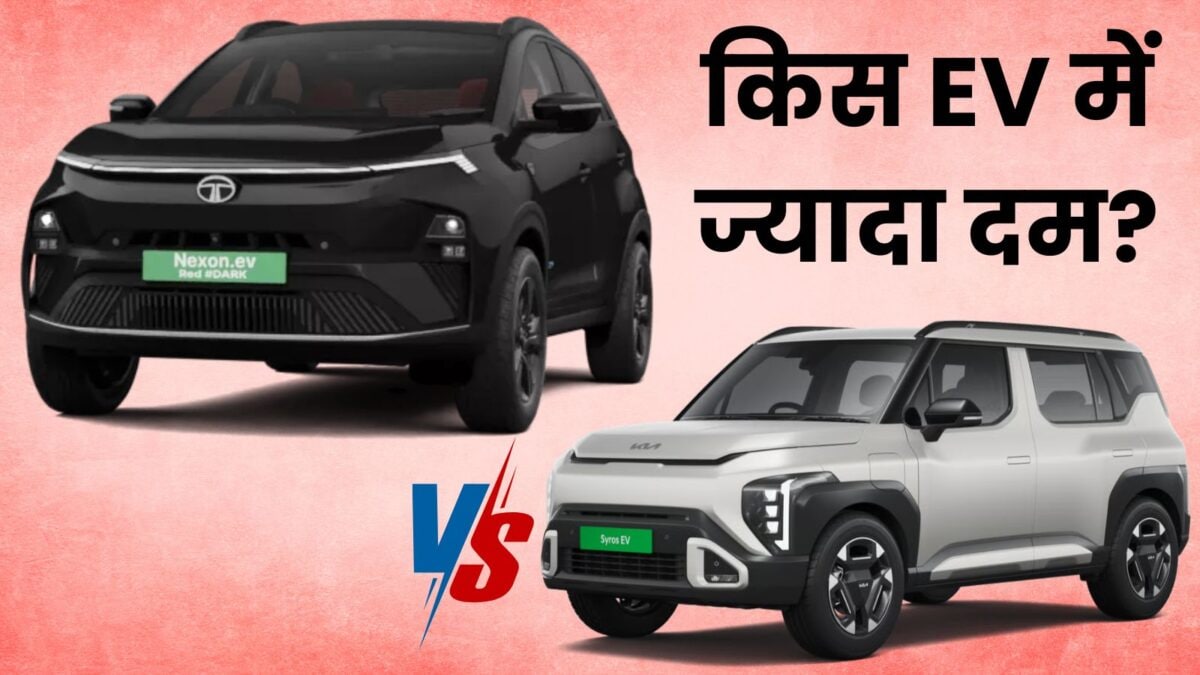
Kia Syros EV vs Tata Nexon EV: Which electric SUV is right to buy? Know

Kia Syros EV vs Tata Nexon EV: Which electric SUV is right to buy? Know

Kia Syros EV vs Tata Nexon EV: There is strong competition in the Indian EV market. The recently launched Kia Syros EV and the popular Tata Nexon EV are giving tough competition to each other in the sub-compact electric SUV segment. Both the cars come with stylish design, modern features and good range, which are suitable for city driving and highway trips.

Ex-showroom price of Cyros EV starts at ₹13.49 lakh and ex-showroom price of Nexon EV starts at ₹12.49 lakh. The Cyros EV comes with two battery options (42 kWh and 51.4 kWh), while the Nexon EV has 30 kWh and 45 kWh packs available. Cyros EV can be made even more affordable with BaaS (Battery as a Service). Let's take a look at the details of both of them, from design to powertrain.

Design and interior

The Kia Syros EV has bold, boxy and EV-specific styling. It can be purchased with LED lights, closed grill and sleek profile. It looks slightly longer and taller than the Nexon EV. The design of Tata Nexon EV is muscular and modern, with connected LED lights and attractive alloy wheels. Both offer a premium look on the road, but the stance of the Cyros EV seems more family-oriented.

The cabin of Cyros EV is spacious and premium. It has a 30-inch panoramic Trinity display (dual 12.3-inch screen), panoramic sunroof, ventilated seats, ambient lighting and Harman Kardon sound system. The Nexon EV also has good space, a 12.3-inch touchscreen, JBL sound and ventilated seats, but the cabin of the Cyros EV feels more luxurious and modern.

Features and safety

Both have wireless charging, 360° camera, wireless Android Auto/Apple CarPlay and connected tech. The Cyros EV comes with Level-2 ADAS, V2L/V2V charging and a larger display in the higher variants. ADAS is also available in the Nexon EV, but the feature list of the Cyros EV seems a bit richer.

The Tata Nexon EV's 5-star BNCAP rating is its strong point, along with 6 airbags, ESP and strong structure. Cyros EV also comes with 5-star safety package, 6 airbags, 360° camera and level-2 ADAS. Both are safe options for the family.

Battery, Motor and Range

The Cyros EV's 51.4 kWh battery pack delivers 526 km range (ARAI) and the 171 hp / 255 Nm motor. The 42 kWh variant produces 135 hp with a range of 443 km. It has 100 kW DC fast charging support.

The Nexon EV's 45 kWh pack delivers 489 km range and 142 hp / 215 Nm (30 kWh: 275 km). Charging is a little slow. Syros EV is ahead in range and power. According to your budget and needs, you can choose any one of these electric SUVs.


Source link

Petrol vs EV: Which car is best for daily office commuting? Understand with 5 year calculation

Petrol vs EV: Which car is best for daily office commuting? Understand with 5 year calculation

Petrol vs Electric Car: Choosing the right car for daily commute is a big decision for every working person. While petrol prices in the country remain around ₹ 100 per litre, on the other hand, electric vehicles (EVs) are attracting everyone's attention with their promise of low running costs. But is buying an EV really beneficial for everyone?

To solve this dilemma, we will understand the complete mathematics of the next 5 years by taking the example of India's most popular compact SUV Tata Nexon and Tata Nexon EV. From this calculation it will become clear to you that which car will be best according to your budget and needs for going to office daily?

Petrol Car vs EV: Daily expense of going to office

Let us assume that your car travels 40 kilometers daily, including the distance from your home to office and weekend travel. According to this, the monthly running of your vehicle will be around 1,200 kilometers and the annual running will be 14,400 kilometers. In 5 years your car will travel a total of 72,000 kilometers.

Tata Nexon Petrol: Its starting on-road price in Delhi starts from around ₹ 8.5 lakh. It gives a mileage of around 14 km/litre in the city. At the rate of ₹100 per liter of petrol, your expenditure on fuel alone in 5 years will be ₹5,14,285.

Tata Nexon EV: The on-road price of its base variant is around ₹ 13.2 lakh. On home charging at the rate of ₹ 8 per unit, this car runs at ₹ 1.1 to ₹ 1.4 per kilometer. In this way, the total cost of charging in 5 years will be only between ₹ 80,000 to ₹ 1,00,000.

5 Year Total Cost of Ownership (TCO)

When buying an EV, you have to pay around ₹4 to ₹4.5 lakh more, which is called 'green premium'. Let us see what is the total cost of ownership including 5 years of service, insurance and fuel/charging-

Type of expenditure (5 year estimate) Tata Nexon Tata Nexon EV
Starting On-Road Price (Approx) ₹8,50,000 ₹13,20,000
Fuel/Charging Cost (72,000 km) ₹5,14,285 ₹96,000
Maintenance and service expenses (5 years) ₹60,000 ₹25,000
Insurance (5 years cumulative) ₹90,000 ₹1,25,000
Total Cost (5 Year TCO) ₹15,14,285 ₹15,66,000

Which car will be best for you?

It is clear from the calculation that if your running is 40 kilometers daily (14,000 km annually), then by the completion of 5 years the total cost of petrol and electric car becomes almost equal.

Electric car is best when: If your daily commute to office is more than 50 kilometers. In this situation, the EV will recover its extra cost (Break-even) in just 3.5 to 4 years and after that your huge savings will start. Also, one can enjoy silent and smooth driving without changing gears in bumper-to-bumper traffic.

Petrol car is best when: If your daily running is less than 20-30 kilometers. In such a situation, it will take 7-8 years to recover the increased price of EV, which will be a loss-making deal. Apart from this, if there is no space for charging setup in your apartment, then petrol car is the most practical option for you.

Source link

Panoramic sunroof, adas! Tata Nexon launched in new avatar, 5 star safety

Panoramic sunroof, adas! Tata Nexon launched in new avatar, 5 star safety

New Delhi. Tata Motors' passenger vehicles are considered the most safe in the market and the Nexon range is one of them. Both versions of Nexon, ie Ice and Battery-Powered variant, are one of the most safe cars available for sale in India, whose built quality is excellent. Both variants of this subcompact SUV have achieved 5-star safety ratings in Global Encap and India Encap.

Big upgrade
Another important upgrade has been made in Tata Nexon EV regarding safety. The Battery-Paward Subcontor Crossover now comes with the Advanced Driver Assistance System (ADAS). This Adas package has been introduced with a 45 kWh battery pack as part of the new Empowered A+ Trim, priced at Rs 17.29 lakh (ex-showroom).

Semi-automatic safety features

The ADAS package includes semi-automatic safety features such as traffic sign recognition, lane centering system, lane departure warning, lane keep assist, forward collision warning (pedestrian/cyclist/car), Autonomous Emergency Breaking (pedestrian/cyclist/car). Apart from Adas, Tata Motors also added some convenient features to this new trim such as rear window Sunshade and ambient lighting.

Tata Nexon EV Dark Edition: What's new?
The most important thing is that this new Empowered A+ trim with 45 kWh battery pack is also available in dark edition derivatives. The new Nexon EV Dark and Red Dark Trims are priced at Rs 17.49 lakh (ex-showroom), which is Rs 20,000 more than the concerned Empowered A+ Trim. Like all other dark edition models in the Tata Motors lineup, Nexon EV Dark has been introduced with black exterior paint and all-black interiors.

Dhansu features

The features offered in the Nexon EV Dark Edition with panoramic sunroof, vehicle to vehicle (V2V) charging, vehicle to load (V2L) technology, 12.3-inch hormon TM Tchscreen Infotainment System and 10.25-inch Instrument for Cluster, Executive UIX, RERERS VINSDE, RERESH VIX, And ambient lighting includes.

Tata Nexon EV45: Paurtrain
The Nexon EV45 has a 45 kwh battery which claims a range of 489 km once charged. However, its range in real world is about 350–370 km. This battery sends energy to the electric motor running the front wheels that generates 143 bhp and 215 Nm peak torque. Using 120 kw DC fast charger, the battery can be charged in 20 to 80 percent in 40 minutes. In other words, the 150 km range can be topped up in just 15 minutes using DC fast charger.

Source link