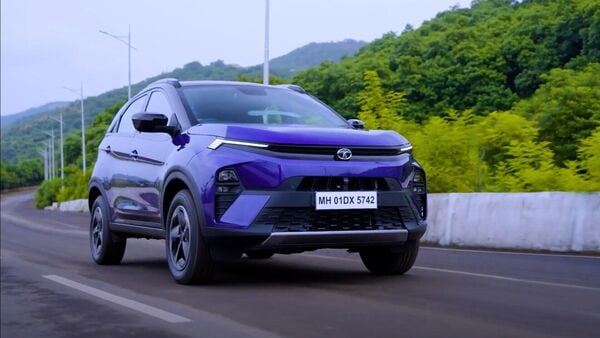
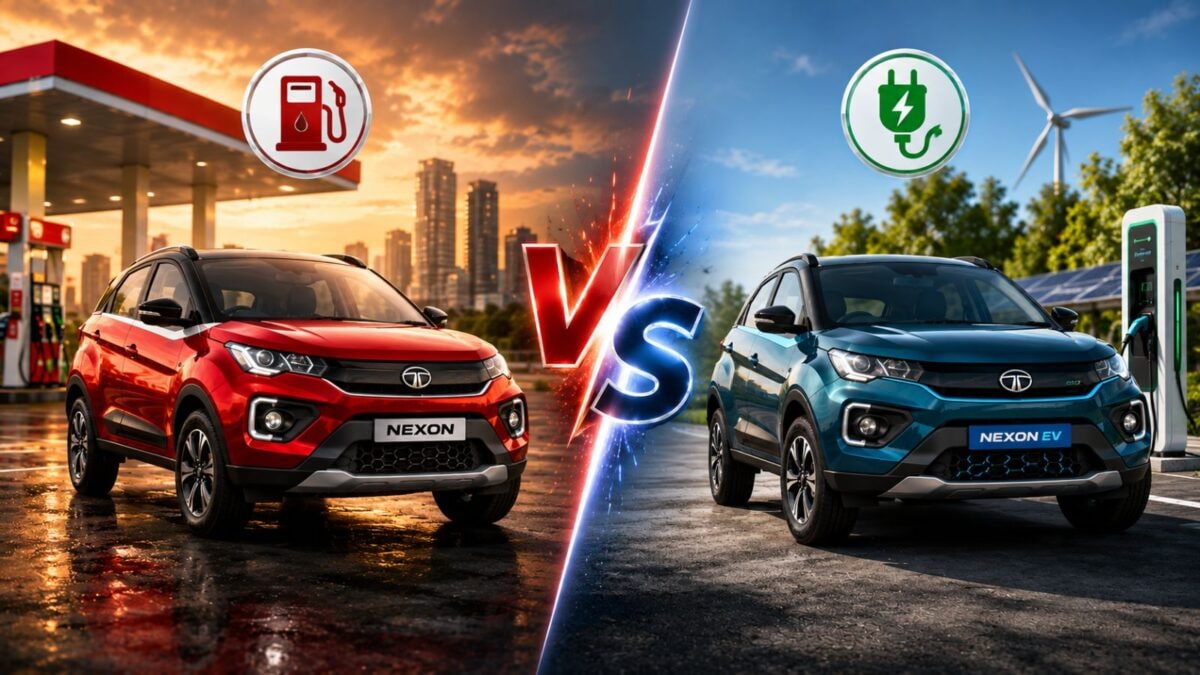
Petrol vs Electric Car: Choosing the right car for daily commute is a big decision for every working person. While petrol prices in the country remain around ₹ 100 per litre, on the other hand, electric vehicles (EVs) are attracting everyone's attention with their promise of low running costs. But is buying an EV really beneficial for everyone?
To solve this dilemma, we will understand the complete mathematics of the next 5 years by taking the example of India's most popular compact SUV Tata Nexon and Tata Nexon EV. From this calculation it will become clear to you that which car will be best according to your budget and needs for going to office daily?
Petrol Car vs EV: Daily expense of going to office
Let us assume that your car travels 40 kilometers daily, including the distance from your home to office and weekend travel. According to this, the monthly running of your vehicle will be around 1,200 kilometers and the annual running will be 14,400 kilometers. In 5 years your car will travel a total of 72,000 kilometers.
Tata Nexon Petrol: Its starting on-road price in Delhi starts from around ₹ 8.5 lakh. It gives a mileage of around 14 km/litre in the city. At the rate of ₹100 per liter of petrol, your expenditure on fuel alone in 5 years will be ₹5,14,285.
Tata Nexon EV: The on-road price of its base variant is around ₹ 13.2 lakh. On home charging at the rate of ₹ 8 per unit, this car runs at ₹ 1.1 to ₹ 1.4 per kilometer. In this way, the total cost of charging in 5 years will be only between ₹ 80,000 to ₹ 1,00,000.
5 Year Total Cost of Ownership (TCO)
When buying an EV, you have to pay around ₹4 to ₹4.5 lakh more, which is called 'green premium'. Let us see what is the total cost of ownership including 5 years of service, insurance and fuel/charging-
| Type of expenditure (5 year estimate) | Tata Nexon | Tata Nexon EV |
|---|---|---|
| Starting On-Road Price (Approx) | ₹8,50,000 | ₹13,20,000 |
| Fuel/Charging Cost (72,000 km) | ₹5,14,285 | ₹96,000 |
| Maintenance and service expenses (5 years) | ₹60,000 | ₹25,000 |
| Insurance (5 years cumulative) | ₹90,000 | ₹1,25,000 |
| Total Cost (5 Year TCO) | ₹15,14,285 | ₹15,66,000 |
Which car will be best for you?
It is clear from the calculation that if your running is 40 kilometers daily (14,000 km annually), then by the completion of 5 years the total cost of petrol and electric car becomes almost equal.
Electric car is best when: If your daily commute to office is more than 50 kilometers. In this situation, the EV will recover its extra cost (Break-even) in just 3.5 to 4 years and after that your huge savings will start. Also, one can enjoy silent and smooth driving without changing gears in bumper-to-bumper traffic.
Petrol car is best when: If your daily running is less than 20-30 kilometers. In such a situation, it will take 7-8 years to recover the increased price of EV, which will be a loss-making deal. Apart from this, if there is no space for charging setup in your apartment, then petrol car is the most practical option for you.