
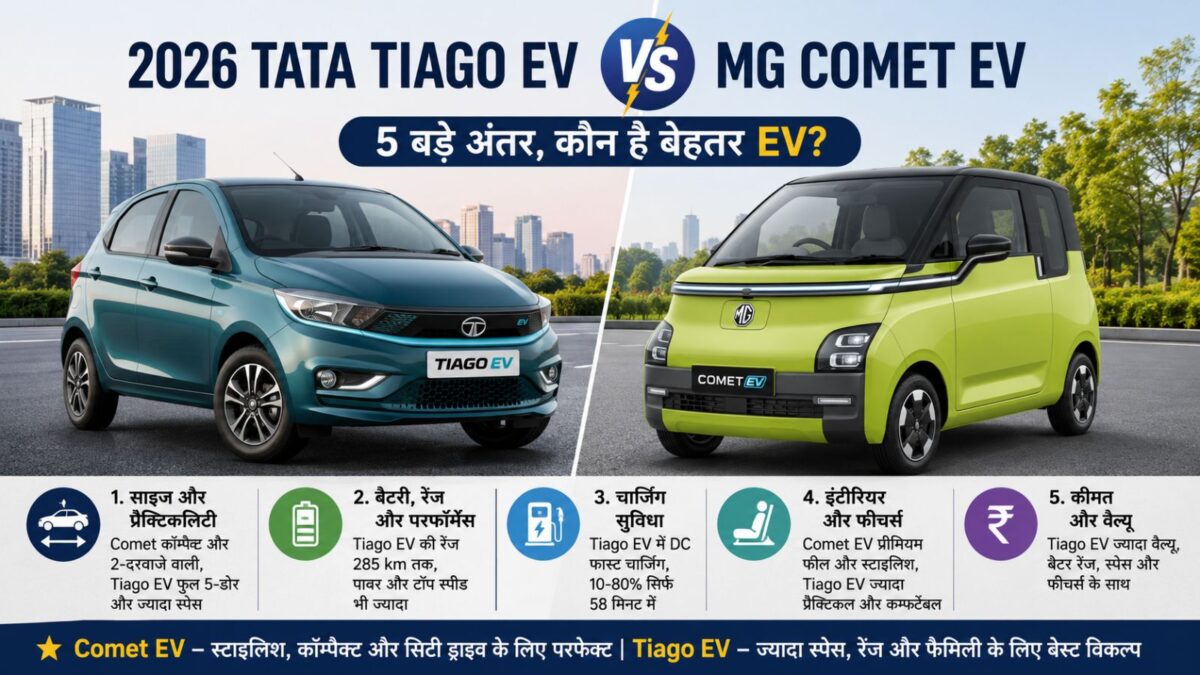
These are the 5 big differences between Tata Tiago EV and MG Comet EV! Know before you buy

These are the 5 big differences between Tata Tiago EV and MG Comet EV! Know before you buy

MG Comet EV and Tata Tiago EV are two popular and affordable electric cars in the Indian market, which are mainly designed for city driving. The MG Comet EV is a compact, stylish and premium-feeling two-door car, while the Tata Tiago EV is a conventional five-door hatchback with an emphasis on practicality. There is a lot of difference in size, performance, range and features between both the EVs.

Comet EV is better for those who want easy parking and premium cabin for small family or solo use. Whereas Tiago EV is more suitable for those users who need more space, better range and longer drive. Both are competitive in terms of price. Starting ex-showroom prices for the Comet EV start at around ₹7.50 lakh, while the Tiago EV can be purchased from ₹6.99 lakh. With BaaS, the price of both comes down to less than ₹5 lakh. Come, let us know about 5 big differences between these two.

1. Size and practicality

The MG Comet EV is quite compact (length approximately 2974 mm) and has only two doors, which makes it easy to maneuver and park in the city. But rear seat access is difficult and space is limited. Tata Tiago EV, on the other hand, is a full five-door hatchback (length 3769 mm) that can comfortably seat four-five people, offers better rear leg room and a larger boot space. Tiago EV is more family-friendly and practical for everyday use.

2. Battery, Range and Performance

The MG Comet EV has a 17.3 kWh battery, which gives an ARAI-claimed 230 km range. Tata Tiago EV comes in two options (19.2 kWh or 24 kWh), with the long range variant offering a range of up to 285 km. The Tiago EV is more powerful (60-75 bhp), offers faster acceleration (0-60 kmph ~5.5 seconds) and a top speed of 120 kmph, while the Comet EV is less powerful (41 bhp) and limited to around 100 kmph. Tiago EV is better for long drives.

3. Charging facility

MG Comet EV supports only AC charging and it can be fully charged in 7 hours. Tata Tiago EV can be charged from 10-80% in just 58 minutes with DC fast charging. This is very useful for emergencies or inter-city trips. The charging flexibility of Tiago EV makes it more versatile.

4. Interior and Features

The cabin of Comet EV is very premium. Dual 10.25-inch screens, rotary gear knob and modern looks. The interior of the Tiago EV is simple but functional, with good storage, auto headlamps and other practical features. Comet EV is better for style, Tiago EV is better for comfort and usability.

5. Price and Value

Comet EV may be a little expensive, but gives a premium feel. Tiago EV offers better value. It can be purchased with more space, range, fast charging and safety features. Overall, the Tiago EV is the more practical option, while the Comet EV is a unique and fun-to-drive city car.
Source link

Spend less, save more! Which car to choose between Tiago iCNG and EV? know this

Spend less, save more! Which car to choose between Tiago iCNG and EV? know this

Last Updated:

Planning to buy Tata Tiago, but confused between iCNG, EV BaaS and EV Outright? We have made a complete calculation of all three options on the basis of price, running cost, long journeys, charging and savings. Know which Tiago will prove to be the most profitable deal as per your driving needs and budget.

news quickly

Zoom

Which is better between Tiago iCNG and Tiago.ev? Know

In the Indian automotive market, Tata Tiago has become the hatchback that offers the maximum fuel options to the customers. If you are looking for an eco-friendly and low running cost alternative to petrol, then you have two of the strongest contenders for the Tiago: Tiago iCNG and Tiago.ev (Electric).

After the recent 2026 facelift update, many major changes have been seen in both these vehicles, due to which choosing the right option has become even more interesting. Which Tiago will be best for you depends entirely on your daily driving, budget and the infrastructure (charging and CNG stations) in your area. Let's make it simple based on price and utility.

Price and Variants (Ex-Showroom)

Tata has kept the prices of Tiago range very competitive. Especially in the EV model, the option of BaaS has also been added, which has reduced its initial price considerably. See-

Model / Variant Starting Price (Ex-S) Note/Additional Expenses
Tiago iCNG Starting from ₹5.79 lakh Top variant ₹8.55 lakh
Tiago.ev (with BaaS) Starting from ₹4.69 lakh ₹2.6/KM Battery Rent
Tiago.ev (outright with battery) Starting from ₹6.99 lakh Top variant ₹9.99 lakh

Who is Tiago iCNG best for?

Tiago CNG may be better for those who have a lot of running and want to cover long distances without stopping. These factors make Tiago CNG special-

  • Long distance trips: If you frequently go out of town on weekends or plan long highway trips, CNG is most practical for you. You do not have to worry about stopping for charging (Range Anxiety).
  • Twin-cylinder technology and boot space: Tata's patented twin-cylinder technology allows the CNG cylinders to be fitted low, giving you a generous boot space for a hatchback.
  • Option of Automatic: In Tiago CNG you get the option of manual as well as AMT (automatic), which makes driving in heavy traffic very easy.
  • Infrastructure: If there are no long lines of CNG stations in your city or route, then it directly reduces your pocket money to half compared to petrol.

Who is Tiago.ev (with BaaS) best for?

Tiago EV is for those who want to enjoy an electric car in a low budget and whose daily running is limited (20-40 km). These factors make Tiago EV (BaaS) special-

  • Low starting budget: If your budget is around ₹5-6 lakh and you want to enjoy the silent and premium drive of an EV at the same price as a petrol car, then BaaS is the best. This has directly reduced the starting price of the vehicle by ₹2.30 lakh.
  • Limited Monthly Running: This model is perfect for those who run only 800 to 1000 kilometers in a month. Due to low running, the subscription charge of ₹ 2.6 per kilometer is not heavy on your pocket.
  • Easy Finance and Resale: Low initial cost reduces the loan amount, thereby reducing your monthly car EMI.

Who is Tiago.ev (outright with battery) best for?

This is suitable for those whose daily running is fixed and high (like 80-100 km daily) and who want to avoid repeated subscriptions. These factors make Tiago EV special-

  • Heavy urban commute (Daily High Mileage): If you live in big cities like Delhi-NCR, Mumbai or Bengaluru and the distance from home to office is very long, then an EV without subscription is better for you.
  • Highest savings in the long run: Even if you are paying ₹6.99 lakh or more initially, if your vehicle is going to drive more than 80,000 kms in 5-6 years, the outright model makes the most economic sense. After this you do not have to pay any additional fee per kilometer.
  • Charging facility at home: If you have your own personal parking space and charging point at home or office, you will not have to depend on any commercial charger outside and the running cost will be only ₹1 to ₹1.5 per kilometer.
  • Excellent performance and warranty: The 2026 updated model comes with a larger 24 kWh battery along with lifetime unlimited kilometer battery warranty, which leaves you completely worry-free.

About the Author

authoring

Ram Mohan MishraSenior Sub Editor

Ram Mohan Mishra, working as Senior Sub-Editor at News18 Hindi, is active in digital media since 2021 and is currently handling the Auto Desk. They provide car and bike related information in an easy, clear and reliable manner.read more


Source link