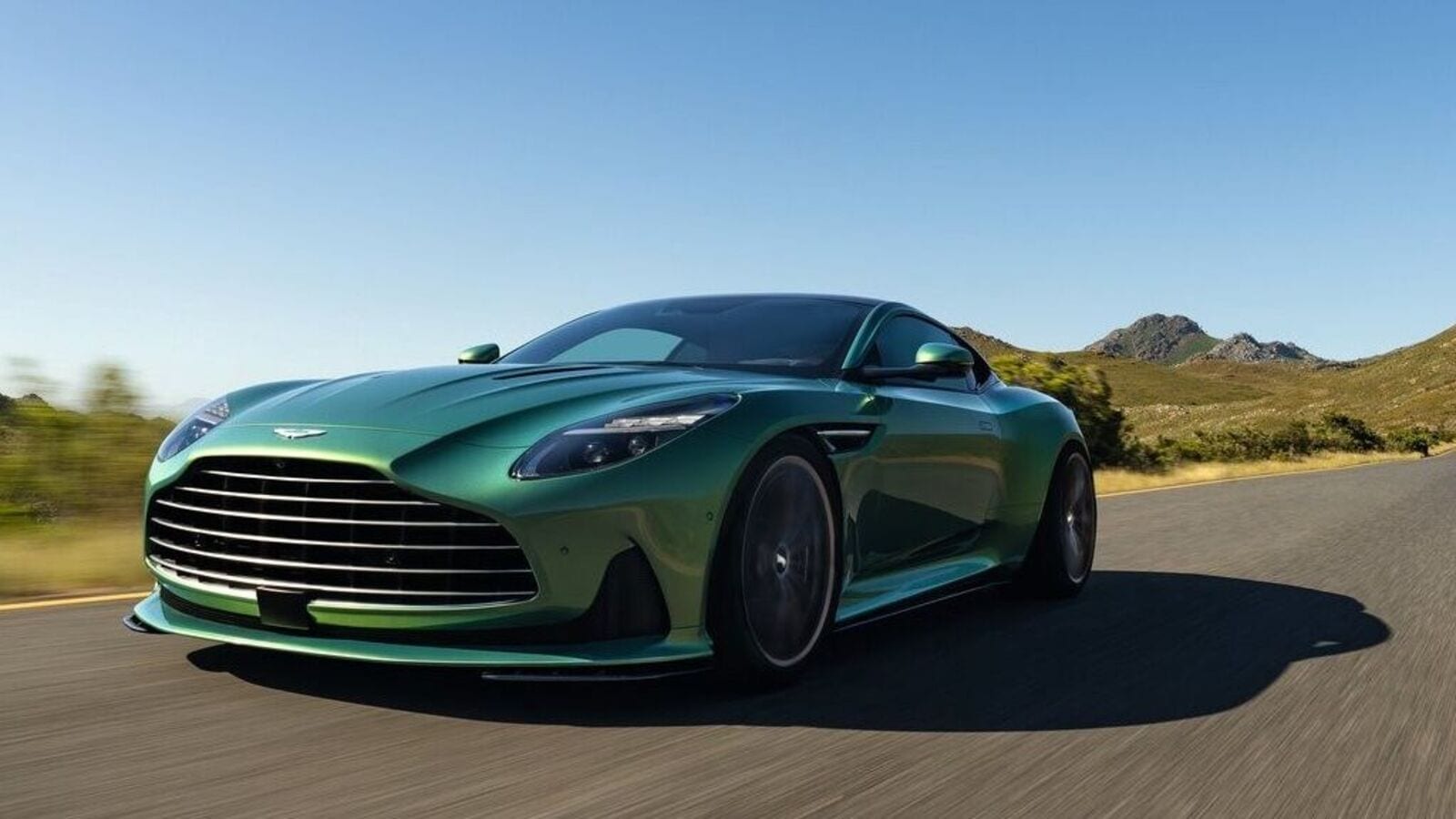
Aston Martin DB12 with 670 bhp to launch on 29th September

Aston Martin DB12 with 670 bhp to launch on 29th September

Aston Martin’s DB12 will be making its India debut on 29th September. The launch event will happen at the British High Commission in New Delhi. Aston Martin DB12 will be priced at 4.80 crore ex-showroom and deliveries will start from Q3 of 2024. It is important to note that this price is before any options. Speaking of options, Aston Martin is offering loads of personalization options through its ‘Q’ customisation programme so expect the price to shoot up quite easily.

By: Paarth Khatri
| Updated on: 05 Sep 2023, 16:57 PM

Aston Martin DB12 borrows its engine from Mercedes-AMG.

Powering the DB12 is a 4.0-litre V8 that has been twin-turbocharged. That figure seems familiar because the engine is derived from Mercedes-AMG. However, Aston Martin is running their tune on it because of which the power output is boosted to 670 bhp and the peak torque output stands at 800 Nm. 0-100 kmph comes up in claimed 3.6 seconds and the top speed is rated at 325 kmph.

The gearbox on duty is an 8-speed unit that transfers the power to the rear wheels only. To handle all that power, a new electronic rear differential has been placed. Unlike a conventional Limited Slip Differential, it can go from fully open to 100% locked in a matter of milliseconds.

The final drive ratio has been shortened for better in-gear acceleration and the transmission has been re-calibrated as well to reduce shift speeds and increase shift characteristics. Aston Martin DB12’s bonded aluminium structure has seen a 7 per cent increase in global torsional stiffness thanks to changes to a range of underbody components.

Also Read : Aston Martin DB12 Volante convertible breaks cover

The adaptive dampers on the grand tourer are also new and the anti-roll bars are stiffer. Aston Martin has given special attention to the steering inputs so that they are sharper and still provide good feedback to the driver. The DB12 is fitted with cast-iron 400 mm front discs and 360 mm rear discs. The brake booster has also been re-tuned to improve pedal feedback.

First Published Date: 05 Sep 2023, 16:57 PM IST


Source link

Volkswagen ID. GTI concept at Munich Motor show, design, features, specs, Volkswagen Golf GTI

Volkswagen ID. GTI concept at Munich Motor show, design, features, specs, Volkswagen Golf GTI

With the ID. GTI concept car, Volkswagen aims to infuse a high-performance touch to its ambitious all-electric vision.

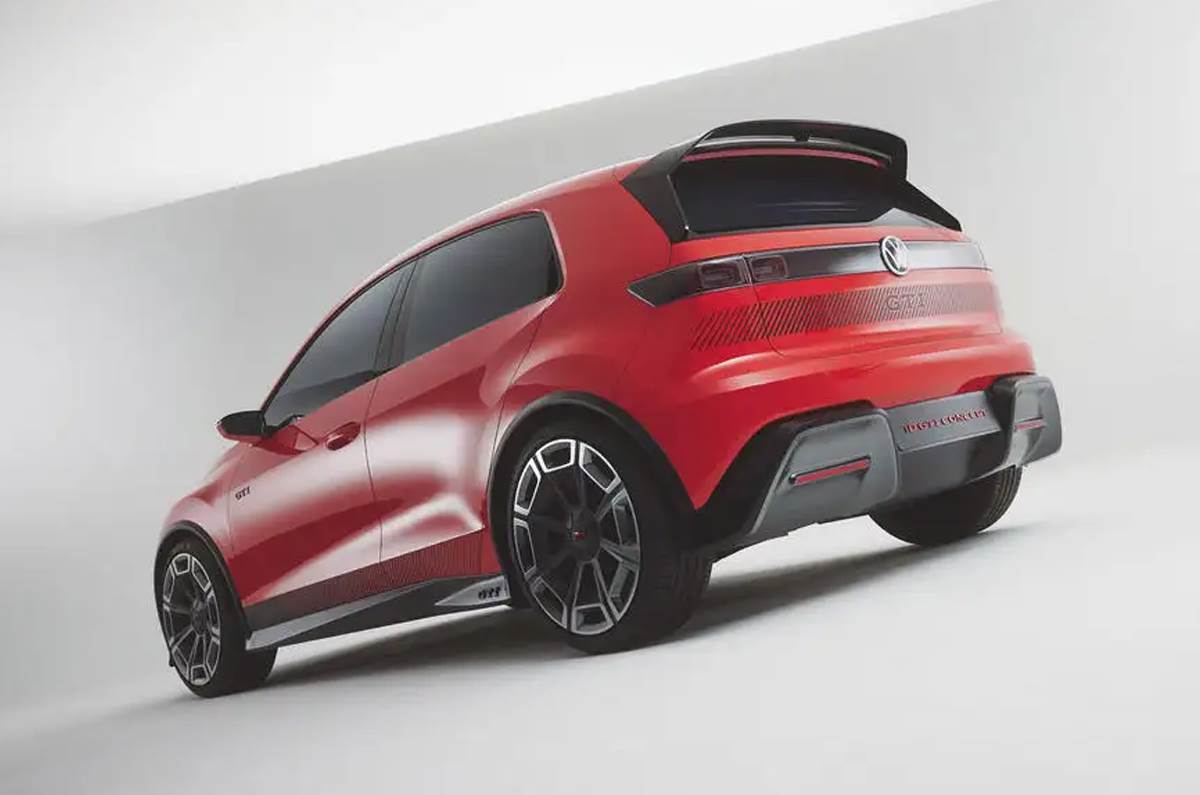
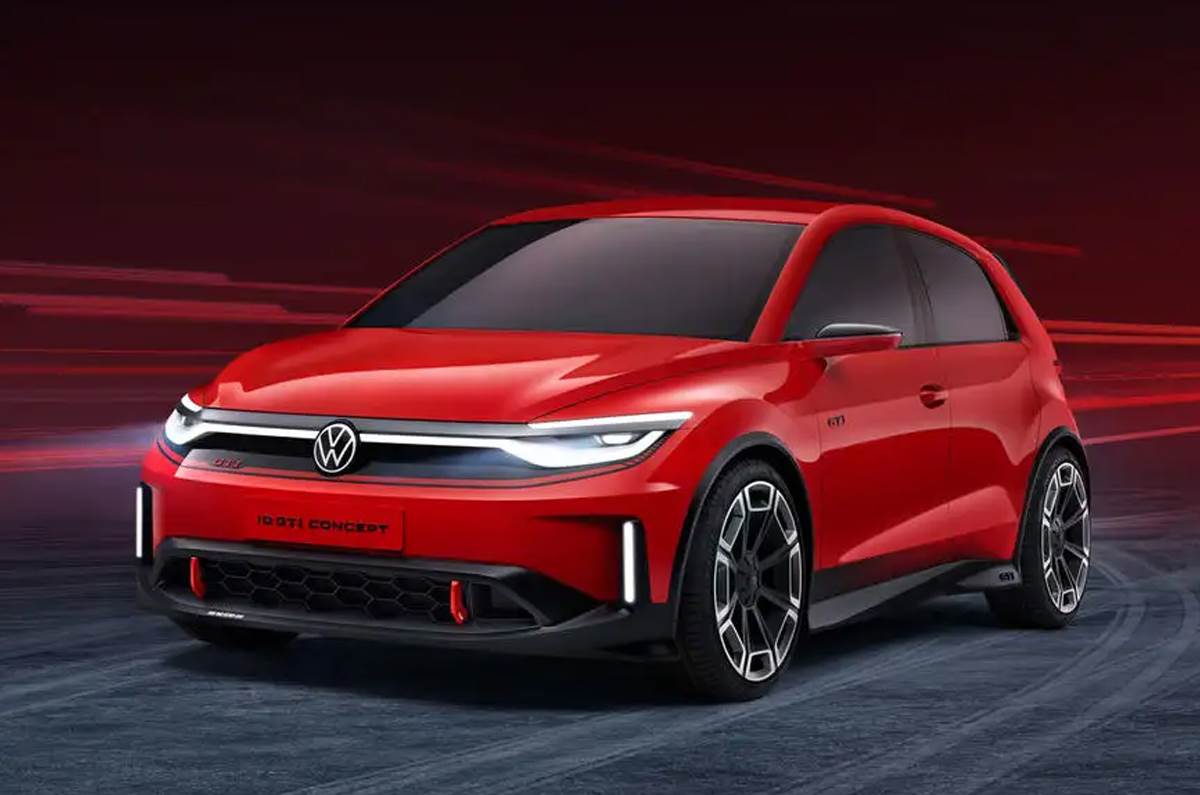
The Volkswagen ID. GTI concept car has been revealed at the ongoing Munich motor show. Based on the Volkswagen born-EV MEB platform, the VW ID. GTI concept aims to leverage the popularity of the GTI brand as a part of its all-electric vision in the future. This concept will materialize into a hot hatch variant of the upcoming ID 2 hatchback, while harking back to the original Golf GTI from half a century ago.

  • ID. GTI concept points at future sporty EV hatch
  • Intelligence replaces Injection in the GTI acronym
  • VW plans to introduce 11 new all-electric vehicles by 2027

VW ID. GTI concept: what is it?

With the ID. GTI concept, Volkswagen plans to revive the GTI brand for performance-focused electric vehicles. “The perfect combination of driving pleasure and everyday usability – that is what the three letters GTI have meant for decades,” said Thomas Schäfer, CEO of Volkswagen Passenger Cars. There is, however, a slight update to the GTI branding; the ‘I’ previously stood for ‘injection’, but  will now stand for ‘intelligence’. Schäfer said the production version of the ID GTI would be revealed in 2026 and be on sale in early 2027. 

VW ID. GTI concept underpinnings

The basis for the ID GTI is the same shortened version of Volkswagen’s existing MEB platform as the standard ID 2, dubbed MEB Entry. It houses a front-mounted electric motor and what Volkswagen describes as a “large” battery – likely the larger 56kWh pack that will be available in the ID 2. As with the original Golf and its GTI sibling, the standard and hot ID 2 share the same body-in-white. Technical details are yet to be made public. However, the development of the ID GTI has been twinned with the range-topping version of the upcoming Cupra Raval, which is claimed to develop up to 229hp with a range of up to 440km. 

VW ID. GTI concept design

Inspired by the simplistic Giugiaro styling of the original Golf, the new concept has been imbued with a number of classic GTI design touches. Among the bespoke features is a deeper front bumper with pronounced air curtains and vertically stacked LED daytime driving lights on either side. The lower section houses a contrasting black air duct with honeycomb-shaped detailing and red-coloured tow hooks.

The VW badge is also illuminated in white for a striking look at night, while the headlights themselves get the firm’s IQ Light matrix technology. Plastic cladding bulks out the wheel arches, which accommodate retro-look 20-inch wheels of a double eight-spoke design, while prominent sills feature GTI logos underneath the doors – all in black.

There’s a chunky new spoiler at the rear for added downforce and high-speed stability, bespoke 3D light graphics, a badge illuminated in red, prominent GTI graphics and a black valance within the lower section of the bumper. At 4104mm long, 1840mm wide and 1499mm tall, the most powerful of Volkswagen’s planned ID 2 variants is slightly larger than today’s petrol-engined Polo GTI.

VW ID. GTI concept interior and features

Traditional GTI design elements continue inside with a three-spoke steering wheel featuring a red 12 o’clock marker, chequered “Jack-e” upholstery for the seats and a golfball-shaped rotary dial for the infotainment. The 10.9-inch digital display can also be configured in ‘analogue’ mode, which closely resembles the gauge cluster of the Mk1 Golf GTI.

The larger 12.9-inch central touchscreen infotainment screen also offers varying themes with links to the past. Among the more conceptual touches is a red LED pulse sensor incorporated within the backrest of the driver’s seat.

Like the standard ID 2, the ID GTI can accommodate up to five people. Boot space is put at 490 litres, with up to 1330 litres available when the rear seat is folded down. An additional 50-litre lockable stowage compartment underneath the rear seat is conceived to house the charging cable and other items.

VW ID. EVs India launch plans

About a year ago, the VW ID.4 GTX had been spied on test in the country, but there has been no word on when it’ll arrive at a Volkswagen showroom near you. Just before the model had been spied testing, we had reported that test mules would be seen from August 2022 onwards, indicating a launch late this year or early in 2024. However, VW India has yet to provide any specific details on when the Volkswagen ID.4 will launch in India, or whether it’ll be the GTX variant or the standard model.

Also See:

New Mini Cooper EV India launch in Q3 2024


Source link

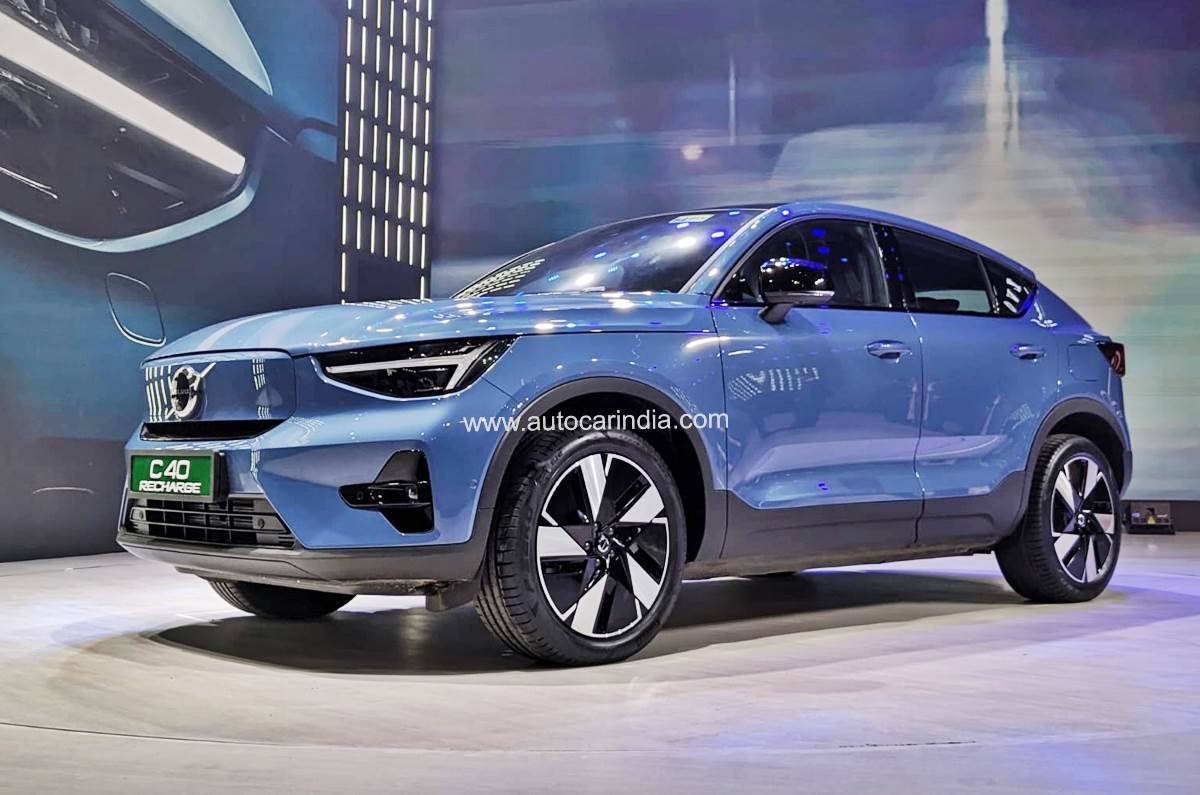
Volvo C40 Recharge launched in India at ₹61.25 lakh

Volvo C40 Recharge launched in India at ₹61.25 lakh

Volvo India on Monday launched the much-awaited C40 Recharge at 61.25 lakh (introductory, ex-showroom). It comes as the second all-electric car in the country from the Swedish luxury car brand after the XC40 Recharge. The Volvo C40 Recharge comes challenging the rivals like Kia EV6 and Hyundai Ioniq 5 among others. Besides the rivals from other brands, the new EV is expected to dent the sales numbers of its sibling XC40 Recharge as well. Also, this EV comes strengthening the automaker’s position in the Indian electric car market further, where several other players have been introducing their respective products.

Volvo India unveiled the electric car earlier this year on June 14, revealing the design, features and specifications of the C40 Recharge. However, pricing was the mystery that the automaker uncovered today. Delivery of the Volvo C40 Recharge is slated to commence in early September this year. Volvo C40 Recharge is already available in multiple global markets and India now has been added to that list.

By: Mainak Das
| Updated on: 04 Sep 2023, 21:01 PM

The C40 Recharge is the first Volvo EV which has been developed from the ground up.

View all Images

Watch: Volvo C40 Recharge review: Packs a punch with more range

The Volvo C40 Recharge comes carrying signature Volvo design elements. It gets the signature Thor’s Hammer LED headlamps with integrated LED daytime running lights. Being an EV, it gets the closed panel look instead of a conventional front grille. The sleek LED fog lamps and black air intake at the lower bumper are similar to the Volvo XC40 Recharge. Moving to the side profile, the car looks distinctive compared to the XC40 Recharge thanks to its coupe-like sloping roofline instead of the XC40 Recharge’s boxy appearance. The alloy wheels look stylish and sporty, while at the back, the vertically oriented sleek LED taillights enhance the EV’s overall visual appearance.

Volvo C40 Recharge is available in eight different colour options: Black Stone, Fusion Red, Thunder Grey, Fjord Blue, Silver Down and Crystal White, Sage Green, and Onyx Black. Dimensionally, the EV measures 4,440 mm in length, 1,910 mm in width, and 1,591 mm in height.

Inside, the Volvo C40 Recharge packs a nine-inch touchscreen infotainment system complemented by a 12.3-inch digital driver’s display. Other features include heated and ventilated front seats, vegan interiors, dual-zone automatic climate control, a panoramic sunroof, a 360-degree camera, a wireless charger, and an ADAS safety suite.

The India-spec Volvo C40 Recharge EV comes equipped with twin electric motors paired with a 78 kWh lithium-ion battery pack and an AWD drivetrain. The dual electric motors are capable of generating 402 bhp of peak power and 660 Nm of maximum torque. The EV is capable of accelerating 0-100 kmph in 4.7 seconds at a top speed of 180 kmph.

Globally, the EV is available in both rear-wheel drive and all-wheel drive options. The India-spec model promises to run a 530 km range on a single charge. The new Volvo EV is capable of getting topped up from 10 per cent to 80 per cent in 27 minutes using a DC fast charger. Using an 11 kW level 2 charger, the EV takes eight hours to be charged fully.

First Published Date: 04 Sep 2023, 21:01 PM IST


Source link

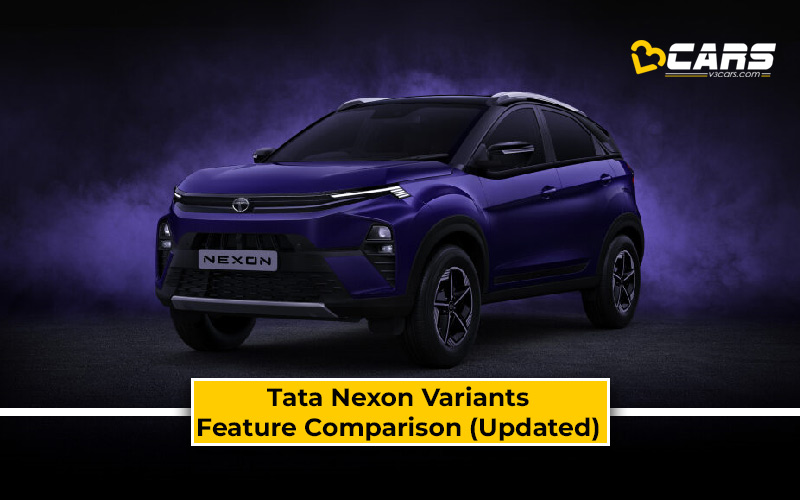
Tata Nexon New Gen Petrol, Diesel Engine Specs, Mileage, Power And Torque

Tata Nexon New Gen Petrol, Diesel Engine Specs, Mileage, Power And Torque

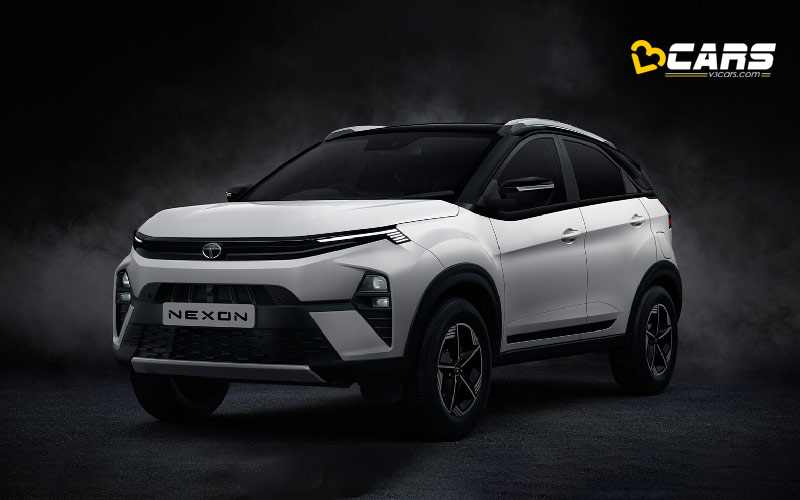
This article will give you details about the engine specs, like displacement, power, torque, mileage and transmission details, of the 2023 Tata Nexon petrol and diesel engine.

Considering the body style, size and price range of the Tata Nexon, it competes with the following cars:

  • Nissan Magnite
  • Renault Kiger
  • Hyundai Venue
  • Kia Sonet
  • Maruti Suzuki Brezza

What Are The Engine Specs Of Tata Nexon 2023?

TATA NEXON NEW GEN | ENGINE SPECS

Engine

1.2L Turbo Petrol

1.5L Turbo Diesel

Displacement

1199cc

1497cc

Cylinder

3

4

Power

120PS @ 5500rpm

110PS @ 4000rpm

Power:Weight

96.77PS/t

83.65PS/t

Torque

170Nm @ 1750 – 4000rpm

260Nm @ 1500 – 2750rpm

Torque:Weight

137.10Nm/t

197.72Nm/t

Manual

5-speed MT / 6-speed MT

6-speed MT

Automatic

6-speed AMT / 7-speed DCT

6-speed AMT

The Tata Nexon New Gen is available with 2 engine options: 1.2L turbo petrol and 1.5L turbo diesel.

The 1.2L turbo petrol engine makes 120PS of power at 5500rpm and 170Nm of torque between 1750rpm and 4000rpm. This engine is available with a 5-speed manual and a 6-speed manual transmission. The 1.2L turbo petrol engine is also with  6-speed AMT and a 7-speed DCT automatic transmission.

The 1.5L turbo diesel engine churns out 110PS of power at 4000rpm and 260Nm of torque between 1500rpm and 2750rpm. The 1.5L turbo diesel engine gets a 6-speed manual and a 6-speed AMT automatic transmission.

What Is The Mileage Or Fuel Efficiency Of 2023 Tata Nexon?

The mileage figures of the 2023 Tata Nexon are not officially available yet. 

10 Tips To Get The Best Mileage From Your Petrol, Diesel Or CNG Car


Source link

Volvo C40 Recharge price, range, specs, features, interior, battery and more

Volvo C40 Recharge price, range, specs, features, interior, battery and more

It costs Rs. 4.35 lakh more than its SUV sibling, the XC40 Recharge.

Volvo has launched the new, all-electric C40 Recharge for an introductory price of Rs 61.25 lakh, ex-showroom, India. The brand will officially commence bookings for the C40 Recharge from September 5, 5pm onwards. Deliveries are set to commence sometime next week.

The C40 Recharge is essentially the XC40 Recharge re-fashioned into an SUV-coupe; the all-electric SUV, Volvo claims, contributed 25 percent to the brand’s total sales in the first half of 2023 (Jan-June 2023). This will be the second EV in Volvo’s India line-up, one with which the brand intends to push its EV penetration to 35 percent by next year. Unlike the XC40 Recharge, which also has a petrol counterpart in India, the C40 is only available in an all-electric guise. 

  1. C40 Recharge has a claimed range of 530km (WLTP cycle)
  2. Interior is completely made of vegan-friendly materials, fabric
  3. Is a coupe-SUV sibling of the XC40 Recharge

Volvo C40 Recharge exterior design

The C40 Recharge looks largely similar to its SUV counterpart, save for its rear where the roofline has a coupe-like finish and a steeply raked rear windscreen. This has led to a redesigned tailgate and tail-lamp assembly – the tail lamps are a lot slimmer, have a wider wraparound effect, and get new reverse lights. The LED light elements are also fragmented towards the top, instead of the continuous strip found on the XC40 Recharge. Unlike the SUV, the LEDs also protrude onto the tailgate and the overall design gives the C40 Recharge a much wider stance when viewed from the rear.

There’s also a new two-part spoiler – one on the boot lid that’s blacked out, and one on the roof with a unique twin-pod design aimed at improving aerodynamics. And while the bumper remains unchanged from the SUV, the rear design of the C40 Recharge looks a lot sportier than the XC40 Recharge. Additionally, the window line has also been slightly redesigned due to the sloping roofline. The C40 Recharge also exclusively gets Pixel LED headlights that you’ll not find in any other Volvo in India, yet.

Elsewhere, the C40 Recharge remains unchanged from its SUV sibling: the headlamps with Thor’s Hammer LED daytime running lamps; the front bumper and hood; the contouring on the doors; and the dual-tone 19-inch alloy wheels. There’s generous plastic cladding on the lower sides to enhance the SUV character, while the rising window line, which kicks up at the rear, plays to the coupe look.

Volvo C40 Recharge interior and features

On the inside, the dashboard design is typically Volvo and, unsurprisingly, is identical to the XC40 Recharge. It continues with a 9.0-inch portrait-style touchscreen flanked by slim AC vents, wood inlays on the dashboard, and a 12.3-inch digital instrument cluster.

As far as equipment is concerned, the C40 Recharge gets an Android-based infotainment system with direct access to Google Maps and Assistant, and several apps from the Play Store with the help of an onboard e-SIM. It also gets a panoramic sunroof, wireless phone charging, a 360-degree camera, a full suite of sensor-based ADAS tech with autonomous driving, connected car tech, powered front seats with driver-side memory function, heating and cooling, a dual-zone climate control system, and a premium Harman Kardon sound system. The climate control functions, however, are tucked away in the infotainment screen.

The C40’s Recharge’s boot space, however, has gone down to 413 litres from the SUV’s 452 litres, although the 31-litre frunk space remains unchanged. The rear seat headroom will also have gone down due to the sloping roofline. Notably, Volvo claims that the C40’s interior is completely leather-free, in line with the brand’s aim to eliminate leather from all its electric cars by 2025 to reduce animal harm and carbon emissions.

Volvo C40 Recharge powertrain, range and specs

The underpinnings and powertrain configuration also remain unchanged from the XC40 Recharge. Based on the CMA platform (Compact Modular Architecture), the C40 Recharge in India gets a dual-motor set-up – one on each axle – with a 78kWh battery pack for a claimed range of 530km on a single charge on the WLTP cycle or 683km as per ICAT. Interestingly, the range has shot up massively over the SUV’s claimed 418km range, thanks to a newer generation battery and better aerodynamics.

The two electric motors give it all-wheel-drive capability and, combined, produce 408hp and 660Nm of torque. Volvo claims it can sprint from 0-100kph in 4.7 seconds, which is 0.2 seconds faster than the XC40 Recharge. The C40 Recharge is capable of fast charging with a 150kW DC charger that can top up its batteries from 0 to 100 percent in 27 minutes.

Volvo C40 Recharge rivals

The C40 Recharge competes with the likes of the Kia EV6 (Rs 60.95-Rs 65.95 lakh) and the Hyundai Ioniq 5 (Rs 48.47 lakh), and sits comfortably below other luxury electric SUVs. Like the XC40 Recharge (Rs 56.90 lakh), the C40 is locally assembled, but commands a premium of Rs. 4.35 lakh over its SUV counterpart. 

Also see:

Mercedes-Benz unveils new Concept CLA Class at Munich Motor Show

BMW previews future EVs with Vision Neue Klasse concept


Source link

2025 Audi Q6 e-tron gets tons of screens; AR-based HUD. Will it come to India?

2025 Audi Q6 e-tron gets tons of screens; AR-based HUD. Will it come to India?

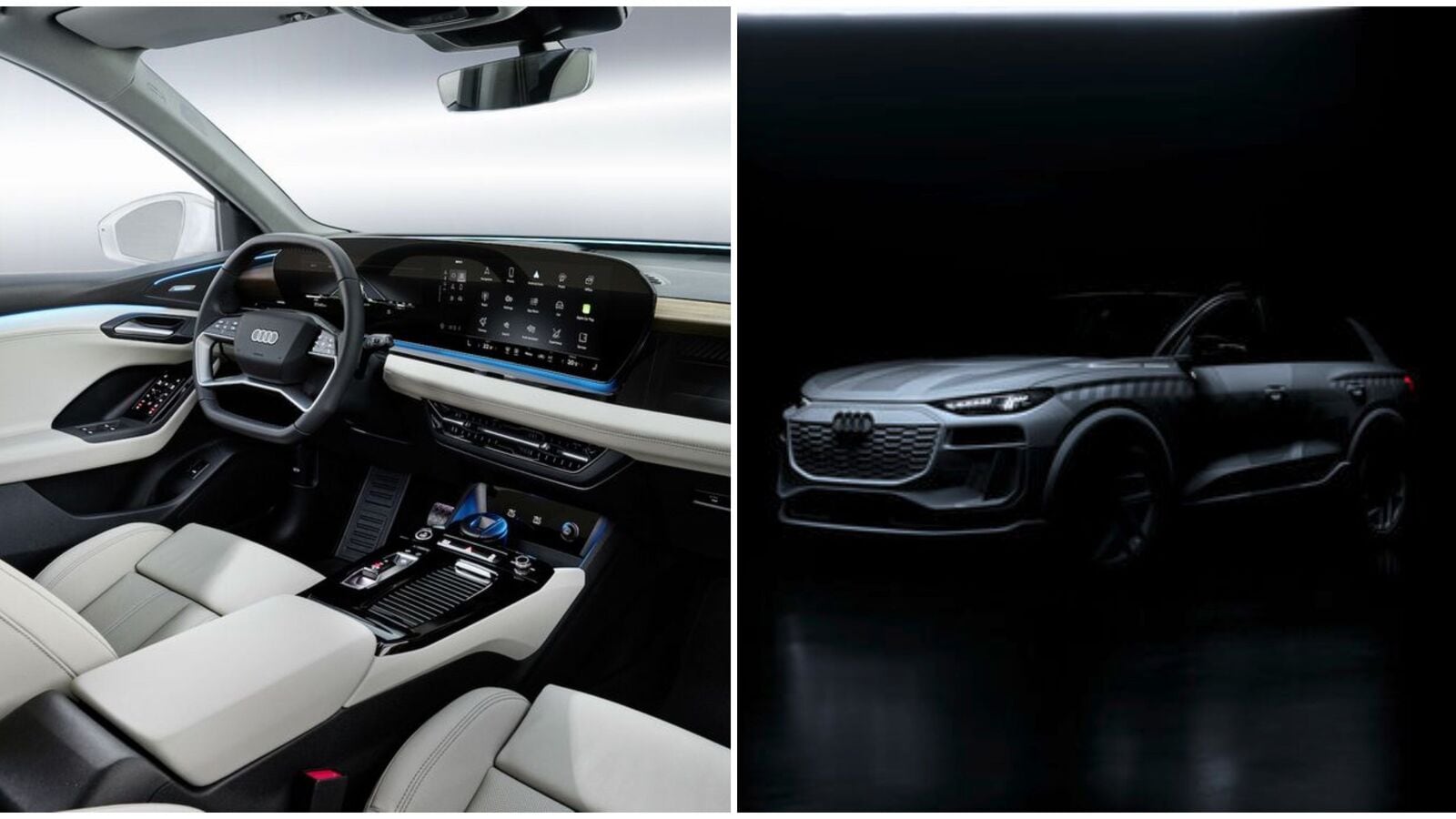
Audi has unveiled the interior design language of its upcoming EV SUV Q6 e-tron which comes as a screen-packed vehicle. The Q6 e-tron will be the brand’s first EV that will be built on its new Premium Platform Electric (PPE) architecture. The vehicle gets a total of three screens facing the passengers – an OLED gauge cluster, an infotainment touchscreen and one front-passenger dedicated touchscreen.

By: HT Auto Desk
| Updated on: 04 Sep 2023, 16:23 PM

Audi Q6 e-tron gets a total of three screens – an OLED gauge cluster, an infotainment touchscreen and one front-passenger dedicated touchscreen.

The OLED gauge cluster measures 11.9-inch and the infotainment touchscreen measures 14.5-inch, while both these reside under a single curved bezel underlined by ambient lighting. Another 10.9-inch touchscreen is dedicated to the front-seat passenger, and has a way of blocking the driver’s view of its contents, per safety regulations.

Also Read : 2024 Audi Q8 facelift teased ahead of global debut on September 5

The electric SUV gets a new Android-based infotainment software which gets a ‘self-learning voice assistant’. It responds to – “Hey, Audi.” and can learn a driver’s preferences gradually and even make suggestions. Coming to the optional head-up display (HUD), it comes with augmented reality.

When the SUV’s speed, navigation directions, or traffic signs are reflected onto the windshield, the HUD tilts forward their images to create the impression that they’re floating in front of the vehicle. Audi claims this helps reduce distractions, particularly in low-visibility situations.

Another interesting feature inside the Q6 e-tron is the customizable ambient lighting. The vehicle also has interactive lighting elements such as a welcome action and the ability to notify people when the vehicle is locked and unlocked. Other features include mimicking the turn signals and visualizing the EV’s charging levels.

The steering wheel is squared-off and is flat on the top and bottom and hosts a bunch of touch-sensitive controls. Coming to its exteriors, the Audi Q6 e-tron’s dimensions are said to be similar to that of the ICE Q5 SUV.

First Published Date: 04 Sep 2023, 16:23 PM IST


Source link

Tata Nexon New Gen Ground Clearance, Boot Space & Dimensions

Tata Nexon New Gen Ground Clearance, Boot Space & Dimensions

This article will give you details about the dimensions, or length, width, height and wheelbase of the Tata Nexon New Gen. We’ll also look at the ground clearance, boot space, fuel tank capacity and tyre size of the Tata Nexon New Gen.

The Tata Nexon New Gen is 3995mm long, 1804mm wide and 1620mm tall. Bigger exterior dimensions give a car a stronger road presence. The Nexon New Gen has a 2498mm long wheelbase. A longer wheelbase makes the car more stable at high speeds and gives better legroom in the back seat, while a shorter wheelbase makes the car more agile.

TATA NEXON NEW GEN DIMENSIONS

Length

3995mm

Width

1804mm

Height

1620mm

Wheelbase

2498mm

Ground Clearance

208mm

Boot Space

382L

Fuel Tank Capacity

44L

Wheel Size (Base)

195/60 R16

Wheel Size (Top)

215/60 R16

The Tata Nexon New Gen has a fuel tank capacity of 44 litres and a boot space measuring 382 litres. The Nexon New Gen has a ground clearance of 208mm. The tyre size of the Tata Nexon New Gen base model is 195/60 R16 and the top model rides on 215/60 R16 tyres. Cars running on bigger wheels provide better handling and styling. However, these advantages come at the cost of efficiency. Having bigger wheels means more metal and more rotating mass. Therefore, it adversely impacts your drivability, performance and mileage.

What Are The Dimensions Of Tata Nexon New Gen?

The Tata Nexon New Gen is 3995mm long, 1804mm wide and 1620mm tall.

What Is The Length Of Tata Nexon New Gen?

The Tata Nexon New Gen is 3995mm long. Here’s the length of Nexon New Gen in other units like centimetres, metres, feet and inches:

Tata Nexon New Gen Length

Millimetres

3995mm

Centimetres

399.5cm

Metres

3.995m

Inches

157.28in

Feet

13.11ft

What IsThe Width Of Tata Nexon New Gen?

The Tata Nexon New Gen is 1804mm wide. Here’s the width of Nexon New Gen in other units like centimetres, metres, feet and inches:

Tata Nexon New Gen Width

Millimetres

1804mm

Centimetres

180.4cm

Metres

1.804m

Inches

71.02in

Feet

5.92ft

What Is The Height Of Tata Nexon New Gen?

The Tata Nexon New Gen is 1620mm tall. Here’s the height of Nexon New Gen in other units like centimetres, metres, feet and inches:

Tata Nexon New Gen Height

Millimetres

1620mm

Centimetres

162cm

Metres

1.62m

Inches

63.78in

Feet

5.31ft

What Is The Fuel Tank Capacity Of Tata Nexon New Gen?

The Tata Nexon New Gen has a fuel tank capacity of 44 litres.

What Is The Wheelbase Of Tata Nexon New Gen?

The Tata Nexon New Gen has a wheelbase measuring 2498mm. Here’s the wheelbase of Nexon New Gen in other units like centimetres, metres, feet and inches:

Tata Nexon New Gen Wheelbase

Millimetres

2498mm

Centimetres

249.8cm

Metres

2.498m

Inches

98.35in

Feet

8.2ft

What Is The Boot Space Of Tata Nexon New Gen?

The Tata Nexon New Gen has a boot space measuring 382 litres. Here’s the boot space information of Nexon New Gen in other units like cubic centimetres, cubic metres, cubic inches and cubic feet:

Tata Nexon New Gen Boot Space

Litres

382L

Cubic Centimetres

382000cm3

Cubic Metres

0.382m3

Cubic Inches

23311.17in3

Cubic Feet

13.49ft3

What Is The Ground Clearance Of Tata Nexon New Gen?

The Tata Nexon New Gen has a ground clearance of 208mm. Here’s the ground clearance of Nexon New Gen in other units like centimetres, metres, feet and inches:

Tata Nexon New Gen Ground Clearance

Millimetres

208mm

Centimetres

20.8cm

Metres

0.208m

Inches

8.19in

Feet

0.68ft

Also read: New-Gen Tata Nexon 2023 Expected Price Range – With Logic (Updated September 4)


Source link

2023 F1, Italian GP results: Verstappen takes record win; Ferrari on podium

2023 F1, Italian GP results: Verstappen takes record win; Ferrari on podium


Perez finished second, giving Red Bull a 1-2 finish; Sainz fended off pressure from Leclerc to land last podium spot.

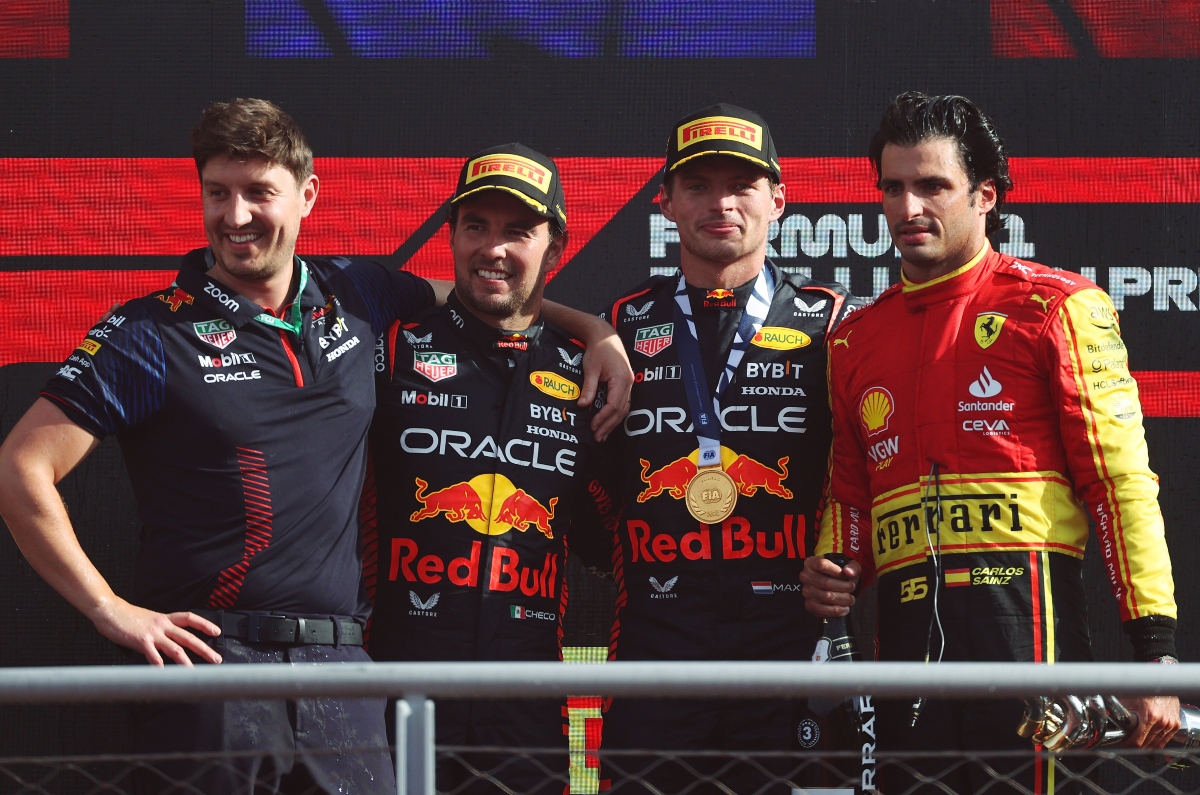
Max Verstappen has re-written the F1 history books, with this latest triumph at Monza earning him 10 consecutive race wins. Sergio Perez finished second, handing Red Bull a 1-2 finish.

Ferrari put up a valiant fight on home turf, with polesitter Carlos Sainz keeping Verstappen at bay for the first 14 laps – the most laps led by a non-Red Bull driver so far this season. But he ultimately had to settle for a podium appearance in third place.

  1. Verstappen wins, 6.064 secs from Perez
  2. Sainz on podium for Ferrari
  3. Albon P7 for Williams

Verstappen makes history at Monza

Verstappen’s been on a victory charge, but Monza proved to be his toughest battle of the season so far. Ferrari opted for a low-drag set-up and it worked, handing Carlos Sainz a triumphant pole position on Saturday. But on the flip side, this also meant that the Spaniard would have to deal with rear tyre degradation in the race.

As the laps went on, Verstappen amped up the pressure on Sainz, eventually forcing his Ferrari rival into a mistake at the first chicane on Lap 15. He sweeped past around the outside at Curva Grande and in typical fashion went on to open a comfortable gap.

“I never would have believed [10 wins in a row] was possible, but we had to work for it today and that was definitely a lot more fun,” said Verstappen, who has now beaten Sebastian Vettel’s 2013 record for the most consecutive F1 race wins.

“We had good pace, we were good on the tyres, but [Ferrari] had a lot of top speed. It was so hard to get close and make the move into Turn 1. I had to force [Sainz] into a mistake and luckily it came at some point where he locked up, and I had better traction out of Turn 2, which was good, so we could do my own race.”

Sergio Perez also beat the Ferrari drivers, giving Red Bull it’s sixth 1-2 finish this year.

Leclerc puts the pressure on Sainz

The Ferrari duo of Sainz and Charles Leclerc provided plenty of heart-racing entertainment for fans at the team’s home race. The two battled wheel-to-wheel right till the chequered flag, with some very close calls – including a huge lock up for Leclerc on the very last lap.

Sainz’ displayed some skilled defending to keep his teammate at bay and secure the last spot on the podium.

Mercedes also bagged some valuable points. Both, George Russell and Lewis Hamilton overcame five-second time penalties to finish fifth and sixth, respectively. Alex Albon continued his solid run, improving on his Dutch GP performance by one place to finish P7.

Lando Norris was eighth for McLaren, followed by Aston Martin’s Fernando Alonso and Alfa Romeo’s Valtteri Bottas.

2023 F1 standings

Verstappen now leads the championship by 145 points from his teammate Perez. Alonso holds on to third overall, but he’s 49 points behind Perez.

F1’s next stop is the Singapore GP on September 15-17.

2023 Italian GP results

2023 Italian GP results
Pos Driver Team
1 Max Verstappen Red Bull Racing
2 Sergio Perez Red Bull Racing
3 Carlos Sainz Ferrari
4 Charles Leclerc Ferrari
5 George Russell Mercedes
6 Lewis Hamilton Mercedes
7 Alex Albon Williams
8 Lando Norris McLaren
9 Fernando Alonso Aston Martin
10 Valtteri Bottas Alfa Romeo
11 Liam Lawson AlphaTauri
12 Oscar Piastri McLaren
13 Logan Sargeant Williams
14 Zhou Guanyu Alfa Romeo
15 Pierre Gasly Alpine
16 Lance Stroll Aston Martin
17 Nico Hulkenberg Haas
18 Kevin Magnussen Haas
NC Esteban Ocon Alpine
NC Yuki Tsunoda AlphaTauri

Also see:

Verstappen wins Dutch GP to equal Vettel’s F1 record


Source link

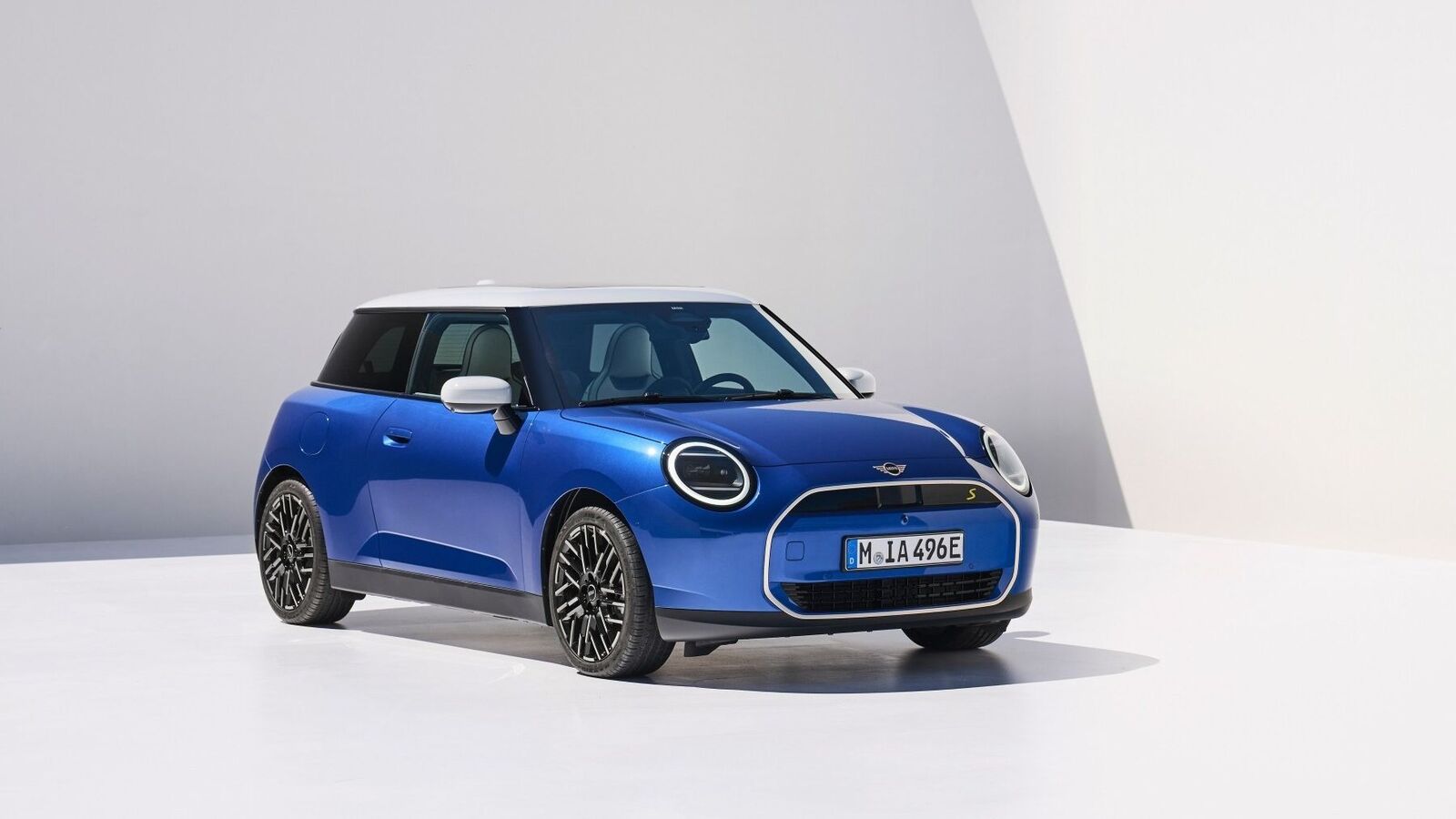
India-bound fifth-gen MINI Cooper EV breaks cover

India-bound fifth-gen MINI Cooper EV breaks cover

BMW MINI has debuted the fifth-generation MINI Cooper EV which comes with a purely electric powertrain which provides an emission-free mobility and offers new digital experiences as well as modern assistance systems. With the new vehicle, the brand has taken a step in the right direction as it aims to transform into an all-electric brand by 2030.

By: HT Auto Desk
| Updated on: 03 Sep 2023, 17:18 PM

The new MINI Cooper EV adopts a minimal exterior and interior design for a powerful presence.

The design reflects the traditional MINI DNA constituted by short overhangs, a short bonnet and contrasting long wheelbase with large wheels. The design language contributes to an athletic impression and underlines the model’s contemporary urban orientation. The hallmark MINI appearance is completed by circular headlights and octagonal front grille.

MINI Cooper E variant comes with 75 kW battery pack while the Cooper SE comes with up to 95 kW. Using a fast charger, the latter can be charged from 10 per cent to 80 per cent in just under 30 minutes.

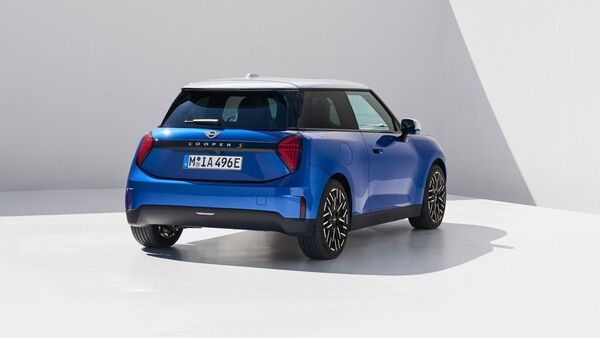
The rear section too gets a contemporary feel, featuring clear surfaces and flush rear lights.

The new MINI Cooper EV adopts a minimal exterior and interior design for a powerful presence. The headlights have shed the chrome elements while there is no circumferential Black Band for the first time. The rear section too gets a contemporary feel, featuring clear surfaces and flush rear lights. A striking black handle strip divides the rear section and its horizontal orientation.

On the inside, there is a round instrument cluster and a characteristic toggle bar below. These two elements along with the steering wheel structure the interior with its maximum purist design. There are smaller number of components cleverly designed and implemented. The dashboard on the driver’s side does not require an additional display, so it opens up the view to the front.

Coming to technology, the MINI Operating System 9 allows for vehicle functions to be operated intuitively with touch or voice control. There are three MINI Experience Modes – Core, Green and Go-Kart, each with their specific user interface design.

First Published Date: 03 Sep 2023, 17:17 PM IST


Source link

Ather Energy starts to roll out 450S electric scooter, rival to Ola S1 Air

Ather Energy starts to roll out 450S electric scooter, rival to Ola S1 Air

Ather Energy is gearing up to deliver the 450S electric scooters to its customers ahead of the festive season. The Bengaluru-based EV maker has started to roll out its most affordable electric scooter from its facility in Hosur, Tamil Nadu. Tarun Mehta, founder and CEO at Ather Energy, shared the new electric scooters being prepared for delivery today. The electric scooter, which rivals the likes of Ola S1 Air, was launched earlier this year at a price of 1.30 lakh (ex-showroom).

By: HT Auto
| Updated on: 02 Sep 2023, 15:53 PM

450S electric scooters being rolled out of Ather Energy’s facility. Launched in June, the EV maker will start delivery of the 450S ahead of the festive season.

The bookings for the Ather 450S started in June this year when the electric scooter was officially launched. Ather Energy says the price complies with the revised FAME 2 scheme. The customers can avail further benefits from respective states’ own electric vehicle policies.

Ather 450S comes equipped with a 3 kWh lithium-ion battery pack that claims to offer 115 kms of range on a single charge. Using home chargers, the battery pack can be charged up to 80 per cent in around six hours and 36 minutes while charging up to 100 per cent takes eight hours and 36 minutes.

The electric motor is capable of generating 7.24 bhp of peak power and 22 Nm of maximum torque. The 450S electric scooter can also run at a top speed of 90 kmph. Ather 450S offers three ride modes with the 450S which include Sport mode, Eco mode and Ride mode.

Watch: Ather 450S review: Worthy of its price tag?

In terms of design, there is very little to differentiate the 450S from its more premium sibling 450X. Ather 450S gets the same curvy front cowl with the same LED headlamp as the 450X. From the side profile and rear too, it looks exactly the same as the flagship Ather electric scooter.

The big difference between the Ather 450S and 450XX is the instrument cluster. To keep the cost down, Ather replaced the unit used in 450X with an LCD panel, which lacks usual map navigation. In 450S, one needs to use the MapMyIndia-powered navigation system which offers turn-by-turn navigation.

First Published Date: 02 Sep 2023, 15:53 PM IST


Source link

BMW Neue Klasse EVs, future electric vehicles, design and interior theme

BMW Neue Klasse EVs, future electric vehicles, design and interior theme

Showcased at the ongoing Munich Motor Show, this previews a future 3 Series-sized electric sedan.

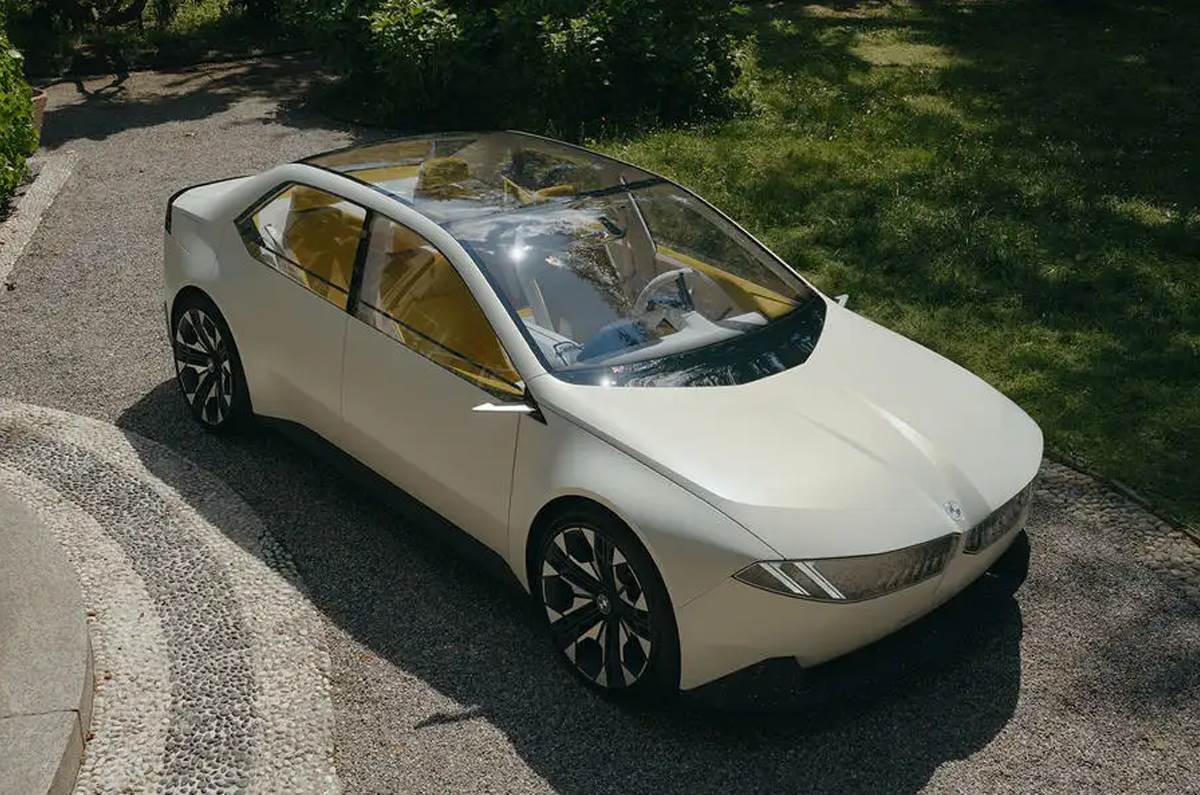
BMW has showcased the Vision Neue Klasse concept at the ongoing Munich Motor Show which gives the best look yet at BMW’s all-electric future. It previews a dramatic change in exterior and interior design direction alongside the introduction of highly advanced drivetrain technology.

BMW’s ambition with Neue Klasse

By the end of 2023, BMW will have an electric car on sale in each of its core market segments, and it aims for more than a quarter of its global sales to be electric by 2025, rising to a third just a year later. Now well on the way to achieving those goals with its current fleet of electric sedans and SUVs, BMW is shifting its focus to the launch of a radical new family of EVs.

It has dubbed this ‘Neue Klasse’ as a reference to the family of brand-reshaping premium sedans and coupés that it launched in the 1960s.

BMW will launch six Neue Klasse EVs in the space of 24 months, although not all of them will be based on the same platform because of the differing requirements of the various segments BMW seeks to cover. CEO Oliver Zipse pledged: “From SUV to sedan, we will have something for every customer.”

The first is set to be a striking 3 Series-sized sedan, and while BMW bosses said this new Vision Neue Klasse concept doesn’t directly preview a production car, it’s understood that it gives strong clues about what to expect from this pioneering EV.

Beneath the skin, the new sedan – and its closely related range-mates – will be almost completely unrelated to BMW’s current crop of EVs, and this technological revolution will be signalled by a totally new design treatment that does away with many established hallmarks and reinterprets others for the new era.

BMW Vision Neue Klasse exterior design

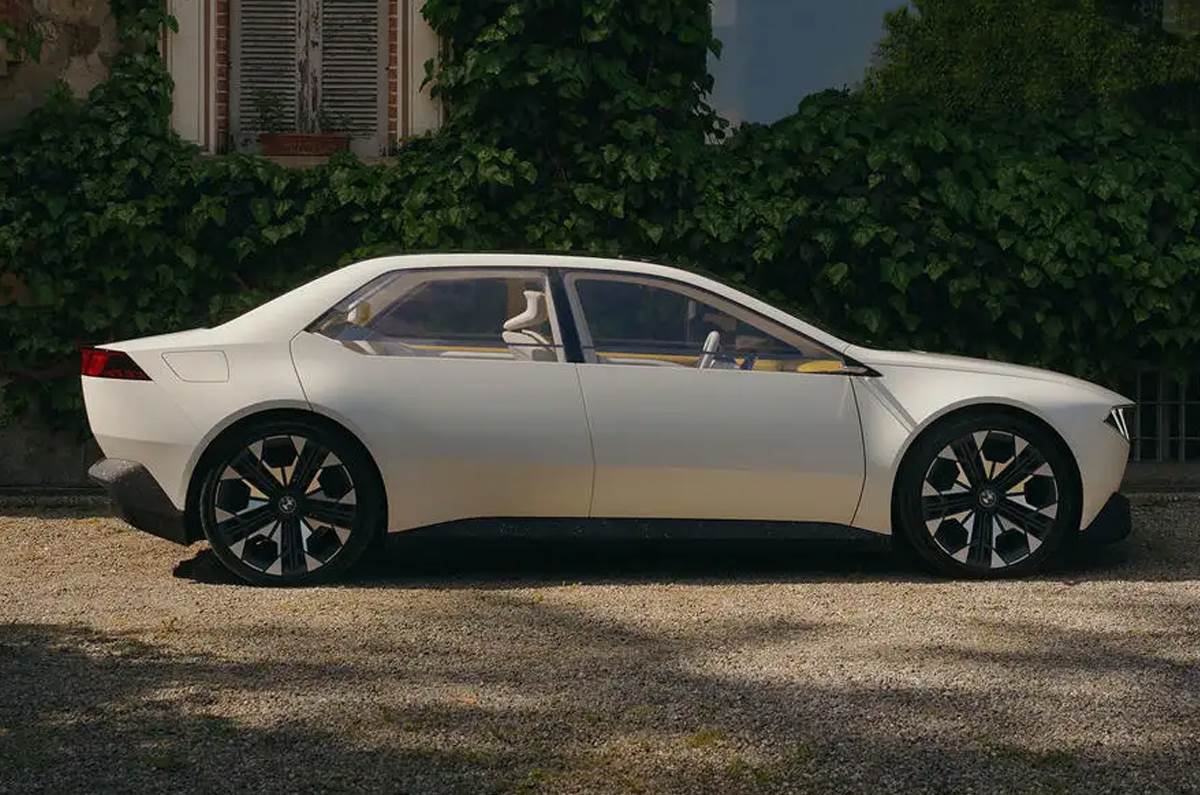
The Vision Neue Klasse is clearly an evolution of the outlandish i Vision Dee concept that BMW showed at CES in Las Vegas earlier this year, drawing on that car’s sharp-angled silhouette but with wide-reaching refinements that paint it more obviously as a close preview of a production car.

BMW has labelled it “clear, elegant, timeless”, highlighting features that will become hallmarks of the Neue Klasse line-up, including a broader, horizontal interpretation of the firm’s kidney grilles, expansive side windows, slimline LED light designs and a “monolithic” silhouette, which is, according to design boss Domagoj Dukec is, “much cleaner in its surfacing and details” than those of recent BMW cars. Not only does this promote a fresh, futuristic treatment, it also means Neue Klasse cars can be made with simpler tooling and fewer components.

The front end is described as a “single interaction area”, with the headlights programmed to display an animation when users approach the car. “Light has helped us strengthen our identity in recent years,” explained Dukec, adding that BMW wants “to replace chrome with light”. Meanwhile, the ‘grille’ panels are designed to host the many cameras and sensors needed for high-level driver assistance functions, although hidden behind the seemingly opaque bodywork for a cleaner look.

The ‘grille’ could also, it has been suggested, display notifications about the car’s charging status or even direction indicators. Similarly, the light clusters could show different colours and designs depending on which driving mode is selected.

Notably, while SUVs account for a huge proportion of BMW’s global sales, the Vision Neue Klasse and i Vision Dee concepts have taken the form of saloons, because the firm believes “there is still a future for flat, low cars – especially the [sedan]”, according to Dukec.

BMW Vision Neue Klasse interior design

Neue Klasse EVs will be marked out from current cars by their minimalist cockpits, which feature only the bare minimum of physical controls, even dropping the iDrive rotary control knob that has been a hallmark of the brand’s interiors since the E65-generation BMW 7 Series arrived in 2001.

Instead, users interact with the new system using a slick central touchscreen, BMW’s voice-activated Intelligent Personal Assistant and a new Panoramic Vision head-up display, which extends across the entire windscreen to provide information at “the ideal height” for the driver and front passenger.

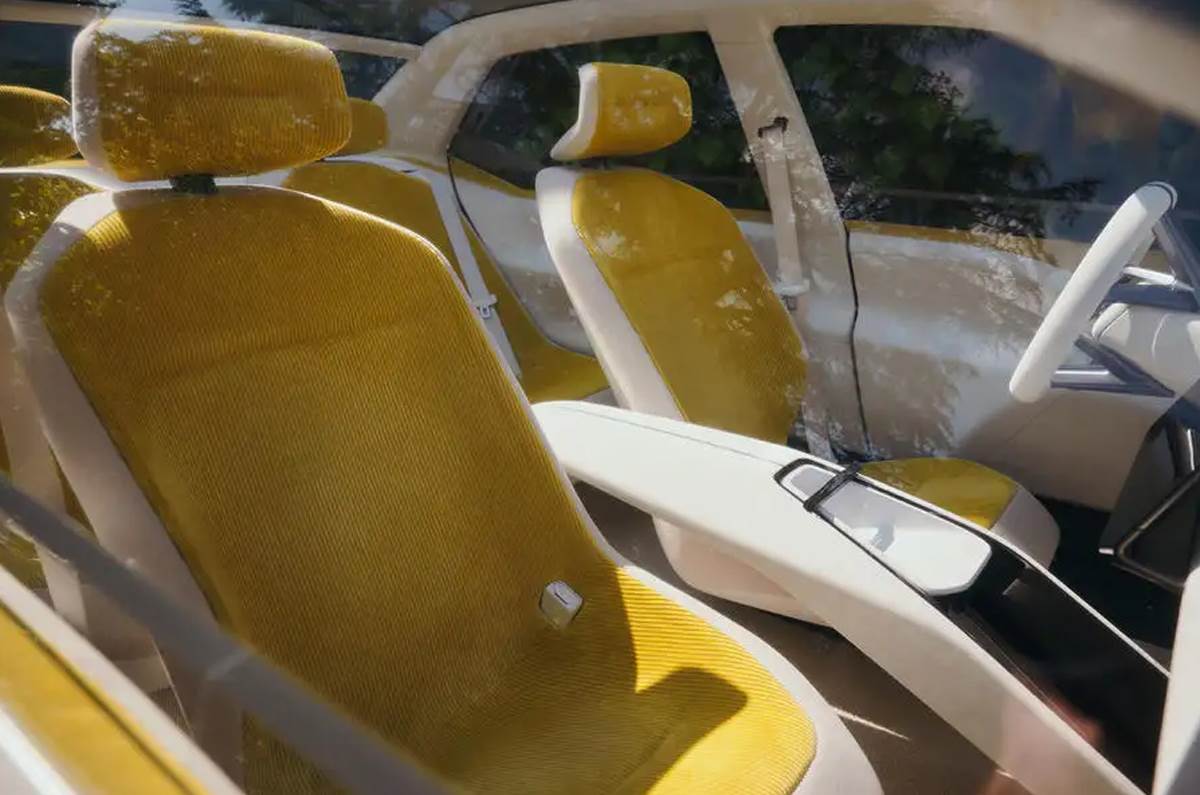
This is operated primarily using a switch on the right-hand spoke of the steering wheel, but the driver can transfer content from the touchscreen to the holographic projection using a swiping gesture. Other clues to Neue Klasse interiors come in the form of the concept’s bright yellow corduroy upholstery, chunky, squared-off steering wheel and ‘floating’ centre console, which holds a wireless phone charger. Also, BMW highlights that just one bracket supports each of the front seats, leaving more room for rear passengers’ feet.

BMW Vision Neue Klasse technical details

Technical details of BMW’s next-generation EV platform remain to be revealed, but R&D boss Frank Weber said it will bring “30 percent more range, 30 percent faster charging, and 25 percent more efficiency” compared with current cars.

BMW’s new Gen6 lithium-ion batteries – with cylindrical rather than prismatic cells and slimmer than current units – will be 20 percent more energy-dense, able to charge at up to 270kW (to add 300km in just 10 minutes) and ultimately offer up to 1000km of range.

Changes to the design and production processes of these next-generation batteries are estimated to cut costs by as much as 50 percent, which could have significant implications for the final prices of BMW’s EVs – although the firm has given no indication of what the Neue Klasse cars will cost.

The EVs will initially be built at BMW’s new factory in Debrecen, Hungary, in a process that is said to be entirely free from fossil fuels, be much more dependent on the use of secondary materials and have a lower CO2 output.

Also See:

New Mini Cooper EV India launch in Q1 2024

Refreshed Tesla Model 3 breaks cover



Source link

City, Amaze keep Honda sales steady, carmaker pins hope on Elevate for a boost

City, Amaze keep Honda sales steady, carmaker pins hope on Elevate for a boost

Honda Cars India has registered a marginal rise in its sales in August with one of the smallest fleet any carmaker has in India. With the help of its two sedans – the fifth generation City and the sub-compact Amaze, the carmaker has been able to deliver 7,880 units last month. The Japanese auto giant’s sales in India has grown by one per cent compared to the same month last year. The carmaker is now gearing up to launch the Elevate compact SUV, its third model in India, on Monday (September 4).

City and Amaze sedans hold Honda Cars’ sales in India steady with marginal growth in August.

Honda’s sales last month is barely 31 units more than the carmaker sold in August last year. However, the carmaker has clocked a decent jump in sales compared to the previous month. In July this year, Honda had clocked 4,864 units. The Japanese carmaker attributed the rise to growing demands ahead of festive season. “The festive demand has been strong and continues to show good momentum. The celebratory fervour, which began with Onam in southern India, will extend to the rest of the markets as we move towards the peak of festivities in the coming months,” Yuichi Murata, Director Marketing and Sales at Honda Cars India, said.

Meanwhile, Honda’s export has dropped to 2,189 units against 2,356 units in August 2022, a decline of around seven per cent.

Honda is gearing up to add a compact SUV in its sedan-only lineup on September 4 when it officially launches the Elevate. Honda Cars has already received good response on bookings for the SUV. Bookings were opened on July 3 for 5,000. The deliveries are expected to begin soon after it is launched.

Watch: Honda Elevate SUV First Drive Review

Honda Elevate SUV will be offered in four variants – SV, V, VX and ZX. The carmaker will initially offer the SUV with seven single colour options. The SUV will be offered with a 1.5-litre DOHC i-VTEC petrol engine, which is also used for the Honda City sedan. This engine churns out 119 bhp of power and 145.1 Nm torque. The engine is available with a six-speed manual gearbox and an advanced CVT gearbox.

First Published Date: 02 Sep 2023, 13:26 PM IST


Source link

Tata Motors domestic sales remain flat in August, EV volumes grow by 55%

Tata Motors domestic sales remain flat in August, EV volumes grow by 55%

Tata Motors reported its sales for the month of August 2023 and the automaker’s domestic volumes stood at 76,261 units when compared to 76,479 units in August 2022. The automaker’s total sales (passenger + commercial) were at 78,010 units, compared to 78,843 units during August last year, maintaining the sales momentum.

By: HT Auto Desk
| Updated on: 01 Sep 2023, 17:37 PM

Tata Motors total sales for August 2023 remained flat but EVs continued to show solid growth of 55% during the same period

Total Passenger Vehicle (PV) sales in August 2023 were at 45,933 units, a drop of 3 per cent over 47,351 units sold in August last year. Domestic PV sales stood at 45,513, down by 3.5 per cent, as against 47,166 units sold in August 2022.

Also Read : Tata Nexon facelift teased for the first time ahead of launch

On the other hand, exports grew by 127 per cent from 185 units last August to 420 units last month. Electric vehicles showed maximum growth of 54.9 per cent with 6,236 units sold last year, as opposed to 4,026 units sold in August 2022.

Total Commercial Vehicle (CV) sales in August were at 32,077 units, growing by 1.9 per cent over 31,492 units sold during the same period last year. HCV trucks, ILMCV trucks and passenger carriers were all in the green, while volumes for cargo and pick-up vehicles saw a 4.4 per cent decline. Domestic CV sales stood at 30,748 units, up by 4.9 per cent over 29,313 units sold last August. Exports declined by 39 per cent to 1,329 units, from 2,179 units a year ago.

First Published Date: 01 Sep 2023, 17:37 PM IST


Source link

Hyundai teases 2023 i20 facelift, to launch in India soon

Hyundai teases 2023 i20 facelift, to launch in India soon

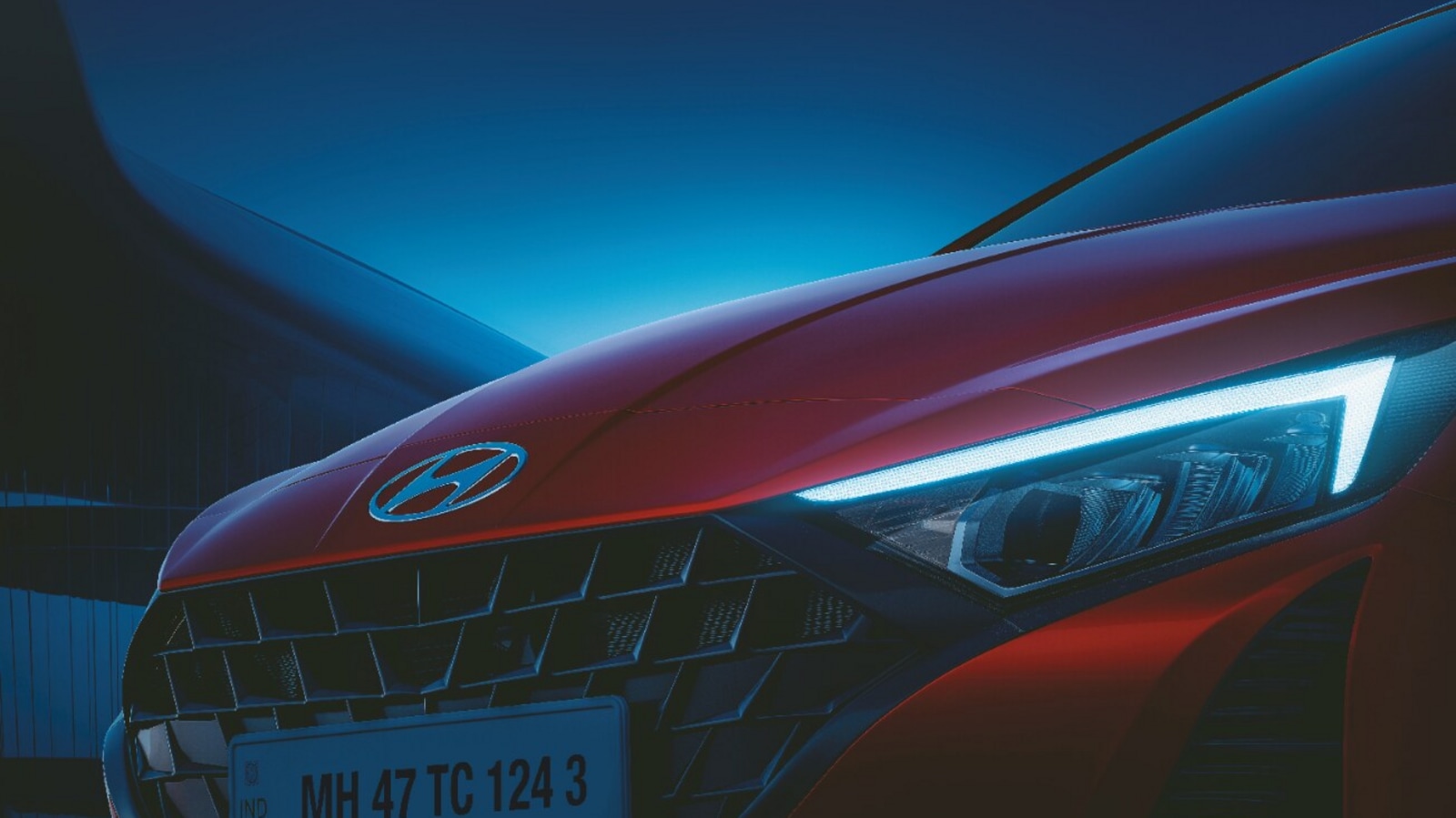
Hyundai Motor is gearing up to launch the facelift version of its popular hatchback i20 soon. The carmaker took to social media to tease the first look at the upcoming model ahead of its launch, which is expected to take place later this year. The new Hyundai i20 facelift model is likely to come with several updates in terms of its features. When launched, the 2023 i20 hatchback will renew its rivalry with the likes of Maruti Suzuki Baleno among others in the compact segment.

By: HT Auto Desk
| Updated on: 01 Sep 2023, 16:42 PM

Hyundai Motor has teased the upcoming facelift version of the i20 hatchback which is expected to launch this festive season.

Hyundai i20 facelift hatchback is expected to come with several design changes on the outside. The new-look i20 has already been spotted testing a number of time on Indian roads. The spy shots hint that the front face of the i20 will be updated with new elements like the grille and LED headlight units. The side and rear profile of the hatchback is expected to remain largely similar to the outgoing version, except for the taillight design. The alloy design too may get minor updates.

The interior of the new i20 is also expected to come with additional features.Hyundai may introduce dashcam as a first-in segment feature in the i20 facelift. It could use the same dashcam that was introduced in Exter SUV earlier. Besides this, Hyundai may also add other features like an electrically adjustable sunroof, 360-degree camera, front parking sensors and a larger touchscreen infotainment system. The i20 already offers features like digital instrument cluster, automatic climate control, cruise control, wireless charger and ambient lighting.

Hyundai is unlikely to make any changes under the hood. Expect the new i20 to come equipped with the same 1.2-litre petrol or the 1.0-litre turbocharged petrol unit as options. The 1.2-litre unit is capable of generating 82 bhp of maximum power and 114.7 Nm of maximum torque. The turbocharged unit can churn out 118 bhp of power and 172 Nm of peak torque. The transmission job is handled by either a five-speed manual, an IVT or a seven-speed DCT gearbox.

The current generation i20 hatchback is priced between 7.46 lakh and 11.88 lakh (ex-showroom). Expect the new facelift version to cost slightly more than that.

First Published Date: 01 Sep 2023, 16:42 PM IST


Source link

Jeep sells five millionth Wrangler off-roader globally, milestone achieved in 37 years

Jeep sells five millionth Wrangler off-roader globally, milestone achieved in 37 years

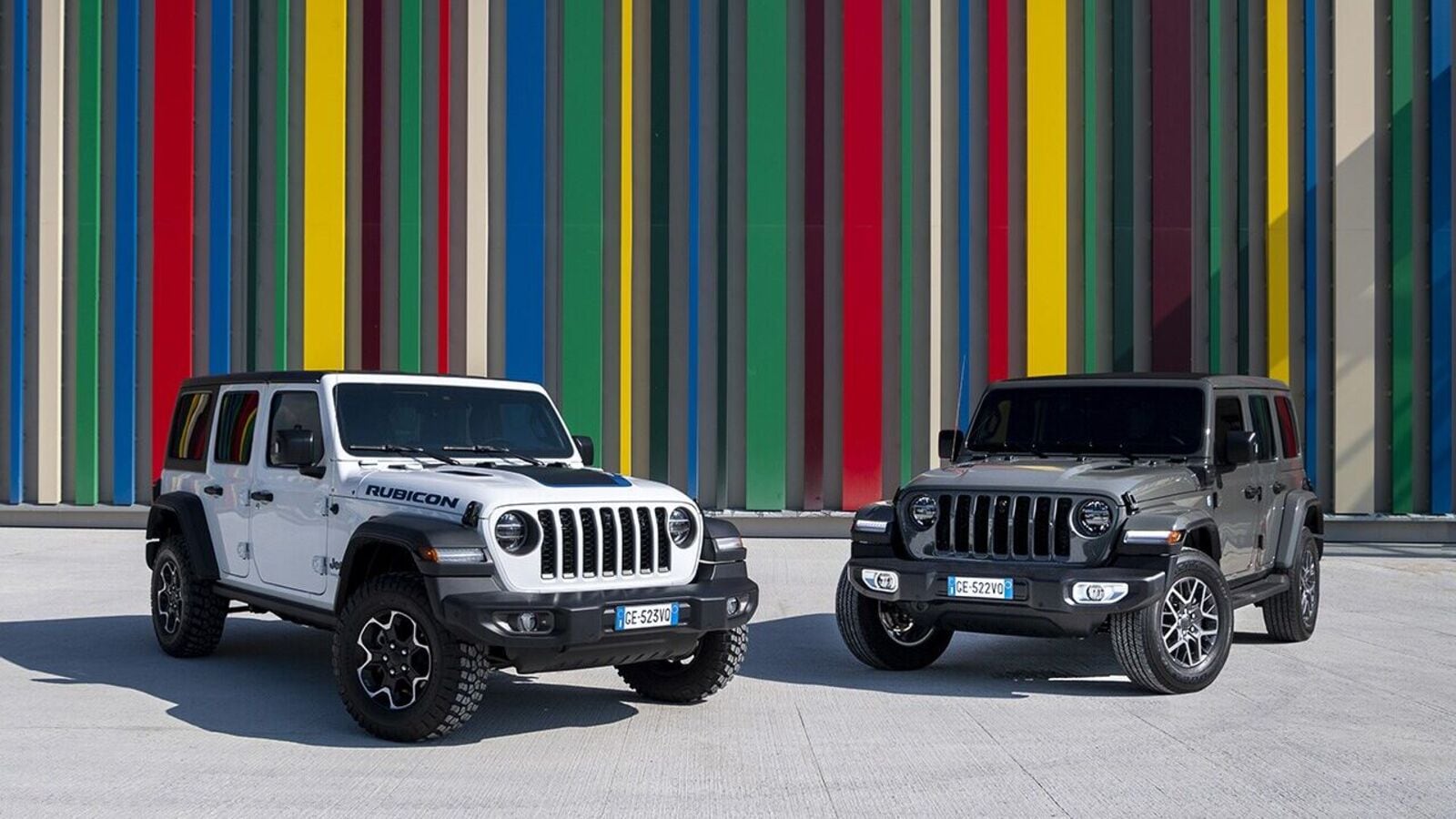
The iconic Jeep Wrangler has achieved a new milestone as the automaker rolled out the five millionth example of the off-roader globally. The five-millionth Jeep Wrangler has been sold to a customer in New Jersey in the US and is the fifth-generation 2024 version. The automaker achieved the milestone in a span of 37 years since the first Wrangler rolled out in the US in 1986 (as a 1987 model), replacing the Jeep CJ that continued the legacy of the original 1941 Willy MB.

By: Sameer Fayaz Contractor
| Updated on: 31 Aug 2023, 18:36 PM

The Jeep Wrangler was first launched in 1986 in the US and is now a global off-roading icon

Since the launch of the first Jeep Wrangler (YJ), the automaker went on to sell 630,000 units of the off-roader between 1987 and 1995. The second-generation Wrangler (TJ) would go on to sell 900,000 units between 1996 and 2006. The third generation Wrangler (JK) arrived in 2006, followed by the JL in 2017. The five-millionth model sold is the 2023 4xe Rubicon 20th Anniversary Edition in the Earl paint scheme. The owner will also receive $ 5,000 worth of Jeep Performance parts and Jeep Wave customer care benefits.

The five-millionth Jeep Wrangler to be sold is the 2023 4xe Rubicon 20th Anniversary Edition

Speaking about the sales milestone, Jim Morrison, Senior Vice President and Head of Jeep brand North America, said, “With five million Wranglers sold, the Jeep brand continues to grow fueled by the unwavering passion of the Jeep global community. With legendary 4×4 capability, open-air-freedom and a timeless design, the Wrangler embodies the spirit and the soul of the Jeep brand. Over 80 per cent of the five million Wranglers sold since 1986 are still on the road, having fun out there and showcasing the amazing staying power of the vehicle. Our new 2024 Wrangler raises the bar once again as the most capable Wrangler yet, with more technology, safety features and refinement.”

The Jeep Wrangler started life as a two-door model with a 2.5-litre four-cylinder and a 4.2-litre inline six-cylinder engine options. Over the years, the automaker went on to introduce the four-door version, which is sold globally as well including in India. The fifth-generation Wrangler will make its way to the Indian market at a later date.

First Published Date: 31 Aug 2023, 18:36 PM IST


Source link

Hero Electric enters premium electric bike segment under new A2B brand

Hero Electric enters premium electric bike segment under new A2B brand

Hero Electric has announced that the company will be diversifying into the premium electric bike segment under its new brand ‘A2B.’ The electric two-wheeler giant is one of the leaders in terms of volume in the electric scooter segment. The new A2B brand will further diversify the portfolio with electric bikes, scooters and other new variants in the category, the company said in a statement.

By: HT Auto Desk
| Updated on: 31 Aug 2023, 18:06 PM

Hero Electric will expand in the premium electric two-wheeler segment under the new A2B brand

Hero Electric says its upcoming range of premium electric two-wheelers will be tailored to withstand Indian road and climatic conditions. The upcoming electric model range also promises robust battery systems, integrated powertrains, and aesthetics that reflect the premium buyer sensibilities.

Also Read : Hero Electric, Okinawa among other EV makers asked to refund FAME II incentives

Speaking on entering the premium e-bike segment, Sohinder Gill, CEO – Hero Electric, said, “While the Hero Electric brand continues to be the bedrock of our basic E-mobility thrust, we intend to invest in new brands for specific market categories. We believe that differentiation is key to market dominance, and going forward we will enter categories under specialist brand entities to bring focus to the market segments they represent, complementing the Hero brand as a legacy player in the mass mobility segment.”

Hero Electric is bullish about the long-term growth of the electric vehicle segment even as short-term challenges hamper the e-two-wheeler space at large. The company has over 15 years of experience in retailing electric two-wheelers largely focussed on the sub 1 lakh entry segment.

“The Indian market is ripe for e-mobility exploration, and we are perfectly positioned to meet the emerging demands, including those from the premium segment. Our commitment resonates with India’s aspiration to become a global EV hub, and we are eager to play a pivotal role in making that a reality,” Gill added further.

Commenting on the announcement, Naveen Munjal, MD – Hero Electric, said, “We are embarking on a de-aggregation strategy with specific brand offerings in different segments. This tactical move aims to focus on our traditional turf with the Hero Electric brand while allowing us to break into newer segments as competition builds up in this sector.”

Hero Electric has not announced the launch timeline for the premium EVs under the A2B brand. The company also remains tight-lipped about its upcoming model range, whether these models will be indigenously developed and at what price points will they be retailed at. The company has over 850 sales and service outlets across the country and has sold over six lakh units so far. The manufacturer has a manufacturing facility in Ludhiana, Punjab, and a shared facility in Pitampura, Madhya Pradesh with the Mahindra Group.

First Published Date: 31 Aug 2023, 18:06 PM IST


Source link

Tata Nano EV price, Jayem Neo EV for sale, buyers guide

Tata Nano EV price, Jayem Neo EV for sale, buyers guide

Here’s what you should know if you are considering buying a used Tata Nano-based Jayem Neo EV.

Published On Aug 31, 2023 05:35:00 PM

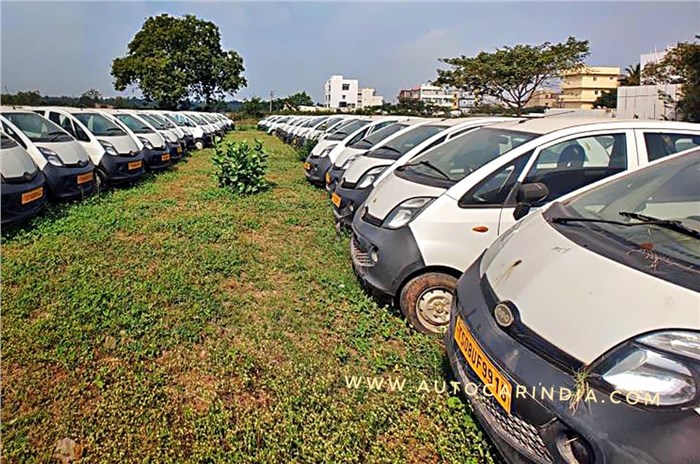
Do you fancy owning a small, nimble electric hatchback in the Rs 3 to 5 lakh price bracket? Then here’s an option that might interest you. It has been brought to our attention that there are several pre-owned examples of the Jayem Neo EV – the all-electric Tata Nano – for sale in cities like Bengaluru, Hyderabad and Delhi, on various online used car portals.


  1. Jayem Neo EV is based on the Tata Nano
  2. Used examples available for Rs 3-5 lakh
  3. Can be registered by private buyers too

Jayem Neo EV: what is it?

The Jayem Neo EV, or electric Tata Nano as some might know it, was jointly developed and engineered by Coimbatore-based engineering and production house Jayem, and Tata, under the close watch of Emeritus Chairman Ratan Tata. In 2018, Jayem made a batch of 400 cars to cater to an order from Ola Cabs, and these were delivered for use in Hyderabad and Bengaluru. The Neo EV was only available in a white finish and wore yellow plates, as these were used for commercial purposes only.

It came with a 17kWh battery and an electric motor that generated 27hp of power and 68Nm of torque. It boasted of a 0-40kph time of around 5.8 seconds. We recently reviewed the Jayem Neo EV, and we can confirm its real-world range is approximately 130km on a full charge. 

Buying a used Jayem Neo EV


Several examples of this electric Nano are on sale in the used car market, and even though it wore commercial plates originally, buyers have the option to register it as a private vehicle as well, as it’s on sale in the pre-owned market. 

Sellers are asking between Rs 3 lakh and 5 lakh for it, and while the price might seem relatively reasonable compared to new entry-level EVs like the MG Comet or Tata Tiago EV, prices for which start at Rs 7.98 lakh and Rs 8.69 lakh, respectively, there are a few things to keep in mind before signing on the dotted line for the Neo EV.

Our sources tell us that most Neo EVs have been out of commission and left abandoned for a few years. Some dealers, however, are refurbishing them, recalibrating their Battery Management System (BMS), and updating their passive cell balancing tech to optimise performance before putting them up for sale.

In addition to the electric powertrain, it is important to check whether all fluids (eg. brake fluids) and its 12V battery are replaced; electrical bits are working fine; and its suspension, brakes, steering and tyres are in good nick. Do keep a close eye for corrosion, as many of these cars were left unattended for unusually long periods of time. 

Along with watching out for the above, you must inspect all the ownership documents (registration certificate, insurance) as well as the availability of an NOC (no objection certificate) from the seller to the buyer, if the latter is from a different state. 

If all these points check out, consider moving ahead, but bear in mind the Jayem Neo EV isn’t backed by any warranty, nor will Tata service centres be able to provide technical support for this niche, all-electric offering.

Copyright (c) Autocar India. All rights reserved.


Source link

Uber completes four crore green kilometres; 10 years in India

Uber completes four crore green kilometres; 10 years in India

Uber has completed 10 years in India and a total of four crore green kilometres – a cumulative figure from all its zero emissions rides. In total, all Uber rides in a decade of its operations here have clocked 3,300 crore kilometers, which the company says is equivalent to travelling from Earth to the Moon about 86,000 times.

File photo used for representational purpose only (PTI)

As per the data sheet shared by the company, a total of 300 crore trips have been taken via the Uber India app thanks to over 30 lakh driver partners associated with the app. The company claims that the number is equivalent to filling up the Narendra Modi stadium in Ahmedabad over 30 times. And through these trips, the drivers have earned over 50,000 crore rupees since 2013.

The Uber app is now available in 125 cities across the country. On the occasion of the milestone of completing a decade in the country, the company release a short digital film to show how it has touched the lives of millions through its mobility solutions and innovations.

The company recently rolled out the ‘Group Rides’ feature that allows an individual customer to share their respective Uber rides with up to three other commuters if all the commuters are travelling to the same destination. It is a cab service equivalent of car pooling and can be shared by four persons who know each other.

With this, Uber India is promising a more economical way of commuting between two points as commuters can now share their rides on the app-based taxi-hailing service. The US-based company, in fact, claims that an individual sharing his or her Uber ride can save up to 30 per cent on the eventual payment by making use of the feature.

First Published Date: 30 Aug 2023, 17:11 PM IST


Source link

Rumion Petrol Vs CNG | Mileage & Running Cost Comparison

Rumion Petrol Vs CNG | Mileage & Running Cost Comparison

If you’re wondering whether you should buy the Toyota Rumion petrol or CNG then this article will help you come to a conclusion. Here, we’ll take the latest ex-showroom prices of the Rumion and look at the price difference. Based on the current petrol and CNG prices, we’ll calculate the kilometres you need to drive the car to recover the higher upfront cost. This should help you decide which engine option of the Rumion will work best for you and save you money in the long run. Let’s start with the difference in their ex-showroom prices.

Toyota Rumion Petrol Vs CNG – Price Comparison

Let’s look at the latest ex-showroom prices of the Toyota Rumion petrol and CNG to see what extra cost you’re paying for the Rumion CNG over the Rumion petrol.

TOYOTA RUMION PETROL VS CNG PRICES

EX-SHOWROOM DELHI (SEPTEMBER 2023)

Variants

Petrol Prices

Difference

CNG Prices

S Manual

Rs. 10,29,000

Rs. 95,000

Rs. 11,24,000

For the Rumion CNG manual, you’re paying Rs. 95,000 more than the Rumion petrol.

Toyota Rumion Petrol Vs CNG – Running Cost Calculation – September 2023

Now, let’s compare the per kilometre fuel cost you’ll incur with both the engine options. For this, we’ll use the latest petrol and diesel prices in Delhi and the official mileage figures as a baseline.

TOYOTA RUMION

COST PER KM (SEPTEMBER 2023)


Petrol

Difference

CNG

Fuel Price Delhi

Rs. 96.76

Rs. 23.17

Rs. 73.59

Manual Mileage

20.51kmpl

5.60km

26.11kmpkg

Manual Cost Per KM

Rs. 4.72

Rs. 1.90

Rs. 2.82

At the current fuel prices, the Toyota Rumion petrol manual will cost you Rs. 1.90 more than the Toyota Rumion CNG manual for every kilometre you drive.

Kilometres To Breakeven With Toyota Rumion CNG

TOYOTA RUMION PETROL VS CNG

KM TO RECOVER (SEPTEMBER 2023)

Variants

KM to Recover

S Manual

50,020km

You’ll have to cover 50,020km with the Toyota Rumion CNG manual to recover the extra price you pay upfront over the Rumion petrol.

Should You Buy Toyota Rumion Petrol Or CNG?

Considering the current fuel prices, the Rs. 95,000 upfront cost seems like a reasonable price to pay for the Toyota Rumion CNG. It’ll take you just over 50,000km to recover that higher upfront cost. So, this is a suitable option for buyers who intend to drive the car a lot and are willing to compromise a bit on performance and are ready to give up whatever little boot space the Rumion offers.

You can use our Fuel Cost Calculator to see how any petrol, diesel or CNG car will cost to run based on the latest fuel price in your city.

Fuel Cost Calculator in India


Source link