Over the last few years, several Tesla electric cars have made headlines for reasons that were unexpected and at times, unpleasant. The latest addition to the list of antics performed by Tesla car owners is when an EV bashed through a wall and plunged into a swimming pool. The incident took place in Arizona when a homeowner found the Tesla barreled through his house’s concrete wall and took a dive in the backyard pool, reported AZFamily.
By: HT Auto Desk | Updated on: 06 Aug 2023, 15:10 PM
It is not confirmed if the Tesla EV plunged into the pool because of a driver’s error or some technical glitch. (Image: Youtube/AZFamily)
The report says that despite such a crash into the swimming pool, the Tesla EV’s driver survived without any injury. However, the same can’t be said of the car or the yard it crashed into. The report has further revealed that the police are still searching for the cause of the crash. It is not known if the mishap took place because of the driver’s error or some technical glitch in the car.
The affected homeowner, Joe Papineau, said that he thought that he’d heard an explosion. “I was sleeping in my bed when all of a sudden I hear this huge crash and big explosion,” he said to the local news station. Papineau also said he believes that the Tesla car was passing through the area when another car pulled out in front of him. In a desperate attempt to avoid the accident, the Tesla driver made an evasive manoeuvre but couldn’t recover in time to avoid crashing into the wall and ending in the pool.
The video that emerged online shows the Tesla car has received extensive damage including a demolished windshield. Its front profile got damaged severely. However, the driver reportedly escaped with only minor injuries. There was no other passenger in the car during the time of the accident, the report has further revealed.
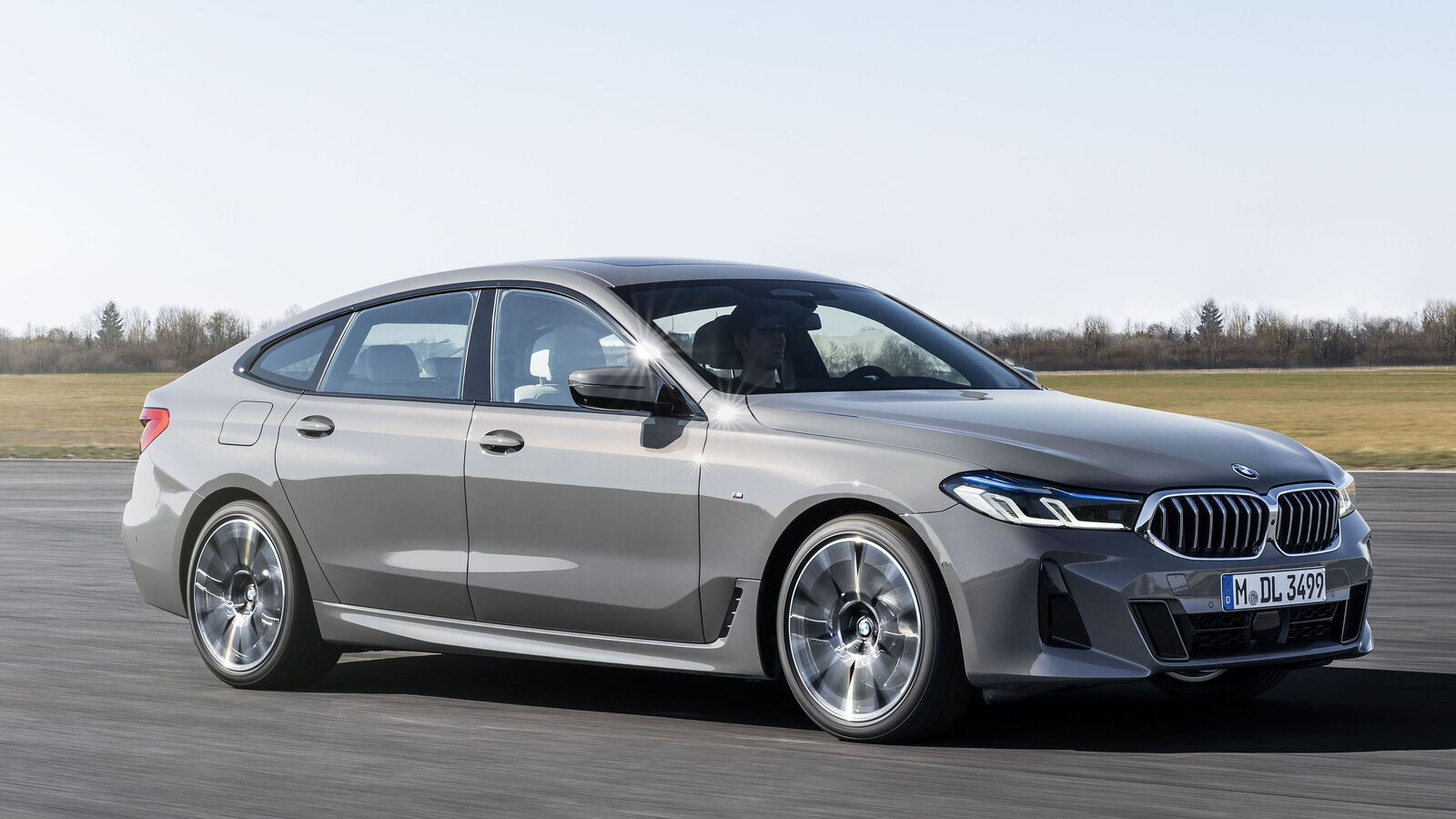
BMW 6 Series Gran Turismo is all set to meet the end of the road later this year, as the German luxury car brand is ready to pull the plug on this model by November 2023. Launched in 2017, the BMW 6 Series Gran Turismo has never been a market success for the automaker. BMW updated the 6 Series Gran Turismo back in 2021 and introduced an electrified powertrain to the car. The car has not been able to register many sales to private customers and has mostly been used as an airport and hotel shuttle in some European countries, which prompted the company to discontinue this model, reports BimmerToday.
By: HT Auto Desk | Updated on: 06 Aug 2023, 11:44 AM
BMW 6 Series Gran Turismo will go out of sale by November 2023.
While the report of the BMW 6 Series Gran Turismo has been leaked unofficially, the automaker remains tight-lipped about the decision. The report claims that the BMW 6 Series Gran Turismo will remain in production for a few more months before the 6 Series moniker is retired. The car brand has not seen satisfactory demand for the car. The report claims that it sold only 509 units in Germany in 2022, which marks an absurdly low number. Halfway through 2023, the 6 Series GT has sold just 237 units in the company’s home country, becoming the worst performer of the automaker.
BMW sells the 6 Series Gran Turismo in India as well. Powered by a diesel engine, the car is available at a starting price of ₹72.50 lakh (ex-showroom), in India. As of now, the car is available on the German auto giant’s website.
Meanwhile, BMW India has registered its best-ever half-year and quarterly sales during January-June and April-June periods this year, respectively. The automaker claimed that BMW and Mini together have sold 5,867 cars combined between January and June this year. The company also said that its flagship models witnessed the highest demand.
French design flair makes it stand apart from the crowd but is that enough in the hyper-competitive SUV segment?
Late to the Indian market, Citroen hasn’t wasted time and in just a little over two years has brought four products to Indian market, including the all-electric eC3 which gave it a good head start over its multi-national rivals in the EV race. But despite launching fresh, all-new models the French brand has barely made any impact in the Indian market thanks to a step-by-step approach and modest ambitions which prioritises profitability over volumes and market share. However, Citroen is upping its game with the C3 Aircross, the company’s fourth and most important model yet. This 4.3 metre long C3 Aircross dives straight into the mid-size SUV segment which is the holy grail for all automakers. For Citroen, the C3 Aircross too is a potential cash cow and a chance to establish itself in the Indian market which can’t seem to get enough of SUVs. But, Citroen will have to pull something special out of the box to get a strong foothold in this hyper competitive segment, so is the C3 Aircross which comes with a first-in-class seven seat variant special enough?
The rear quarter window merges with the rear windscreen to make it look like a wraparound unit.
Citroen C3 Aircross design
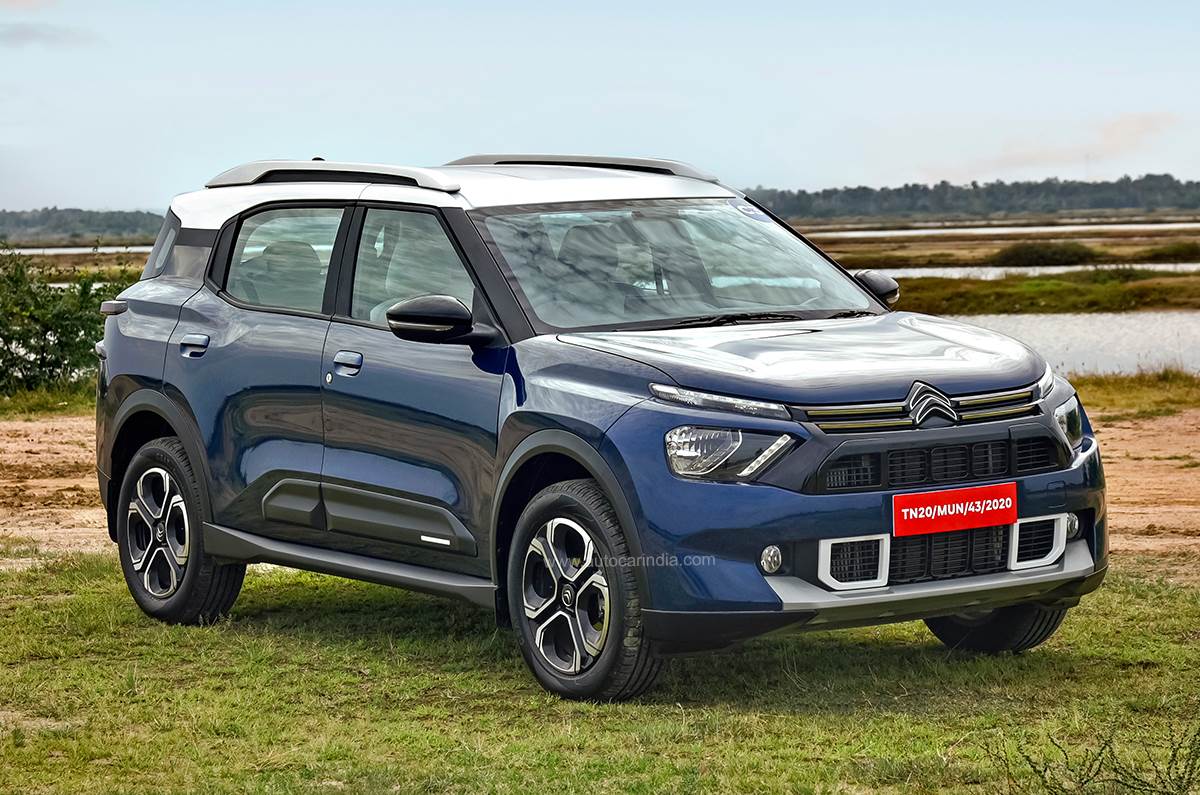
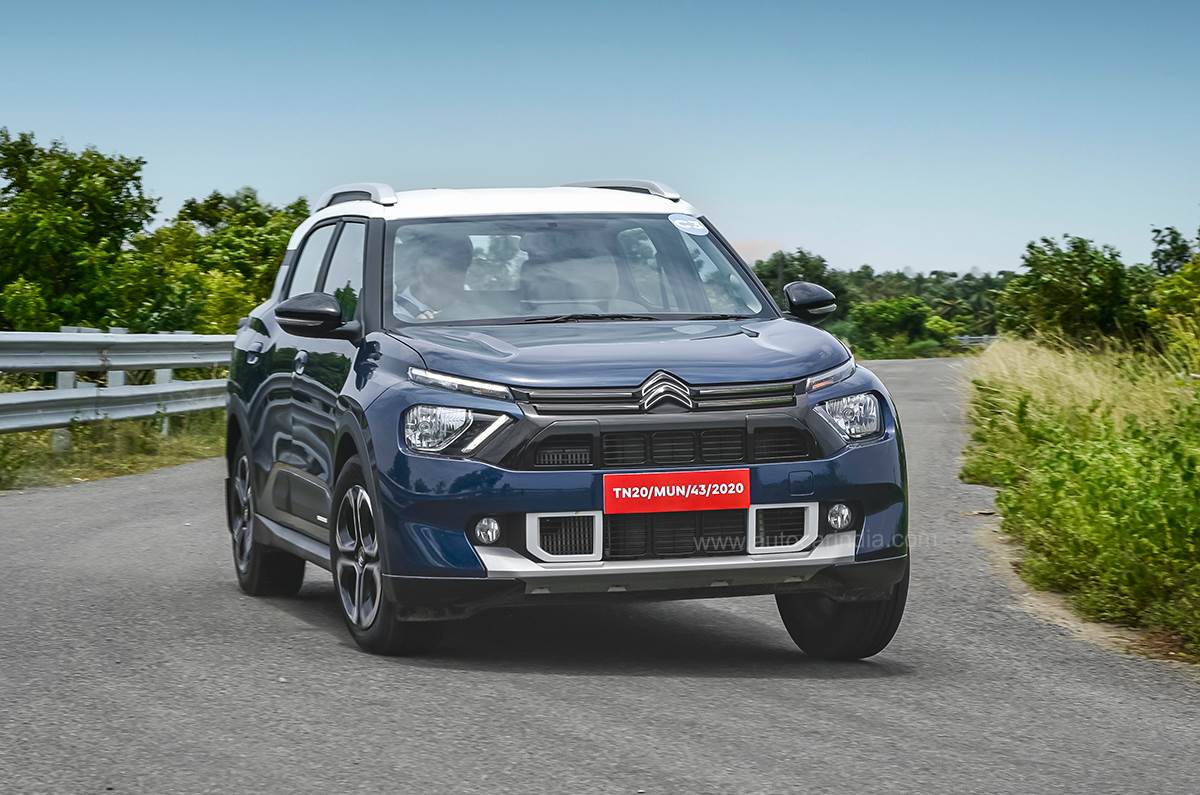
French cars have a certain design flair and individuality and the Citroen C3 Aircross is no exception. It looks refreshingly different from other mid-size SUVs and If there’s anything familiar about it, it’s because it looks related to the C3 hatchback with which it shares the same C-Cubed platform. The front in particular is very similar to the C3 and in fact right upto the B-pillar, the C3 hatch and C3 Aircross share the same sheet metal panels. That’s not a bad thing because the C3 is quite distinctive to look at and the C3 Aircross which gets a new lower bumper with a prominent skid plate with a pair of distinctive dummy housings above, looks even better. The air intake above the bumper is now wider which accentuates the width of the car and the Chevron logo finished in glossy black with a silver surround looks classier. The headlamp and DRL cluster is carried over from the C3 and so are the halogen lights. You don’t get LEDs, even as an option which is something you now expect in this segment.
C3 Aircross’ unique design has a distinctive French flair.
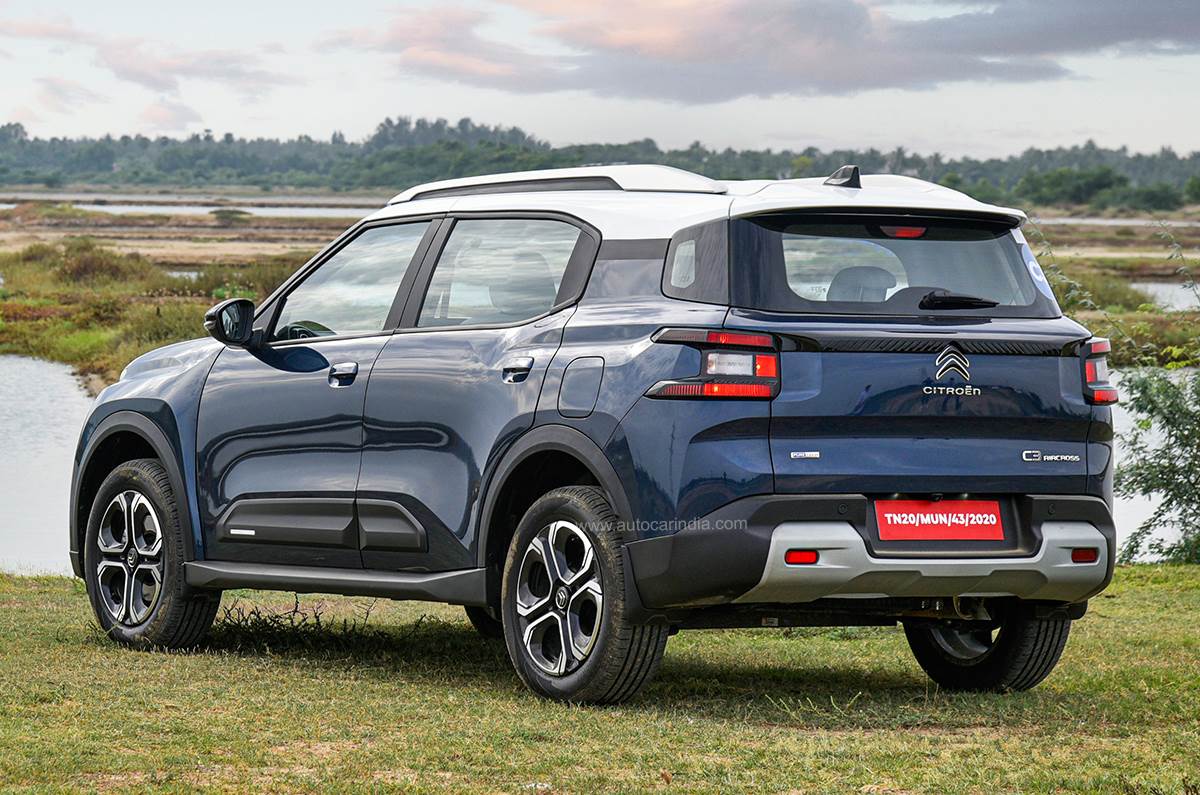
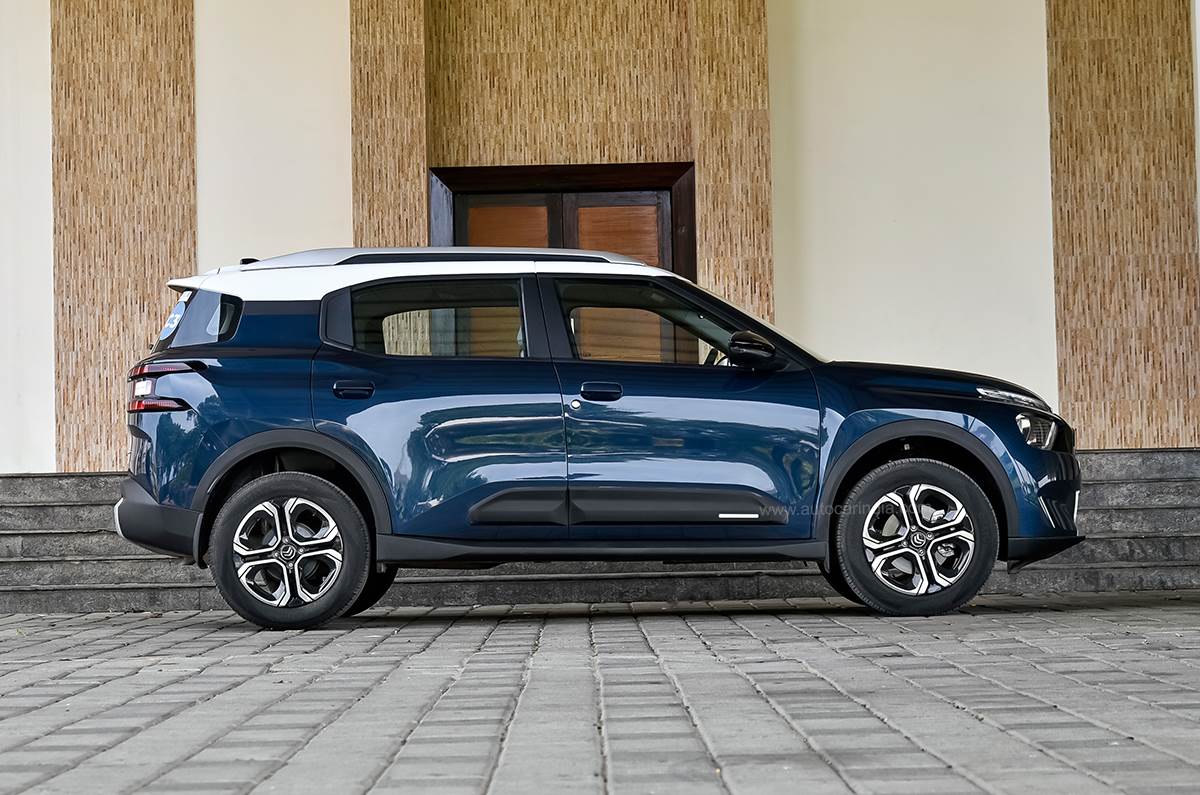
The side profile of the Citroen C3 Aircross showcases a superbly balanced design which Citroen’s designers have achieved by skillfully harmonising the upright stance with a best-in-class 2671mm wheelbase, 4323mm length, tight overhangs, and well-proportioned wheel arches and glass areas. Generous plastic cladding on the doors, a distinctive crease in the rear fender, a two tone roof and fantastic looking 17-inch ‘Quadratic’ alloys enhances the overall aesthetics even further. The striking C-shaped tail lights, prominent roof spoiler and chunky rear skid plate make the C3 Aircross attractive from the rear as well.
The two-tone roof and fantastic-looking 17-inch alloys enhance the aesthetics of the C3 Aircross.
Beneath the car, you’ll notice that the spare tire is positioned under the floor rather than inside the boot, which can make changing a flat tire a somewhat messy task. Nevertheless, the C3 Aircross boasts a distinctive and unique design, setting it apart from the crowd of SUVs.
Citroen C3 Aircross interior
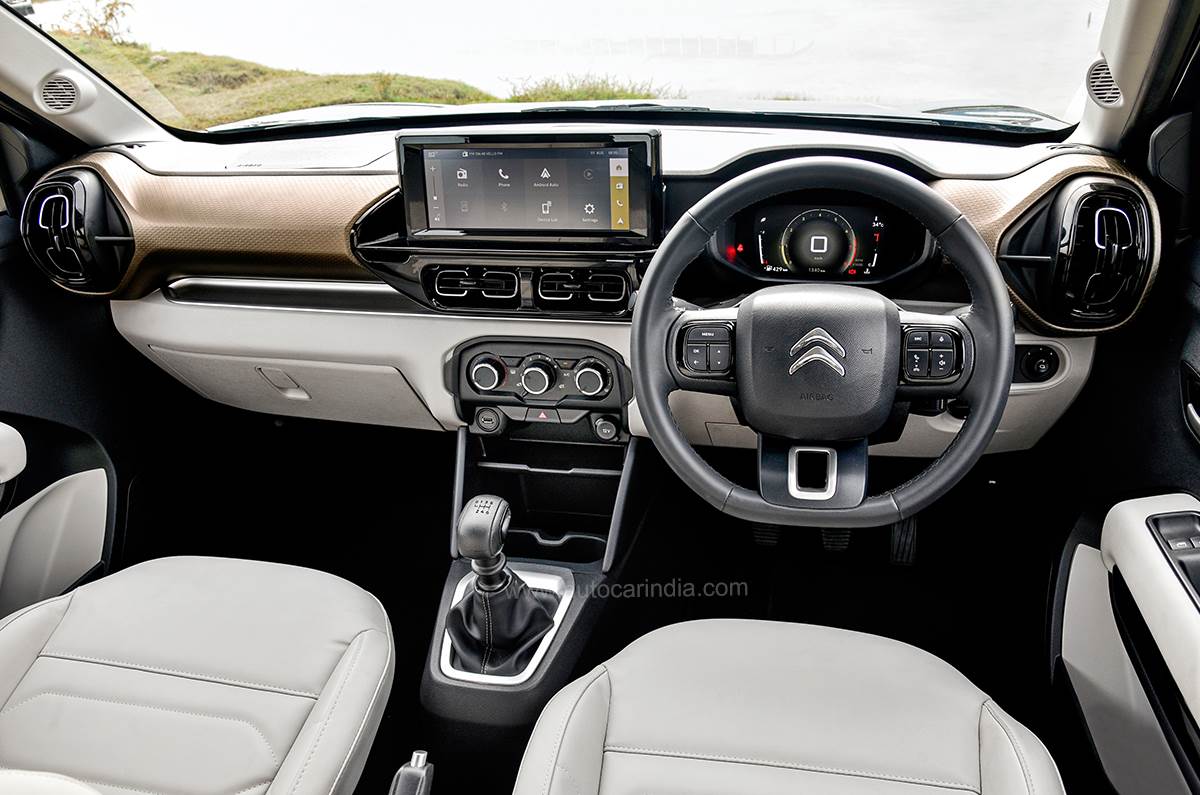
Dashboard design is interesting but cabin feels low rent.
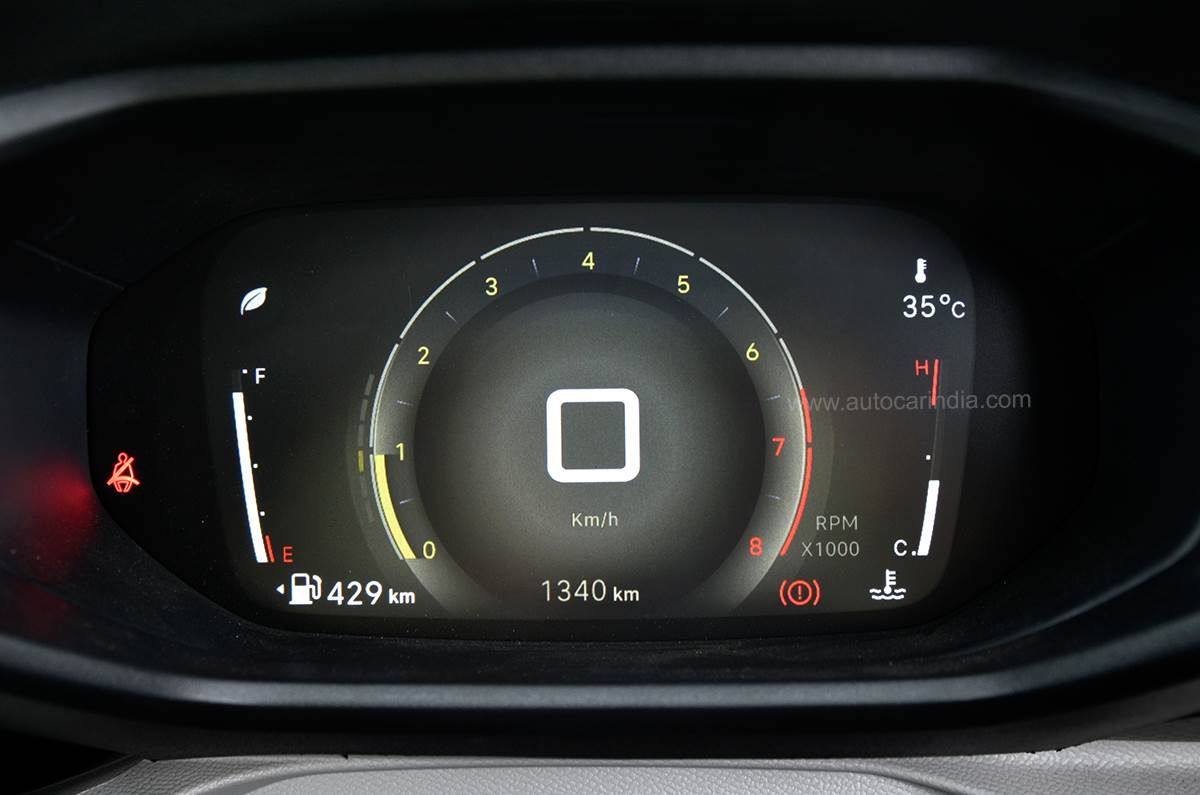
To enter the C3 Aircross, you’ll have to lift the old school flap-type door handle which has a cheap looking keyhole next to it and the non-foldable key itself looks like it belongs to a budget car from the 1990s. This first point of contact with the car sets the tone for the in-your-face paisa-pinching that abounds in the cabin. Again, the two-tone dashboard is similar to the smaller C3’s which means it’s stylish, nicely sculpted and full of interesting design details. The steering wheel too is from the C3 and gets an additional of set buttons (with a piano black surround) to play around with the different modes and displays that come with the new customisable and easy-to-read digital instrument cluster.
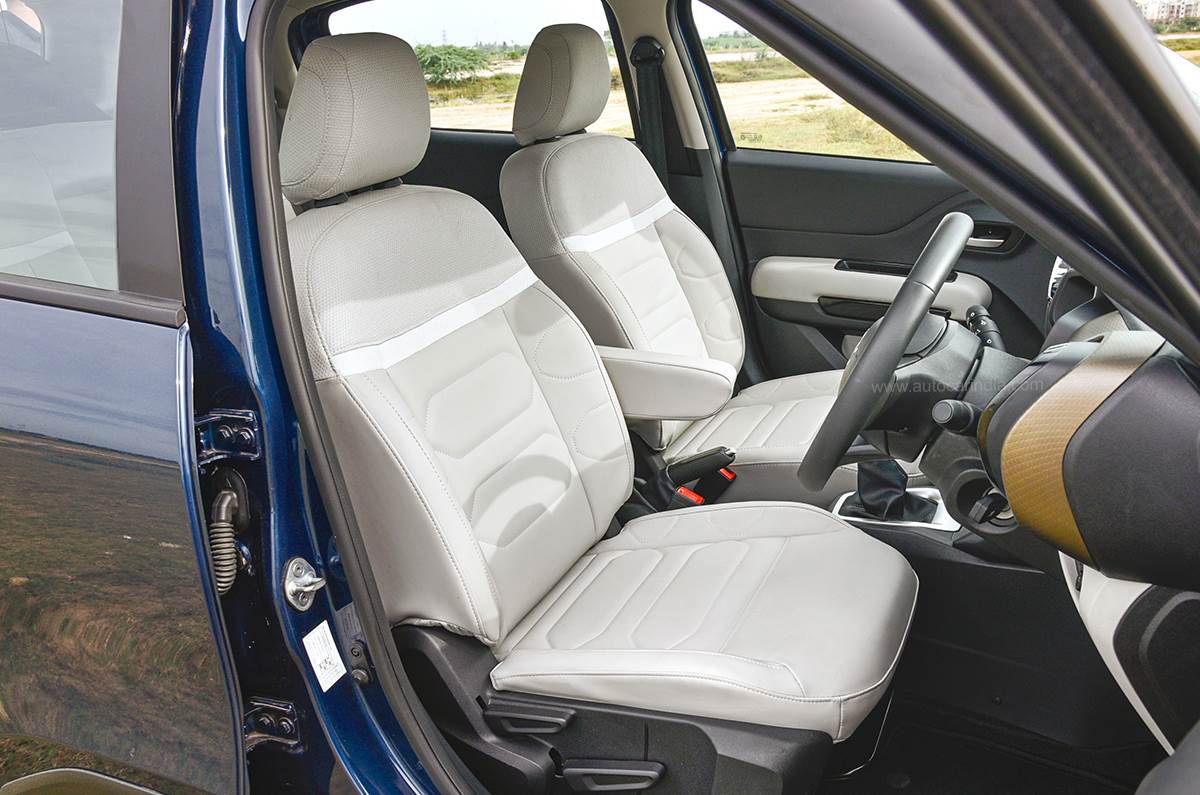
Front seat cushion a bit thin but driving position comfy. Only manual adjust.
The driver’s seat is a touch slim but nevertheless is quite comfortable with right amount of cushioning and though there is only manual adjust it’s easy to arrive at the right driving position. Short drivers can crank themselves up to a nice height for good outside visibility and all the controls too are well placed and fall nicely to hand.
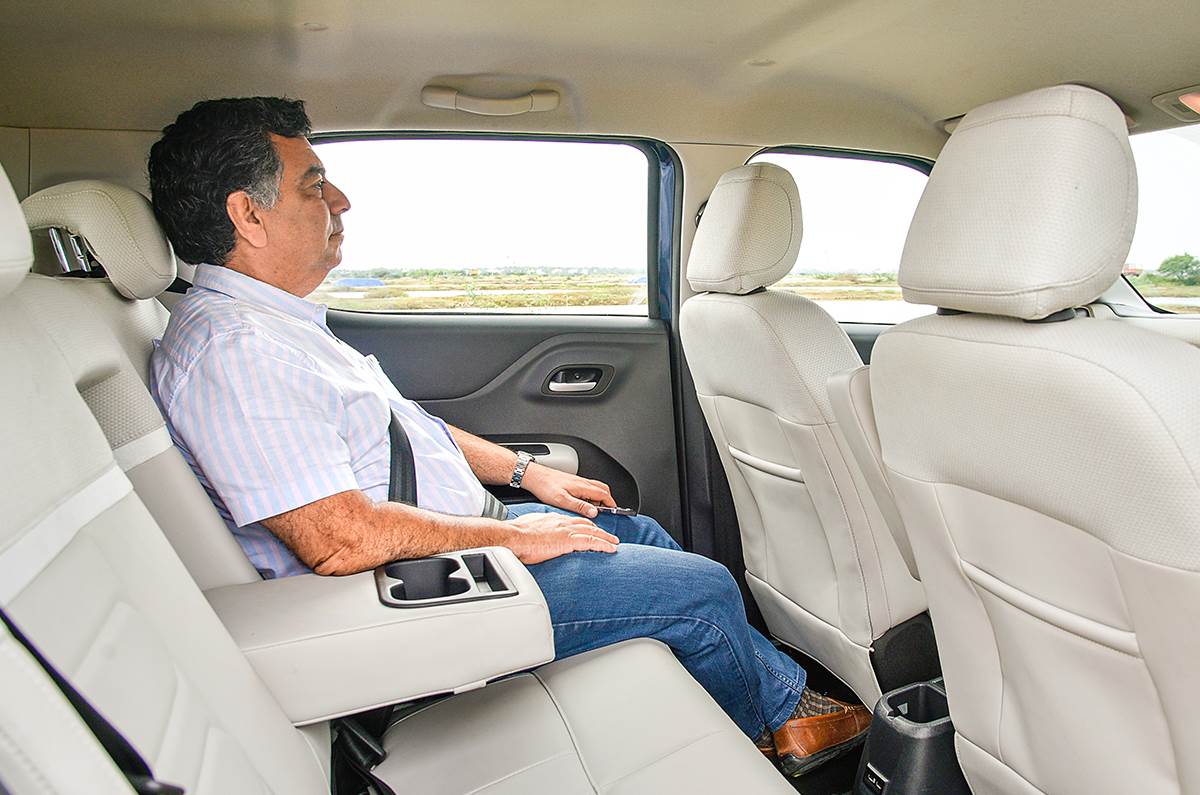
The rear seat is also a comfortable space to be with generous headroom and legroom, even for tall passengers. Though the under thigh support is a tad short, the overall cushioning and high seat position lets you spend long journeys in comfort. Citroen are masters at judging the foam density for their seats which are not too hard and not too soft.
Rear seat spacious, arm rest only available with five seater variant.
Whilst the five seater variant has an arm rest, you miss the absence of one in the seven-seater version (difficult to engineer along with the tumble function of the second row) but you do get a seat back that reclines instead which is great for long drives. There’s a moderate amount of storage space in the cabin with large door bins and bottle holders for all passengers, cupholders in the front and a reasonably sized glove box.
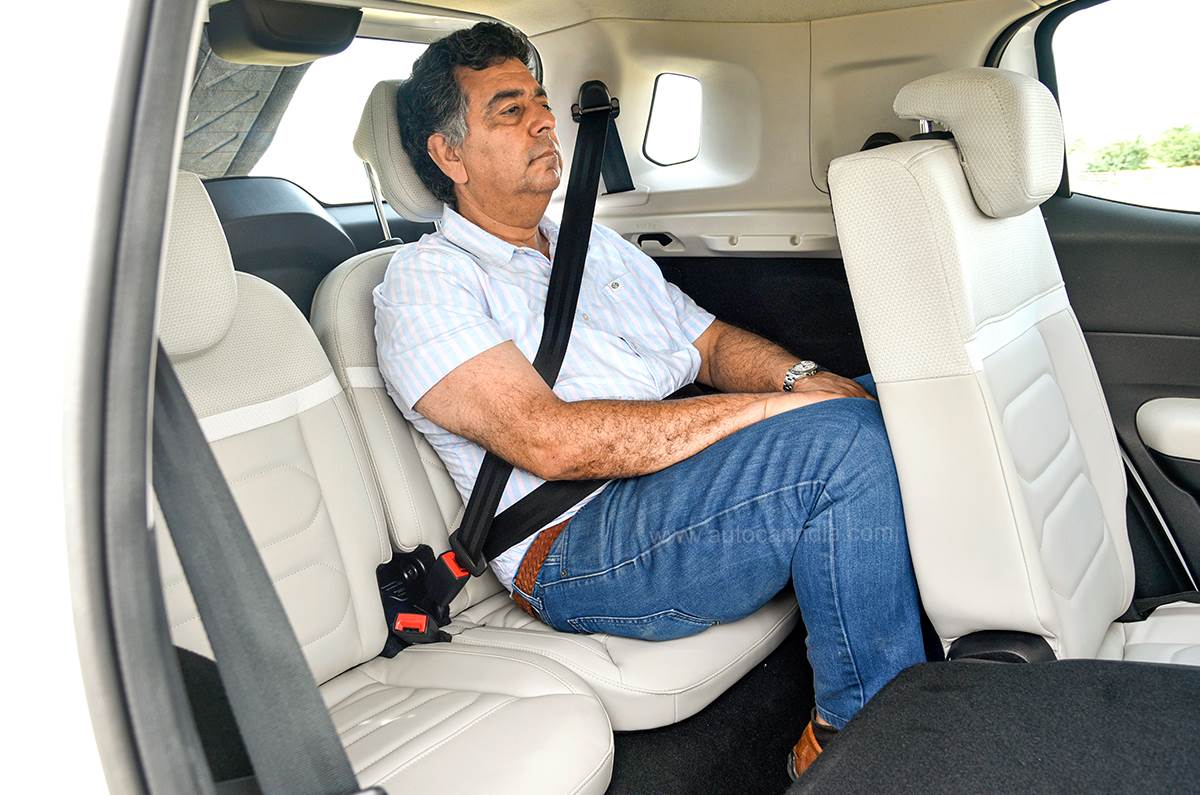
Third row very tight for adults and for short journeys only.
The seven-seater or 5+2 seats as Citroen more appropriately terms it, is a master stroke which makes the C3 Aircross the only SUV in its class to offer a third row of seats which can easily accessed thanks to a smooth tilt and tumble operation of the second row. Sure, the rear seats which are placed on the flat floor are meant only for children but even adults can squeeze in there for short drives.
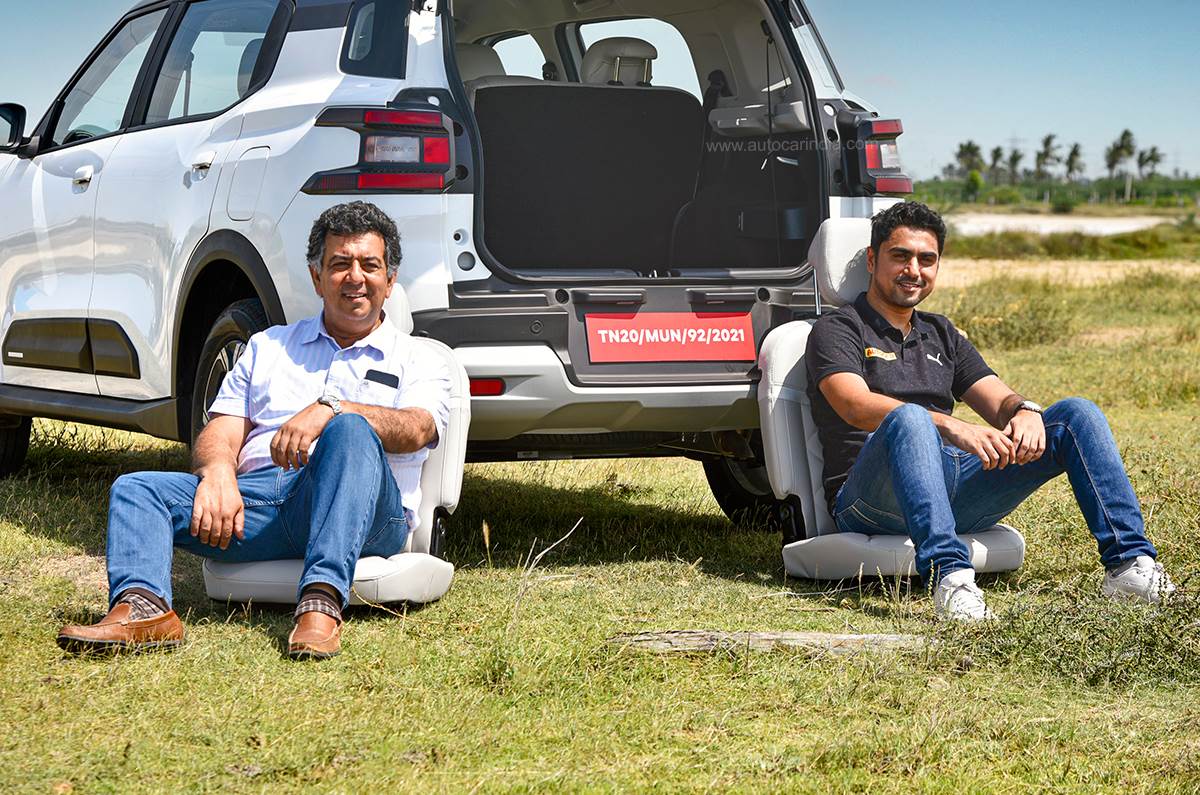
Third row pair of seats can be removed in under a minute. Useful as picnic chairs.
During a night out with friends, these tiny rear seats prove invaluable, as they can make all the difference between needing an additional car or not. And when you don’t need them you can remove them in 20 seconds flat (yes, we timed ourselves!) and either store them away or use them as picnic chairs. With both seats removed you get a clear luggage 511 litres of luggage space (a good 67 litre more than the 5 seater) which jumps to 839 litres with the second row seats folded. You can even remove just one seat and use the C3 Aircross as a six-seater with some luggage space to spare. It’s this versatility of the third row, which allows multiple configurations, that is the genius of the C3 Aircross and a great example of clever design that needn’t complicated or costly.
Citroen C3 Aircross features
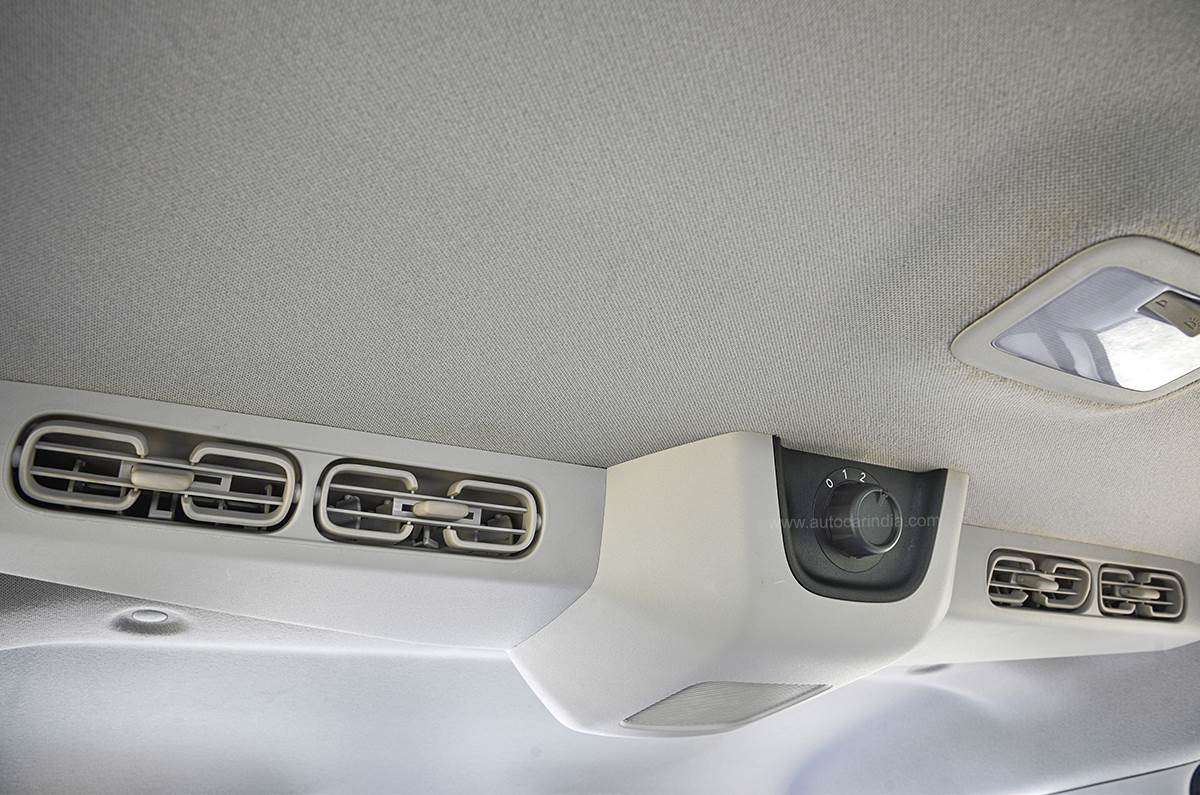
Roof mounted rear aircon vents in 7 seater looks tacky and ruled out scope for a sunroof.
The 10.2 inch infotainment system is the same as the C3’s too which means it’s slick to operate has a good touch response, clear graphics and also gets wireless Apple CarPlay and Android Auto. You also get a total of 5 USB (Type B and not Type C) charging ports (including two for the third row of seats), a get a standard rear view camera with reverse parking sensors and just two airbags as part of a feature list that is stingy by class standards. The C3 Aircross doesn’t come with one of the most desired features in an SUV today – a sunroof. What were Citroen product planners thinking?
All digital instrument cluster has multiple displays and modes.
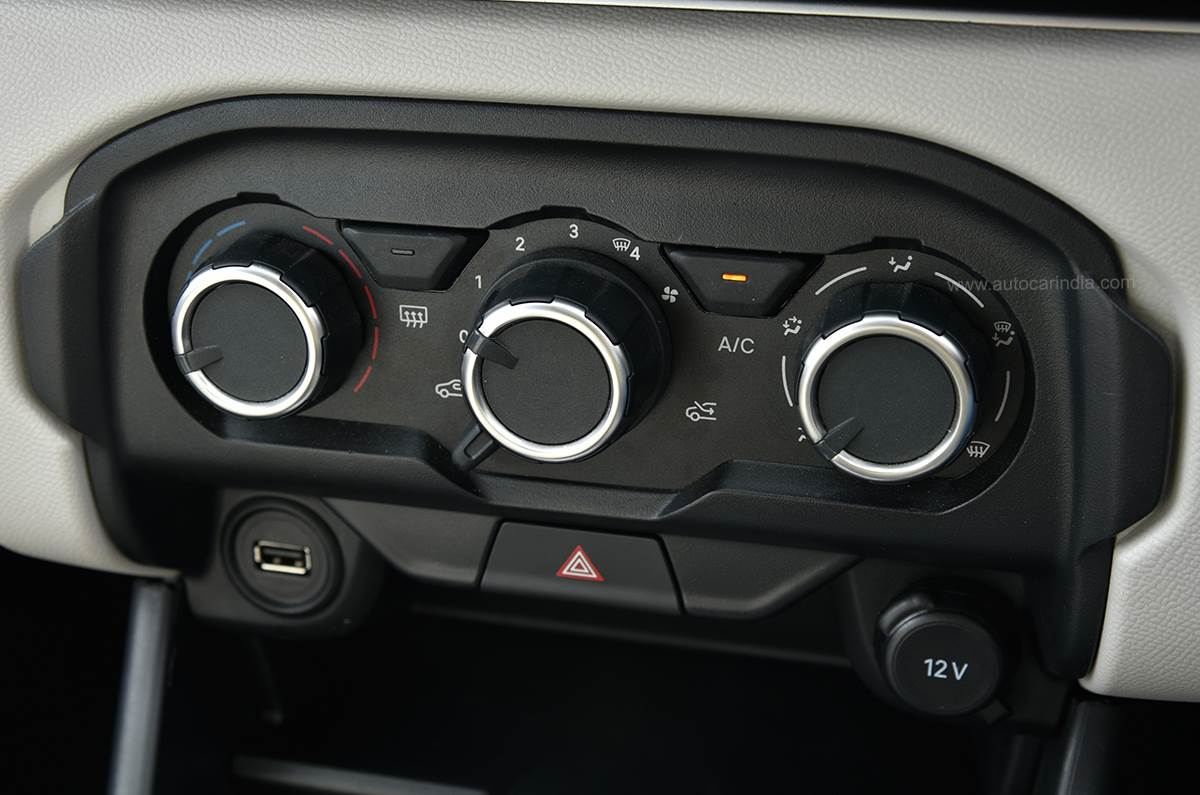
Start poking around the cabin and you’ll quickly discover where Citroen’s accountants have had the final say. Most obvious is the clunky set of knobs to manually adjust the aircon controls instead of an electronically actuated system which even hatchbacks get today. On the five-seater version there are no rear aircon vents at all whilst the 5+2 variant gets a tacky looking roof mounted rear vent but the good thing is that it gets a strong three-speed blower to effectively cool the back row. Other annoying bits of cost cutting are, no grab handle for the front passenger, and whilst there’s a one-touch auto down function for all windows, there’s no auto up. Why? Because that would have meant installing an anti-pinch function (a mandatory safety requirement to prevent injury) which would have added to cost!
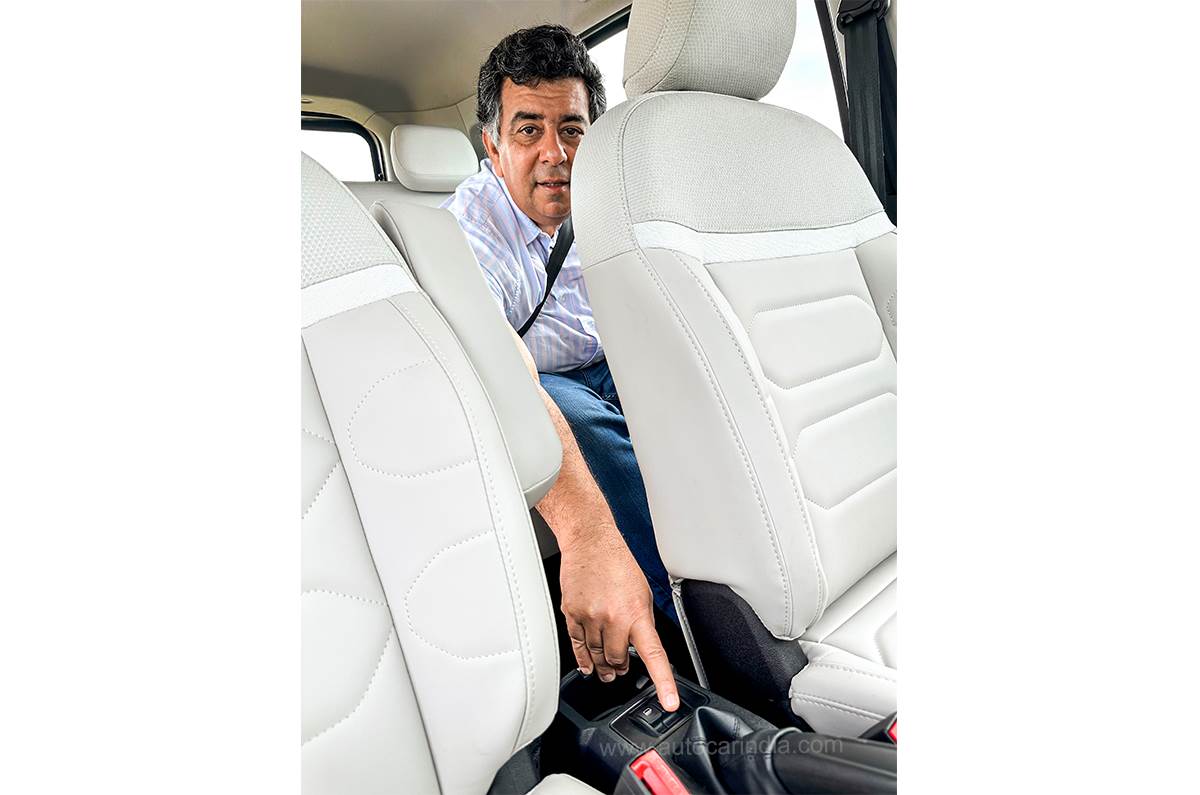
You need long hands to operate the rear windows.
Like in the C3, the rear window switches are not present on either the rear doors or the driver’s door. To reduce costs, a single pair of switches is provided for both front and rear passengers, inconveniently positioned between the front seats. This silly placement of the switches which also precludes the use of a central storage box and arm rest drew a lot of flak in the C3 and in the more expensive C3 Aircross (which gets basic fold down armrests attached to seats) it’s even more unacceptable. Citroen knows this but given the long lead times for design and engineering, it will be awhile before any changes can be done. There’s no wireless charging either and whilst the shelf in the centre console is big enough to take the largest smart phones, it doesn’t have a lip nor is it rubberised so under hard acceleration your phone slips out. It’s small details like this which irritate.
Clunky, manually operated aircon controls look and feel downmarket.
Citroen C3 Aircross powertrain
The C3 Aircross comes with just one engine and gearbox option, the same three-cylinder 1.2 litre turbo-petrol mated to a six-speed manual that powers the higher variants of the C3. There’s no diesel option which forty percent of mid-size SUV buyers want but it’s the lack of an automatic transmission, that puts the C3 Aircross on the backfoot as it eliminates around 50 percent of the SUV market which has gravitated to automatics A 6-speed, Aisin torque converter unit is in the works but that won’t come before the end of the year.
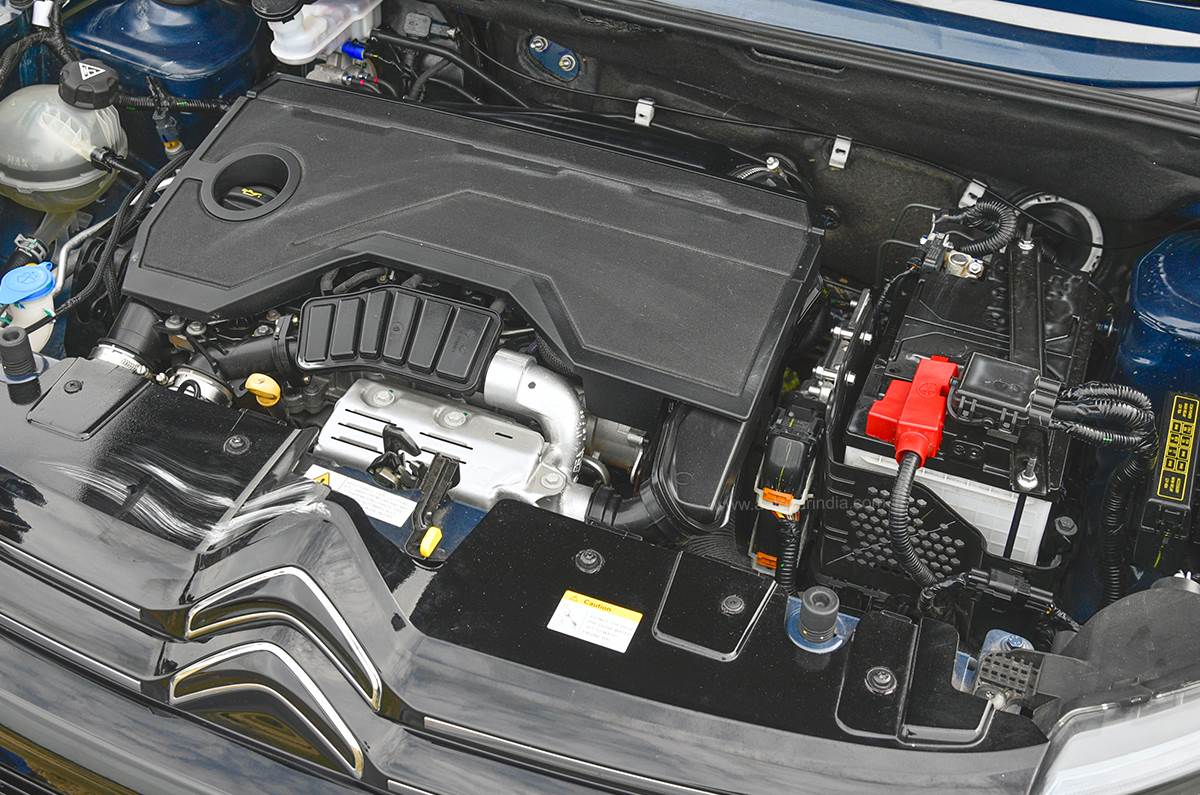
Smooth and strong 1.2 turbo petrol is the best around.
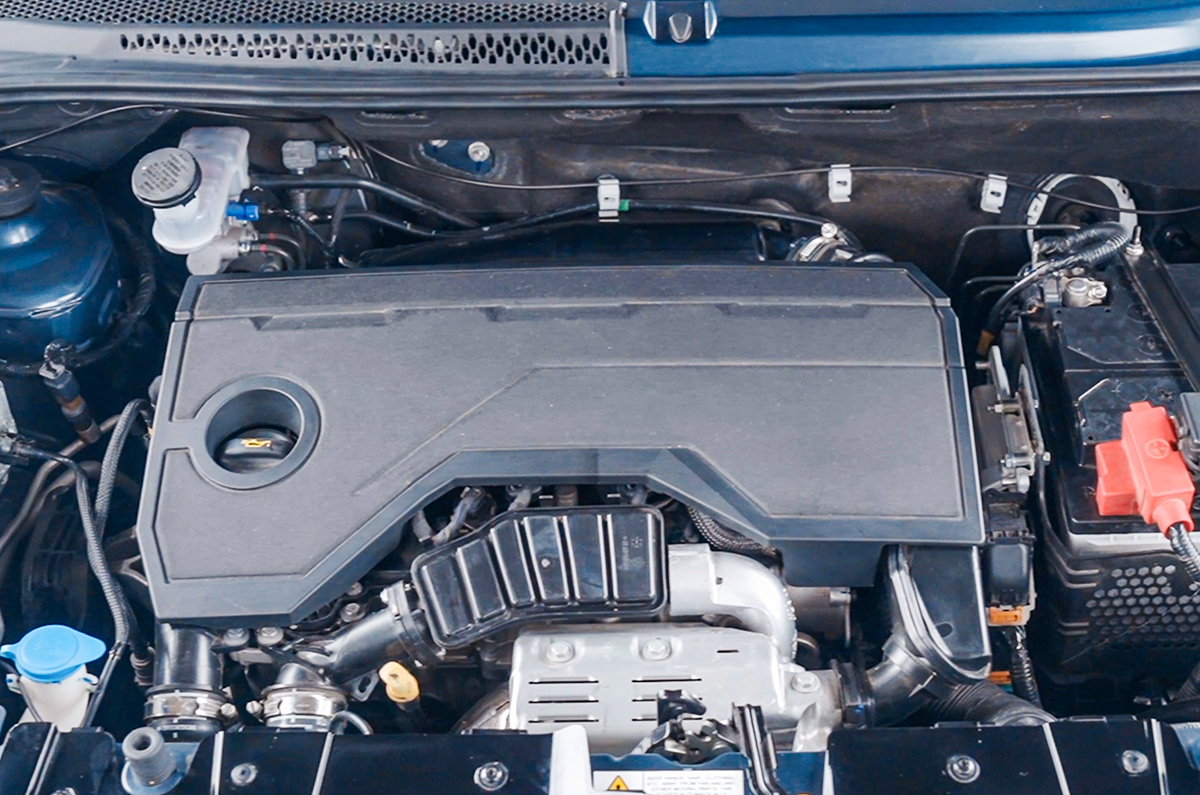
We’ve said this before and we’ll say it again, Citroen’s turbo-petrol is the best 1.2 litre engine in the market today. Updated to meet to the latest BS6.2 regulations, the latest generation of Citroen’s ‘PureTech’ engine gets the latest software and ECU tweaks but power and torque are unchanged at 110hp and 190Nn respectively The six-speed gearbox has been revamped with a shorter set of ratios than in the C3, to suit the heavier SUV.
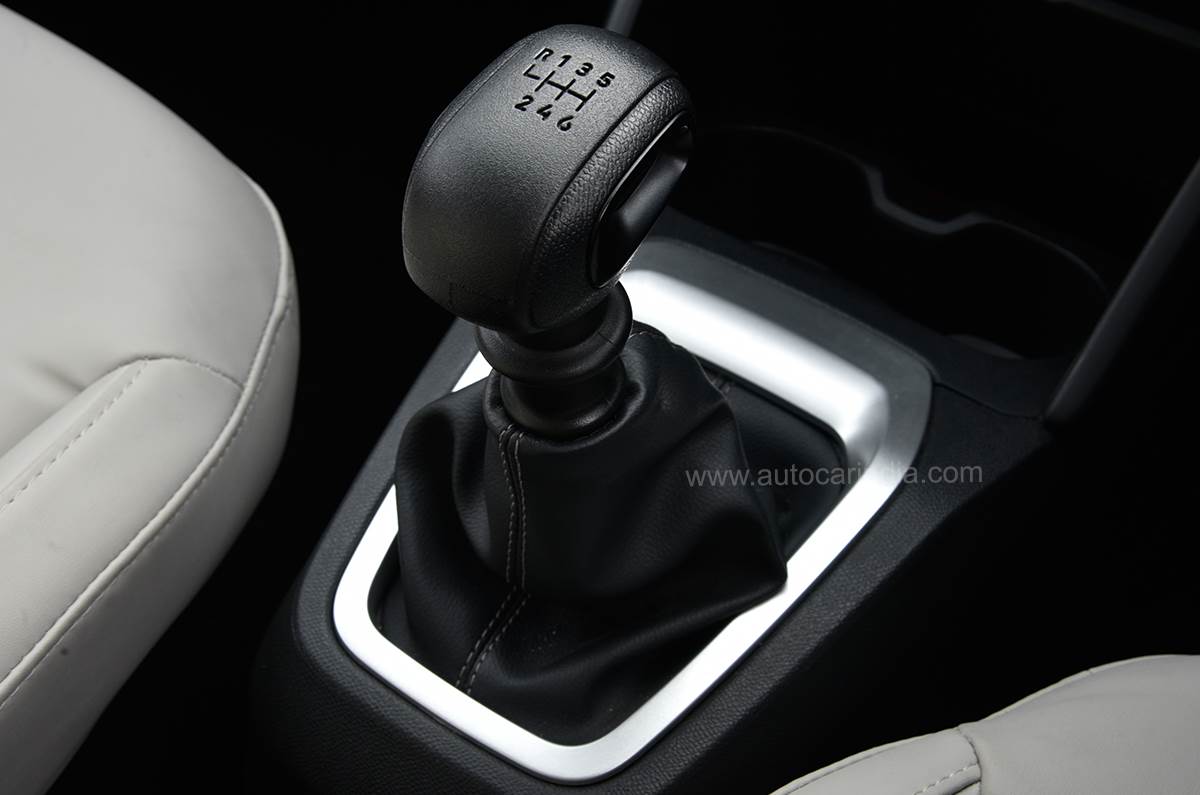
6-speed gearbox is smooth and precise with a short throw.
There’s a bit of engine rocking idle that’s typical of many three-cylinder motors but the moment you get the revs up all vibrations disappear and in fact, this engine feels incredibly smooth and refined throughout its rev range. The C3 Aircross steps off the line smartly and part throttle response is really good. It’s only when you press your right foot down hard that you encounter turbo lag and need to downshift. Keep the revs above 2,500 rpm and you get a strong, linear tug all the way to the 6,200 rev limit. Whilst the Aircross may not be as quick as more powerful rivals, you’re rarely left wanting for more power and we were truly impressed with the way the C3 Aircross briskly gathered pace. Flat out acceleration is strong, the zingy engine has a willingness to rev and a smartly stacked set of ratios drops you in the meat of the powerband with every upshift. The engine’s mid-range is particularly strong which makes overtaking easy and highway cruising a breeze. Whilst a bigger and more powerful engine would be nice to have as an option, the 1.2 turbo effortlessly does the job.
Old fashioned key doesn’t belong in a 2023 SUV.
The short throw 6-speed manual is also brilliant with smooth, precise shifts that makes gear changing a joy but the clutch is a bit snappy and needs careful modulation. Driving in bumper-to-bumper traffic underscores the need for an automatic at the earliest.
Citroen C3 Aircross ride and handling
Comfort has long been a Citroen hallmark and the softly sprung C3 Aircross sets a new benchmark for ride quality in the mid-size SUV segment. Low-speed ride is phenomenal, the suspension soaks up rough edges, potholes and ruts like a velvet sponge. This soft edge makes to the C3 Aircross a very comfortable car to ride in. At high speeds, the Aircross tends to bob up and down a bit, especially at the rear and a firmer rebound damper setting would have given a flatter ride. However this would have corrupted the all-important ride comfort at moderate speeds and bad roads and hence the suspension set-up is a happy compromise best suited for everyday use. Besides, straight line stability is fantastic thanks to the long wheelbase and the steering like we experienced in the C3 hatch is again one of the best around. It’s light at low speeds, weights up perfectly as you go faster and has little slack around the straight ahead position which lets you drive with precision and control. In fact, at speed, the C3 Aircross is a joy to drive with the confidence it inspires.
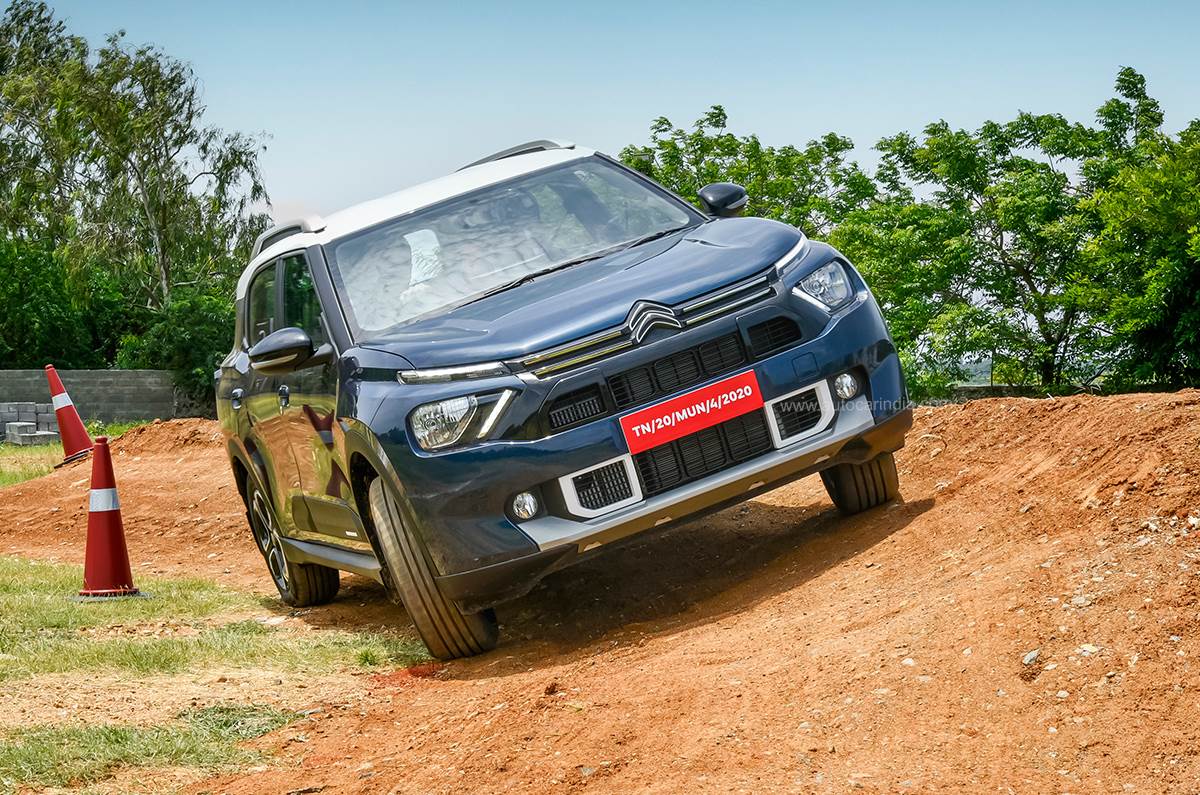
200mm ground clearance and short overhangs allows it to indulge in some off-roading.
To showcase its ground clearance and short overhangs, Citroen organised an off-road course that was more for a Jeep. Yes, the C3 Aircross clambered over obstacles with ease and the sharp inclines were a good test for the hill hold function which worked rather well.
Citroen C3 Aircross verdict
Despite being softly sprung, the C3 Aircross is a tidy handler.
There is so much to like about the unconventional Citroen C3 Aircross which in many ways is a breath of fresh air in the mid-size SUV segment. The standout design and innovative three-row configuration makes it unique in a clutter of mid-size SUVs that all follow a similar template. The 1.2 turbo-petrol is a jewel of an engine and when it comes to ride comfort the C3 Aircross is in a different as well. Sadly, great product engineering can be undone by poor product planning and whoever specced the C3 Aircross has little understanding of the Indian consumer. Offering just a single petrol engine with no diesel or automatic options seriously limits the Aircross’ appeal but what’s worse is the lack of features and the in-your-face cost cutting. The C3 Aircross is a no-frills car that will need a no-frills price tag if it is to have a fighting chance. Prices will be announced in September with deliveries starting in October. Let’s hope Citroen surprises us.
Mahindra and Mahindra have teased an electric version of the Thar. It will be called Thar.e and will make its debut in concept form on 15th August in Cape Town, South Africa where the Mahindra is hosting an event called ‘Futurescape’ where the manufacturer will be showcasing a global tractor platform and a pick-up truck concept as well.
By: Paarth Khatri | Updated on: 05 Aug 2023, 12:44 PM
A screenshot from the teaser that Mahindra shared.
Not much is known about the Thar.e as of now. However, it can be expected that Mahindra will either re-purpose the existing platform of the Thar so that it can be used to fit batteries and electric motors or they will base the Thar.e on an all-new dedicated electric skateboard platform. Mahindra already has an electric platform called INGLO on which its upcoming electric SUVs will be based on.
Considering that Thar is an off-roader and comes with four-wheel drive, it makes sense for Mahindra to equip its electric version with a dual-motor setup where one motor sits on the front axle and another one sits on the rear axle. Having said that, what would be the icing on the cake would be a proper quad-motor setup. This means that each wheel will have its own electric motor to modulate the torque and traction individually while off-roading.
The teaser also shows us a glimpse of the rear tail lamp whose design is in line with the current Thar. So, it is a square unit with a smaller square inside. Considering this, it can be expected that the current design language of the Thar will mostly stay intact but will get a few changes here and there so that it can be recognized as the Thar.e and not the ICE version of the Thar.
Apart from this, it is important to note that Mahindra is only showing the concept version of the Thar.e so the production-spec version is still a few years away. Speaking of concepts, Mahindra will also showcase a pick-up truck concept which is expected to be based on the platform that Scorpio N and the upcoming Thar 5-door will use. Again, we do not know when the production-spec version of the pick-up truck will launch.
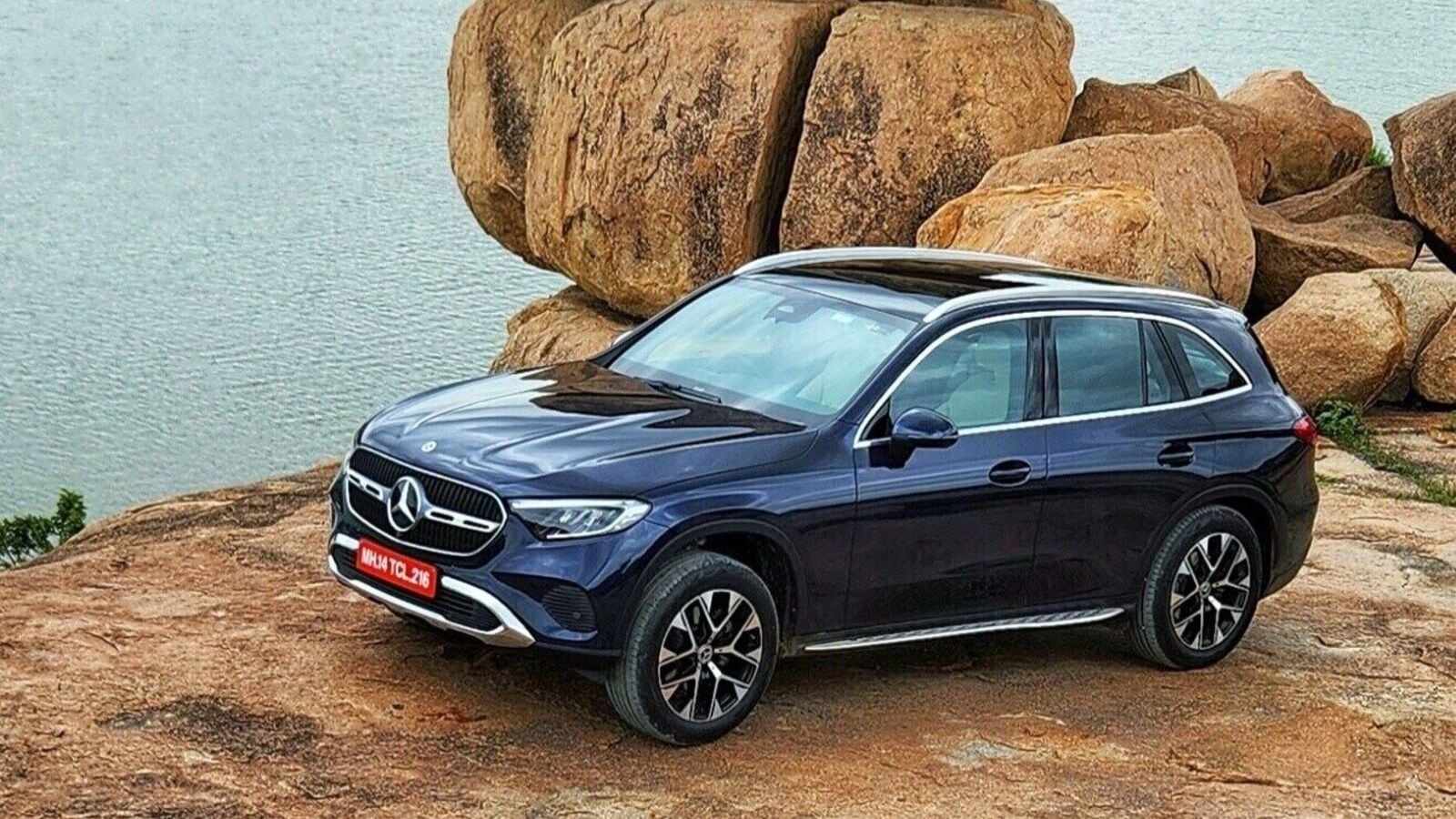
Mercedes-Benz has revealed the new-generation GLC for the Indian market and the brand’s bestselling SUV has witnessed a complete overhaul over its predecessor. The new offering is larger, more luxurious and packs updated powertrain options as well. Here’s a more detailed look at what we can expect from the second generation Mercedes-Benz GLC.
By: HT Auto Desk | Updated on: 05 Aug 2023, 12:16 PM
The 2023 GLC is now larger, more luxurious and loaded with features.
The 2023 Mercedes-Benz GLC will be offered with the familiar 2.0-litre petrol and diesel engines paired with a mild-hybrid motor. The updated engines are paired with a 9-speed automatic transmission with All -Wheel Drive (AWD) as standard. The petrol unit develops 254 bhp and 400 Nm of peak torque, while the diesel churns out 194 bhp and 400 Nm of peak torque. The mild-hybrid further gives an additional boost of 200 Nm that helps improve low-end acceleration and overall fuel efficiency.
The cabin has seen a major upgrade and mimics that of the new-generation C-Class. This includes the new floating digital instrument console and the larger, vertically-stacked 11.9-inch touchscreen infotainment system. The unit runs the latest MBUX UI and gets a host of features including navigation, voice command, customisation options, along with telematics and more. The SUV is also loaded on the feature front with premium leather upholstery, a panoramic sunroof, Burmester sound system, three-spoke multi-function steering wheel, park assist and more.
On the design front, the second generation Mercedes-Benz GLC gets evolutionary styling. It’s still recognisable but looks bolder with cleaner lines all over. The SUV is also roomier with better legroom and shoulder room. It continues to be a five-seater and is positioned above the GLB in the brand’s lineup.
Watch: Mercedes GLC 2023 SUV: First Look
With respect to colour options, the new GLC will be available in five shades Nautic Blue, Mojave Silver, Selenite Grey, Polar White, and Obsidian Black. The cabin will get three interior themes including Black, Macchiato Beige, and the new Sienna Brown.
Bookings for the new GLC have already begun across the country for a token of ₹1.5 lakh, while deliveries will take place soon after the launch. The new-generation offering is set to go on sale on August 9, 2023, which is when we get to know the prices as well. The compact luxury SUV will be available in two variants at the time of the launch – 300 4MATIC and 220d 4MATIC. The new GLC will compete with the Range Rover Evoque, BMW X3, Audi Q5 and the Volvo XC60 in the segment. Do check out the new GLC’s review coming soon.
The Thar.e will likely be based on Mahindra’s new born-EV platform.
Mahindra has teased the upcoming Thar EV concept, ahead of its global debut on August 15 in South Africa, which confirms our previous scoop. The teaser shows the electric offroader concept will be called the Thar.e.
Mahindra Thar.e concept will debut in South Africa
Alongside, Mahindra will also showcase a pickup concept
Besides the moniker, the social media teaser also gives us a few more hints of what to expect. In terms of styling the concept will feature Squircle like design elements seen in the LED lights teased. The lights also show a pixel structure similar to the pickup concept that Mahindra will showcase at the event.
The biggest clue to what we can expect however is the Born Electric lettering, indicating the concept – and thus the production car – will be built on the new dedicated EV platforms that Mahindra are readying.
Electrifying a ladder-on-frame platform is technically possible and quite a few brands have done so, for example the Ford F150 Lightning pickup. Given that Mahindra is also a commercial vehicle manufacturer, electrifying ladder-frame vehicles is something it needs to look into, it has also said it is doing so previously.
However, using the new born electric platform for the Thar.e Mahindra will not have to struggle with weight and space issues the current Thar’s ladder-frame would pose. This would therefore also give the Thar.e a better range with a lower weight and more space for batteries. For now details like its range and powertrain and not known but more will likely be unveiled at the August 15th event, where Mahindra will also showcase a pickup concept, so stay tuned.
Note: If you prefer watching the review in Hindi instead of reading it in English, then you can play the following video:
2023 Kia Seltos Facelift – Safety Features
The facelift of the Seltos primarily involves cosmetic changes and feature upgrades, with no major alterations to the platform, chassis or its build quality. If there are any changes, it’s not possible for anyone to determine whether this Seltos is any safer than the older version, solely through visual inspection or by opening and closing its doors.
As of now, no third-party agency has conducted a crash test on the India-spec new Seltos facelift. Given that there’s no significant change in its structure, we will consider the injury report of the pre-facelift Seltos. According to Global NCAP data, the pre-facelift Seltos crash test offered Adequate protection to the driver’s head, Good for the neck, and Marginal for the chest. These are the three areas where injuries can potentially be fatal. We do not consider Global NCAP’s body shell integrity as, in the end, the only thing that matters is the extent of the injury to the occupant.
If there’s no change in the construction, and the car gets more safety features – which it does – and if the car is subjected to the same test, then it’s understandable that the driver injury should not exceed that of the old Seltos.
Since there’s no weak or poor rating for the driver’s head, neck, or chest in the Seltos crash test, based on Global NCAP’s data, you can consider the Seltos from a safety perspective.
Regarding safety technology, in addition to the standard safety features, the Seltos gets the following safety features as standard:
2x front side thorax curtain airbags
2x curtain airbags
All 3-point seatbelts
Rear disc brakes
Electronic stability control (ESC)
Hill start assist (HSA)
Tyre pressure monitoring system
Automatic door lock/unlock
You can now see all the safety-related features of all variants in the following table:
2023 SELTOS | VARIANT-WISE SAFETY TECH
HTE
Std. safety features
2x front side thorax airbags
Emergency stop signal
Remote central locking*
Rear disc brakes
2x curtain airbags
Day/night inside mirror*
Electronic stability control (ESC)
Halogen projector headlamps
Hill start assist (HSA)
Impact-sensing auto door unlock
Speed-sensing auto door locks
5x 3-point seatbelts with reminder
Tyre pressure monitoring system
HTK
Rear parking camera w/ live feed
Projector fog lamps
Front parking sensors
HTK Plus
Rear washer wiper
Rear defogger
2023 SELTOS | VARIANT-WISE SAFETY TECH
HTX & HTX Plus
LED headlamps
LED projector fog lamps
LED tail lamps
ISOFIX
Traction control w/ modes (Automatic Only)
Auto-dimming inside mirror
GTX Plus & X Line
Blind-spot monitoring in instrument cluster
360-degree parking camera
Electronic parking brake with auto hold
Auto wipers
ADAS Features
Blind spot monitoring, warning and avoidance assist
Auto high beam
Rear cross traffic warning and collision avoidance
Adaptive cruise control with stop and-go
Forward collision warning and avoidance assist
Safe exit warning
It is worth noting that the Seltos GTX Plus and X Line variants now come equipped with ADAS (Advanced Driver Assistance Systems) technology. During this initial drive, we tested the Seltos front collision avoidance, rear cross traffic avoidance assist and safe exit warning ADAS features and they worked satisfactorily. Now, let’s talk about the 2023 Seltos facelift exterior.
New Kia Seltos 2023 Turbo X Line – Exterior Review
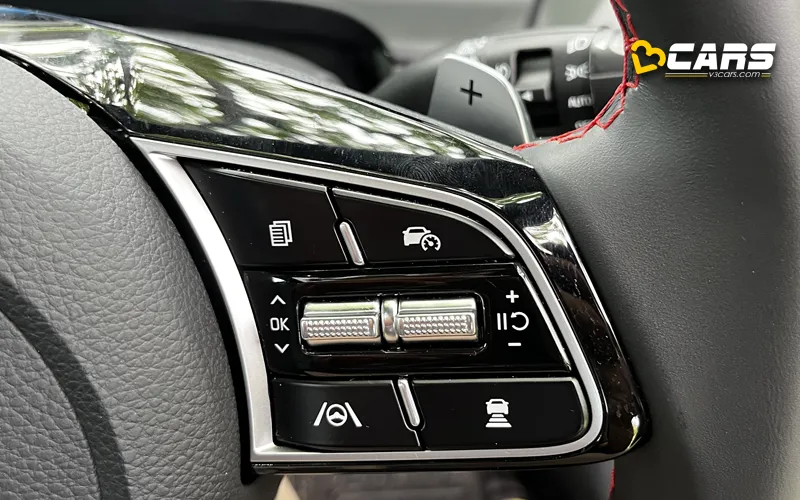
Before we discuss the exterior, I believe we should talk in detail about the new key with buttons on the side — it feels nice to hold.
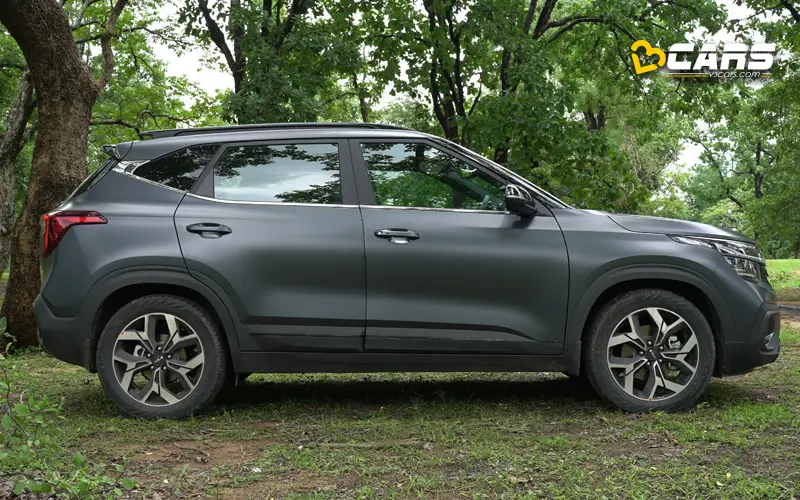
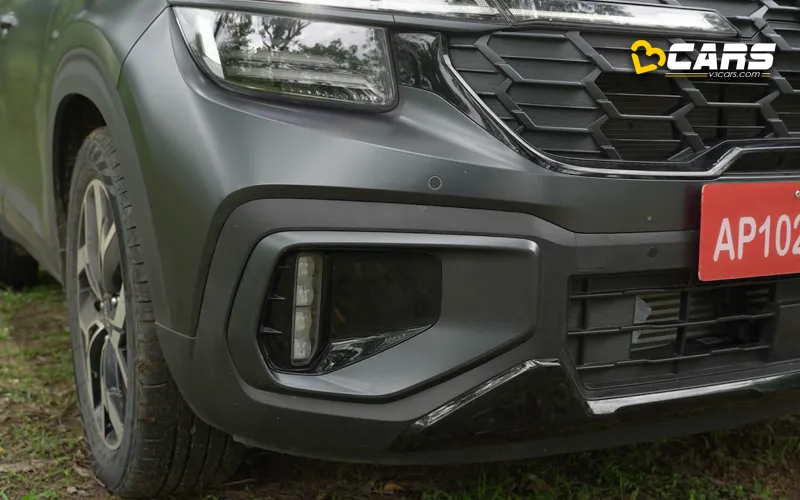
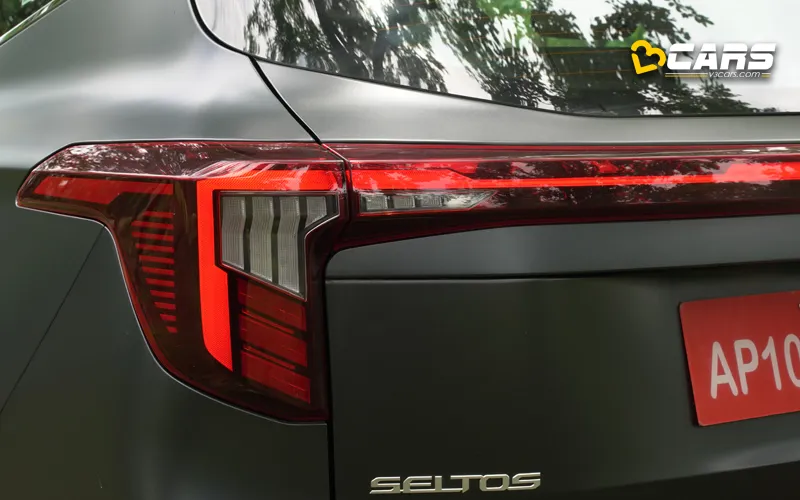
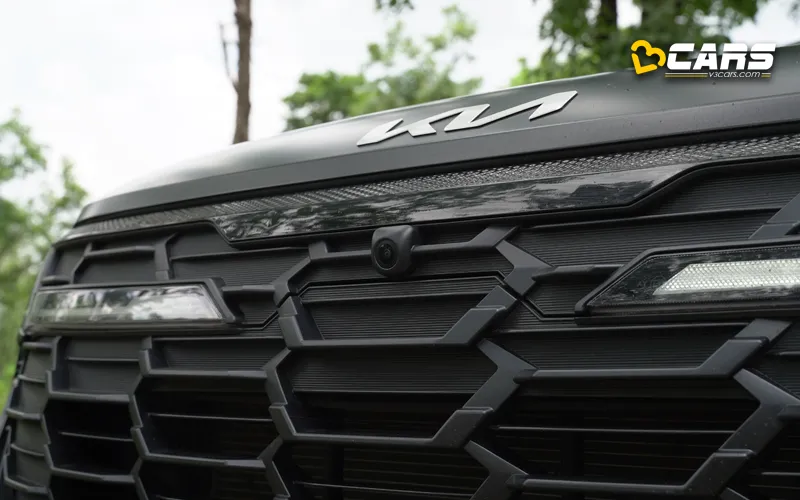
We drove the X Line version of the Seltos, which comes in a matte grey colour. If we compare the changes to the pre-facelift Seltos, its front grille is now larger and gets a new design for the front bumper. The honeycomb pattern of the grille is different and the new DRLs extend through the grille. Speaking of lightwork, it now includes sweeping turn indicators, front and back, and it adds a nice styling touch to the exteriors.
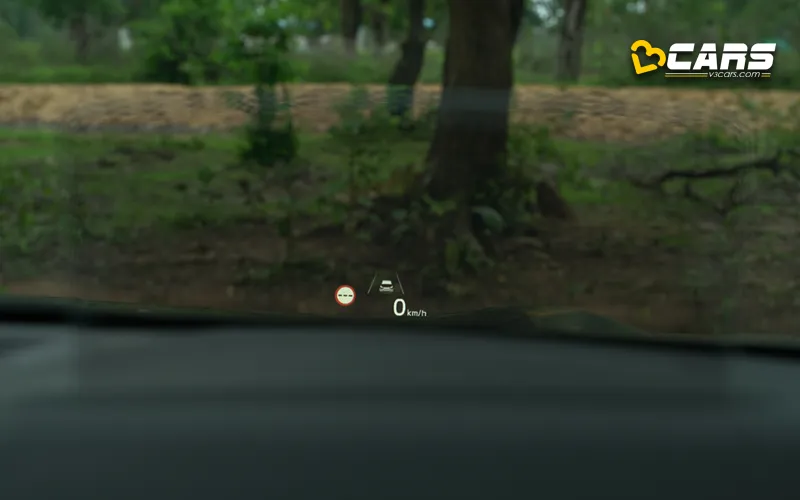
Moving to the front bumper, it now has extra cladding, giving it a more muscular design. Like before, it houses the LED fog lamps. As we mentioned at the beginning, the Seltos now comes with ADAS. It has a radar in the front bumper with the front camera behind the windshield.
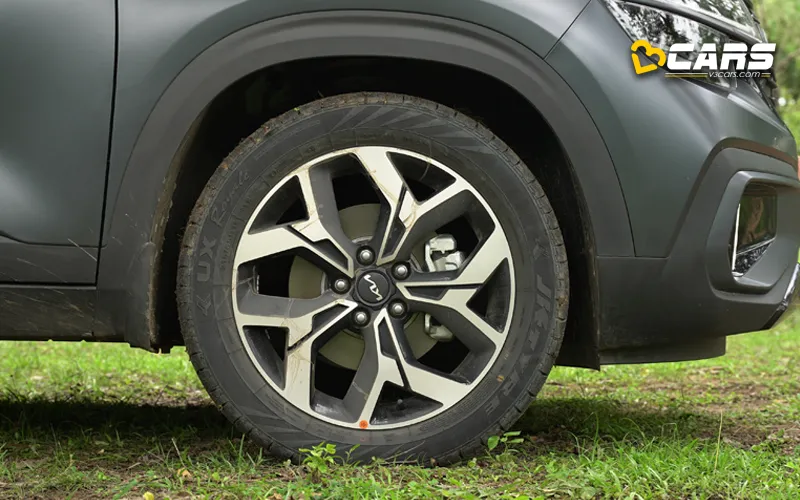
The Seltos facelift gets alloy wheels measuring 18 inches in the top variant and with a new design. This is the most prominent visual change on the side. It’s worth pointing out that the Seltos now has glossy black trim in many places, but there’s no red or any other coloured detailing in any variant. Earlier, the GTX variant had red accents on the exterior and interior to highlight its sporty nature.
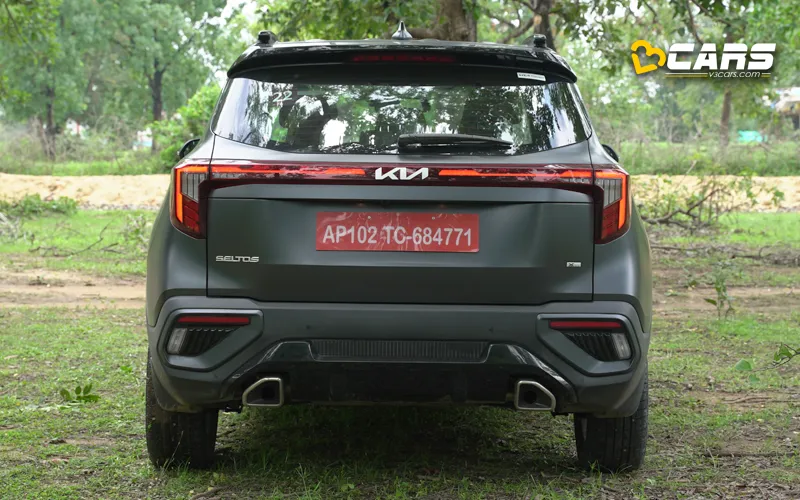
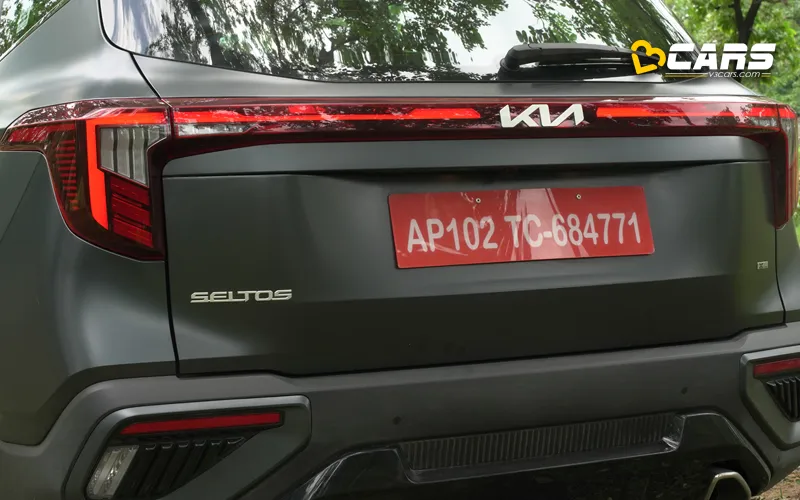
In terms of the rear design, it has significant changes. The new Seltos now has a new set of tail lamps that are sleeker and almost interconnected. The design of its rear bumper is also new, and like before, it still has thick cladding. This version also gets functional dual exhausts, and the overall rear look is simple and appealing, yet sporty.
I personally feel that the exterior design of the pre-facelift Seltos is still appealing. But with the new colour options and other design upgrades, the Seltos 2023 has a fresh approach to the exterior design compared to the predecessor. It is an obvious improvement over the already pleasing exterior of the Seltos. Now, let’s look at its interior.
2023 Kia Seltos – Interior Review
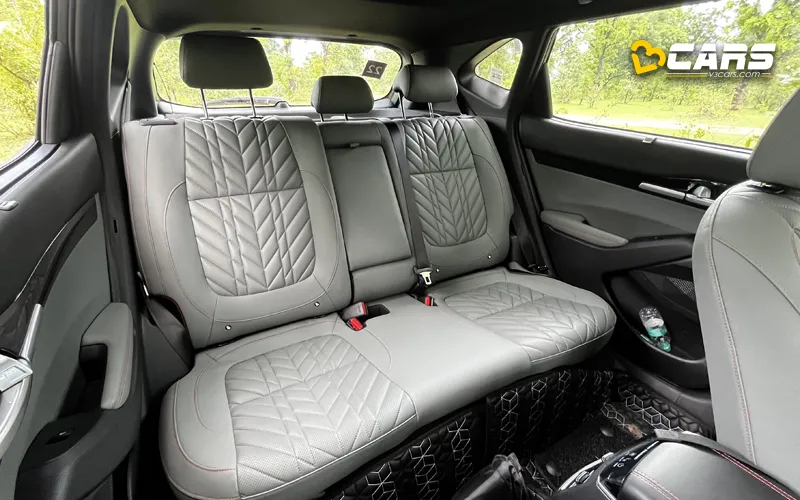
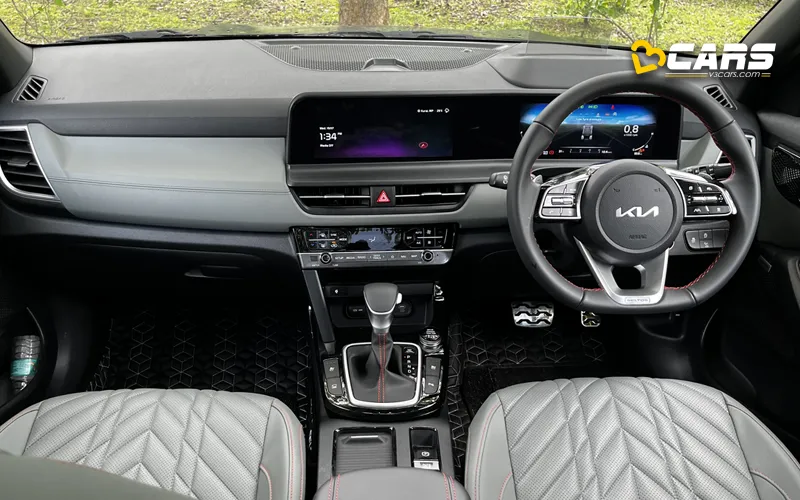
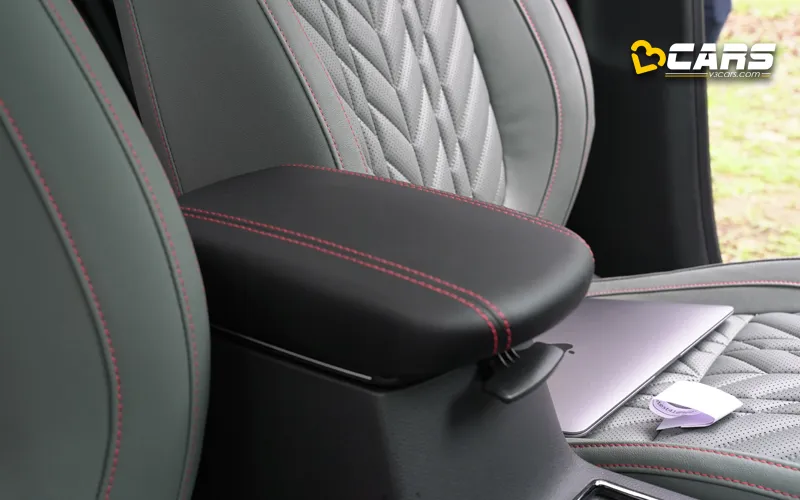
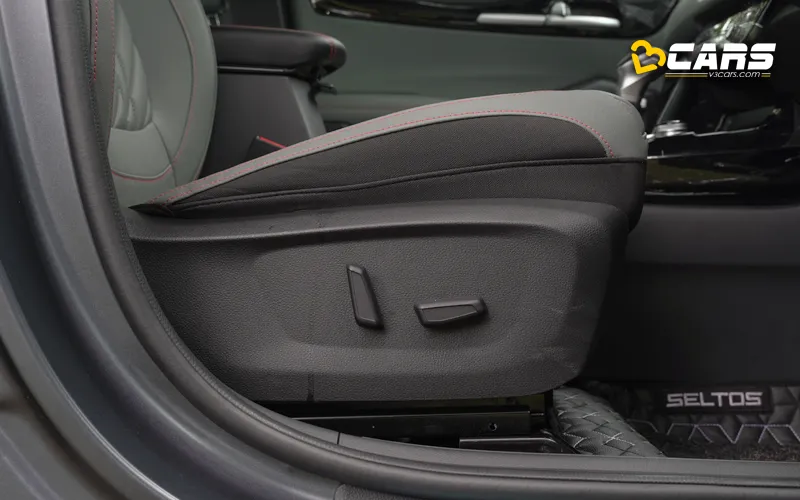
In addition to beige-black, brown-black and all-black interior themes, the Seltos X-Line variant brings a greyish green-black interior. This colour combination feels premium and it also gets a leather finish on the dashboard and upholstery with some contrast red stitching.
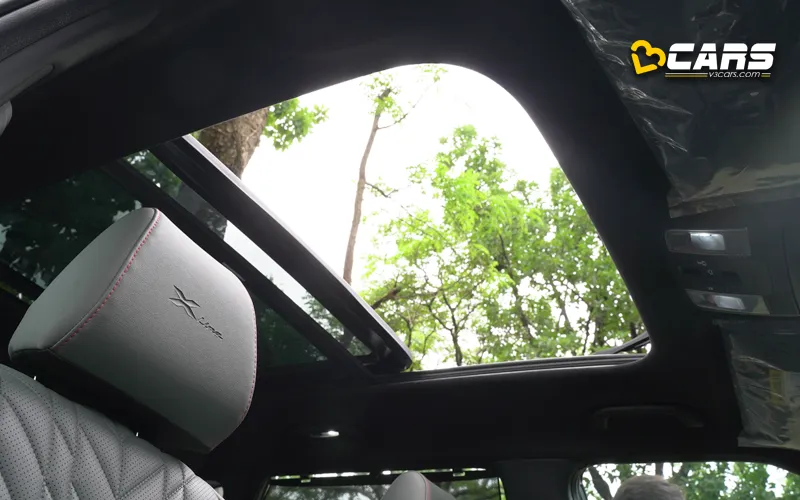
The interiors instantly appear tastefully done. Along with this, the roof liner is black around the large panoramic glass sunroof. The sunroof curtain is so thick that light doesn’t pass through it. For my height of 5-feet 8-inch, there’s ample headroom in front as well as rear seats.
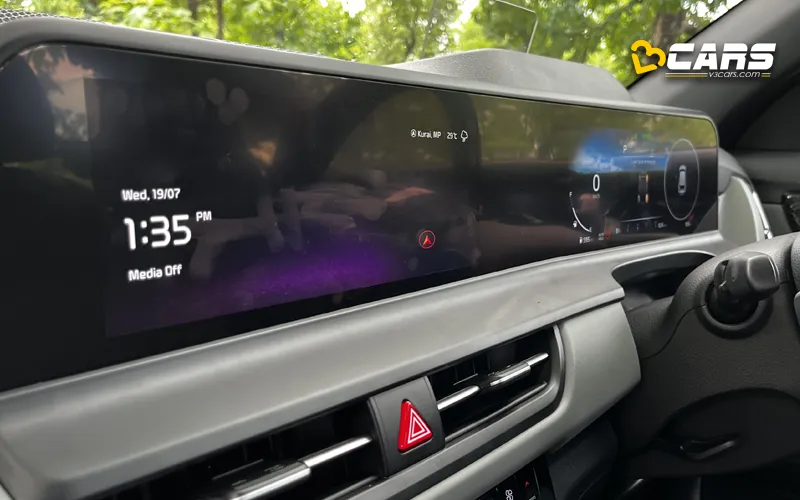
Now, coming to another prominent change in the cabin – the dual-screen curved housing. It integrates two 10.25-inch screens, making the dashboard layout look neat and modern at the same time. The touch feedback of its infotainment system is satisfactory, and there are a lot of features available here.
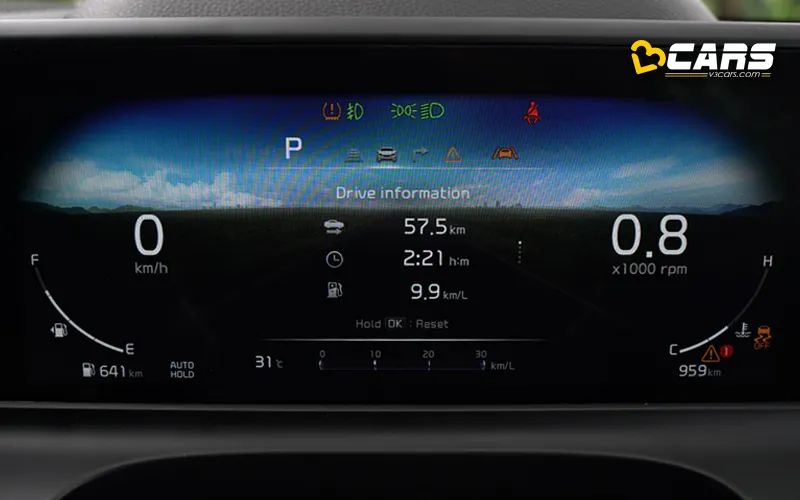
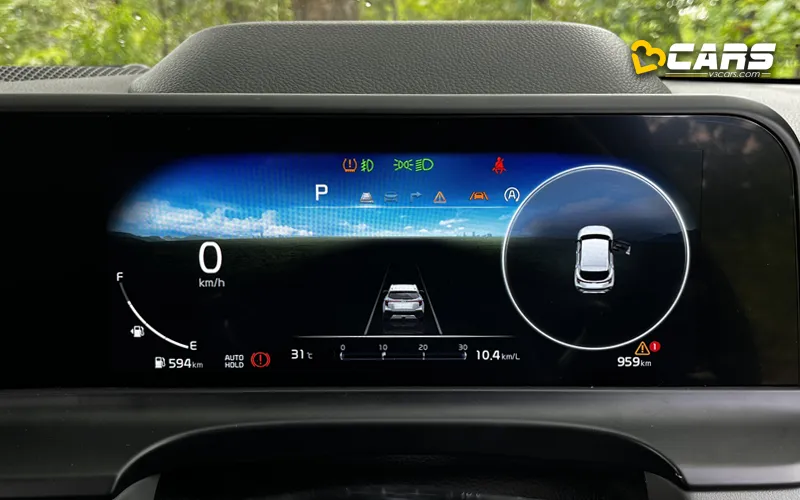
For instance, the settings for the instrument cluster include a Dynamic theme that displays information with a landscape background. Other than that, there aren’t many design-related changes, but Kia have reduced some inserts from the dashboard, which also makes the dashboard design appear cleaner.
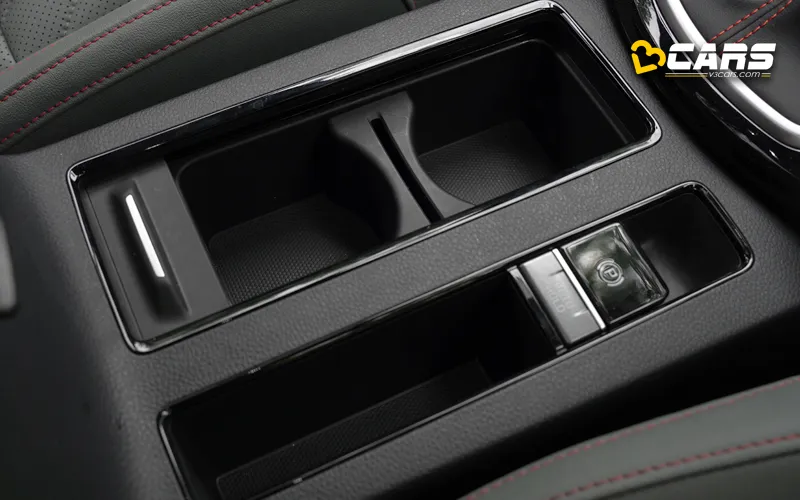
There’s a layout-related change in the air-con control panel. Just above the glovebox on the dashboard, there’s an ambient light strip, which should enhance the cabin’s ambiance during night drives. Lastly, to accommodate the electronic parking brake, its centre console has a new design.
However, the rest of the cabin and design remain more or less the same, including the rear seat space, which is suitable for 2 adults and a child. 3 adults is a squeeze but completely doable for short trips. We have no complaints as such, because the new interior theme and dashboard layout make the Seltos interior feel richer compared to before. Now we’ll talk about the performance of the new 2023 Seltos turbo petrol engine.
Kia Seltos Facelift Turbo Petrol-Automatic – Engine Performance And Drive Review
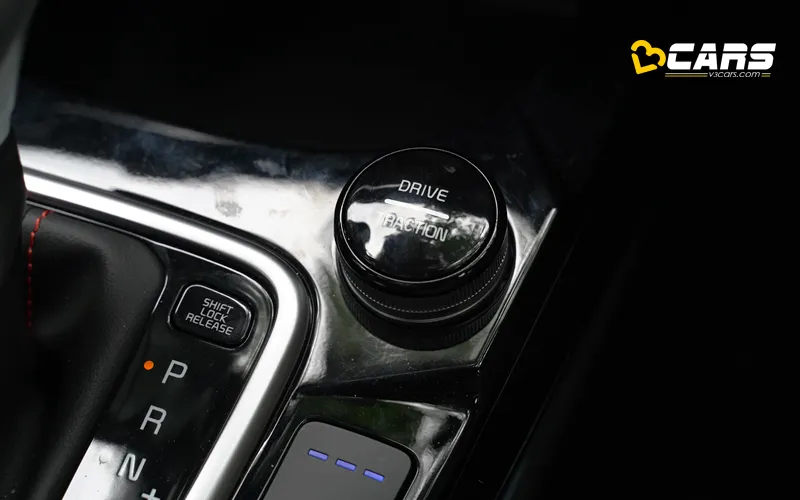
The Seltos comes with 3 engine options: a 1.5L normal petrol engine, a 1.5L turbo diesel engine and a 1.5L turbo petrol engine. The only new addition among these is the turbo-petrol engine which replaces the olde 1.35L turbo petrol engine. This engine makes 160PS of power and 253Nm of torque. You can have it with either a 6-speed auto-clutch manual transmission or a 7-speed dual-clutch automatic. The X Line variant, which we drove, is only available with the automatic.
It’s the most powerful engine in the Seltos line-up, and Kia claim a time of 8.9 seconds with the dual-clutch automatic transmission and 10.1 seconds with the auto-clutch manual transmission. In our brief test in Sport mode, it easily achieved 0-100kmph in around 9.5 seconds. Under ideal test conditions, we’re sure it can achieve Kia’s 8.9 seconds of claimed acceleration time. We think any mass market car accelerating to 100kmph in less than 10 seconds is pretty quick by any standards.
That said, when you drive it calmly, it doesn’t immediately feel energetic and instead it feels like it’s a heavy car. But rev it a little and you will realise how strong this engine’s mid-range is — and when you take it beyond the 2000rpm mark, it feels brisk and picks up speed rather quickly. We mainly drove it on the highway where it was cruising comfortably at 100kmph while revving around 1800rpm in the seventh gear.
So, it felt at ease doing triple digit speeds while staying in the peak torque zone for quick overtakes if necessary. Most of the time, you won’t feel the need to manually downshift, but if you want that control over gear shifts, you can do so with its gear lever or paddle shifters.
What we also learnt about the engine on this short drive is that its noise is audible in the cabin. It is not bothersome, but it filters through at both slow as well as higher speeds. The vibrations or harshness is not much — so like we said before — it is not bothersome. Now, talking about its ride, Kia have increased the damping force of the front suspension setup compared to the old Seltos. Thus, the front might feel a little stiff now while the damping force of the rear has been reduced — so it should feel a little softer.
From an experience standpoint, it’s difficult to say how much this has affected its ride, but what we can say with some degree of confidence is that it still feels a bit firm and handles a bit better than before. You can also feel the road surface in the car and we think this may lead to rattling noises with frequent rough road usage. We would also like to draw your attention to the fact that the Seltos we drove rode on 18-inch wheels. With a lower side wall to cushion the ride, compared to the older GTX Plus variant, it felt a bit firm.
On the other hand, it is because of this suspension setup only, that the car also feels planted, which is confidence inspiring for the driver. It also nicely complements the 160PS power output of this new turbo petrol engine. We found its handling and braking satisfactory for the performance on offer. With this new engine, the Seltos also has an auto engine start/stop tech, and so it has become more fuel efficient.
On this short drive, we couldn’t test its fuel efficiency, but the official mileage figures claim to offer 17.70kmpl with the turbo petrol-ACMT and 17.90kmpl with the turbo petrol-automatic. We will test the real-world mileage figures once we get to review it for a longer time. With the normal petrol engine, Kia suggest an ARAI-tested mileage figure of 17.0kmpl and 17.70kmpl with the manual and automatic transmission options, respectively.
To sum up the drive, we think that this 160PS engine completes the Seltos as a package — so you get a car that looks upmarket on the outside and inside. It also performs and rides like a more expensive car. Now, let’s look at its prices and sum up this review.
2023 Kia Seltos Facelift – Verdict And Buying Recommendation
The prices for the new Seltos start from Rs. 10.89 lakh. With the normal petrol engine, HTX is its top variant, which costs Rs. 16.59 lakh with the CVT automatic transmission. The variants available with the turbo petrol engine are HTK Plus, HTX Plus, GTX Plus and X Line. The top variant is available only with automatic transmission and costs Rs. 19.99 lakh (ex-showroom).
The Seltos was already a car with mass appeal and when we had the older version of the Seltos with us for a long-term review, we were satisfied with the car. It felt like it even matched the cabin experience of more expensive cars. With this update, the cabin experience of the Seltos has improved further and it feels even more polished now with the new colour schemes. The new screens, the larger sunroof, new cabin features, ADAS and a powerful turbo-petrol engine makes it a car that is difficult to nitpick, especially in the higher variants.
More importantly, rather, most importantly, its higher variants also carry an attractive price, prices are also attractive — so we think at this moment — THIS IS THE C-SEGMENT SUV to buy if you want that premium experience with a manageable, compact dimensions.
Here’s a look at the ex-showroom prices for the 2023 Kia Seltos facelift:
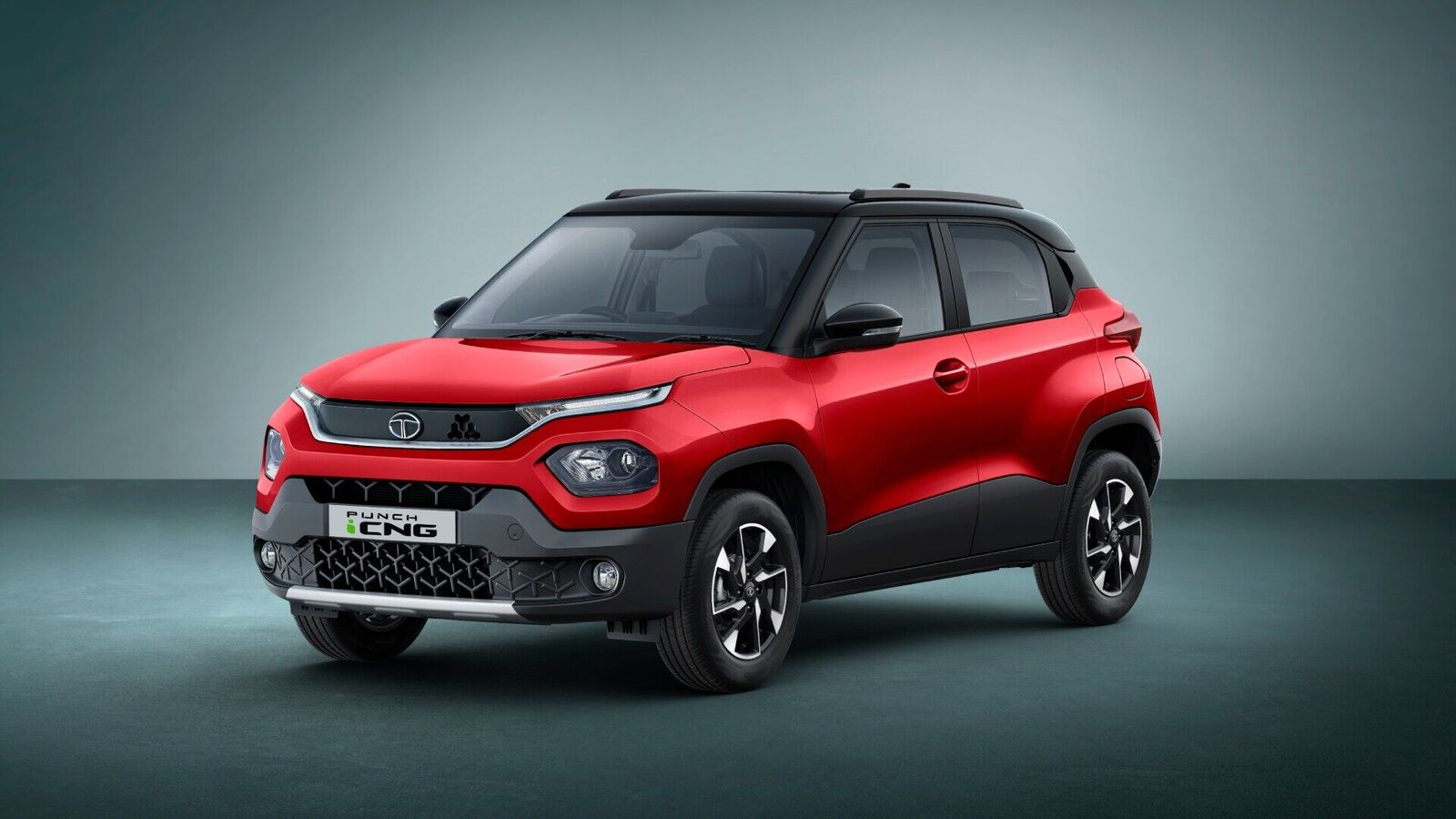
Tata Motors has launched the Tiago and Tigor iCNG variants in the country with its new twin-cylinder technology. The updated Tata Tiago iCNG is priced from ₹6.55 lakh, going up to ₹8.10 lakh for the XZ NRG CNG variant. Meanwhile, the Tata Tigor CNG is now priced from ₹7.10 lakh, going up to ₹8.95 lakh. All prices are ex-showroom, Delhi. The same twin-cylinder CNG tech has also been introduced on the Tata Punch micro SUV.
By: Sameer Fayaz Contractor | Updated on: 04 Aug 2023, 13:05 PM
The Tata Tiago CNG and Tigor CNG now get twin CNG cylinders with a capacity of 70 litres, the highest in the segment
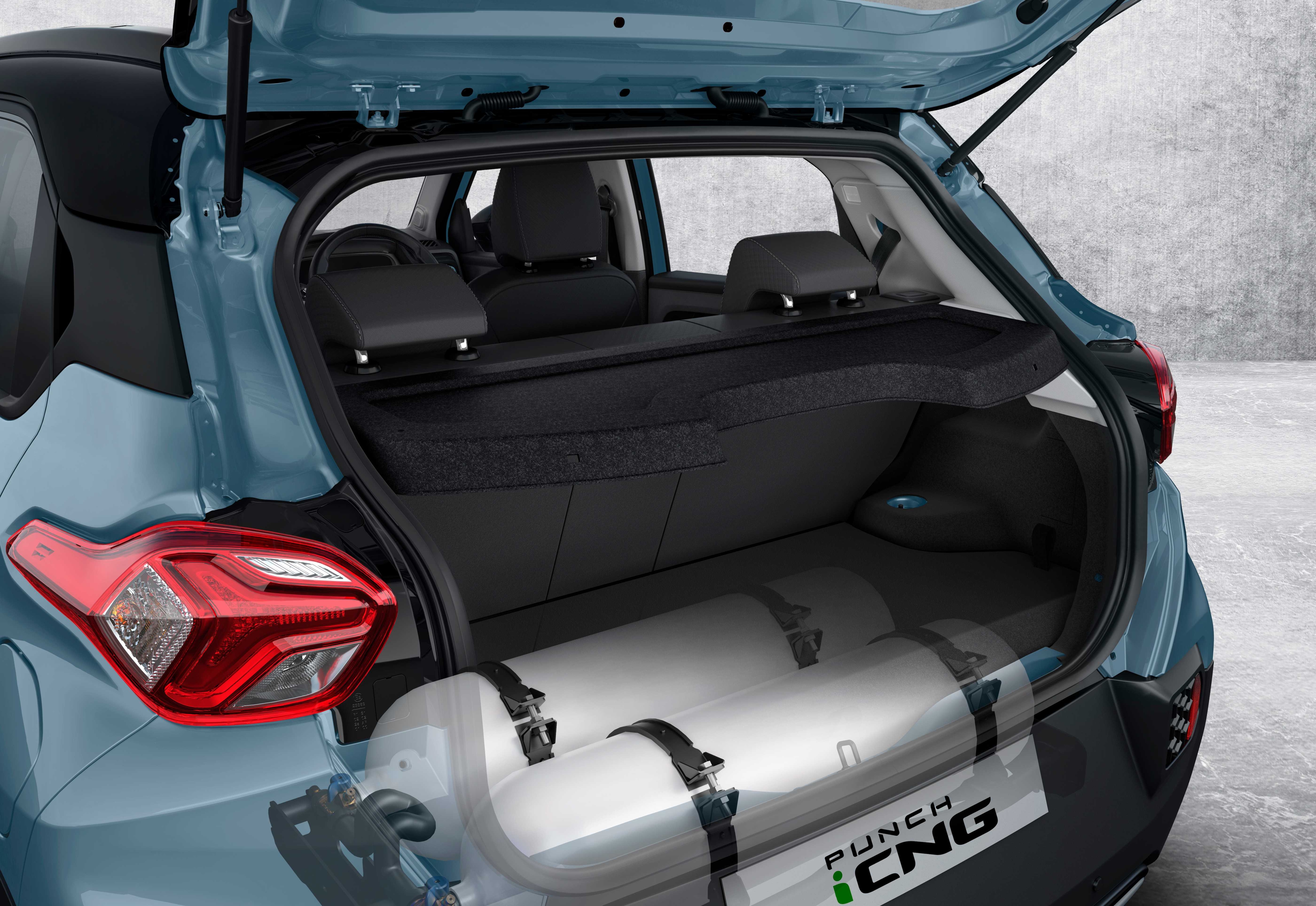
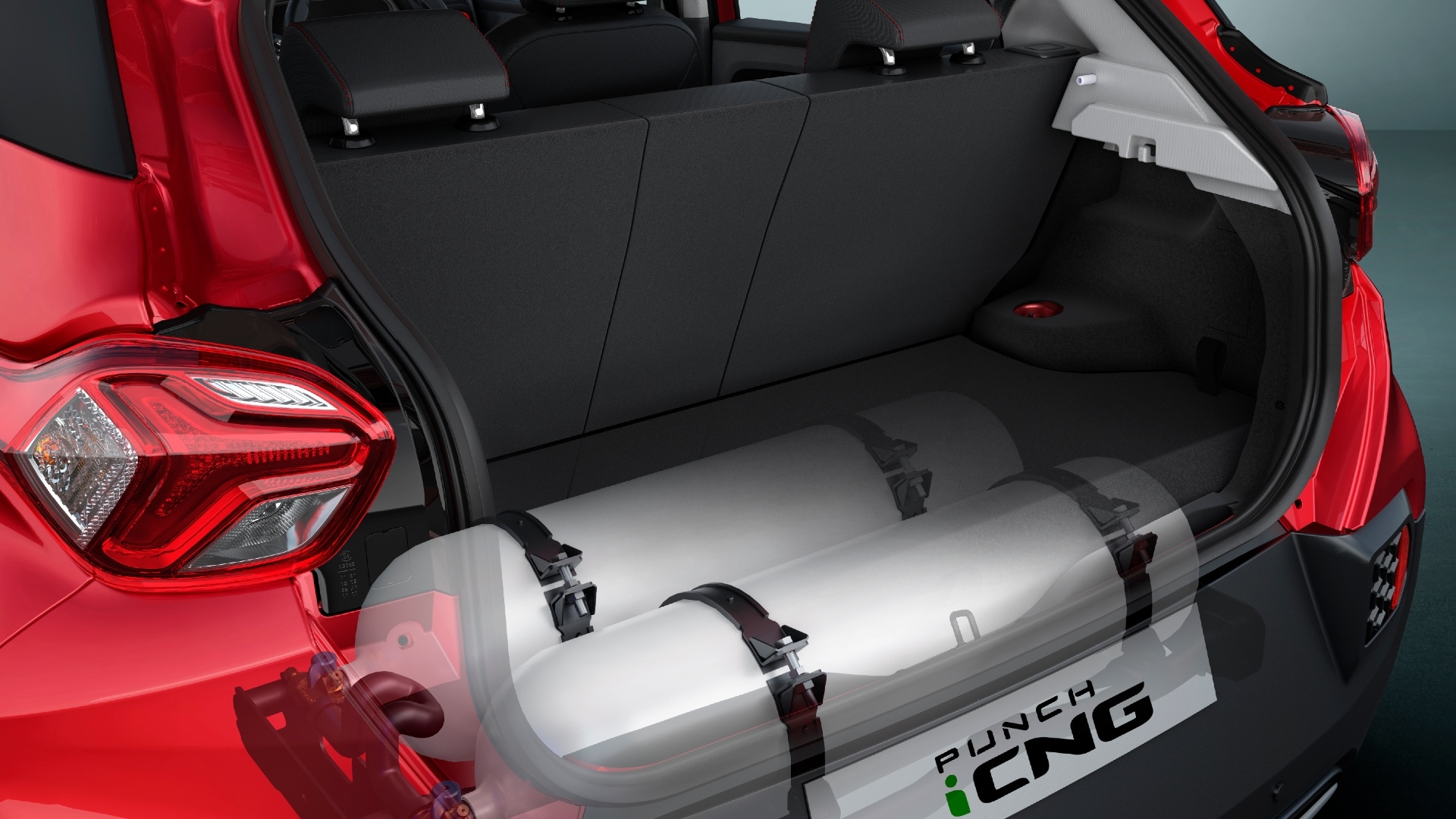
The automaker introduced the new tech on the Altroz earlier this year and the cleverly factory-fitted CNG tanks liberate more room for practical cargo capacity. Tata’s twin-cylinder tech places two fuel tanks of a capacity of 70 litres combined in place of the spare wheel under the cargo area. This ensures there’s usable space to keep a suitcase, bags and more. The spare wheel is moved to the rear underbelly of the car on either vehicle.
The cylinder are placed below the cargo area in the boot on the Tiago and Tigor, as seen on the Punch iCNG version above
Commenting on the launch, Vinay Pant, Head-Marketing, Tata Motors Passenger Vehicles, said, “Building further on our success with the Altroz iCNG, and to make the CNG segment even more hotly contested, we are excited to introduce the twin-cylinder technology in not just one but three products today – the Tiago, Tigor and the much awaited and loved subcompact SUV, the Tata Punch. I am confident that these introductions put together will make our CNG lineup appealing, holistic, and stronger than ever.”
The Tata Tiago and Tigor CNG draw power from the 1.2-litre naturally-aspirated petrol engine. The motor has been detuned to produce 76 bhp and 97 Nm of peak torque on the CNG-powered version, while paired with only a 5-speed manual gearbox. Offered in multiple variants, the Tiago and Tigor CNG options also boast decent features when compared to their rivals – Maruti Suzuki Celerio, Maruti Suzuki Dzire and Hyundai Aura.
The Tata Tiago and Tigor iCNG were launched in January 2022 and the latest update makes the models more practical. The company says it has sold over 50,000 units of the CNG versions since the launch, helping the automaker command a 16 per cent market share in the overall CNG segment. Individually too, the CNG variants contribute 20 per cent to the Tiago’s overall volumes, 55 per cent to the Tigor and 40 per cent to the Altroz. Tata’s CNG range is available for private buyers though and not for commercial operators. Deliveries for the new updated CNG lineup should begin in a few days from now.
Powering the Punch iCNG is a 1.2-litre, three-cylinder engine that produces 84.82 bhp of max power and a peak torque output of 113 Nm while running on petrol. On CNG, the power output falls to 75.94 bhp whereas the torque output decreases to 97 Nm. The engine comes mated to a 5-speed manual gearbox or a 5-speed AMT. However, the CNG powertrain only gets a 5-speed AMT.
One of the biggest distinguishing features of Tata’s iCNG range is the use of dual-cylinder tech. Instead of using one large CNG cylinder, Tata Motors is using two small 30-litre cylinders which means the total capacity is rated for 60 litres. The cylinders are placed in the floor well of the boot. This means that there is still a usable boot space available for the occupants to store their luggage and other stuff.
Being a Tata, the CNG vehicles also come with several safety features. It gets a leak detection feature and Tata is using high-quality stainless steel and rust and corrosion-resistant materials. There is also thermal incident protection in which the CNG supply to the engine is cut off automatically and the gas in the cylinder is released into the atmosphere automatically. There is also a microswitch that makes sure that the car does not start if the fuel lid is open.
Cosmetically, the brand has not made any changes apart from the new iCNG badging. The cabin gets a CNG button that is used to switch the fuel supply from CNG to petrol or vice versa. The instrument cluster is updated to show a CNG gauge.
The Tata Punch CNG will come with twin-cylinder technology that brings two 30-litre tanks under the boot space, for a more practical storage solution
Commenting on the launch, Mr. Vinay Pant, Head-Marketing, Tata Motors Passenger Vehicles Ltd., said: “Building further on our success with the Altroz iCNG, and to make the CNG segment even more hotly contested, we are excited to introduce the twin cylinder technology in not just one but three products today – the Tiago, Tigor and the much awaited and loved sub compact SUV, the Tata Punch. Since its debut at the Auto Expo 2023, the Punch iCNG has been one of the most awaited products in this segment. With its uncompromised boot space and high end feature upgrades, the Punch iCNG demonstrates the go anywhere attitude of an SUV, which is engineered to meet the constantly evolving requirements of customers, who are tech savvy and demand best in class features along with an environment friendly and economical product. I am confident that these introductions put together will make our CNG line up appealing, holistic and stronger than ever.”
Now in its third generation, the Alto continues to be a popular choice in the entry-level hatchback segment.
Maruti Suzuki has announced that its entry-level product, the Alto, has crossed the 45 lakh sales (4.5 million units) milestone, becoming India’s highest-selling car. Since its launch in 2000, Maruti’s people’s car for the millennium saw strong consumer acceptance, and by 2004, it had become the bestselling car in the country.
The Alto is now in its third generation
10 lakh unit sales mark hit in 2008
Rivals the Kwid and S-Presso
Maruti Alto: tough early times
It wasn’t smooth sailing for the Alto in its first years; the catch here was that the Maruti 800 – the car that put India on wheels – still lured many first-time car buyers. Maruti Suzuki initially struggled to convince buyers to pick the Alto over the iconic 800 despite the former looking fresher, having better engine and gearbox options, and more features without a big premium over the 800. The first Alto came with two engine options – the 45hp, 796cc petrol engine from the Maruti 800 hatchback, and a 65hp, 1.1-litre, 4-cylinder petrol motor.
Maruti Alto: 40 lakh unit sales by 2020
To draw more buyers to the Alto, Maruti made some strategic moves. It narrowed the 800’s range, launched more affordable variants of the Alto and marketed it aggressively. The efforts paid off, and after three years, the Alto wrested the throne from the 800 as India’s bestselling car.
Since then, the Alto sales have continued to grow, reaching milestones upon milestones. In 2008, Maruti Suzuki sold 10 lakh units of the Alto, making it only the fourth car in the Indian market to hit that milestone after the 800, Santro and the Omni.
The Alto just took four years to sell another 10 lakh units and in 2016, it crossed the 30-lakh milestone, making it the only car in India to do so. By August 2020, Maruti Suzuki had sold 40 lakh Alto units.
Maruti Alto: now in its third generation
Since the hatchback’s launch, the Alto has seen three iterations. In 2010, the first-gen Alto K10 was launched along with a CNG variant. Two years later, the Alto 800 was introduced and marked 2 million sales of the car. The second-generation Alto K10 was launched in 2014, followed by the third-gen model more recently in 2022.
Currently sold in seven variants, the Alto K10, which is powered by the K-Series 1.0-litre petrol engine, is priced at Rs 4,67,000 (on-road, Delhi) for the base Standard variants, going up to Rs 6,78,000 for the top-end VXi+ AMT variant.
Over 2 million units sold since FY2014
A quick look at the domestic market sales numbers of the Alto reveals that 22,20,441 units have been sold over 10 fiscal years, between FY2014 and FY2023, accounting for 49.34 percent of the total 4.5 million units. FY2019 has been its best year with 2,59,401 units but demand slowed down over the next couple of years.
FY2020 sales of 1,90,814 units were down by a substantial 26 percent, while the Covid-impacted FY2021 saw demand reduce by 16 percent to 1,58,992 units and to 1,45,167 units in FY2022.
Current-gen Alto still a favourite of the masses
What has brought the fizz back is Maruti Suzuki introducing the third-gen Alto K10 in August 2022, followed by the CNG variant, which delivers a fuel efficiency of 33.85km/kg, in November 2022. This move has seen sales improve year on year by 24 percent to 1,79,698 units.
The decadal sales data reveals that the Alto continued to be India’s best-selling car each year right till FY2020. In FY2021, the Alto dropped three positions to fourth rank and ceded the title to sibling Maruti Swift (172,671 units). In FY2022, when the Maruti Wagon R became the top seller (1,88,837 units), it continued to have fourth position, improving upon that in FY2023 to take third spot with 1,79,698 units after the leader Wagon R (2,12,340) and Baleno (2,02,901 units).
The Triumph Speed 400 finally rolled out into dealerships late last month and as originally announced, the company has now begun deliveries of the new roadster to customers across India. Deliveries have commenced in a phased manner in cities like Mumbai, Hyderabad, and Pune, while deliveries in other cities should start within the next few days.
By: Sameer Fayaz Contractor | Updated on: 03 Aug 2023, 15:33 PM
The Triumph Speed 400 commands a waiting period of about four months
The Speed 400 was launched with a highly competitive introductory price tag of ₹2.23 lakh for the first 10,000 customers. Triumph and Bajaj managed to surpass the 10,000 booking number quickly and the price now stands at ₹2.33 lakh (ex-showroom, Delhi). The on-road prices vary between ₹2.67 lakh in Delhi, going up to ₹2.87 lakh in Mumbai and Pune. You can check out the on-road prices for different states below.
As previously reported by HT Auto, the waiting period for the Speed 400 stands at about four months. Triumph India has also increased the booking amount from ₹2,000 at the time of the launch to ₹10,000. The demand is only expected to increase further as Bajaj Auto expands Triumph’s retail presence in the country. The company previously had 15 operational dealers pan India, and it plans to increase to 50 outlets by October, and up to 100 by March 2024 across 80 cities. The strategy will also help bolster the company’s operations right time for the Triumph Scrambler 400 X’s arrival in two months.
Currently, Bajaj Auto is ramping up production of the Triumph Speed 400 at its Chakan 2 facility to meet the growing demand. The plant has an installed production capacity of 5,000 units for Triumph motorcycles, which could be increased further to address the demand. That said, production will be increased in a staggered manner, the company had clarified earlier.
Watch: Triumph Speed 400 Review: Worth the hype?
The Triumph Speed 400 is powered by a 398 cc single-cylinder, liquid-cooled engine tuned for 39.5 bhp at 8,000 rpm and 37.5 Nm at 6,500 rpm, paired with a 6-speed gearbox. We rode the Speed 400 last month and came back impressed with its impressive performance, design and overall build quality. Triumph has ventured into a segment dominated by Royal Enfield, while also locking horns with offerings from BMW, KTM, Honda, Zontes, and more.
Hyundai Motor India is offering some of its cars with benefits up to ₹2 lakh in the month of August. The offer applies on models like i20, i20 N Line, Grand i10 Nios, Aura, Alcazar and Kona Electric. Benefits include cash discounts, exchange bonus and benefits for corporate and government employees. However, Hyundai has kept some of its best-selling models like Creta, Venue and Verna out of this scheme.
By: HT Auto Desk | Updated on: 03 Aug 2023, 14:58 PM
Hyundai Alcazar
Hyundai Kona Electric
The OEM is offering benefits up to ₹2 lakh on the electric model, which is a significant rise from the ₹1 lakh benefit being offered in July. It is the brand’s first all-electric vehicle that was launched in the country. It comes with a 39.2 kWh lithium-ion polymer battery that churns out 136 PS of power and 395 Nm of torque.
Hyundai i20, i20 N Line
Both the models are available with benefits up to ₹40,000. The premium hatchback is a good fit if one is looking to buy a car that costs around ₹10 lakh and comes loaded with features. It comes with a 26.03-cm HD Touchscreen Infotainment and Navigation System in the high-spec Asta(O) variant.
Hyundai Grand i10 Nios
The hatchback from Hyundai is available with benefits up to ₹43,000. Benefits can include cash discount, exchange bonus and corporate benefits. The car gets a 1.2-litre Kappa petrol unit mated to a manual or an automatic gearbox. There is also a CNG variant on sale.
Hyundai Aura
This sedan from the OEM gets benefits up to ₹33,000 this month. The car gets various features such as wireless phone charging, smart key with push button, keyless entry, cruise control, among others.
Hyundai Alcazar
The carmaker is offering the SUV with benefits up to ₹20,000 in August. This model comes in a six-seat and a seven-seat configuration with height adjustable headrest for all three rows.
Disclaimer: These discounts are indicative figures and one must reach out to nearest dealerships for a detailed break up of the scheme.
Note: If you prefer watching the review in Hindi instead of reading it in English, then you can play the following video:
2023 Honda Elevate – Exterior Review
Elevate is a C-segment SUV, with an overall length of around 4.3m. Its general design theme is upright – thus you can observe a lot of straight lines and the exterior looks particularly boxy at the front. Its large grille and wide chrome strip are attention-grabbing elements.
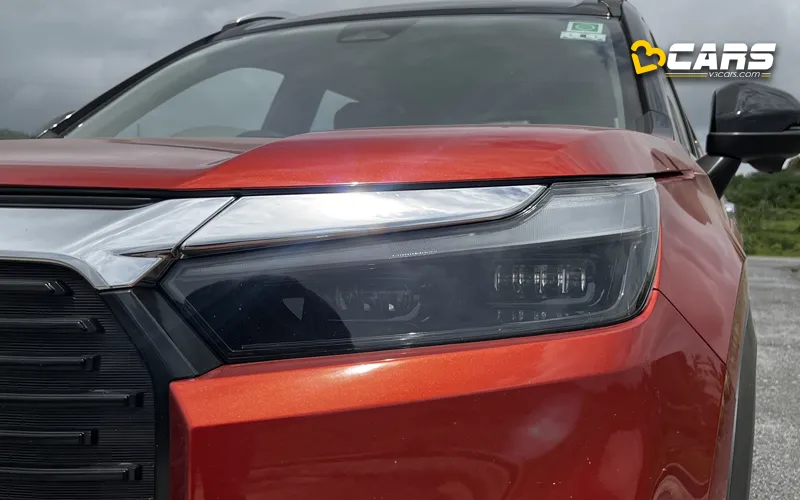
Its headlamps and fog lamps are of LED type, as are the front turn indicators. Talking about the features on offer, the Elevate comes with the Honda Sensing package, which is a camera-based ADAS. Its camera is integrated into the windshield, but there is no other parking camera here, nor does it come with front parking sensors. We think at least one of these features should become a common feature in top variants of C-segment SUVs.
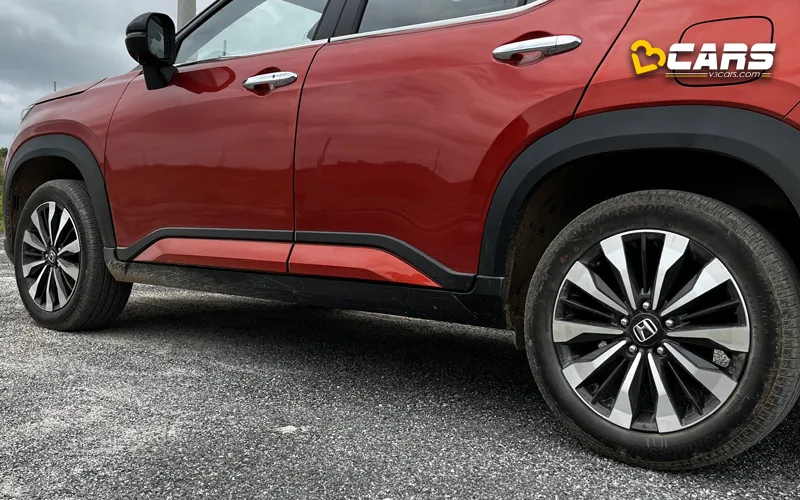
This cladding continues on the side as well with the squarish wheel arches covering 17-inch alloy wheels in the top variant. Speaking of distinct SUV traits, the Elevate’s 220mm ground clearance is a stand-out attribute. The good thing is – despite having such ground clearance, it does not look under-tyred.
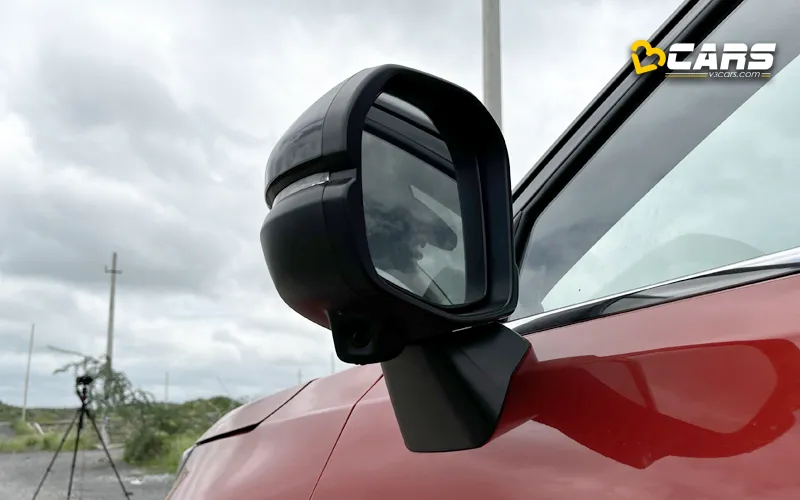
Notable elements in its side design include a left mirror-mounted blind spot camera, chrome door handles, thick body-coloured side cladding, roof rails and a shark-fin antenna.
At the rear, you get LED tail lamps, but the turn indicators here are of the regular bulb type. It gets a connected tail lamp design but the red strip between the tail lamp clusters doesn’t have backlighting. The bumper gets thick cladding, and the overall rear design is simple but pleasing.
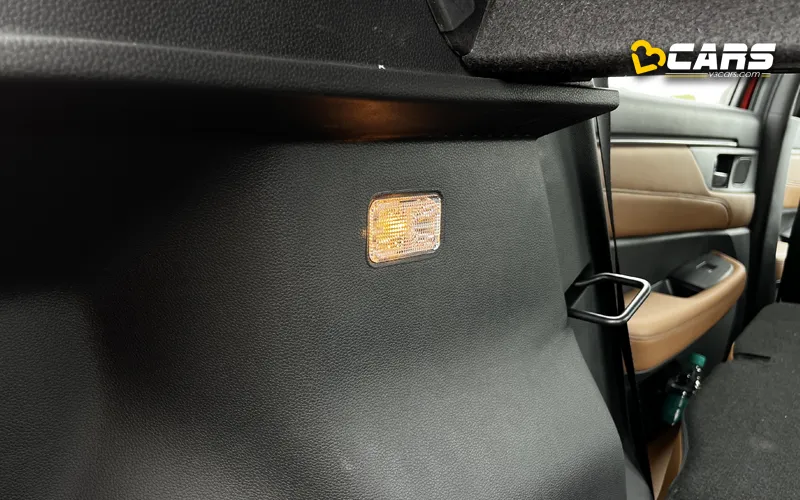
The highlight of the Elevate’s boot is its 458-litre luggage space. It’s the largest in the segment and with the split folding rear seat, you can expand it further. The boot has shopping bag hooks and a lamp, and there’s also the parcel tray here. Under the boot floor, there’s a 16-inch spare tyre, on which the toolkit is neatly placed, and there’s some space beside it to keep a puncture repair kit.
Overall, the Elevate looks a little bland to us at the front, but it has a typical appeal of an SUV, which most buyers will find pleasing. The highlight, of course, remains the class-leading 220mm ground clearance. The following table gives you an idea of the dimensions of key C-segment SUVs competing with the Honda Elevate:
C-SEGMENT SUVs | DIMENSION COMPARISON
Elevate
2023 Seltos
Creta
Gr. Vitara
Hyryder
Length
4312mm
4365mm
4300mm
4345mm
4365mm
Width
1790mm
1800mm
1790mm
1795mm
1795mm
Height
1650mm
1645mm
1635mm
1645mm
1635mm
Wheelbase
2650mm
2610mm
2610mm
2600mm
2600mm
Ground Clearance
220mm
190mm*
190mm*
208mm
208mm
Boot Space
458L
433L
433L
373L (265L Hybrid)
373L (265L Hybrid)
Tyre Size (top)
215/55 R17
215/55 R18
215/60 R17
215/60 R17
215/60 R17
Here’s a look at the dimension comparison of the Honda Elevate with other C-segment SUVs:
C-SEGMENT SUVs | DIMENSION COMPARISON
Elevate
C3 AC
Astor
Kushaq
Taigun
Length
4312mm
4300mm*
4323mm
4225mm
4221mm
Width
1790mm
1796mm
1809mm
1760mm
1760mm
Height
1650mm
1654mm
1650mm
1612mm
1612mm
Wheelbase
2650mm
2671mm
2585mm*
2651mm
2651mm
Ground Clearance
220mm
200mm
180mm*
188mm
188mm
Boot Space
458L
444L
448L*
385L
385L
Tyre Size (top)
215/55 R17
215/60 R17
215/55 R17
205/55 R17
205/55 R17
*Estimated
Let’s now take a look at its interior.
Honda Elevate – Interior Front Review
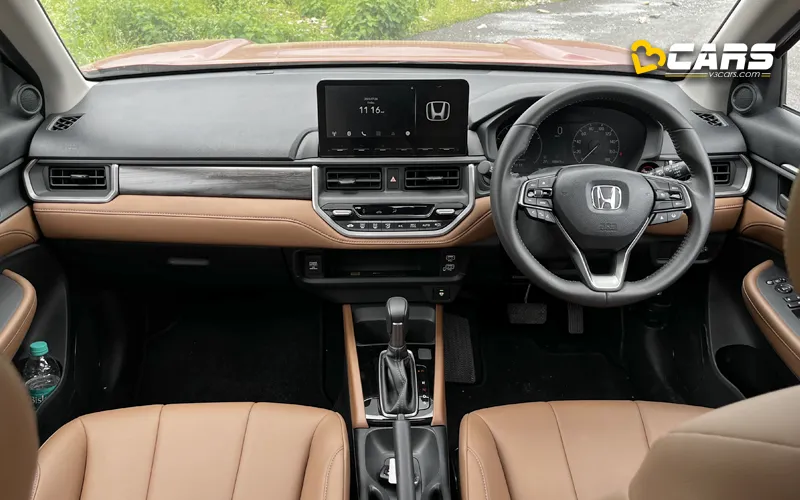
The Elevate comes with a black-brown dual-tone interior, with dark wooden trim and matte grey detailing on the dashboard. The top of the dashboard is all hard plastic, but it feels alright for the segment.
For an upmarket feel in the cabin, there is leather finish on the dashboard and doors, and the fitment of the centre console is satisfactory. While the glove box lid is light, its finish is only acceptable. It’s spacious though and can easily accommodate 2-3 pet bottles. Speaking of space for bottles, there are also bottle holders in all 4 doors with door pockets.
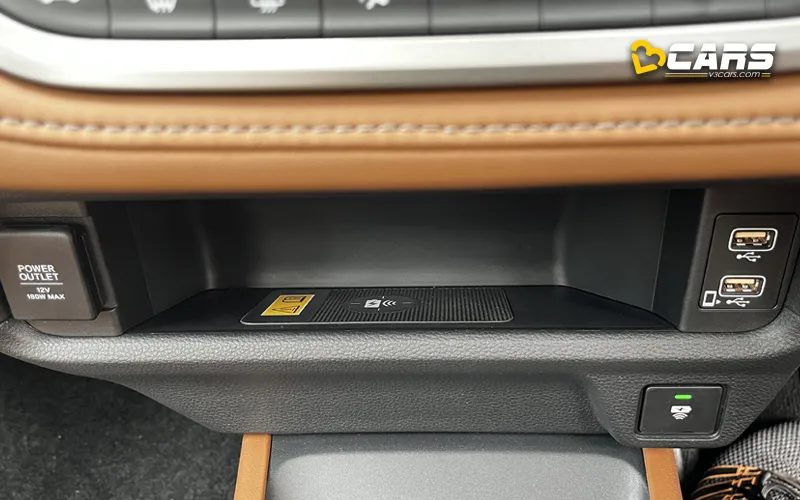
In terms of storage, there’s a place to keep a wallet in the front armrest, and 2 cupholders in the centre console. Next to these is a wireless charging pad with 2 USB ports and a 12V power socket.
So, there’s enough storage here to keep and charge multiple devices simultaneously. Above this are the physical air-con controls with a new 10.25-inch touchscreen infotainment system towering on top. It gets wireless smartphone connectivity and gets an 8-speaker audio system with an immersive sound output.
The display and UI of this infotainment system are basic, but the touch feedback is satisfactory. You can divide the main infotainment screen into 2 or 3 parts. While it doesn’t get many features to brag about, you can always keep the live feed from the rear or side camera on the display. The big downside is that this feature will not work with Apple CarPlay, because that takes up the full screen space.
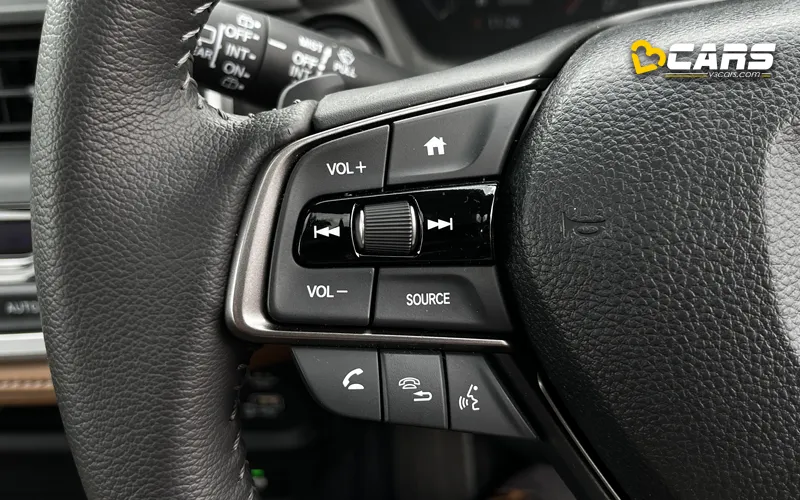
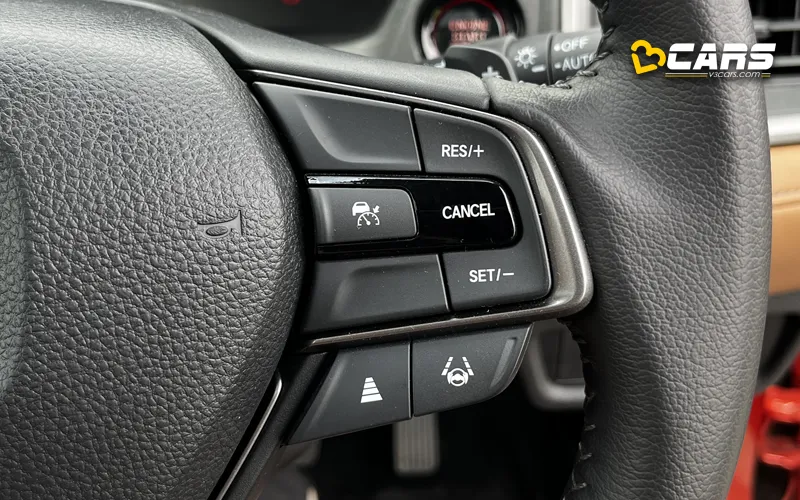
Anyway, this infotainment system can be accessed via driver steering-mounted controls, and apart from this, the steering wheel also has ADAS related buttons and paddle shifters. Like in the case of Honda City, Elevate also offers adaptive cruise control with both manual and automatic transmissions.
There’s one more feature here that needs a special mention – customisable wiper settings. With this feature, if the car’s wipers are left on for some time period, basically in case of extended rainfall, its headlamps automatically turn on to improve the visibility of this car.
Other important add-ons from the driver’s perspective are:
Tilt & telescopic steering wheel adjustment
Height-adjustable driver seat
Full colour-LCD instrument cluster
Power mirrors with power folding
Sunroof
Frameless auto-dimming inside mirror
Keyless entry with push-button start/stop
We CAN NOT talk about the Elevate’s interior and not mention its outstanding driving position. There’s a rawness in the way the bonnet’s side bulges are visible from here – so you will get the traditional SUV-like feel while driving it.
If you’re someone who prefers a high driving position, then you’re going to love the view out from here, which is unobstructed despite the fact that it gets massive outside mirrors. With the driver’s seat set to my driving position (5-feet 8-inch), let’s examine the rear seat space.
Honda Elevate – Rear Interior Review
Entering and exiting the rear of the Elevate is easy, mainly because of its high ground clearance. There’s more than adequate knee space for me and enough space to slide my feet under the front seat.
In terms of seating position, you would sit upright in the rear of the Elevate, and in this position, I would have liked it more if its floor was flat – and not angled upwards like it is. Despite having a generous seat base, I found the under-thigh support lacking. That said, the cushioning of this seat – whether it’s on the base or back, especially the lower back – is quite likeable.
Talking about space again, there’s more than adequate headroom for me, and there’s generous space between me and the door as well. Other notable features here include:
2x adjustable headrests
Rear AC vents with a 12V power outlet
Centre armrest
Power windows
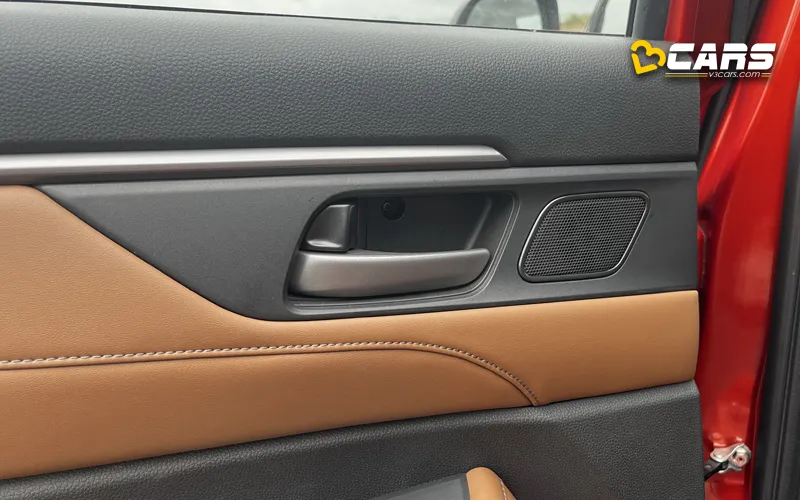
Door leather trim
If you consider the Elevate mainly as a high-riding alternative to Honda City, and you’re someone who sits more on the back seat, then we think City is still the better option. But if you drive more often and you want that SUV-like driving position – then Elevate is a better car.
A few things that we think the Elevate misses out on are:
Ventilated front seats
Power driver seat with memory
Multicoloured ambient lighting
Cooled glovebox
Rear curtains
Puddle lamps
The general sense of quality and space in this cabin is likeable, and the seats are very, very comfortable. Let’s now see how it drives.
2023 Honda Elevate SUV – Engine Performance And Drive Review
The Elevate comes with a 1.5L, 4-cylinder, normal petrol engine that produces 121PS or power at 6600rpm and 145Nm of torque at 4300rpm. This engine is available with a 6-speed manual and CVT type automatic transmission, and we drove the automatic.
It’s a CVT unit, but it also comes with paddle shifters, which you can use to control various ratios of this transmission. It seamlessly manages engine revs because there are no mechanical gear changes, but actual acceleration and engine revs are not smoothly synchronised. Basically, when pushing it, the engine revs increase quickly, but there’s a lag in the car picking up speed. It seems more of a CVT characteristic than anything else, and it is more pronounced only when you’re looking for immediate acceleration.
We performed a brief 0-100kmph test, which it completed in around 13 seconds. So it’s not outright fast, but offers satisfactory performance. The powertrain feels refined in terms of vibrations. We do, however, feel that the engine noise seeps into the cabin, especially when revving it hard.
When it comes to cruising, its engine remains at around 2000 revs at 100kmph, and it feels planted and confidence inspiring at these speeds even when changing lanes quickly. The braking also feels confident, but from a dynamics perspective, its ride stands out the most. We drove it at varying speeds over regular road uncertainties and even rough roads, and it was pretty comfortable.
On our drive, we experienced the adaptive cruise control and lane keep assist features of the ADAS setup. We found the adaptive cruise control to be reliable, but the lane keep assist wasn’t as effective.
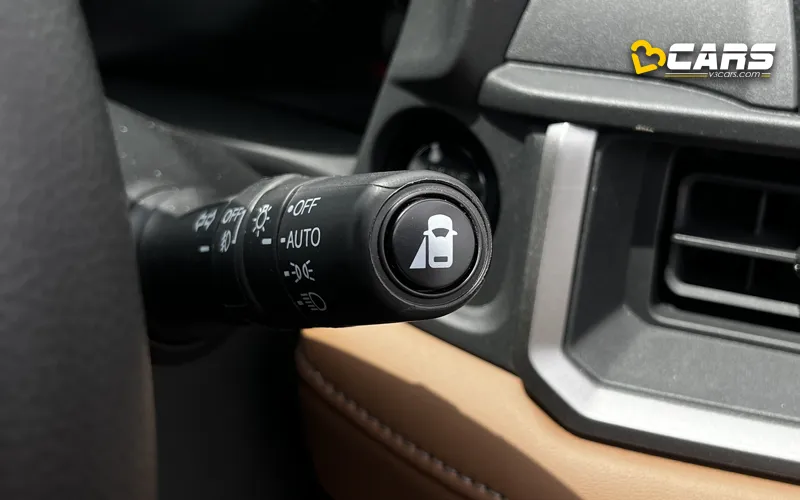
The one feature I personally like a lot is the display of the blind-spot monitoring camera in the infotainment system while using the left turn indicator. I think it’s a feature that can improve driving habits and make the driver want to be more aware of the surroundings.
For the Elevate, Honda claim a fuel efficiency of 15.31kmpl with the manual transmission and 16.92kmpl with the automatic. We will test its fuel efficiency when we get this car for a longer period. For now, as far as our initial impression is concerned, the Elevate is a sorted car in terms of dynamics, and its highlights are its comfortable ride, seats and very high ground clearance.
Following is a look at the comparison of the Honda Elevate’s engine with key C-segment SUVs:
C SEGMENT SUVs | PETROL ENGINE SPECS
Elevate
2023 Seltos
Creta
Gr. Vitara / Hyryder
Gr. Vitara / Hyryder
Astor
Engine
1.5L
1.5L
1.5L
1.5L
1.5L Hybrid
1.5L
Cylinder
4
4
4
4
3
4
Displacement
1498cc
1497 cc
1497 cc
1462cc
1490cc
1498cc
Power
121PS @ 6600rpm
115PS @ 6300rpm
115PS @ 6300rpm
103PS @ 6000rpm
115.5PS
110PS @ 6000rpm
Peak Torque
145Nm @ 4300rpm
144Nm @ 4500rpm
144Nm @ 4500rpm
137Nm @ 4400rpm
141Nm
144Nm @ 4400rpm
Manual
6-speed
6-speed
6-speed
5-speed
–
5-speed
Manual FE
15.31kmpl
17kmpl
16.8kmpl
21.11kmpl (19.38kmpl AWD)
–
NA
Auto
CVT
CVT
CVT
6-speed TC
CVT
CVT
Auto FE
16.92kmpl
17.7kmpl
16.9kmpl
20.58kmpl
27.97kmpl
NA
Here’s a comparison of the Honda Elevate’s engine specs with the small turbo petrol engines of the C-segment SUVs:
C SEGMENT SUVs | PETROL ENGINE SPECS
Elevate
C3 AC
Kushaq 1.0
Taigun 1.0
Engine
1.5L
1.2L Turbo
1.0L Turbo
1.0L Turbo
Cylinder
4
3
3
3
Displacement
1498cc
1199cc
999cc
999cc
Power
121PS @ 6600rpm
110PS @ 5500rpm
115PS @ 5000rpm
115PS @ 5000rpm
Torque
145Nm @ 4300rpm
190Nm @ 1750rpm
178Nm @ 1750 – 4500rpm
178Nm @ 1750 – 4500rpm
Manual
6-speed
6-speed
6-speed
6-speed
Manual FE
15.31kmpl
18.50kmpl
19.76kmpl
19.87kmpl
Auto
CVT
–
6-speed TC
6-speed TC
Auto FE
16.92kmpl
–
18.09kmpl
18.15kmpl
*Estimated
2023 Honda Elevate Petrol-Automatic – Verdict
The Elevate seems underwhelming on paper. It doesn’t get many features that are available in its rivals, and some of them are even found in lower segments. In terms of outright performance as well, the Elevate doesn’t really push the bar much further.
However, having driven it, we think that this car is more than just what the spec sheet might suggest. Take the seats for example – these are certainly among the most comfortable in the segment. Its cabin space and material quality are commendable – you feel like sitting in a premium car. The same goes for the ride quality – it’s very comfortable once you’re on the move.
So, the Elevate is not a car that you will be able to show off for a unique feature or the way it looks. It’s a no-nonsense type of car – a car that gets the basics right. So, if you are looking for a comfortable car with high ground clearance from a long-term perspective, then consider the Elevate.
We think the prices for the Elevate could range between Rs. 12.50 lakh and Rs. 17.0 lakh. It will go on sale in September. According to Honda, it is likely to have a waiting period of 3-4 months for buyers who intend to book it after the price announcement.
Ather Energy is all set to unveil its next big electric scooter on August 3. The EV startup has been teasing its upcoming Ather 450S for the last few weeks. Slated to be unveiled on August 11, the Ather 450S is going to be the brand’s most affordable electric scooter, which will compete with rivals like Ola S1 Air, just like the Ather 450X competes with the Ola S1 Pro. The upcoming electric scooter will arrive as a toned-down and cheaper version of the manufacturer’s flagship model 450X.
By: HT Auto Desk | Updated on: 02 Aug 2023, 15:29 PM
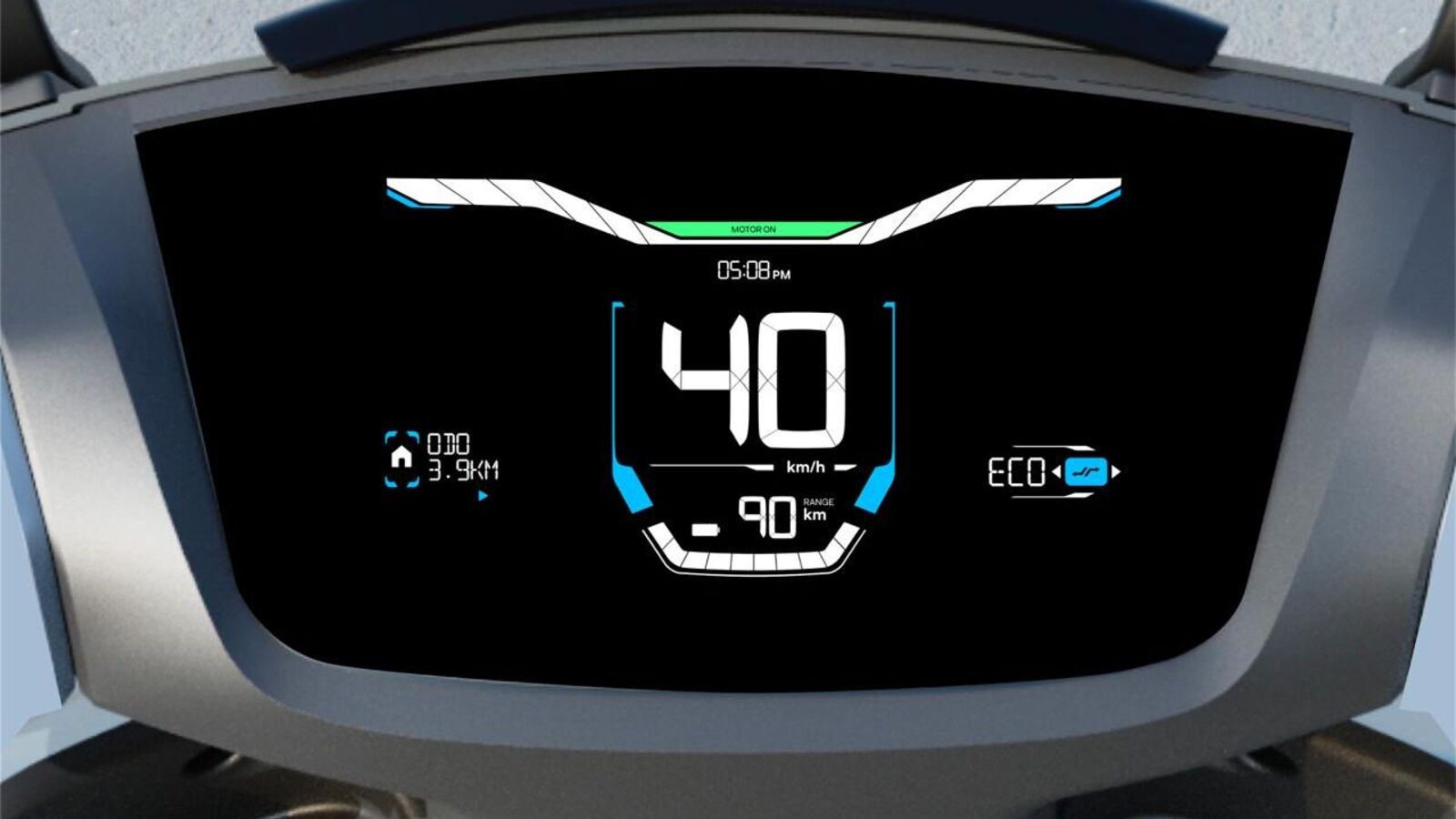
The Ather 450S will get an LCD console in a bid to be more cost-effective over the 450X with the touchscreen console
Ather Energy has already revealed the pricing details of the upcoming 450S electric scooter. It will be available at an introductory price of ₹129,999 (ex-showroom). Ather has not revealed to what extent the introductory pricing will be available for the consumers. The design of the upcoming 450S remains a mystery.
Watch: Ola S1 Pro vs Ather 450X vs Okinawa Praise Pro: Range, charging, performance compared
Ather has revealed that the Ather 450S will come featuring a different instrument cluster compared to the 450X. It would feature an LCD panel with a lack of connectivity and navigational features compared to 450X. It could miss out on cloud connectivity, Google Map functionality and Bluetooth connectivity as well. Also, expect it to come with a joystick for controlling the screen.
The Ather 450S is claimed to come promising a 115 km range on a single charge, at a top speed of 90 kmph. However, the EV manufacturer has not revealed any further specification details of the upcoming scooter. Considering the top speed of the 450S same as the 450X, it could come powered by the same motor as the flagship model. The electric motor is capable of churning out 8.58 bhp of peak power and 26 Nm of maximum torque. Ather 450X gets energy from a 3.7 kWh battery pack that delivers a 146 km range on a single charge. Considering the fact that 450S will offer a 115 km range on a full charge, it could come powered by a smaller 3 kWh battery pack.
Tata Motors dealerships have unofficially begun accepting pre-bookings for the upcoming Punch CNG variant for a token of ₹21,000. First showcased at the 2023 Auto Expo, the Tata Punch CNG will be the automaker’s next model to get the twin-cylinder technology and is expected to arrive later this month. Tata Motors is yet to open bookings officially for the model. That said, the model has begun arriving at dealerships.
By: HT Auto Desk | Updated on: 02 Aug 2023, 15:21 PM
The Tata Punch CNG is expected to be launched later this month
The Tata Punch will be the first “SUV” from the automaker to get the CNG fuel option. The micro SUV will get the twin-cylinder technology that debuted on the Altroz earlier this year. The twin-cylinder tech cleverly stores two 30-litre CNG tanks under the cargo space where the spare wheel is placed on the petrol version. The spare wheel is mounted under the vehicle instead.
The Tata Punch CNG will come with twin-cylinder technology that brings two 30-litre tanks under the boot space, for a more practical storage solution
The Punch CNG will offer a usable cargo space, which sets it apart from other CNG passenger cars on offer at the moment. The model will also be offered in a host of variants mimicking features from its petrol counterpart. Expect to see all the features carried over including, projector headlamps, 16-inch alloy wheels, an electric sunroof, as well as a 7-inch touchscreen infotainment system with Apple CarPlay and Android Auto, automatic climate control, six airbags, ABS and more.
Power will come from the detuned version of the 1.2-litre naturally-aspirated petrol engine. The motor also powers the Altroz and is tuned to produce 76 bhp and 97 Nm on the CNG version, while paired with a 5-speed manual gearbox. Pricing and fuel efficiency details will be available closer to the launch. Expect the CNG option to get a hike of ₹50,000-60,000 over the petrol versions.
The Tata Punch CNG comes right in time for the festive season. It will also lock horns against the newly-launched Hyundai Exter CNG while offering an edge over the Nissan Magnite, Renault Kiger, and Maruti Suzuki Ignis in the segment.
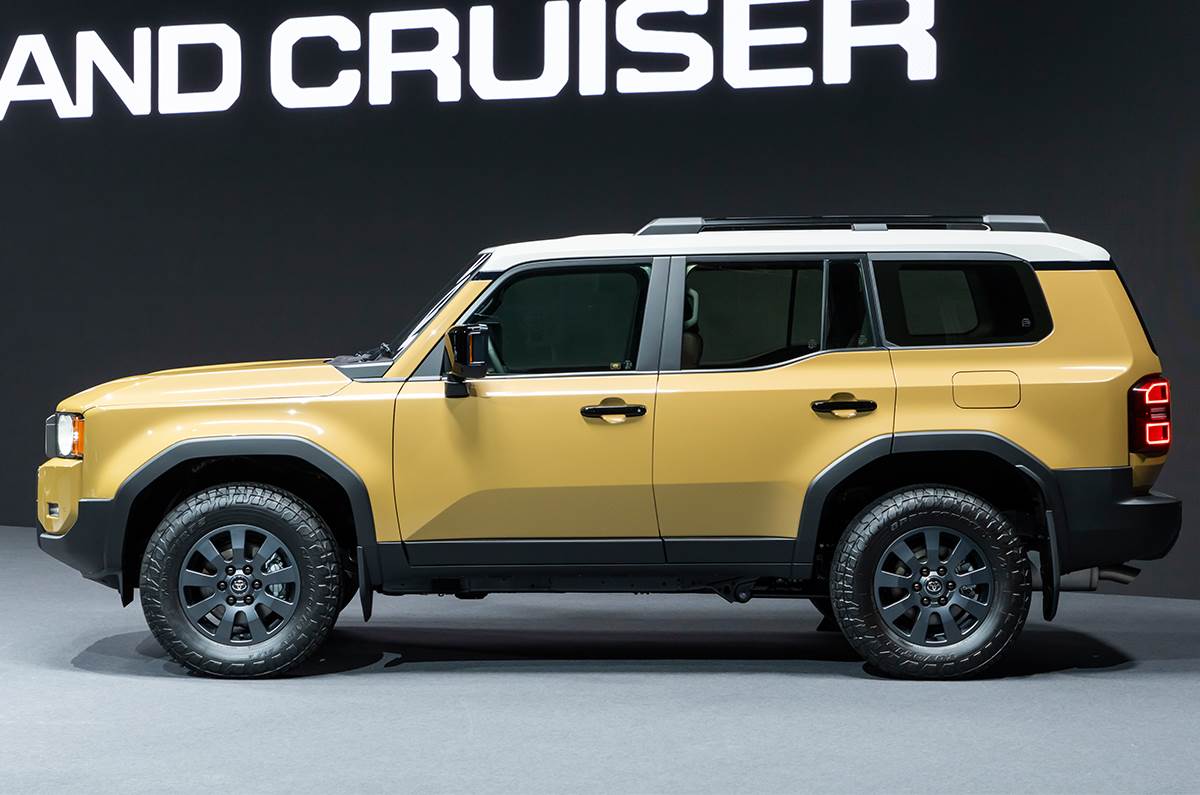
When it launches in India, the new Land Cruiser Prado will be positioned above the Fortuner and below the Land Cruiser 300 SUVs.
Toyota has taken the wraps off not one but two Land Cruiser SUVs – the all-new (and smaller) Land Cruiser 250 for the North American market, and the heavily updated retro-styled Land Cruiser 70. The Land Cruiser 250 will be sold as the “Land Cruiser Prado” in other markets globally with slight differences in the trim and powertrain line-ups.
Toyota updates its Land Cruiser Prado after 14 years
Land Cruiser brand makes a comeback in the US
Land Cruiser 70 gets updates too
With the all-new Land Cruiser 250, Toyota has reintroduced the Land Cruiser brand in the North American market (United States domestic market – USDM) after the bigger Land Cruiser 200 was discontinued a few years ago. The much larger Land Cruiser 300, which is sold in India and other markets, never went on sale in North America.
New Land Cruiser Prado, Land Cruiser (USDM) break cover
The Toyota Land Cruiser Prado has received a full model change after nearly 14 years. It now sits on a modular TNGA-F architecture and is based on the recently showcased Lexus GX SUV. The new SUV is squarely aimed at the Ford Bronco, the Land Rover Defender and the Jeep Wrangler, and has a design influence that mimics cues from almost all generations of past Land Cruiser. It gets a chunky two-box silhouette that nods to its “ability to withstand harsh conditions”, the model again majors on practicality, durability and dependability.
Toyota says the focus for this new Land Cruiser Prado SUV (codenamed J250) is on providing improved on-road refinement as well as the latest off-road technology. The chassis is said to be 50 percent more rigid than that of its predecessor, and the entire body-on-frame assembly is some 30 percent stiffer. It measures 4,920mm in length and 1,870mm in height, and has a 2,850mm long wheelbase. The J250 is slightly larger than its predecessor and its roomier, redesigned cabin is a world away in design and technical terms.
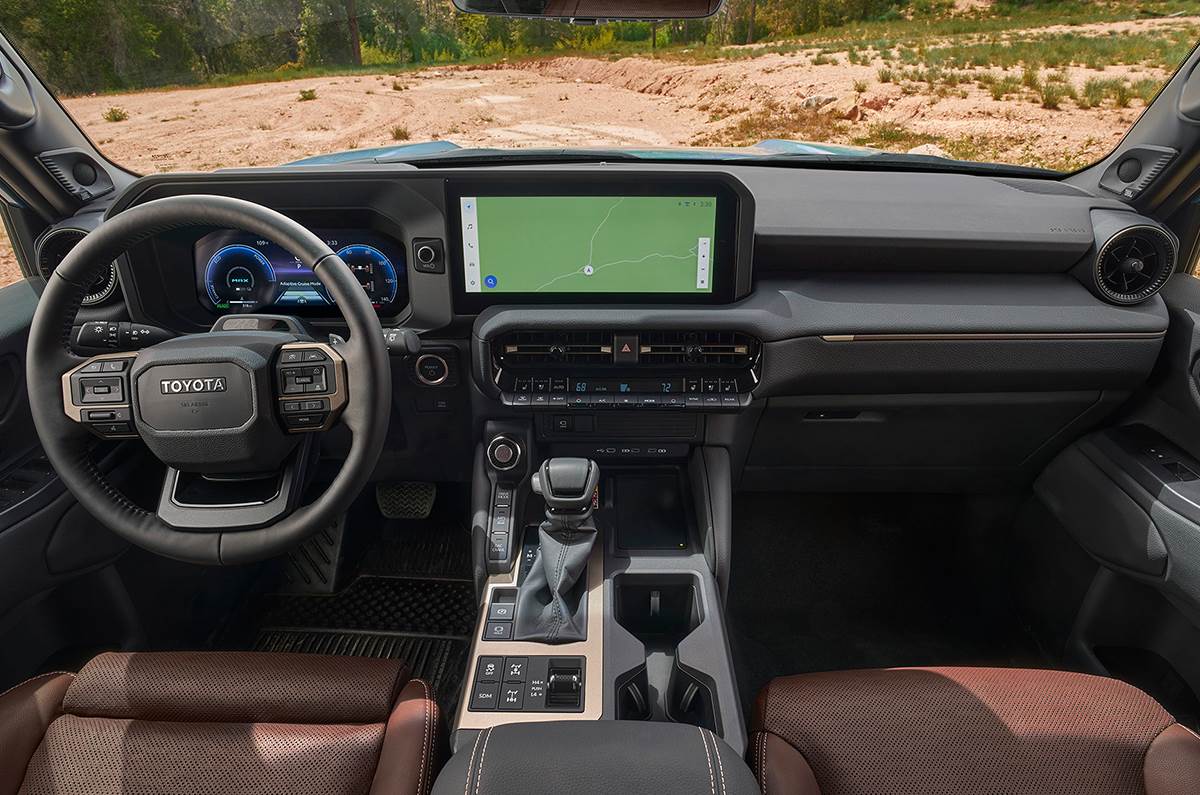
On the inside, it gets chunky physical controls with a lot of switchgear shared with the Land Cruiser 300. It gets multi-zone climate control, plush leather upholstery and a wraparound digital display with a new-generation infotainment system, all of which will help Toyota take on Land Rover’s three-year-old Defender with the new Prado.
Toyota says the new Land Cruiser Prado gets better all-terrain ability, with increased wheel articulation, an upgraded Multi-Terrain Monitor interface and improvements to the off-road driving modes among the headline upgrades that will boost its standing in this area. It also gets a disconnecting front anti-roll bar, which can be disengaged via a switch on the dashboard to allow for maximum wheel articulation on especially challenging off-road courses.
New Land Cruiser Prado, Land Cruiser (USDM) powertrain details
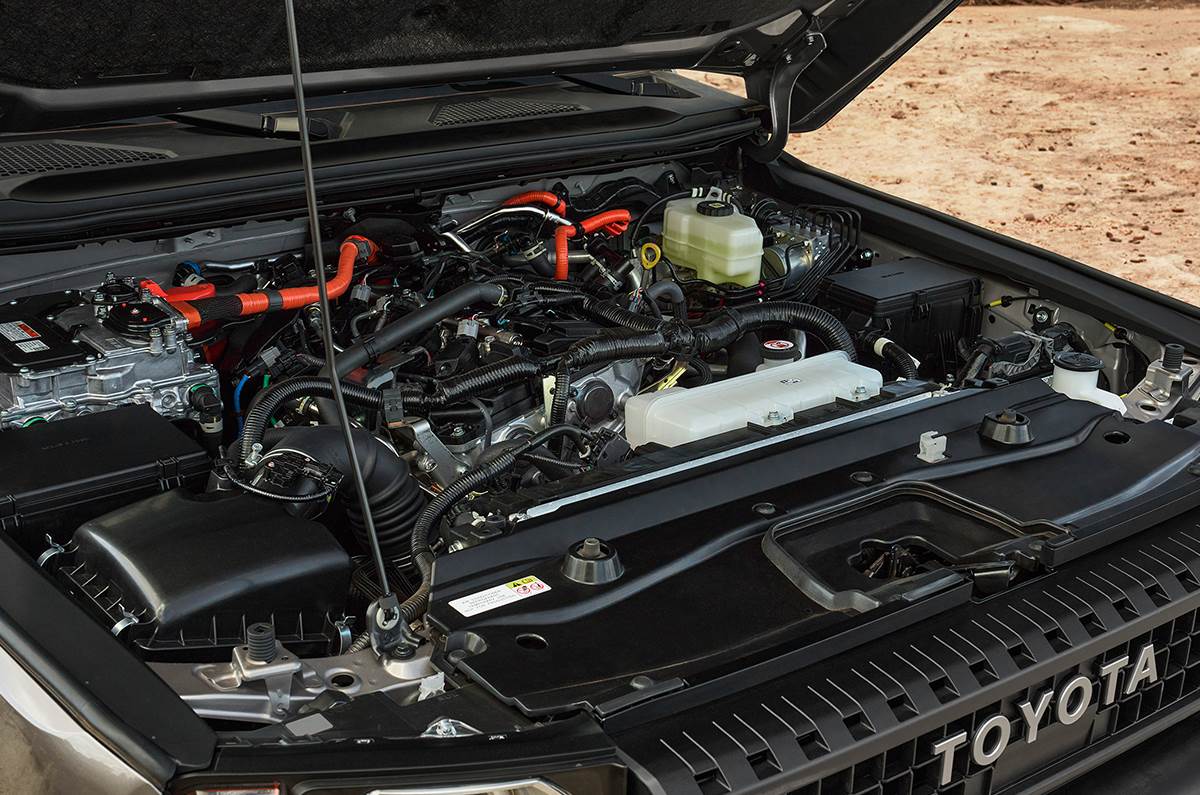
The new Land Cruiser Prado will go on sale in the European, Japanese, Middle Eastern and Australian markets with the same 2.8-litre diesel engine that powers the Fortuner SUV in India. This engine, mated to an 8-speed automatic, will get a 48V MHEV mild-hybrid powertrain by 2025. Toyota recently announced that it is testing an MHEV-equipped Hilux mated to the same 2.8-litre diesel engine.
The Land Cruiser 250 will come with a 2.4-litre petrol engine with a hybrid powertrain – the same engine that powers the Lexus GX 470 and a long list of Toyota and Lexus models globally.
Retro-styled Land Cruiser 70 gets updates too
The Land Cruiser 70, which is still on sale in markets like Australia, the Middle East and Africa, has been updated too. Cosmetic changes are kept at a minimum, with an all-new front styling with rounded headlamps, a new grille design and prominent Toyota badging. It gets a major update under the hood with the addition of the 2.8-litre four-cylinder diesel powerplant that joins the 4.5-litre V8 diesel.
Toyota Land Cruiser Prado, Land Cruiser 70: India launch details
While we don’t expect the Land Cruiser 70 to come to India, the all-new Land Cruiser Prado will surely make it to our shores in the near future, and will be positioned above the Fortuner and below the full-size Land Cruiser 300 SUVs.
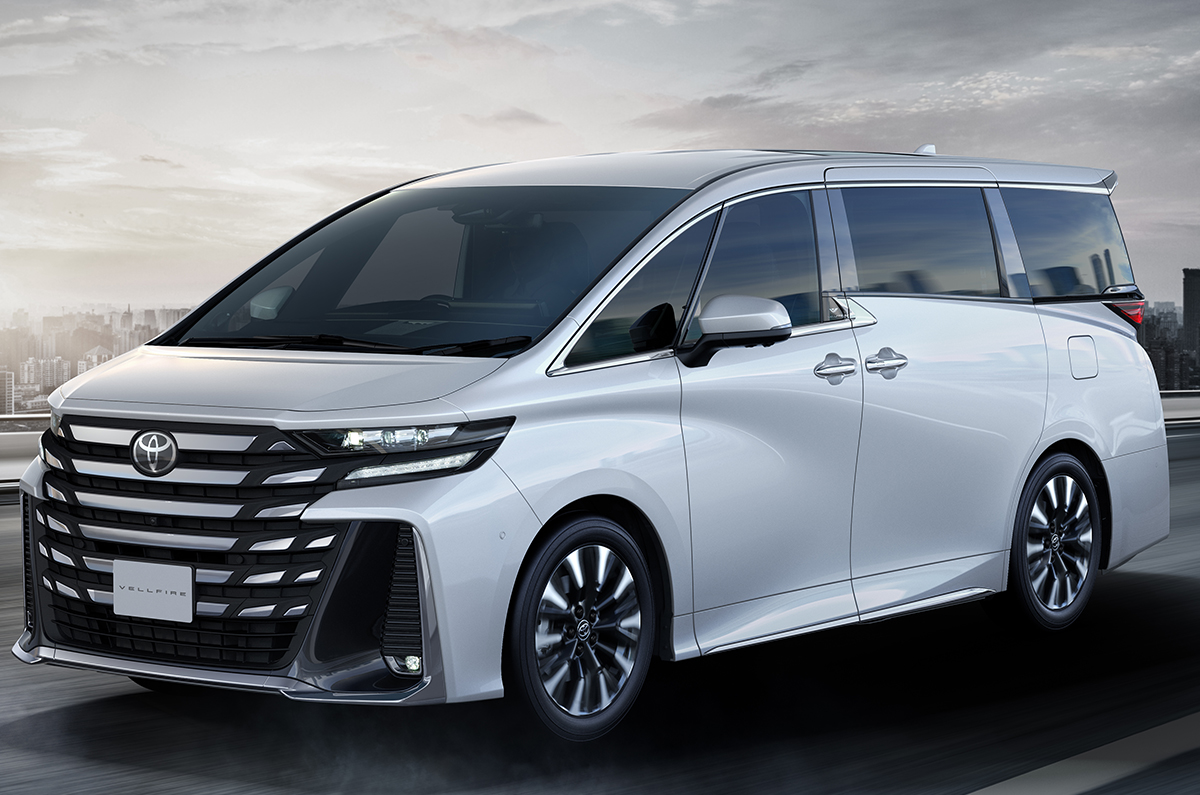
Toyota is also readying the market launch of the new Vellfire in India, as well as two other models. Read more on that here.
BMW Motorrad India has launched the updated G 310 motorcycle range in the country for the 2024 model year. The BMW G 310 R, G 310 RR, and G 310 GS get new colour options for MY2024 while retaining the same mechanicals, styling and features. Prices for the 2024 G 310 R start at ₹2.85 lakh, while the G 310 RR retails at ₹3 lakh and the G 310 GS is priced at ₹3.25 lakh. All prices are ex-showroom India.
By: Sameer Fayaz Contractor | Updated on: 01 Aug 2023, 15:22 PM
The BMW G 310 R, G 310 RR, and G 310 GS get new colours for MY2024 retaining the same mechanicals, styling and features
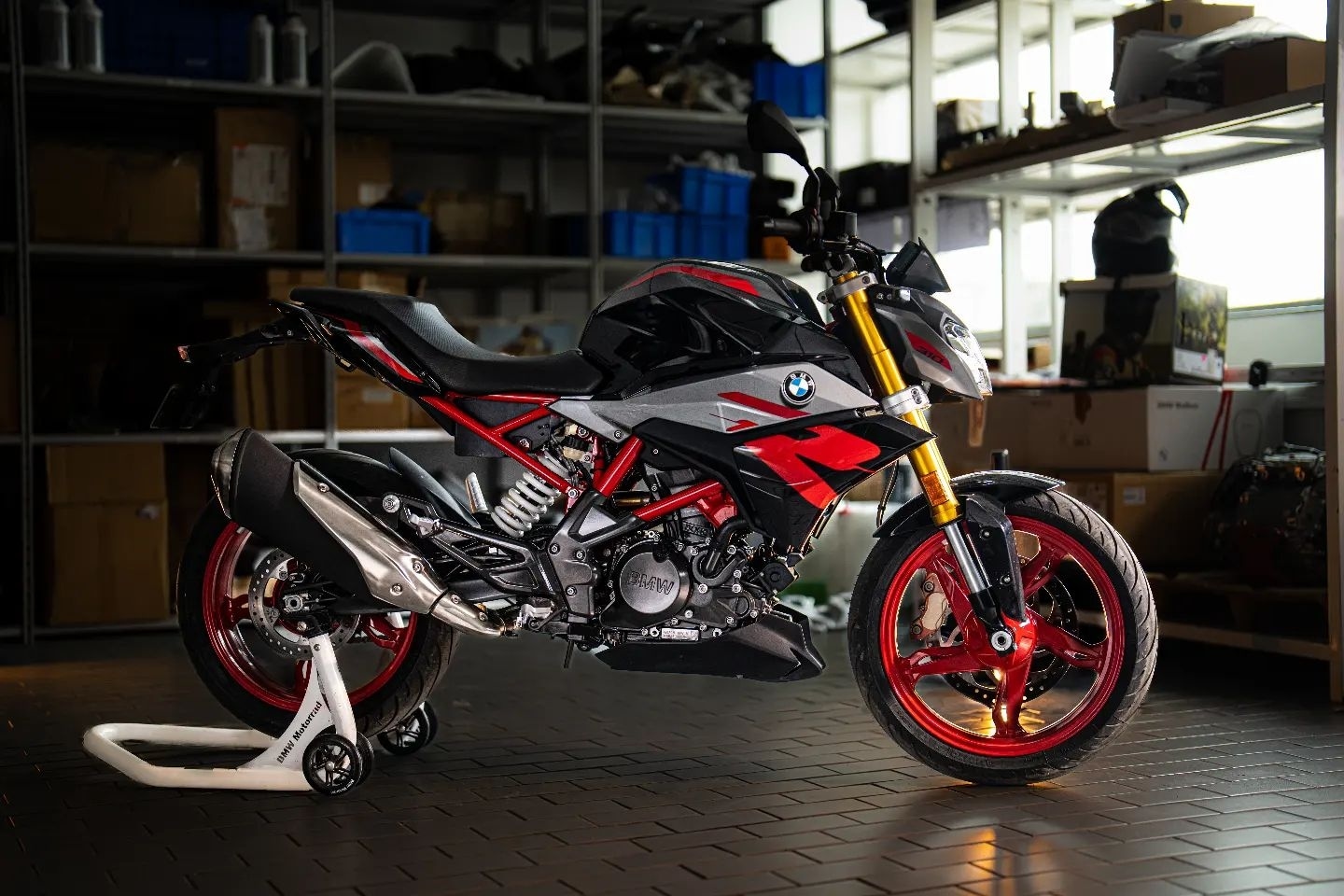
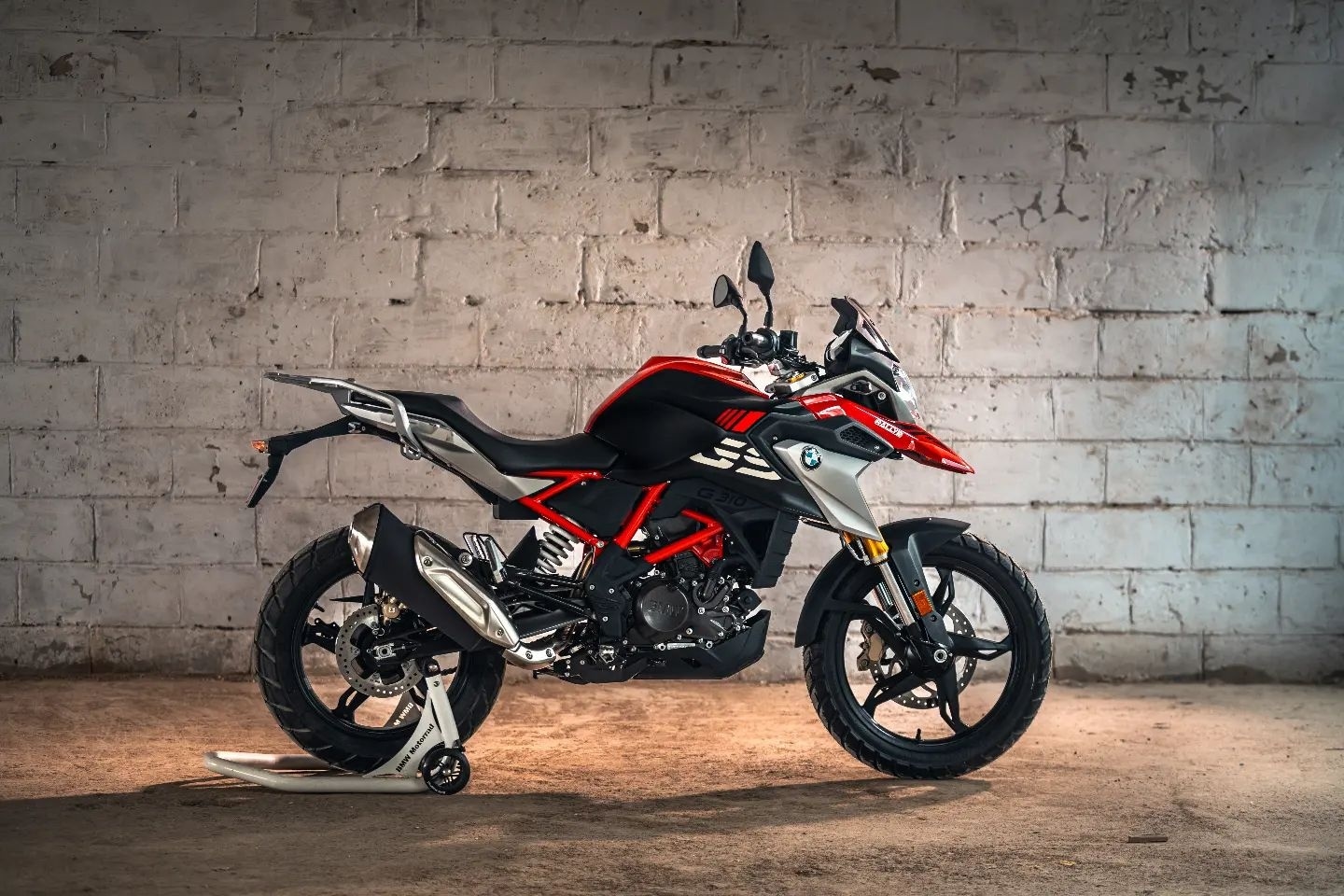
The 2024 BMW G 310 R roadster is now available in the new Style Passion black and grey colour scheme with red highlights. Meanwhile, the 2024 BMW G 310 RR gets a new colour option – Cosmic Black 2 – which brings an all-black paint scheme to the full-faired motorcycle. Lastly, the 2024 BMW G 310 GS adventure tourer gets a new Racing Red colour scheme that brings a feisty red, black and grey paint scheme to the motorcycle.
The 2024 BMW G 310 RR gets the new Cosmic Black 2 colour option
All the new colour options on either motorcycle will be available alongside the existing colours available on the bikes. That said, there are no changes to the bikes on the mechanical front. The BMW G 310 range draws power from the 313 cc single-cylinder, liquid-cooled engine. On the G 310 R and G 310 GS, the motor is tuned for 33.5 bhp at 9,250 rpm and 28 Nm at 7,500 rpm. The same unit is tuned to make 34 bhp at 9,700 rpm and 27 Nm at 7,700 rpm on the G 310 RR. The motor is paired with a 6-speed gearbox on all three machines. The engine was most recently updated to meet the latest OBD2 norms and future E20 fuel compliance.
The 2024 BMW G 310 R is now offered in the Style Passion black and grey colours with red highlights
Hardware components include 41 mm USD front forks and a preload adjustable monoshock at the rear. The bikes get 300 mm front and 240 mm rear single-disc brakes with dual-channel ABS. All three bikes run a 17-inch wheel barring the G 310 GS, which uses a larger 19-inch front alloy with a 17-inch rear wheel, running on dual-sport rubber.
The 2024 BMW G 310 GS gets the feisty Rally paint scheme finished red, black and grey
The entry performance segment has seen major additions over the last month with the arrival of the Harley-Davidson X440 and Triumph Speed 400. Both bikes will be eating into the share of the entry-level BMW Motorrad motorcycles. The G 310 range also competes with the KTM 390 Duke, Honda CB300R, Royal Enfield Himalayan, KTM 250 Adventure, and the like.
Hyundai Motor India Ltd (HMIL), on Tuesday, announced that it cumulatively sold 66,701 cars in July 2023. This marks a 4.46 per cent growth compared to the South Korean automaker’s sales numbers posted in July last year when it registered 63,851 units. In the domestic market, Hyundai India recorded 50,701 units in July this year, registering a marginal growth as compared to 50,500 units sold in the same month a year ago.
By: HT Auto Desk | Updated on: 01 Aug 2023, 12:46 PM
The range of SUVs has helped the automaker to post significant growth in sales in July 2023.
While domestic market sales for Hyundai India have witnessed marginal growth, export numbers for the car manufacturer have seen a substantial surge in sales with 16,000 units sold last month, up by 19.84 per cent from 13,351 units sold in the same month a year ago.
Commenting on the sales performance of the automaker, Tarun Garg, COO of Hyundai Motor India Ltd., said that July 2023 marked a significant milestone for the automaker. He attributed the sales performance of the automaker to the range of SUVs sold by the company in India, which include popular models like Creta, Venue alongside Tucson, Alcazar, Kona Electric etc.
Garg also hopes that the automaker would be able to post even better sales results in the coming days buoyed by the newly introduced Exter. The upcoming festive season too is expected to help the automaker to post even better sales results, hopes the Hyundai official. “July 2023 marks a significant milestone in Hyundai Motor India’s journey in India. Our Domestic July Sales volume of 50 000 plus units is backed by a strong SUV portfolio. This has been bolstered by the addition of Hyundai Exter to an already strong SUV line-up led by brands like Creta, Venue, Venue N-Line, Tucson, Alcazar, Kona Electric and all-electric SUV Ioniq5. With the semiconductor supply issues more or less behind us, we are all geared up for the upcoming festive season in India starting with Onam in Kerala,” he said.