
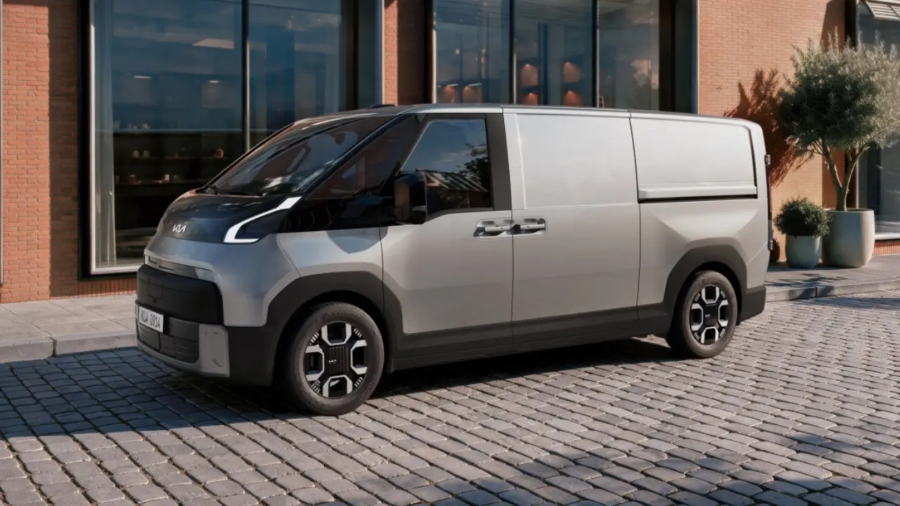
Summary: Kia has unveiled the PV7 – its second dedicated electric Platform Beyond Vehicle (PBV) – at IAA Transportation 2026 in Hannover, Germany. Positioned above the PV5, the PV7 is aimed at businesses and passenger transport operators that need more space and carrying capacity without moving…
Kia has unveiled the PV7 – its second dedicated electric Platform Beyond Vehicle (PBV) – at IAA Transportation 2026 in Hannover, Germany. Positioned above the PV5, the PV7 is aimed at businesses and passenger transport operators that need more space and carrying capacity without moving away from an all-electric powertrain. It will be offered in Cargo and Passenger versions, with sales planned in Korea and Europe from the second half of 2027. Kia also plans to introduce further derivatives and conversion models.
Also Read: Kia Sonet iMT Long Term Report: End of Term – Great Engine, Tricky Gearbox
Kia PV7: What is it?
The PV7 is built on Kia’s E-GMP.S architecture developed specifically for PBVs. The flat-floor platform allows Kia to offer different body styles and interior layouts, while the company’s Flexible Body System is intended to support future conversions. The electric van measures 5,350mm in length, 1,995mm in width and 1,990mm in height, with a 3,500mm wheelbase. Kia will offer 71.5kWh and 96.2kWh NCM battery packs.
The electric motor produces up to 268.2bhp and 420Nm, with front-wheel drive offered initially. An all-wheel-drive version is planned for a later date. The Long Range Cargo version is expected to deliver more than 460km of range on the WLTP cycle. The PV7 also gets an 800V electrical architecture, allowing a 10-80% charge in the mid-20-minute range using a 350kW DC charger.
Kia PV7 Cargo Focuses on Load Carrying

The PV7 Cargo is available in two- and three-seat configurations, depending on the market. Payload capacity reaches 1,165kg for the Long and 1,200kg for the Compact variant. The Long model has a 550mm loading height and can carry up to three Euro pallets. Kia has also added a heavy-load driving mode that adjusts the vehicle’s behaviour according to the payload.
Kia PV7 Passenger offers flexible seating
-1789470693707.webp)
The Passenger version is designed for crew transport, shuttle services, rental fleets, tourism and family use. It can seat up to nine people globally and up to 11 in Korea. The seven-seat version gets Long-Rail Easy Remove Seats, allowing the cabin layout to be changed according to requirements. The nine-seat model can also be specified with or without a fourth row. Rear climate controls, USB-C charging ports and additional storage are available.
Kia PV7 gets connected tech and ADAS
The PV7 uses Pleos Connect, based on Android Automotive OS, with connected navigation, over-the-air updates and access to applications. Gleo AI provides voice control for functions such as navigation and messaging. Vehicle-to-Load functionality can power external equipment, making it useful for business users working away from conventional power sources. Kia also offers fleet-management tools, vehicle data APIs and predictive maintenance services.

Safety equipment includes seven airbags, Forward Collision-Avoidance Assist, Lane Keeping Assist, Highway Driving Assist 2.0, Remote Smart Parking Assist and Surround View Monitor, although availability will vary by market and specification
Source: https://www.autox.com/news/car-news/kia-pv7-debuts-with-460km-range-and-up-to-1200kg-payload-124552/