
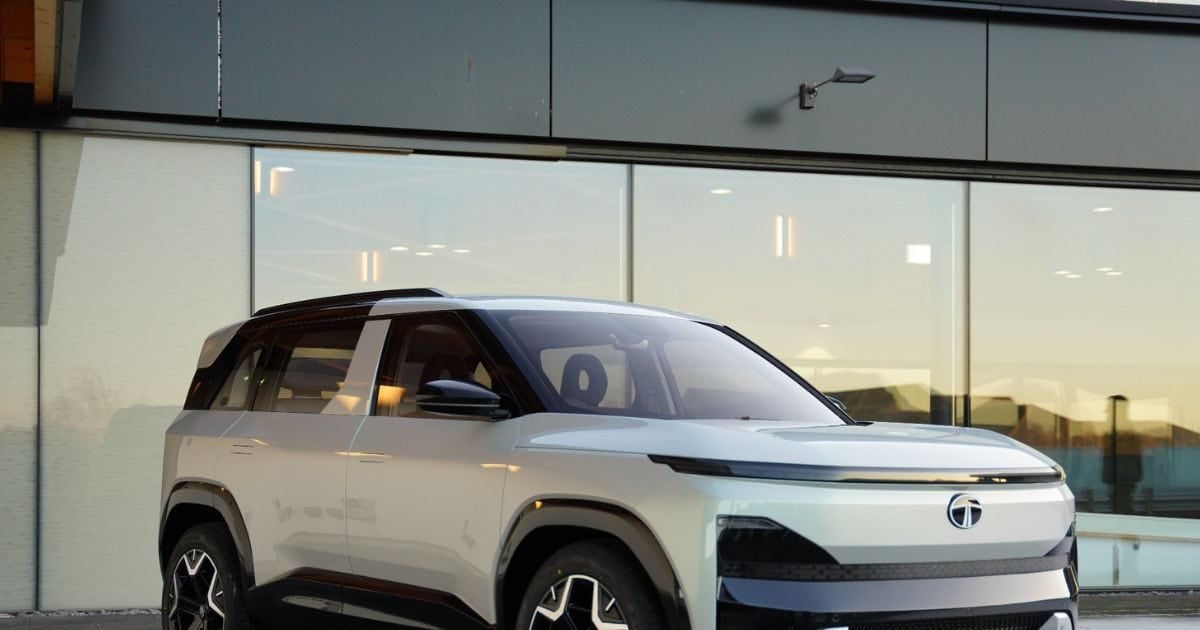
Tata Sierra EV has been spotted testing several times in India. It was recently spotted during road tests in camouflage, which included cold-weather trials and rough terrain evaluations in Leh. This SUV has confirmed its EV identity with a charging flap, no exhaust pipe and independent rear suspension. This new e-SUV built on Acti.EV platform will be positioned between Curve EV and Harrier EV.
In the midsize electric SUV segment, it will compete with rivals like Mahindra BE6 and Hyundai Creta EV. Expected to launch in the second quarter (April-June) of 2026, it may promise retro-modern styling, advanced features and a range of up to 500 km. Estimated price is around ₹15-25 lakh. Come, let us know what can be seen in it.
Design and interior
The design of Tata Sierra EV will be a mix of retro and modern. It will include a boxy SUV silhouette, muscular stance, wraparound rear windows, closed-off grille, slim split-headlamp setup, aero-optimized 19-inch alloy wheels, flush door handles, connected LED lighting, squared-off wheel arches and clean rear with full-width LED tail lamps. It will pay tribute to the original 1990s Sierra and adopt modern EV elements, such as smooth surfaces and muscular bumpers.
The interiors will be minimalistic and airy, with a triple-screen dashboard (12.3-inch infotainment, 12.3-inch passenger entertainment screen and 10.25-inch driver display), panoramic sunroof, ventilated and powered front seats, dual-zone climate control, ambient lighting, wireless charger, premium Harman audio system with Dolby, wireless Apple CarPlay and Android Auto, 360-degree camera, dual-tone materials and light color palette will be included. The seating options could be a five-seat or four-seat lounge layout, which will provide a spacious and comfortable cabin.
Features and safety
Features will include Level 2 ADAS (Adaptive Cruise Control, Lane Keep Assist, Autonomous Emergency Braking, Blind Spot Monitoring), Connected Car Technology, V2L (Vehicle-to-Load) and V2V (Vehicle-to-Vehicle) charging, instant torque, hill launch/descent control, good ground clearance and suspension tuning, which will provide better performance on rough terrain.
Safety features will include six or seven airbags, electronic stability control (ESC), traction control, hill-hold assist, tire pressure monitoring system (TPMS), all-round parking sensors, 360-degree camera and Level 2 EDAS as standard, which will ensure a strong rating in Bharat NCAP.
Battery, Motor and Range
Battery options will be 65 kWh and 75 kWh packs. These will be offered with thermal management. The motor setup will be standard front-wheel drive (FWD) or rear-wheel drive (RWD) and optional dual-motor all-wheel drive (AWD), which will provide better traction and mild off-road capability. Range could be around 450-500 km.