
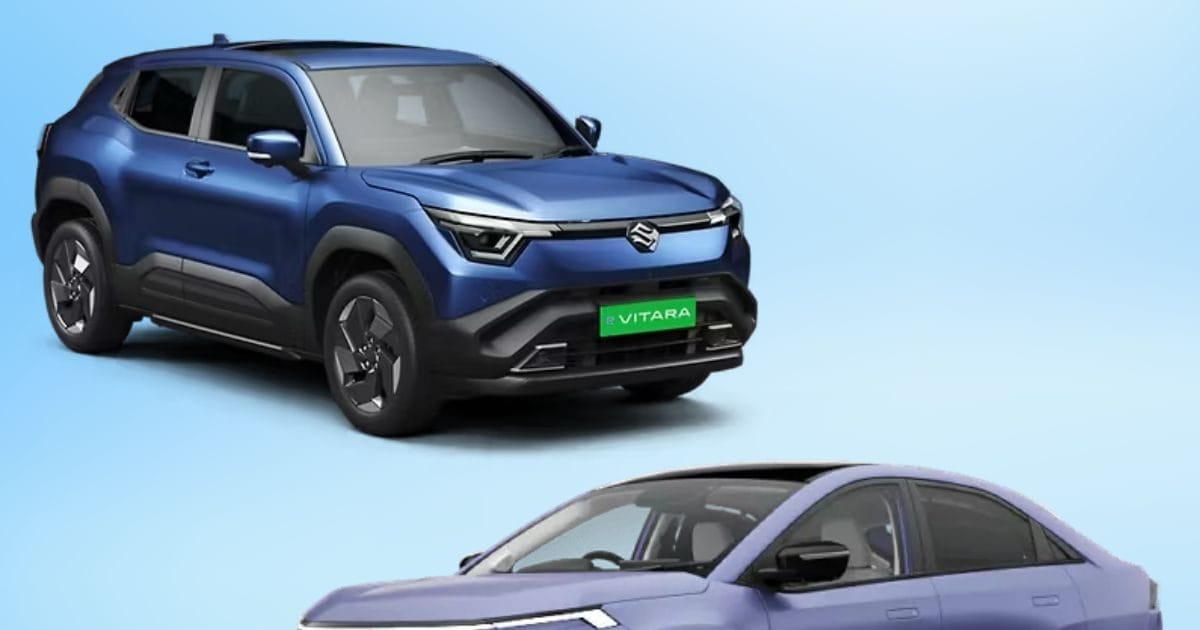
The electric SUV segment is growing rapidly in the Indian auto market. Recently, the country's largest car company has also launched Maruti E Vitara as its first offering in this segment. Its direct competition in the market is with Tata Curve EV. On one hand, Maruti e-Vitara is attractive with its affordable price and Battery as a Service (BaaS) option, while Tata Curve EV is known for its stylish coupe design and strong performance.
Maruti e-Vitara prices start at ₹10.99 lakh with BaaS and go up to ₹14.29 lakh, with a subscription fee of ₹4.39 per km. Without BaaS it is available from ₹ 15.99 lakh to ₹ 20.01 lakh. Variants include Delta, Zeta and Alpha. Whereas, the price of Tata Curve EV ranges from ₹ 17.49 lakh to ₹ 22.24 lakh, in which there are Creative, Accomplished and Empowered variants. Let's take a look at their design, interior, features, safety, battery, motor and range details.
Design
The design of Maruti E Vitara is futuristic SUV style, with bold front grille, matrix LED DRL, projector headlamps and 18-inch alloy wheels. Its length is 4275 mm, width 1800 mm, height 1640 mm and wheelbase 2700 mm, which makes it stable and spacious. Color options include Arctic White, Opulent Red etc.
At the same time, Tata Curve EV is a coupe SUV, which has a sloping roofline, animated LED lighting, flush door handles and aerodynamic alloy wheels. Its length is 4310 mm, width is 1810 mm, height is 1637 mm and wheelbase is 2560 mm. Colors like Virtual Sunrise, Flame Red available. In comparison, Maruti's design is practical and family-oriented, while Tata's is more stylish and has youth appeal.
interior
The interior of the Maruti e-Vitara is dual-tone, with a 10.25-inch digital instrument cluster, 10.25-inch touchscreen infotainment, leather upholstery, ventilated front seats and ambient lighting. There is good space in the rear seats, but headroom could be a little less. Boot space is 500 litres.
The interiors of the Tata Curve EV are also dual-tone, but with a larger 12.3-inch touchscreen, 12.3-inch digital cluster, leatherette upholstery and more storage options. The rear seats are a bit cramped due to the coupe roof, but comfort is good. Boot space is also 500-604 litres. Tata's interior looks more modern, while Maruti's is family-friendly and simple.
Features and safety
Both cars have automatic climate control, wireless charging, cruise control and drive modes (Eco, Normal, Sport). The Maruti has a fixed glass roof, air purifier and more ADAS features like auto emergency braking, lane keep assist. The Curve has a panoramic sunroof, V2V/V2L charging, 360-degree camera and JBL sound system. Tata is ahead in features, but Maruti's connected car tech and smart features are also strong.
Both have received 5-star rating in India NCAP. Maruti has 7 airbags, level 2 ADAS, 360 camera, TPMS and ESC. Tata Curve has 6 airbags, level 2 ADAS, hill descent control and blind spot monitor. Maruti's AOP score is better, while Tata's COP score is strong. Both are safe.
Battery, Motor and Range
Maruti e-Vitara has a 49 kWh battery (142 bhp, 189 Nm, 440 km range) and 61 kWh (171 bhp front, 181 bhp in AWD, 300 Nm, 543 km range). DC fast charging takes 45 minutes from 10-80%. Curve EV has 45 kWh (148 bhp, 215 Nm, 430 km range) and 55 kWh (165 bhp, 215 Nm, 502 km range) batteries. DC charging takes 40 minutes from 10-80%.