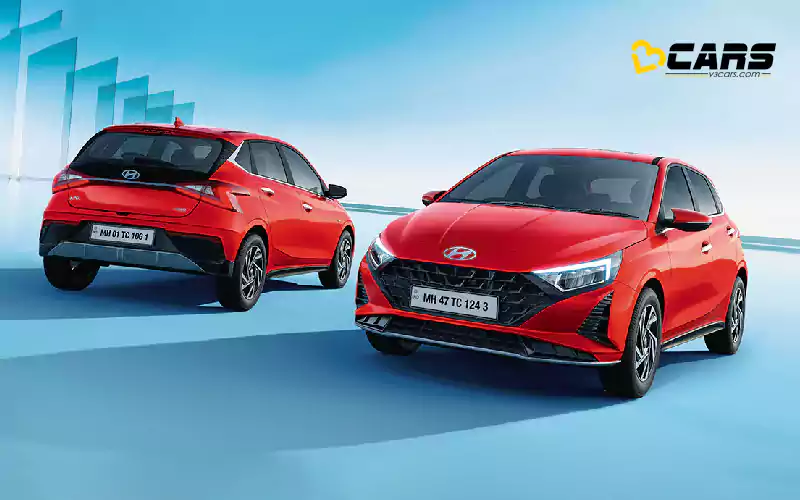
This article will give you details about the dimensions, or length, width, height and wheelbase of the Hyundai i20. We’ll also look at the ground clearance, boot space, fuel tank capacity and tyre size of the Hyundai i20.
The Hyundai i20 is 3995mm long, 1775mm wide and 1505mm tall. Bigger exterior dimensions give a car a stronger road presence. The i20 has a 2580mm long wheelbase. A longer wheelbase makes the car more stable at high speeds and gives better legroom in the back seat, while a shorter wheelbase makes the car more agile.
HYUNDAI I20 DIMENSIONS
Length
3995mm
Width
1775mm
Height
1505mm
Wheelbase
2580mm
Ground Clearance
170mm
Boot Space
311L
Fuel Tank Capacity
37L
Wheel Size (Base)
185/70 R14
Wheel Size (Top)
195/55 R16
The Hyundai i20 has a fuel tank capacity of 37 litres and a boot space measuring 311 litres. The i20 has a ground clearance of 170mm. The tyre size of the Hyundai i20 base model is 185/70 R14 and the top model rides on 195/55 R16 tyres. Cars running on bigger wheels provide better handling and styling. However, these advantages come at the cost of efficiency. Having bigger wheels means more metal and more rotating mass. Therefore, it adversely impacts your drivability, performance and mileage.
What Are The Dimensions Of Hyundai i20?
The Hyundai i20 is 3995mm long, 1775mm wide and 1505mm tall.
What Is The Length Of Hyundai i20?
The Hyundai i20 is 3995mm long. Here’s the length of i20 in other units like centimetres, metres, feet and inches:
Hyundai i20 Length
Millimetres
3995mm
Centimetres
399.5cm
Metres
3.995m
Inches
157.28in
Feet
13.11ft
What IsThe Width Of Hyundai i20?
The Hyundai i20 is 1775mm wide. Here’s the width of i20 in other units like centimetres, metres, feet and inches:
Hyundai i20 Width
Millimetres
1775mm
Centimetres
177.5cm
Metres
1.775m
Inches
69.88in
Feet
5.82ft
What Is The Height Of Hyundai i20?
The Hyundai i20 is 1505mm tall. Here’s the height of i20 in other units like centimetres, metres, feet and inches:
Hyundai i20 Height
Millimetres
1505mm
Centimetres
150.5cm
Metres
1.505m
Inches
59.25in
Feet
4.94ft
What Is The Fuel Tank Capacity Of Hyundai i20?
The Hyundai i20 has a fuel tank capacity of 37 litres.
What Is The Wheelbase Of Hyundai i20?
The Hyundai i20 has a wheelbase measuring 2580mm. Here’s the wheelbase of i20 in other units like centimetres, metres, feet and inches:
Hyundai i20 Wheelbase
Millimetres
2580mm
Centimetres
258cm
Metres
2.58m
Inches
101.57in
Feet
8.46ft
What Is The Boot Space Of Hyundai i20?
The Hyundai i20 has a boot space measuring 311 litres. Here’s the boot space information of i20 in other units like cubic centimetres, cubic metres, cubic inches and cubic feet:
Hyundai i20 Boot Space
Litres
311L
Cubic Centimetres
311000cm3
Cubic Metres
0.311m3
Cubic Inches
18978.46in3
Cubic Feet
10.98ft3
What Is The Ground Clearance Of Hyundai i20?
The Hyundai i20 has a ground clearance of 170mm. Here’s the ground clearance of i20 in other units like centimetres, metres, feet and inches:
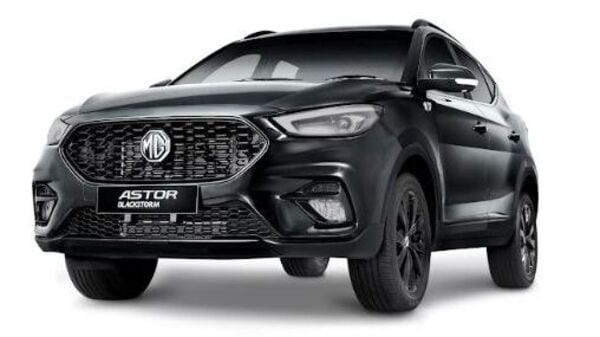
MG Astor Blackstorm Edition follows into the footsteps of MG Gloster Blackstorm Edition.
By: HT Auto Desk | Updated on: 10 Sep 2023, 11:38 AM
1/6
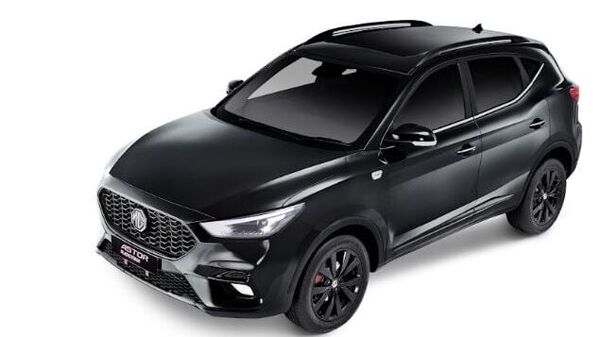
MG Motor India has launched the Astor Blackstorm Edition at a starting price of ₹14,47,800 with the pricing going up to ₹15,76,800 (ex-showroom). This special edition SUV comes sporting an all-black theme on the exterior and inside the cabin. It follows into the footsteps of the MG Gloster Blackstorm edition.
2/6
The limited-edition Astor Blackstorm sports the Starry Black exterior colour, complemented by chrome garnishing at various places, enhancing its premium look. There are Black Edition badges on various places like front fenders on both sides that make this model distinctive from the standard version of Astor.
3/6
The Astor Blackstorm gets an all-black honeycomb pattern grille, black alloy wheels with red front brake callipers, black finish headlamps, glossy black door garnish and black finish roof rails. The differences between the standard version of the Astor and this special edition model are limited to the cosmetic terms only.
4/6
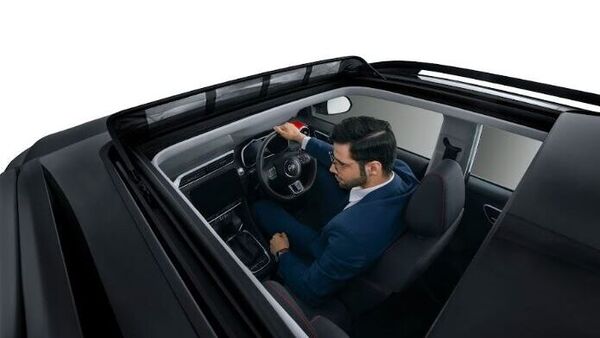
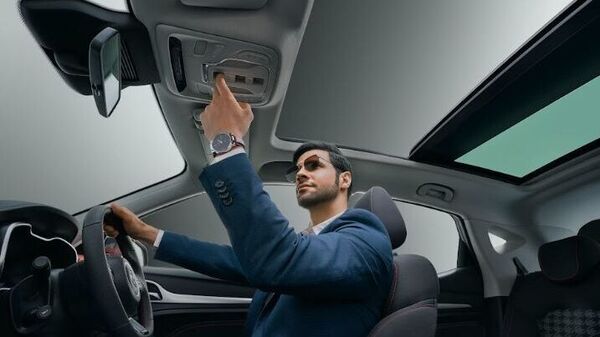
The model gets a panoramic sunroof and Black Edition badges on various places like front fenders on both sides that make it look distinctive from the standard version of Astor.
5/6
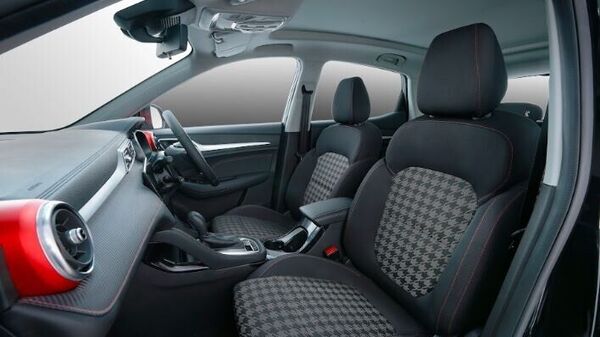
On the inside, the Astor Blackstorm Edition carries on with the same sporty black theme. It gets a Tuxedo Black upholstery with contrasting red stitches, Sangria Red-themed AC vents, an all-black floor console, and red stitches on the steering wheel and door trims. Music is played by premium JBL speakers.
6/6
The MG Astor Blackstorm Edition is available in both six-speed manual and CVT options, and is powered by the same 1.5-litre petrol engine as the standard version of the car.
We chat with Abhay Aggarwal, Entrepreneur, about his love for automobiles.
Published On Sep 10, 2023 09:00:00 AM
What are you driving and why?
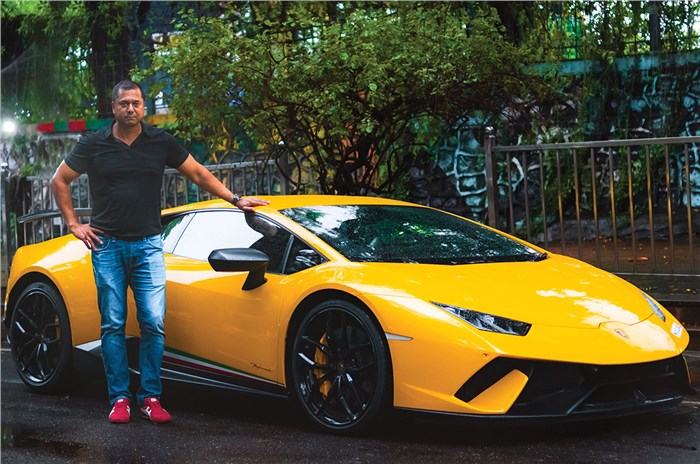
I’m currently driving a Lamborghini Huracán Performante, arguably the best Huracán ever made as I feel it has the perfect balance between a track car and street car. Whenever I drive it, I feel so alive!
What’s next on your wish list?
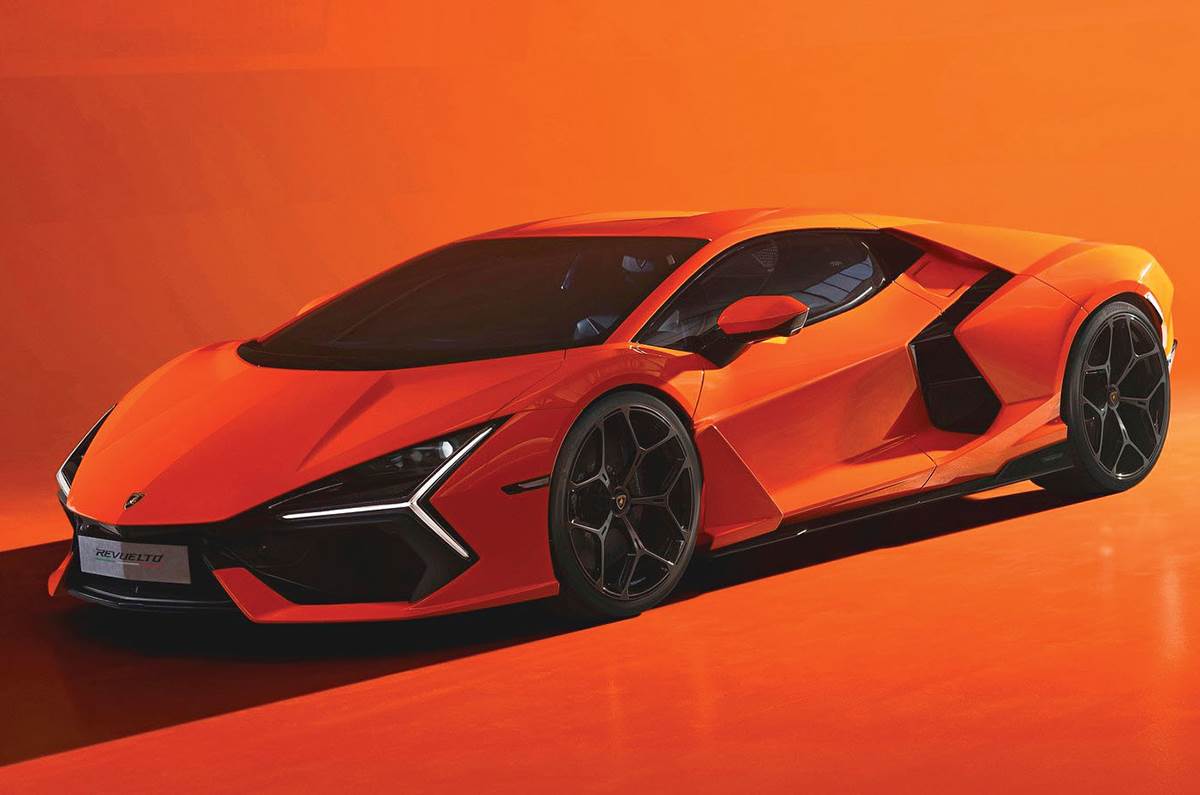
The Lamborghini Revuelto, as it still has a V12 with an added electric dose.
The most fun you’ve had in a car?
Driving swiftly on the old ghat roads up to Lonavala, 30 years ago.
Dream money-no-object car?
At the moment, it’s the Lamborghini Revuelto. Although I’m very impulsive and change my mind easily, so who knows what it will be tomorrow.
The Revuelto is next on Abhay’s wishlist.
Who is your all-time greatest motorsport hero?
Juan Manuel Fangio.
Favourite road?
The derestricted sections of the Autobahn in Germany.
What’s on your automotive bucket list?
To drive the iconic Route 66 in the USA in 2025.
What would you do with your last litre of fuel?
I would burn it all up by doing a launch in my Performante. Not sure I’d cover more than a kilometre with that though!
Your ideal 5-car garage would be?
Lamborghini Revuelto Ferrari 296 GTB Porsche 911 GT3 RS Lamborghini Urus Ferrari 250 GTO
What was your first car?
A 1998 Honda City. I miss that car and wish I’d kept it for nostalgia’s sake.
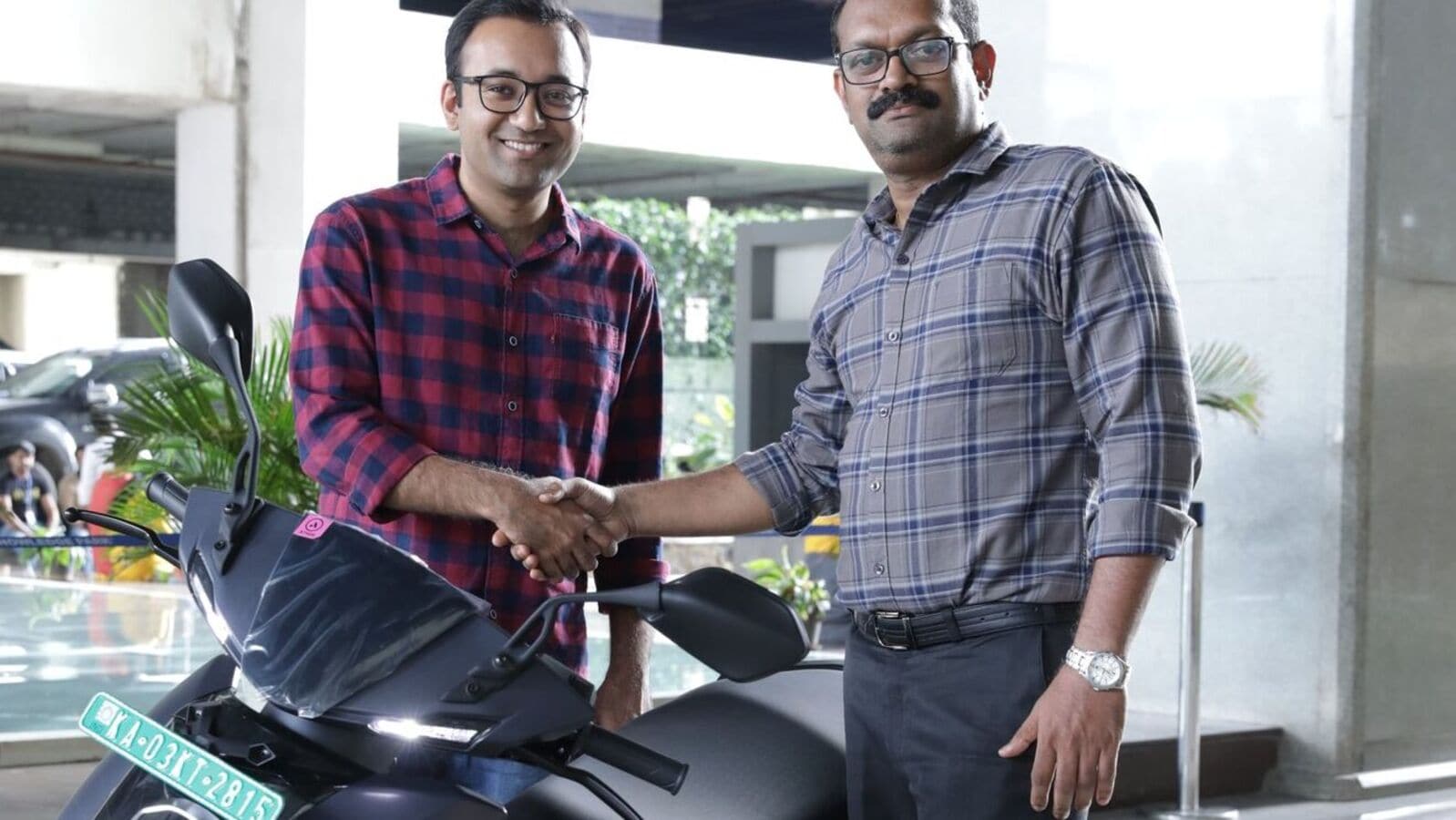
Ather Energy has commenced deliveries of 450S in the Indian market. The image of the delivery was shared by Tarun Mehta, Co-founder and CEO of Ather Energy. The 450S is the most affordable electric scooter in Ather’s lineup. The 450S is priced at ₹1.30 lakh ex-showroom. It competes against the Ola S1 Air in the Indian market.
By: HT Auto Desk | Updated on: 09 Sep 2023, 17:44 PM
Cosmetically, the 450S looks quite similar to the Ather 450X
Ather started accepting bookings of the 450S back in June this year. The price of the scooter complies with the FAME 2 scheme. The customers can avail further benefits from respective states’ own electric vehicle policies. The design of the Ather 450S is identical to the 450X. However, there are some changes which have helped in dropping the costs.
Ather 450S comes equipped with a 3 kWh lithium-ion battery pack that claims to offer 115 km of range on a single charge. Using home chargers, the battery pack can be charged up to 80 per cent in around six hours and 36 minutes while charging up to 100 per cent takes eight hours and 36 minutes.
The electric motor is capable of generating 7.24 bhp of peak power and 22 Nm of maximum torque. The 450S electric scooter can also run at a top speed of 90 kmph. Ather 450S offers three ride modes with the 450S which include Sport mode, Eco mode and Ride mode.
Watch: Ather 450S review: Worthy of its price tag?
Another big difference between the 450X and the 450S is the instrument cluster. The 450S uses a new coloured LCD instrument cluster. It still comes with features such as Bluetooth connectivity and turn-by-turn navigation. But now, it uses MapMyIndia’s navigation system instead of Google Maps. Ather Energy has also added a joystick on the switch console that can be used to control the instrument cluster. Moreover, the reverse mode is simply a button. Earlier, the rider would need to swipe on the screen to get into the reverse mode.
Maruti Suzuki is offering heavy discounts on its Arena models in September ahead of the upcoming festive season across India. India’s largest carmaker is offering as many as eight models sold through Arena dealership with discounts and benefits of up to ₹59,000 based on variants one chooses. The benefits offered by the carmaker include cash discounts, exchange bonuses as well as corporate discounts. The Arena chain of dealerships, which mostly sells the small cars from Maruti Suzuki, recently completed its sixth anniversary during which it has sold around 70 lakh cars.
By: HT Auto Desk | Updated on: 09 Sep 2023, 14:59 PM
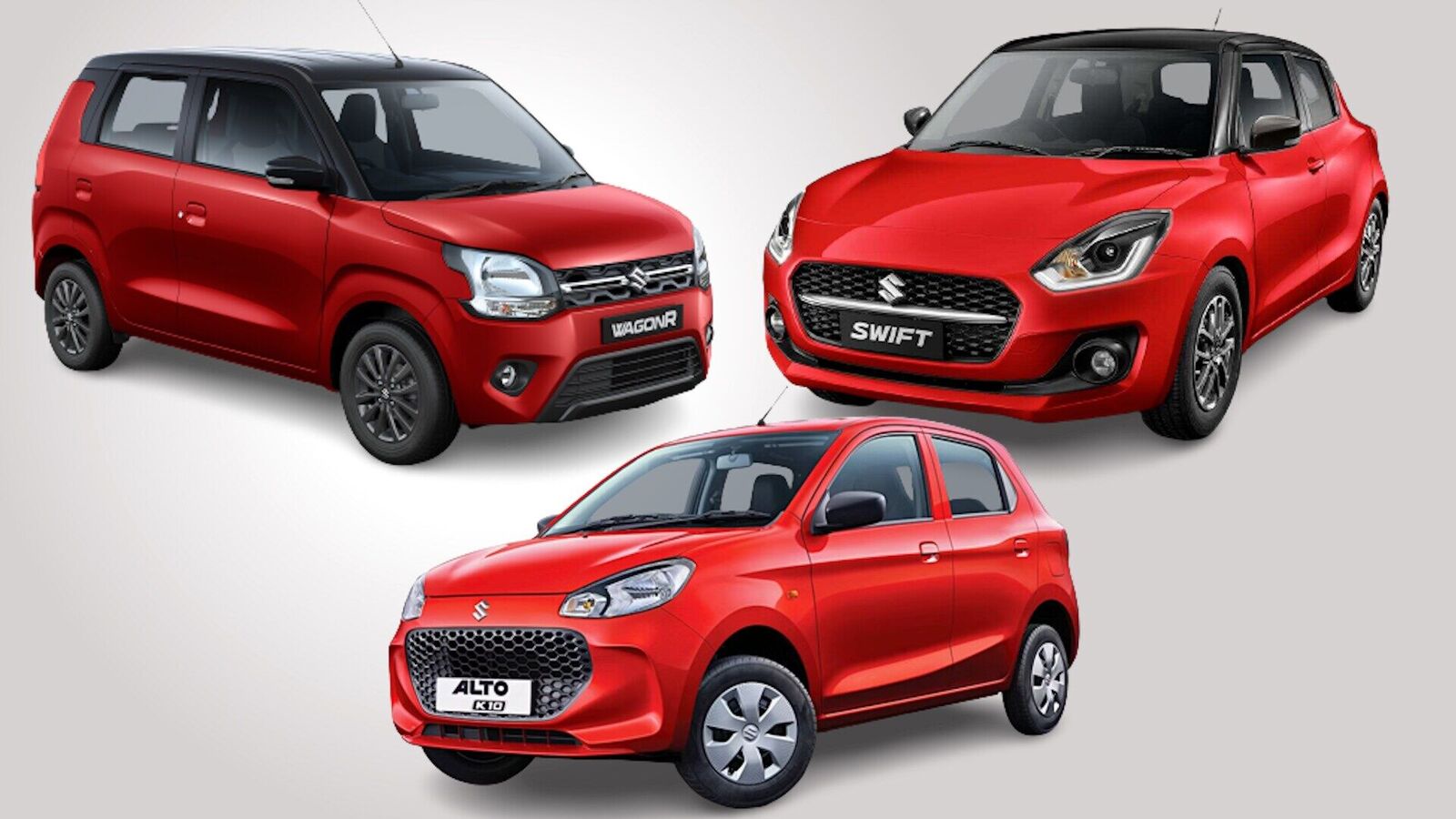
Maruti Suzuki small cars like WagonR, Swift and Alto K10 are being offered at a discount of more than ₹50,000 in September.
Maruti Suzuki sells nine models through its Arena chain of dealership in India. These cars include the Alto K10, S-Presso, WagonR, Celerio, Swift, Dzire, Brezza, Ertiga and Eeco. Only the Brezza SUV among these nine is not offered with any discounts. Here is a quick look at how much one can save on each model this month.
Maruti WagonR
Among all the Maruti cars up for discounts in September, the biggest incentives are for those who wants to drive home the WagonR. Maruti Suzuki is offering cash discount of ₹35,000 besides added benefits like exchange bonus worth ₹20,000 and corporate discount of ₹4,000. Maruti is also offering the CNG version of the WagonR with an overall discount of ₹54,000. This includes cash discount of ₹30,000.
Maruti Swift
The Swift hatchback is also up for grabs with an overall discount of ₹55,000. These include cash benefits worth ₹35,000 cash discount, ₹20,000 worth exchange bonus and another ₹5,000 as corporate discount. One should know that these benefits are not applicable on variants of the hatchback. For the ZXi and ZXi +, the cash discount goes down to just ₹25,000. The exchange bonus amount can be reduced to ₹15,000 if the model to be sold is more than seven years old.
Maruti Alto K10
The Alto K10, Maruti’s smallest car on offer, is available with big discounts. The car gets overall benefits worth ₹54,000. These includes cash discount of ₹35,000 only on the petrol manual variant, ₹15,000 worth exchange bonus and corporate discount of ₹4,000. The petrol automatic and the CNG versions of the Alto K10 are offered with cash discount worth ₹20,000.
Among other models the Celerio, Dzire, Ertiga and Eeco are available with discounts worth between ₹59,000 and ₹20,000 this month.
BMW Motorrad has unveiled the 2023 BMW F 900 GS, F 900 GS Adventure and F 800 GS globally. The motorcycles are expected to make their way to the Indian market by the end of 2023. Considering the way BMW Motorrad priced its current motorcycles, the new versions are expected to be priced quite competitively.
BMW Motorrad has increased the engine capacity from 853 cc to 895 cc.
The weight of the F 900 GS has gone down by 14 kg. The new GS models also feature two riding modes – Rain and Road as standard. There is Dynamic Traction Control, ABS Pro optimized for cornering and dynamic brake light. BMW is offering “riding modes Pro” as an option which allows the rider to control engine drag torque control as well as Dynamic Brake Control or DBC.
BMW F 900 GS features a new fuel tank that is significantly lighter than before as it is made up of plastic. The weight of the swingarm has also been decreased and there is a new aluminium stand and brake lever. BMW has also added knuckle guards and heated grips. Apart from this, the Showa up-side down forks in the front are now fully adjustable on the F 900 GS and F 900 GS Adventure.
The engines on the motorcycle feature two counter-rotating counterbalance shafts to increase the refinement.
The off-road capabilities of the F 900 GS are enhanced by a new riding triangle. The footrests are lower, the handlebar is higher and the fuel tank has been redesigned as well. This makes it easier to ride the motorcycle while standing up. The headlamp unit is also new on the F 900 GS and is an LED unit. The turn indicators on all three motorcycles are LEDs as well.
Powering the F 900 GS and F 900 GS Adventure produce 103 bhp of max power at 8,500 rpm and a peak torque output of 93 Nm at 6,750 rpm. On the other hand, the F 800 GS puts out 85 bhp at 6,750 rpm and a peak torque output of 91 Nm at 6,750 rpm.
The British brand’s first performance sedan since the Carlton arrives as a 918hp EV.
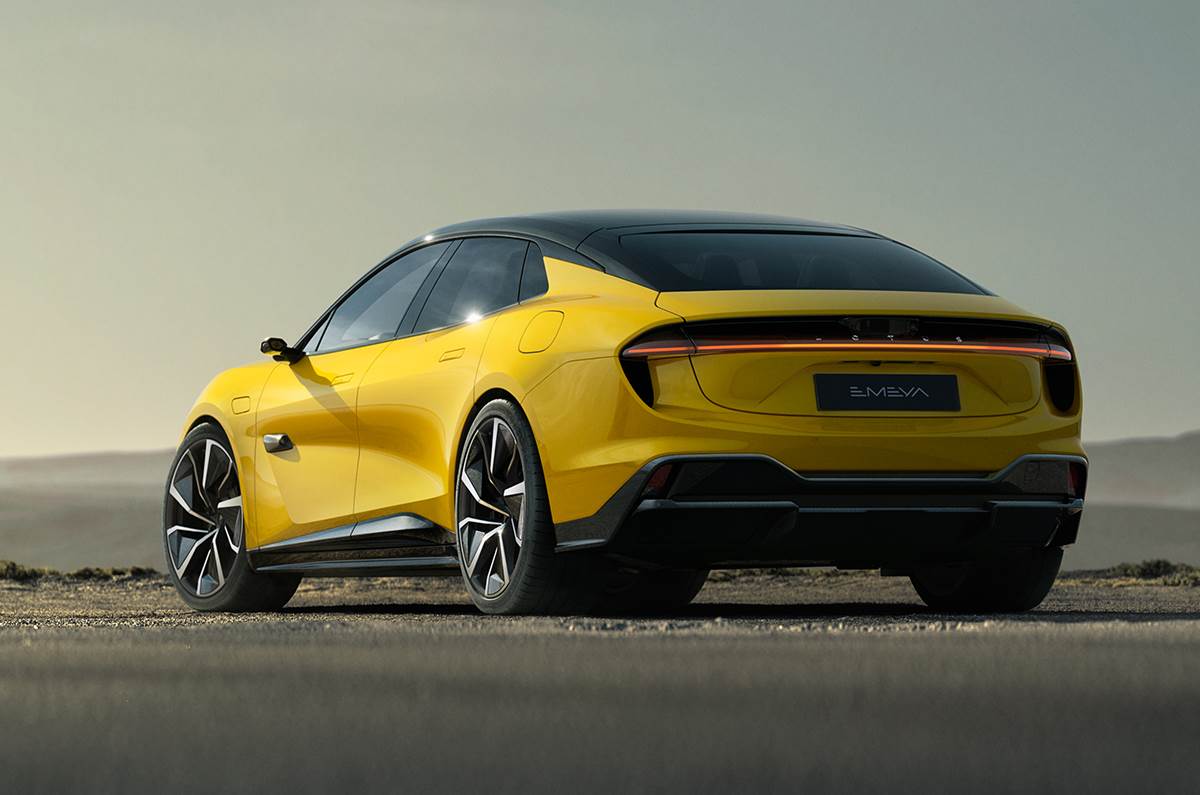
The ground-up reinvention of Lotus continues apace as the brand takes a bold leap into another new segment with the Emeya – a sleek electric sports sedan conceived to rival the Porsche Taycan and Tesla Model S. Carrying the torch from the 1990 Lotus Carlton into the electric era, the Emeya arrives just 18 months after Lotus revealed its first SUV, the Eletre, as part of a new family of lifestyle-oriented electric cars that have been engineered and built in Wuhan, China.
Lotus Emeya gets 918hp and 984Nm sent to all four wheels
102kWh battery expected to provide up to 600km of range
Production of the Emeya begin in 2024 at Lotus’s plant in Wuhan, China
Lotus Emeya powertrain and architecture
The Emeya is based on Lotus’s new Electric Premium Architecture. This bespoke structure is adaptable to suit various car segments as well as different battery sizes, electric motors, component layouts and intelligent driving technologies. Although they are entirely unrelated to the sports cars Lotus still builds in Hethel, outstanding performance remains a priority for these new-era EVs. As a result, the fastest Emeya packs a dual-motor powertrain that sends up to 918hp and 984Nm through all four wheels. That’s sufficient for 0-100kph in 2.8sec, matching the top-link Taycan Turbo S and making the Emeya one of the quickest four-doors on the market.
The Emeya has a 102kWh battery pack that yields an as yet undisclosed range. However, Lotus claims it is “broadly similar” to that offered by the Eletre, which achieves 600km in entry-level and S guise, and 490km in the high-power R models. Charging is possible at rates of up to 350kW, enabling a 150km range boost in just five minutes at the fastest chargers, according to Lotus. Recharging from 10-80 percent is said to take as little as 15 minutes.
The Emeya is not solely about big numbers and brute force, though. Its standard-fit air suspension system scans the road ahead a 1,000 times per second, and actively responds to the harshness of its surface by priming the dampers at each corner of the car appropriately. Lotus’s performance sedan also features an abundance of active aerodynamic elements, including the grille, rear diffuser, and a rear spoiler that is 100mm wider than the Eletre’s, and extends at speed to enhance stability.
The use of active aero is an “opportunity”, vice president of Lotus design Ben Payne told our sister publication Autocar UK, because it allows the firm to produce a high-performance car that also appears elegant. “High-performing, aerodynamic cars are quite fragmented.” Payne said. “You have bits in various positions all over them, so they tend to look less clean, simple and coherent. For us, looking at the future direction for Lotus, we were very keen to try and make the cars look as pure as possible and active aero allows you to do that.”
Lotus Emeya interior and features
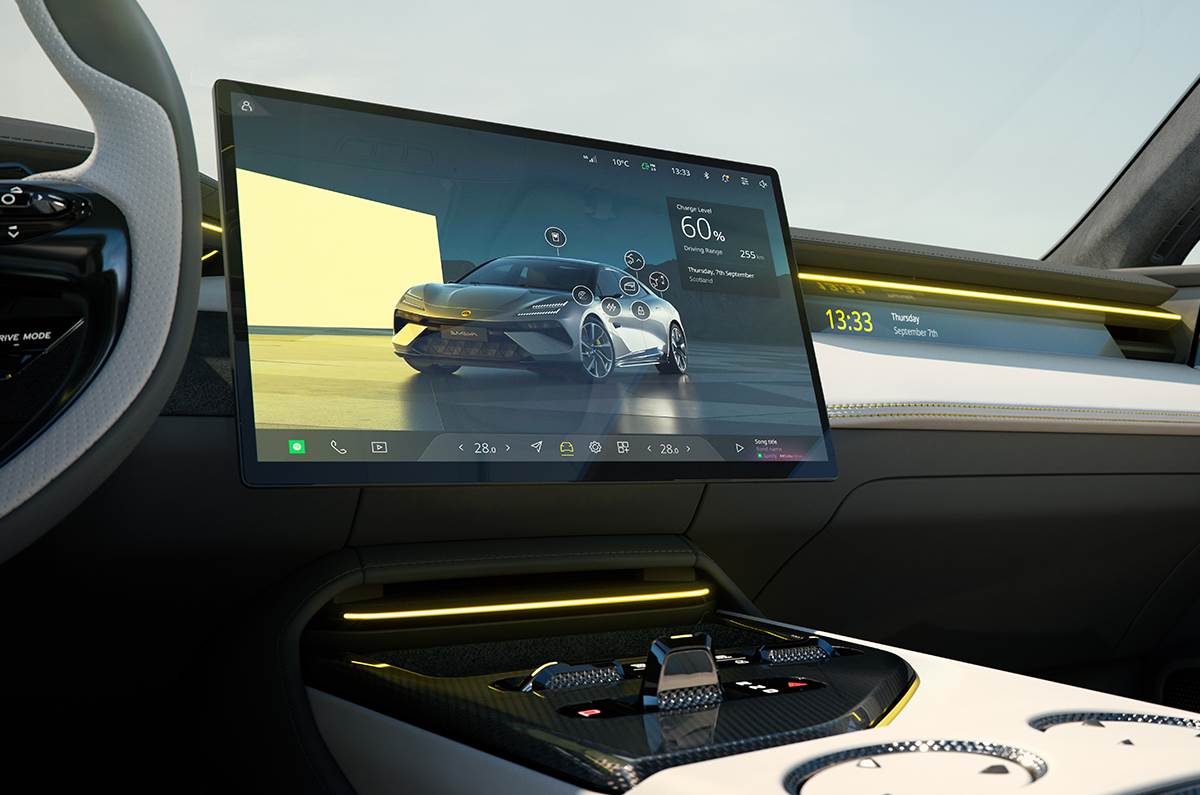
Inside, performance-oriented cues, such as carbon-bodied front seats and a flat-bottomed steering wheel, are combined with more overtly luxurious elements – individual rear seats, digital rear-view mirror screens and materials with high perceived quality among them.
The tech prowess of Lotus Technology, the Chinese EV arm of Lotus, manifests in an expansive 55.0-inch head-up display, which projects key information such as directions and driver assistance system warnings across the width of the windscreen. A large central touchscreen with 5G connectivity and over-the-air updatability is flanked by two slimmer digital displays – one for the driver, one for the passenger – in a set-up that broadly mirrors the Eletre’s.
Physical controls feature on the centre console, steering wheel and steering column, but many of the Emeya’s core functions are controllable using the touchscreen or voice assistance. The high-tech cockpit serves as a “clear indication” of the advanced technical architecture underpinning the Emeya, said Payne.
Lotus Emeya design
This impression is reinforced by the Emeya’s cab-forward silhouette, long wheelbase and short overhangs – proportions made possible by the Emeya’s electric powertrain. “We want to make sure that people understand this is an EV and leverage the possibilities the [skateboard] architecture allows you to have,” said Payne. He explained that traditionally, a GT’s proportions have been determined by “how many cylinders are under the bonnet”, giving “a long, powerful [nose] and a tight cabin at the rear”.
By breaking from these conventions, the Emeya “subconsciously tells you this is an electrified product”, said Payne. “It physically can’t have a big V8 under the hood, because we didn’t have space for it”.
Aside from its sleeker silhouette, the Emeya bears a strong resemblance to the larger Eletre. This is “wholly deliberate”, said Payne, as Lotus aims to restructure its brand image around more practical, daily-usable EVs – against the backdrop of its heritage of building uncompromising sports cars. Payne said: “Eletre is the biggest stretch for the traditional Lotus customer. Looking at where we’ve gone, we had to try very hard to put as much sports car DNA into that product as possible. Bearing in mind its size and proportion, for some people, that’s a stretch. I think, in the design team’s eyes, there are an awful lot of features on that car that really sell it as the hypercar of SUVs.
“Coming on to Emeya, we want to continue that. We’re quite mindful that Lotus needs to build an identity that makes sense and we have a properly joined-up aesthetic from the sports cars to the lifestyle product, so it looks like one complete range. At the minute, obviously, that’s in mid-process.”
Nonetheless, Payne wants to avoid “cookie-cutter” styling for future Lotus models. These include the Type 134 – a Porsche Macan EV rival that is “well in development” – and the Type 135, an electric successor to the Elise. The Eletre and the Emeya form “a springboard” for these models – as well as what comes after that, which is “five years out”. Payne would not be drawn on the form these cars will take but confirmed that “super-exciting” design work has begun.
The Emeya will enter production at Lotus’s plant in Wuhan, China, next year. Trim levels and prices are expected to mirror those of the Eletre.
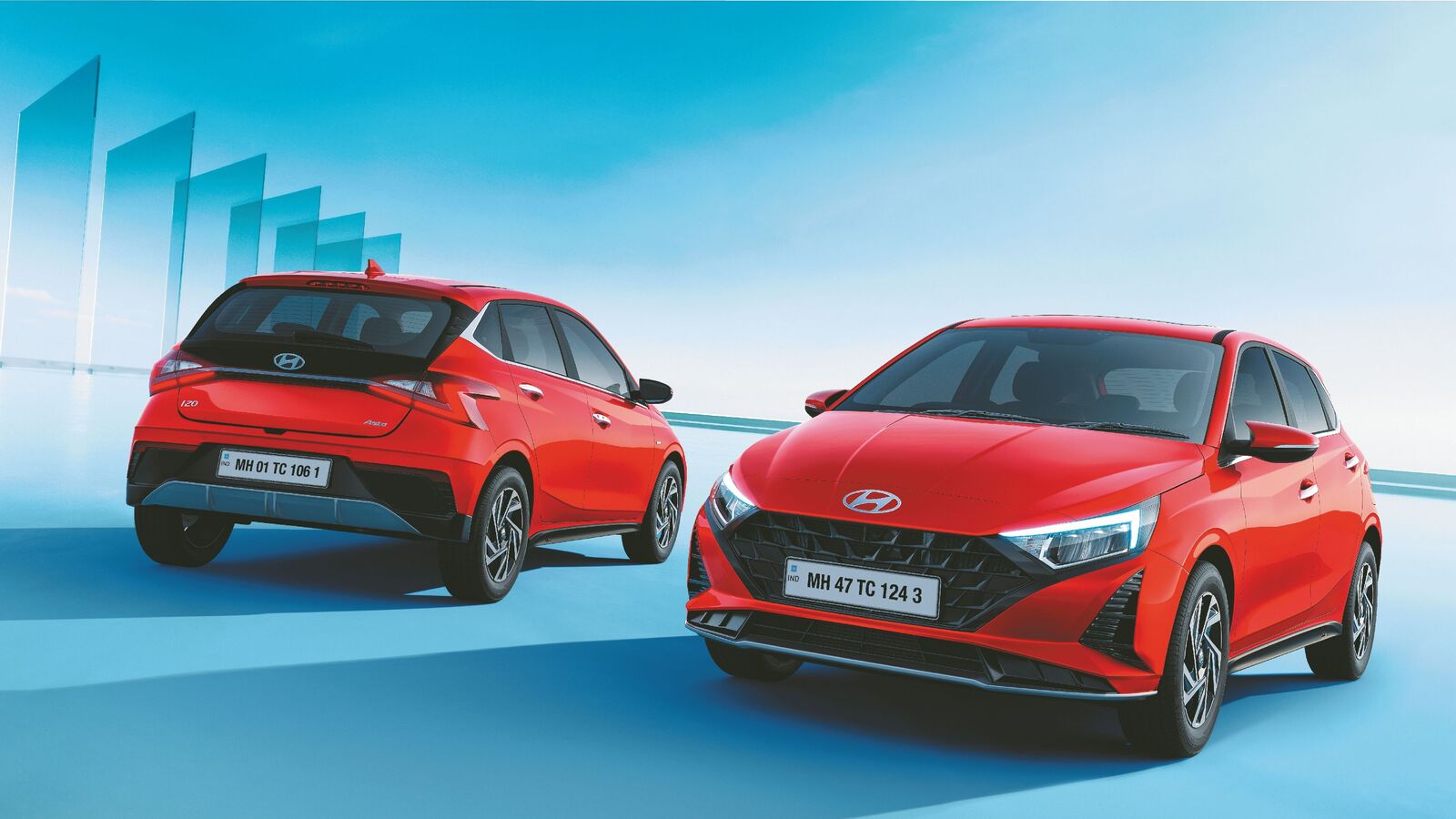
Hyundai has boosted the safety quotient of the 2023 i20 by offering loads of features as standard. It now offers 6 Airbags, Electronic Stability Control, Hill Assist Control, Vehicle Stability Management, Antilock Braking System and Electronic Brake Distribution across all variants.
The interior is finished in a dual-tone grey and black colour scheme, there is ambient lighting, Bose sound system, a redesigned key, semi-leatherette seats, leatherette door armrests and a leather-wrapped D-Cut steering wheel.
The infotainment system now comes with sounds of nature, 60+ connected car features, 127 Embedded VR commands, 52 Hinglish voice commands, Over-the-Air updates, multilanguage support and a Type C charger.
Powering the new i20 is a 1.2-litre naturally aspirated petrol engine that produces 82 bhp with the manual transmission and 86 bhp with the IVT automatic transmission. The engine now also comes with the Idle Stop & Go (ISG) feature.
For cosmetic changes, the bumpers have been redesigned to look sharper and there is a new set of LED headlamps with LED Daytime Running Lamps. On the side, there are new 16-inch alloy wheels.
Commenting on the announcement, Mr. Tarun Garg, COO,Hyundai Motor India Ltd., said, “The i20 brand has consistently set the bar in the Indian automobile industry across generations. With a passionate customer base exceeding 1.3 million, the new Hyundai i20 remains the beacon of customer aspirations. Prioritizing safety as a cornerstone, the new Hyundai i20 delivers a resounding message with its standard features, including 6 Airbags, Electronic Stability Control, Hill Assist Control, Vehicle Stability Management, 3-Point Seatbelts, and seatbelt reminder for all occupants. Crafted for the urban youth, the new Hyundai i20 promises an unmatched mobility experience. We hold unwavering confidence that the new Hyundai i20 will not only elevate customer aspirations but also resonate profoundly with the ambitions of the young Indian buyers who wish to leave an indelible mark.”
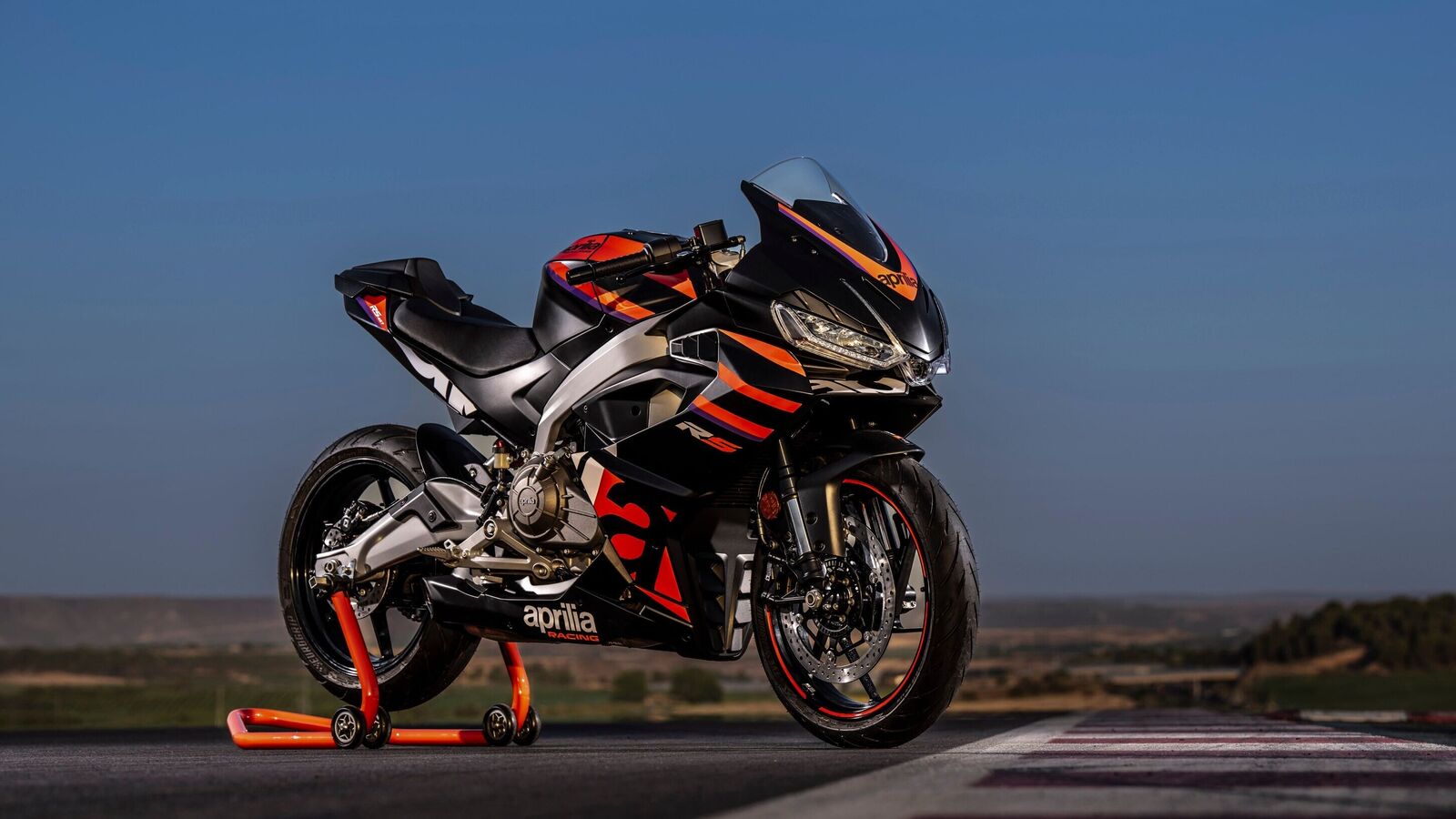
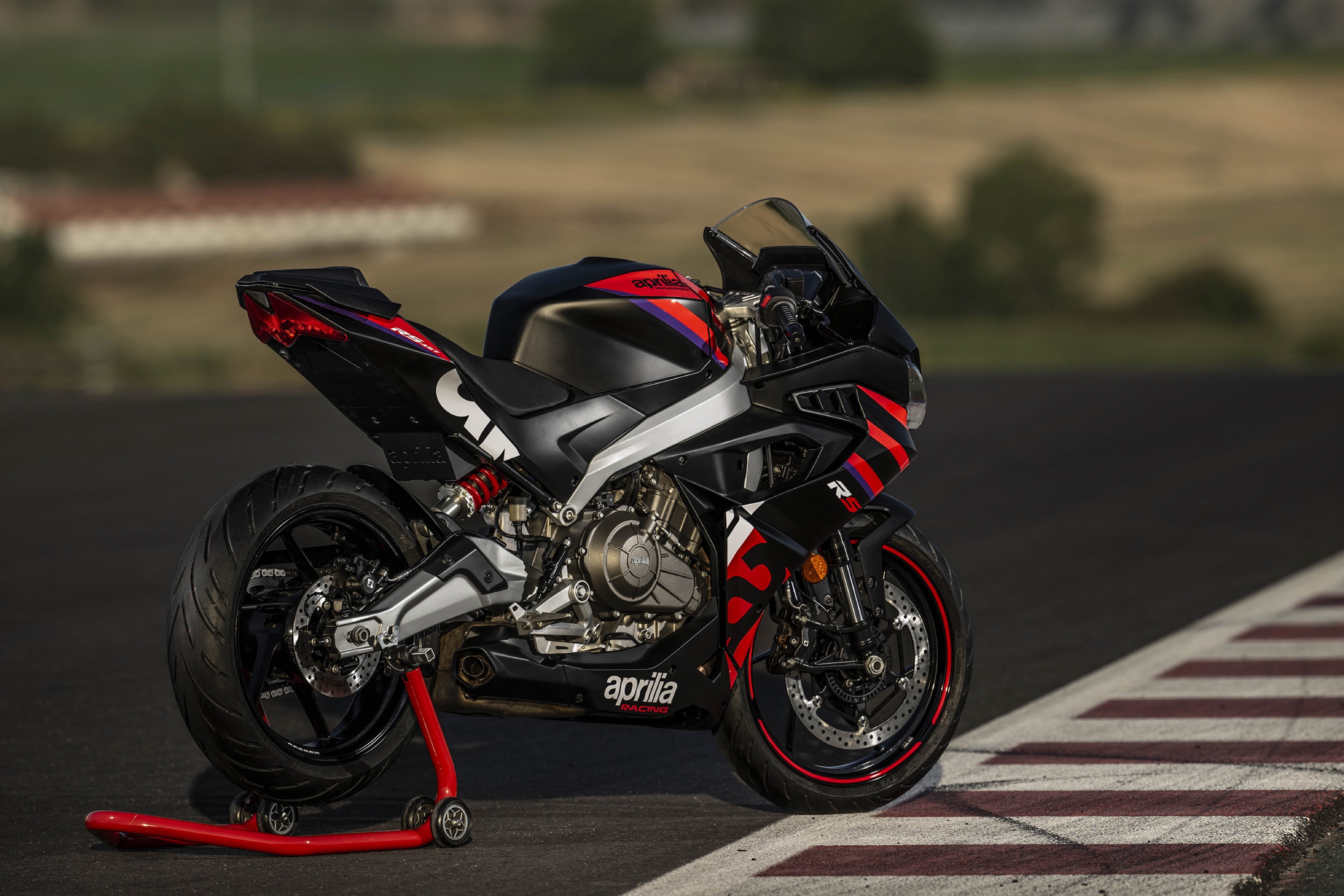
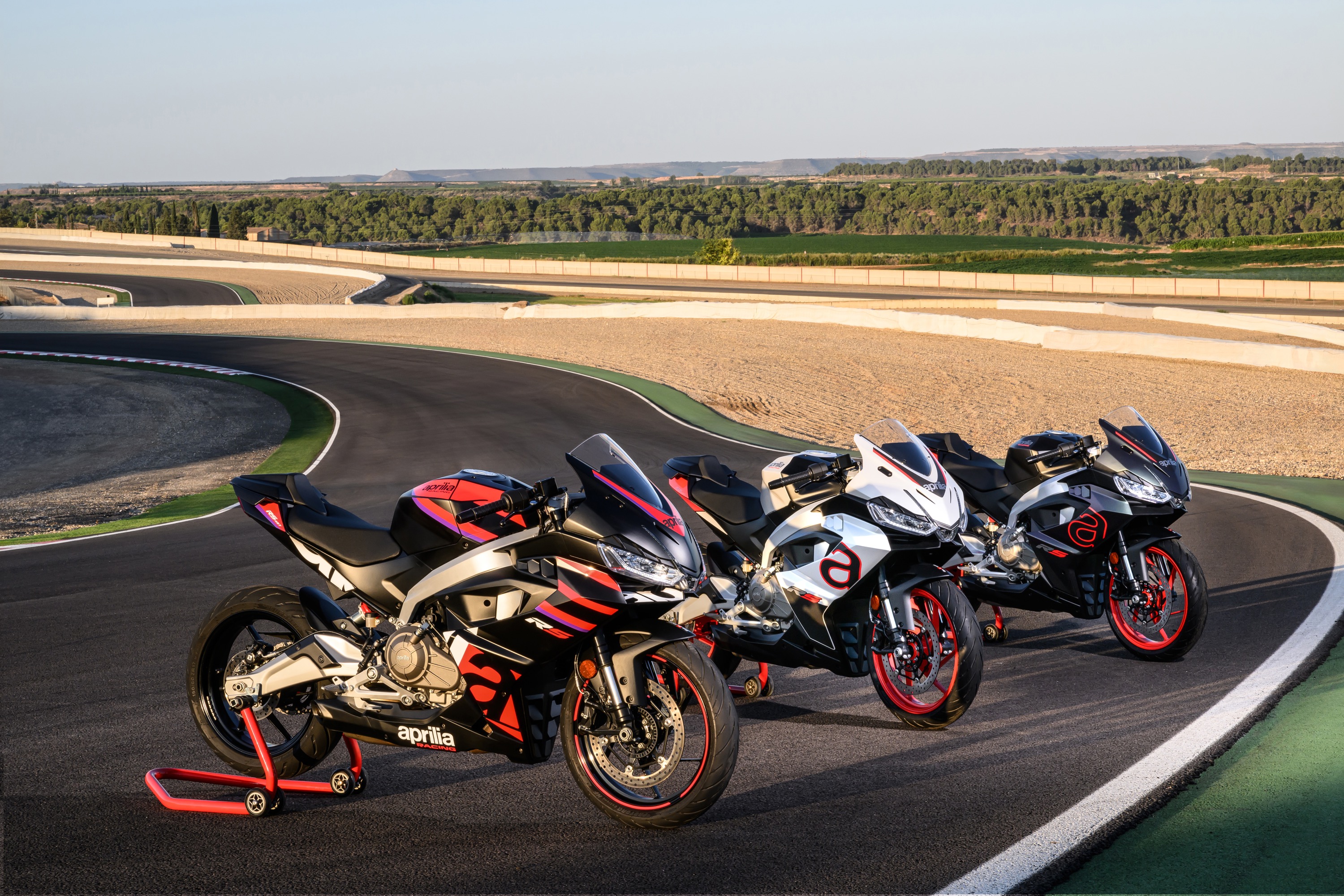
Aprilia has pulled the wraps off the much-awaited RS 47 sportbike for the world. The new Aprilia RS 457 sits below the Aprilia RS 660 in the company’s lineup and the motorcycle has been revealed at the company’s headquarters in Italy, at the same technical HQ that produces superbikes and MotoGP bikes. The RS 457 will be manufactured in India at Piaggio India’s facility in Baramati, Maharashtra, for the world.
The Aprilia RS 457 packs 47 bhp from its 457 cc parallel-twin, liquid-cooled, DOHC, 4-valve motor with a 270-degree firing order
The Aprilia RS 457 draws power from a 457 cc liquid-cooled, parallel-twin, DOHC, four-valve engine tuned for 47 bhp. The motor gets a 270-degree connecting rod assembly for the right exhaust note. The bike promises a stellar power-to-weight ratio with a kerb weight of just 175 kg, while the dry weight is 169 kg. The motorcycle has been developed at the company’s headquarters in Noale, alongside the test team in Baramati.
The Aprilia RS 457 has a kerb weight of just 175 kg, which should make for an impressive power-to-weight ratio. The bike has been developed in Italy in collaboration with the teams in India
The Aprilia RS 457’s design is heavily inspired by the larger RS 660 and the motorcycle very much looks a part of the RS family in the manufacturer’s stable. The bike gets the signature LED DRLs, full-LED lighting, and a two-into-one underbelly exhaust. Underpinning the motorcycle is a new aluminium frame, which the company says has been honed across the world’s racetracks. The crankcase functions as a load-bearing element, which has been borrowed from the RS 660, allowing for low weight and superior handling.
Suspension duties on the RS 457 are handled by 41 mm USD front forks with 120 mm of travel and pre-load adjustability. The rear gets a pre-load adjustable monoshock with 130 mm of travel and a steel swingarm. Braking performance comes from a 320 mm front disc with a ByBre radial-mounted four-piston caliper. The rear gets a 220 mm steel disc with a ByBre caliper. Dual-channel ABS is standard with switchable rear ABS.
The Aprilia RS 457 gets ride-by-wire, three-level traction control, switchable dual-channel ABS and a quickshifter as an accessory
The motorcycle is packed with a host of electronic aids including Ride-by-Wire (RbW) with three riding modes and a three-level traction control that can be disabled, while a quickshifter will be available as an accessory. The bike also comes with a 5-inch TFT instrument console, clip-on handlebars and backlit switchgear. The Aprilia RS 457 rides on 17-inch alloy wheels with 110/70 front and 150/60 rear tyre.
Aprilia India is yet to reveal details on the pricing and availability of the new RS 457. India will most likely be the first market to get the motorcycle. Given its made-in-India nature, prices are likely to be competitive, which should make the Ninja 400 a bit worried. A competitively priced twin-cylinder could take away customers from the RC 390 as well. Has the KTM finally met its match? we’ll find out soon, possibly around MotoGP Bharat scheduled towards the end of this month.
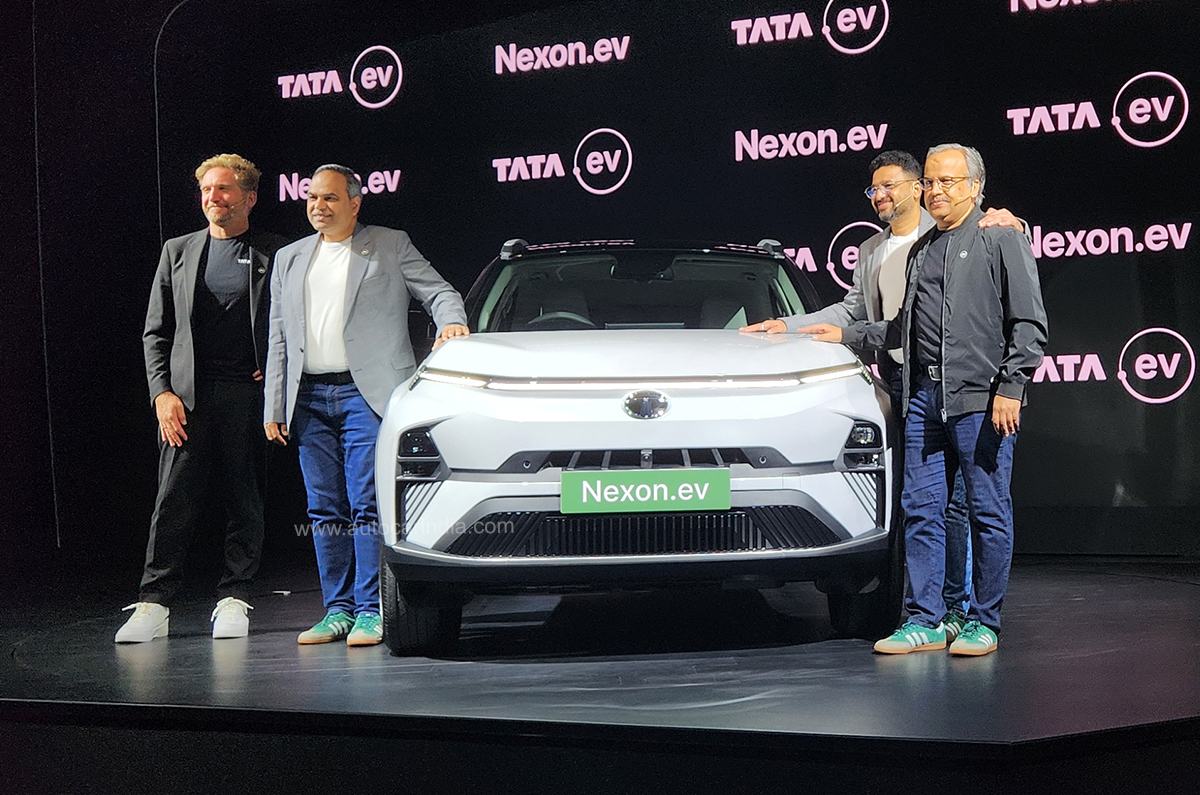
Refreshed Nexon.ev has unique design elements compared to the ICE versions of the Nexon.
Closely following the debut of the ICE versions of the Nexon facelift, Tata Motors has now taken the wraps off the Nexon.ev. Unlike the ICE versions, which have received their second facelift, this is the first mid-life cycle update for the Nexon EV – now renamed to Nexon.ev – but as before, both ICE and EV versions continue to sport a similar design.
In addition to the cosmetic and features updates, the Nexon.ev also gets mechanical updates to the powertrain which contributes which contributes to improved efficiency. Prices for the Nexon.ev facelift will be announced on September 14, and bookings are slated to begin from September 9.
Nexon.ev facelift gets subtle design differences over ICE versions
Packs major mechanical updates to the electric motor
Prices to be announced on September 14
Tata Nexon.ev exterior design
Just as the regular Nexon, updates to the Nexon.ev are inspired by the Curvv concept. But while the outgoing Nexon and Nexon EV looked identical to each other save for the electric blue accents, the facelifted models are more differentiated. Tata claims the new design is more aerodynamic, and even the new LED lighting elements are more energy efficient, thereby contributing to improved range.
Changes on the EV include a single-tone, body-coloured finish for the upper portion of the grille – on the ICE versions, this is finished in a contrasting black shade. The lower portion of the grille and the trapezoidal headlamp housings, meanwhile, gets a unique slatted design – the latter even features functional air vents. But the most distinctive characteristic on the EV is the full-width LED light band running across the nose that’s a direct lift from the Curvv concept – it even has a functional value as it shows the charging status. Elsewhere, the EV wears various ‘.ev’ badges.
As with the regular Nexon, the Nexon.ev also gets a split headlamp design with sequential LED daytime running lights (DRLs) signatures and trapezoidal housings for the main cluster, a large grille on the lower bumper with a thick plastic bar running across it, and a faux-silver skid plate. In profile, the Nexon.ev remain largely unchanged, but gets a new design for the alloys that’s identical to the ICE versions. At the rear, the Nexon.ev looks largely identical to the ICE version with connected LED tail lamps, a pronounced roof-mounted spoiler and a chunky bumper finished in the body colour, along with contrasting black and silver trims.
Tata Nexon.ev interior, features
The interior of the Nexon.ev facelift is, again, largely similar to the regular Nexon. It gets an all-new layered dashboard design that’s finished in multiple texture and materials – there’s a carbon fibre-like trim, soft touch materials on the dashboard and door pads, and several piano black surfaces. The rotary drive selector on the centre console, meanwhile, has been swapped with a traditional looking gear lever.
Highlights include a class-leading 12.3-inch touchscreen with an all-new user interface on the top-spec variant – this is even larger than the 10.25-inch screen on the ICE Nexon. It also gets the two-spoke illuminated steering wheel, new customizable 10.25-inch digital instrument cluster with navigation display, and the new touch-based HVAC controls with toggle switches. The graphics on the screens are crisp and high resolution, and even the touch-based climate controls are relatively slick to operate. The feeling is that of a high-tech cabin with minimal use of physical controls.
Other features on the top-spec Nexon.ev facelift include a 360-degree camera, connected car tech, a wireless charger, ventilated front seats, air purifier, fast charging type-C ports, single-pane sunroof, JBL-branded sound system, voice commands, OTA updates and more. Tata has also introduced a new Arcade.ev app suite that lets you stream your favorite OTT platforms such as Prime Video, Disney+ Hotstar and the works.
Safety features on the Nexon facelift include six airbags, ABS and ESC as standard, front parking sesnors, blind view monitor, three-point seat belts for all seats, ISOFIX anchors, hill descent and ascent control, all-wheel disc brakes, panic brake alert as well as emergency and breakdown call assist. Tata also claims to have reinforced body structure for improved side pole protection.
Tata Nexon.ev powertrain
With this facelift, Tata Motors has dropped the Prime and Max suffixes, and instead uses Medium Range (MR) and Long Range (LR) to differentiate between the two variants of the Nexon.ev.
The Nexon.ev MR continues with the 30kWh battery, while the LR continues with the larger 40.5kWh battery. The MR has an ARAI-claimed range of 325km, while the LR has a range of 465km, both of which are 12km more than before, thanks in part to the improved aerodynamics and other efficiency measures. The battery continues with IP67 protection levels.
Both versions now get a 7.2kW AC charger as standard with which the batteries can be topped up from 10 to 100 percent in 4.3 hours for the MR, and 6 hours for the LR. With a DC fast charger, that time reduces to just 56 mins for both versions. The Nexon.ev now even gets V2V (vehicle to vehicle) and V2L (vehicle to load) charging capabilities, which means you can charger other electrical appliances or even another EV with the Nexon.ev. To further the cause of efficiency, Tata claims the Nexon.ev is fitted with tires that have the lowest rolling resistance in the country.
The Nexon.ev now gets a new Gen-2 permanent magnet synchronous motor that’s claimed to be 20kg lighter, uses 30 percent less rare earth materials, and has improved cooling, battery management and more efficient components. It gets four-level brake regeneration that’s improved by 10-15 percent, and can be controlled through the paddle shifters.
As for outputs, the MR produces 129hp and 215Nm of torque, while the LR produces 145hp and 215Nm. Interestingly, torque on the MR variant has actually gone down by 30Nm, while on the LR variant, it’s is down by 38Nm. Tata claims a 0-100kph sprint of 8.9 seconds for the LR, a top-speed of 150kph and improved NVH levels. There are three drive modes on offer – Eco, City and Sport.
Tata Nexon.ev variants
The MR and LR variants are further split into three core trims – Creative, Fearless and the top-spec Empowered. Tata describes these trims as ‘Personas’, and each comes with their own unique elements such as exterior colours and interior upholstery. These trims also get optional packages denoted by a ‘+’ suffix. The MR variant is available with all three trim while the LR is available with the Fearless and Empowered trims.
Tata Nexon.ev price and rivals
The Nexon.ev facelift has just one direct rival in this segment, and that’s the Mahindra XUV400 EV. As for prices, it will certainly command a premium over the outgoing model given all the tech, equipment and mechanical upgrades it packs in. For reference, the Nexon EV was currently priced between Rs 14.49-19.54 lakh (ex-showroom).
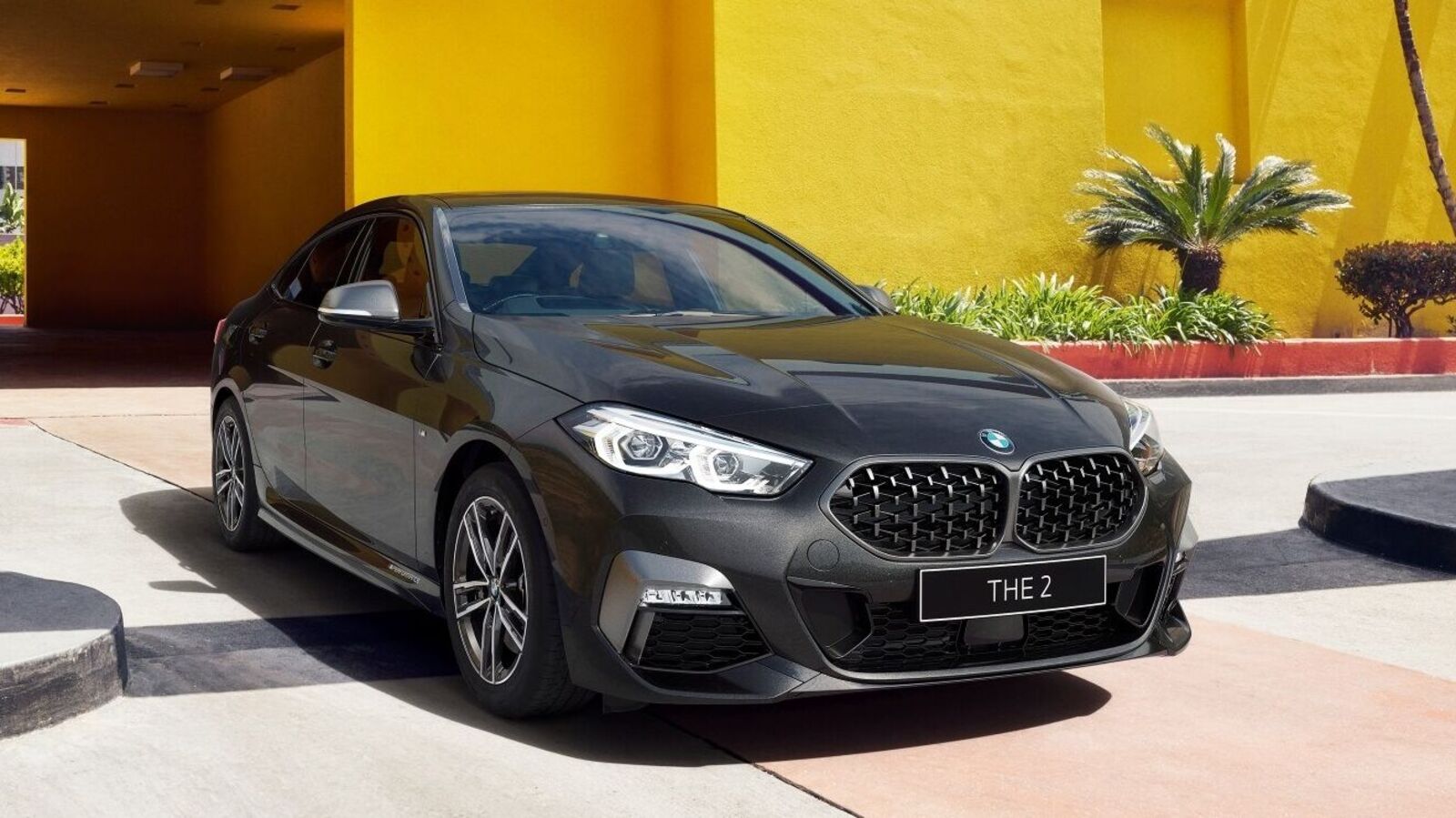
Being a Performance Edition, several exterior elements are finished in Cerium Grey. For instance, the front grille, fog lamp inserts and the outside rearview mirrors. There are M performance stickers as well. BMW has also retweaked the light element and there are full LED tail lamps.
The interior also gets a few upgrades. It now comes with a gear-selector finished in Alcantara. There are M Performance door projectors and M Performance door pin. The sport seats come with electric adjustment and memory function. The boot space measures a generous 430 litre. It can be further expanded because the rear seats can be folded in a 40/20/40 split. There is ambient lighting with six dimmable designs.
In terms of features, there is BMW Live Cockpit Professional which includes a 0.25-inch digital instrument display and a 10.25-inch Control Display. The driver also gets a heads-up display. There is also a virtual assistant and BMW Gesture Control on offer. The car features the HiFi loudspeaker system, a parking assistant with rearview camera and wireless Android Auto and Apple CarPlay.
Powering the 220i M Performance Edition is a 2.0-litre petrol engine that has been twin-turbocharged. It puts out 173 bhp of max power and a peak torque output of 280 Nm at 1350-4600 rpm. The gearbox on duty is a 7-speed automatic transmission with paddle shifters. The car accelerates from 0 -100 kmph in just 7.1 seconds.
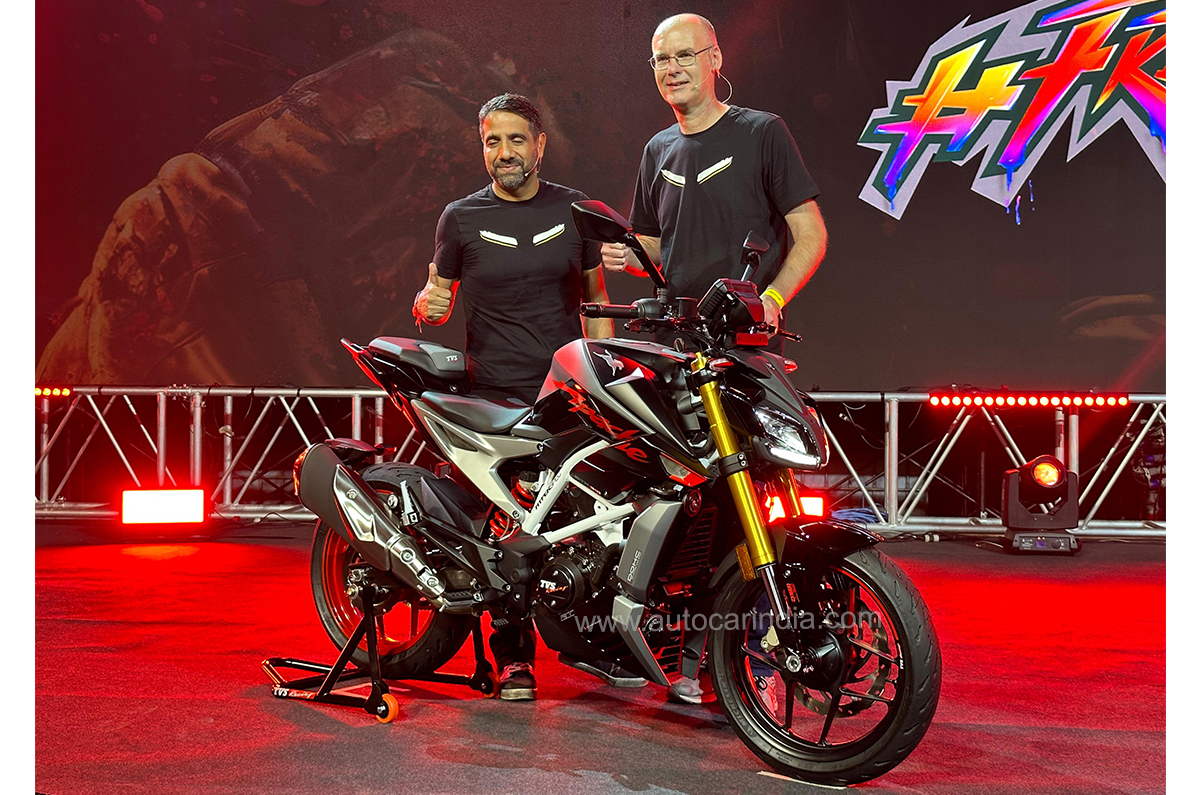
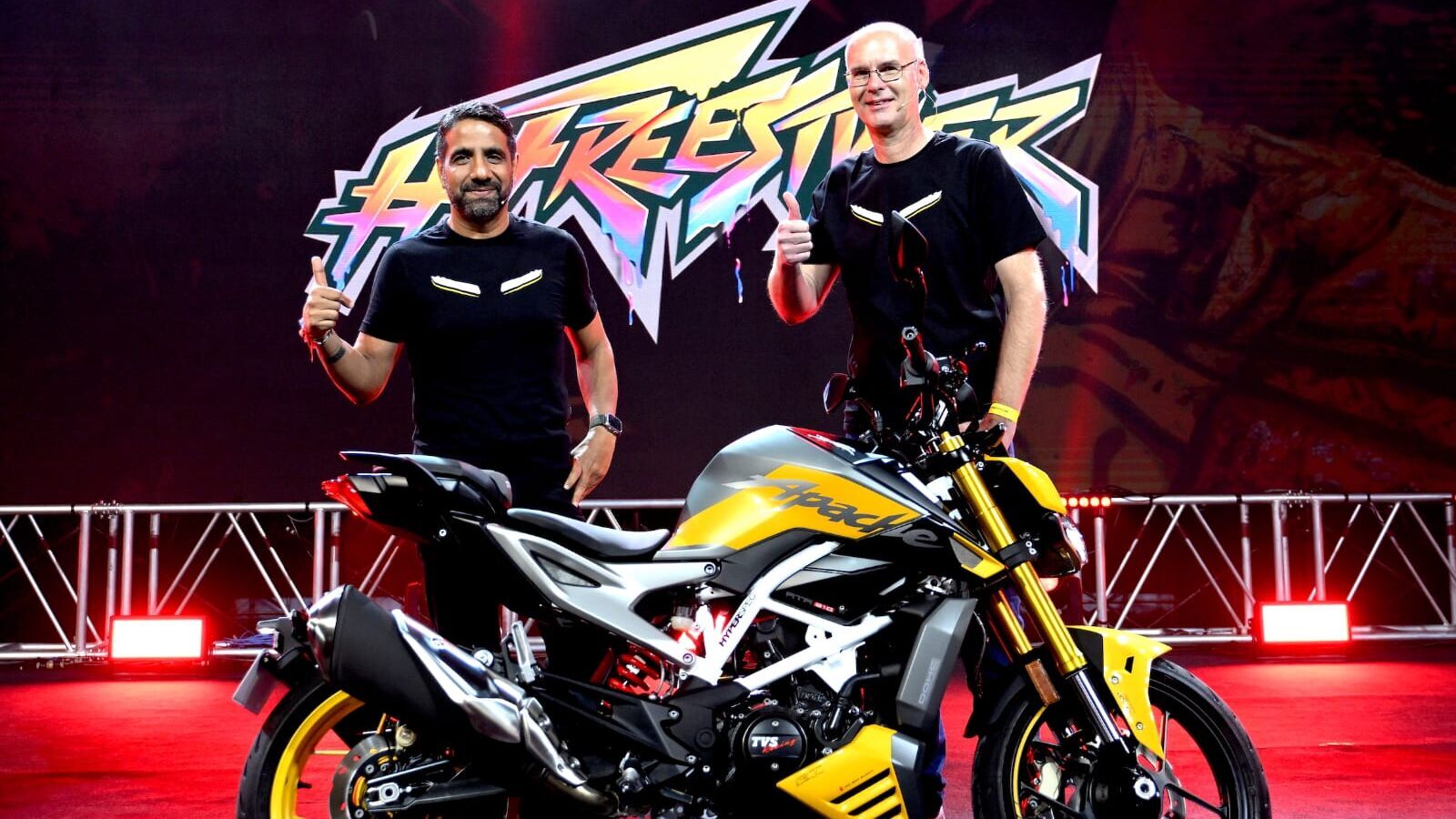
Amid much fanfare, the two-wheeler major has launched the Apache RTR 310 at an event in Thailand. The launch event has come to an end. For the detailed report, click here.
TVS Apache RTR 310 Launched
The TVS Apache RTR 310 has been launched with a starting price of ₹2.43 lakh (ex-showroom). Check out the complete details in our launch report on the website.
TVS Apache RTR 310: Safety features
The TVS Apache RTR 310 will also come with cornering ABS, as well as switchable slope-dependent control. The Apache RTR 310 will also get front whee lift off control
TVS Apache RTR 310: Feature-rich
The new TVS Apache RTR 310 is loaded on the feature front with cruise control, 5 ride modes, twin LED headlamp, 5-inch TFT instrument cluster, climate control seat, and race tuned Dynamic Stability Control (DSC).
TVS Apache RTR 310: New Naked sport
The global segment for naked motorcycles stands at 1.8 million units between 240-450 cc, says TVS.
TVS Apache RTR 310 launch begins soon
TVS Motor Company is all set to introduce its new naked flagship today. The launch proceedings begin soon. Make sure to keep watching this space for all the action.
Rivals of the new Apache RTR 310
Once launched, the TVS Apache RTR 310 will compete against the KTM 390 Duke, Honda CB300R and BMW G310R. The Apache will be the most affordable motorcycle when compared to its rivals.
Apache RTR 310 will be based on Apache RR 310
The Apache RTR 310 is expected to use the same hardware components as the Apache RR 310. So, up-front there will be USD forks while at the rear, there will be a monoshock. Braking duties will be done by discs in the front as well as at the rear.
The Apache RR 310 and Apache RTR 310 will share the same underpinnings.
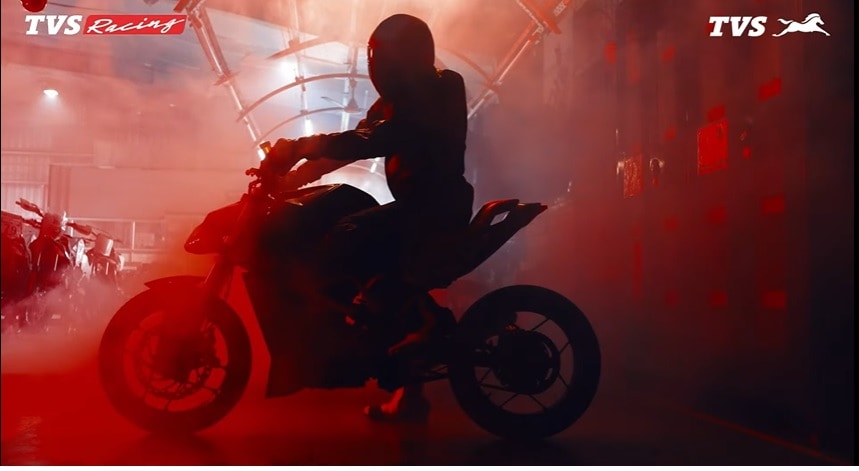
TVS teased the new motorcycle
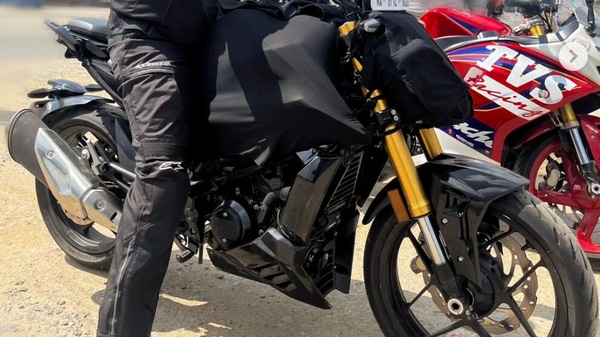
TVS has teased the motorcycle quite a bit. In this image, it can be seen that the exhaust unit will be the same as the Apache RR 310. There is a split seat setup and the turn indicators are placed on the tyre hugger. The radiator gear and the engine cowl seems to be new. The front forks are finished in golden colour and there are tank shrouds on offer as well.
TVS Apache RTR 310 will come as the flagship naked streetfighter from the homegrown two-wheeler manufacturer. (Image: Instagram/TVSMotorCompany)
Expected to be feature loaded
The Apache RR 310 is one of the most feature-loaded motorcycles in the Indian market. It is expected that the motorcycle will feature ride-by-wire, riding modes, Bluetooth connectivity and a hazard switch. The Apache RTR 310 will also come with LED lighting and a new horizontal TFT screen.
Same engine as the Apache RR 310
The Apache RTR 310 will use the same engine as the Apache RR 310. It is a 312.2 cc, single-cylinder, liquid-cooled motor that puts out 33.5 bhp at 9,700 rpm and 27.3 Nm at 7,700 rpm. It is expected that TVS will work on the engine to improve its refinement and maybe change the tune as well.
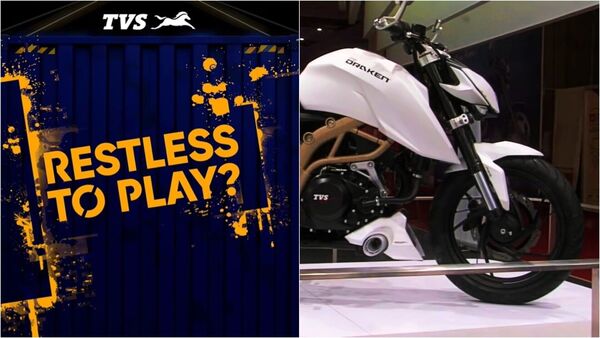
The new motorcycle might take some design inspiration from Draken Concept.
Underpinnings shared with Apache RR 310
The Apache RTR 310 will share its underpinnings with the Apache RR 310. So, the frame will be the same but the sub-frame will be different. The engine and the cycle parts will also be shared between the two motorcycles. So, expect the suspension hardware and braking equipment to be the same.
Will have a striking design language
From the teasers, it is pretty clear, that the design of the new motorcycle will be one of the important aspects. It looks like an aggressive muscular naked streetfighter. The headlamp has a split setup, there is a muscular fuel tank and a sharp rear-end.
A new 310 cc motorcycle in TVS’ lineup
The Apache RTR 310 will be the second 310 cc motorcycle in manufacturer’s lineup. The brand is already selling Apache RR 310 which is a fully faired sport bike.
That’s because the 2023 Tata Nexon facelift gets an extensive redesign and a revamped cabin but the engines are the same and so is the platform with its famed global 5-star safety rating. So, what are these updates and do they make a difference to you? We drove the new Nexon facelift in sunny Jaipur to find out.
Watch – Tata Nexon facelift first drive review: Can it set the benchmark higher?
Tata Nexon facelift: Comprehensive new design
The new Nexon has seen extensive changes to its design and features. It’s still based on the X1 platform — the last connection to the famed Indica. It’s only fair then that the Nexon gets to wear the new design theme before all the new Tata models arrive in the future. If you’ve seen the Curvv concept, this will look familiar. The upright stance looks really nice. I like the fact that it does not have an obvious grille, which means Tata is bringing a more centralised design theme to its cars – whether EV or ICE. You will see more familiar styling elements on these cars going forward.
I also like the haunches on the bonnet, they add a nice masculine appeal, plus you get to know where the edges of the car are far better from the driver’s seat. The LED DRLs look very futuristic, and at the same time, they double up as turn indicators. The headlamp unit is a split set-up and is more compact than before.
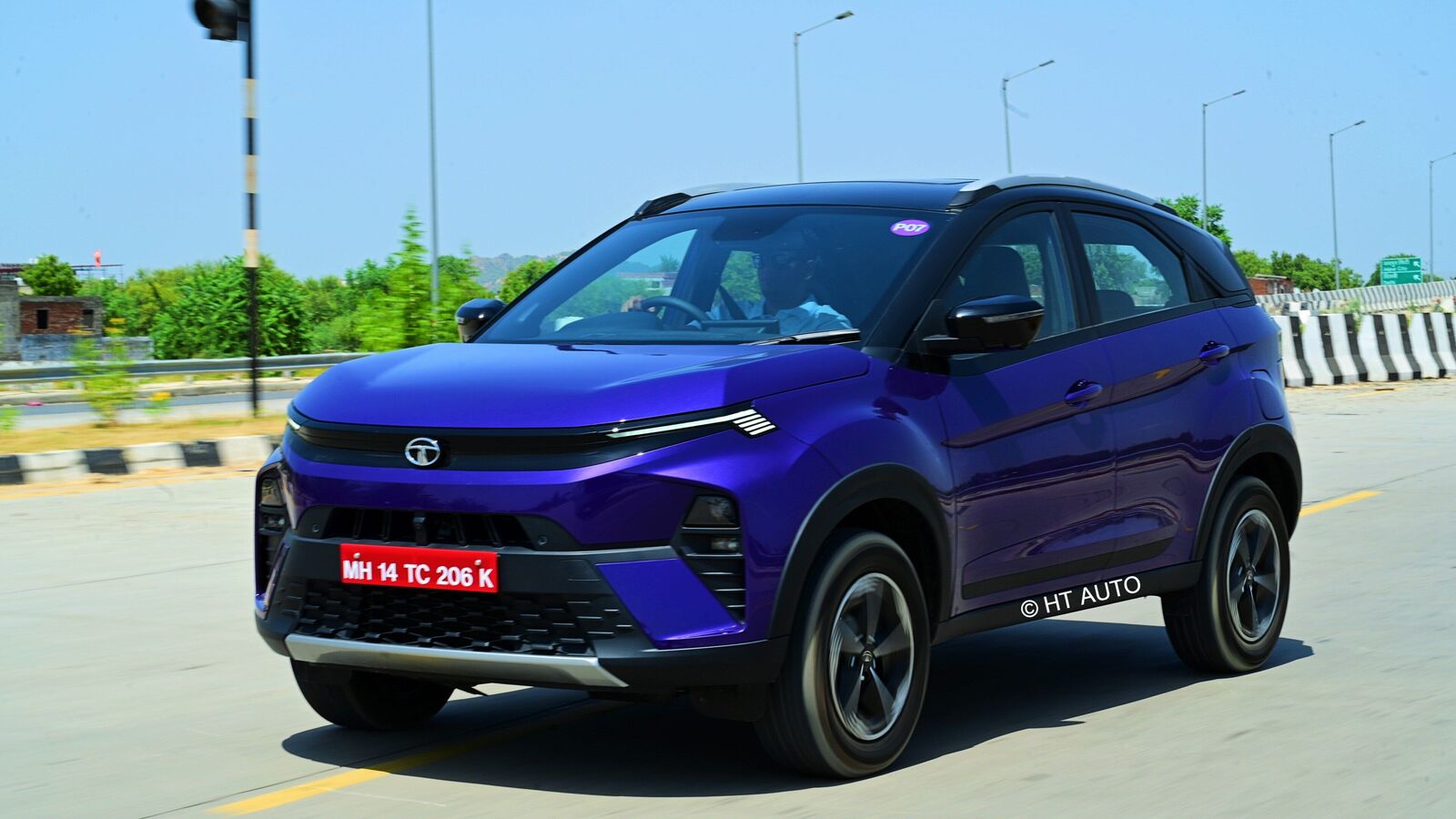
Updates to the profile are minimal and cleverly done. There’s a new beltline that gives the impression of a longer car, while there are new alloy wheels with aero inserts that seem to be shared from the upcoming Nexon EV facelift. The rear gets a redesign too with the new X-themed LED taillights that are connected by a light bar on the tailgate. There are plenty of angular lines on the new bumper and tailgate, which makes for a busy design overall. It’s still one of the more confusing bits on the Nexon’s exterior. The signature raked windscreen stays the same but the Nexon now gets a longer roof spoiler for better aerodynamics. This also integrates the rear wiper for a clutter-free appearance. Apart from the visual upgrades, the Nexon is offered in new colours including this “Fearless Purple” that’s bound to grab your attention.
The Tata Nexon gets a revised dashboard with a minimalist design theme. Fewer buttons, redesigned air vents and new floating infotainment screens are mainstays
Tata Nexon facelift: New interior
If you like the exterior of the Nexon, the interior should impress you even more. It’s seen big changes. Right from the steering wheel to the dashboard, everything feels new and everything feels premium. The steering wheel is now a two-spoke unit. The centre mimics a gaming console design and sports the illuminated Tata logo, which we are told, is a world-first.
The dashboard has been completely redesigned for a cleaner look. You have a three-step unit with black plastics on the top, carbon-fibre finish in the centre and leather inserts at the bottom. This is also finished in purple on the purple exterior shade, which extends to the seats and door pads as well. The plastics are nice and sturdy and the overall design is minimalistic. You also get wireless charging, a leather-wrapped armrest with some storage space but no visible cupholders. The door pockets can hold one-litre bottles and even an umbrella though.
The front seats get improved cushioning for better lumbar and lateral support. The seats also get ventilation and it worked flawlessly to keep us cool in scorching Jaipur. There’s no change in proportions and the Nexon facelift continues to pack decent space inside. The rear seats are comfortable but lack legroom for tall passengers, while the headroom is decent at best.
The rear passengers now get a seatbelt reminder with a three-point seatbelt for the middle occupant. However, they still miss out on a headrest. Depending on the Persona you choose, the Nexon’s feature list skips a few goodies, especially in the Smart variant. The Pure, Creative and Fearless personas are more loaded in this regard.
The new digital instrument console can also show navigation with the full-screen mode for distraction-free driving. This is a segment-first feature.
Tata Nexon facelift: Tech galore
The Nexon’s cabin has not only seen an aesthetic upgrade, but it’s a lot more tech-friendly as well. That comes from two new displays. There are two new 10.25-inch digital screens. One is for the instrument console and the other is for the infotainment unit. We’ve seen this before on the Nexon EV Max Dark Edition but the bezels are slimmer, so it looks a lot more modern. Both of these units come with a new UI. They are far too easy to use. The graphics are great – nice and crisp – and the colours look equally nice. The new digital console will also show the navigation map like on luxury cars and the feature is certainly impressive.
There are fewer buttons in the cabin overall and the HVAC controls have also been replaced with a touch-based panel at the bottom. You get only 2 toggle switches – AC temperature and blower speed. The feature looks and feels premium but we would’ve liked haptic feedback over here like we see on Land Rover and Audi models. This would’ve made it safer to use on the road.
The feature list continues with wireless Android Auto and Apple CarPlay, a new 360-degree camera and a blind-view monitor that shows up every time you engage either indicator. The Nexon also gets an air purifier, a 9-speaker JBL sound system, height-adjustable passenger seat and voice commands in seven languages. The system can also take voice commands via Alexa.
The Nexon also gets remote engine start/stop and remote AC features for the first time, both of which can be activated using the app to pre-start the SUV or pre-cool the cabin. On the safety front, the Tata Nexon facelift gets six airbags, ESP, ISOFIX child seat anchor mounts, and hill hold function as standard. The SUV retains its five-star safety tag by the Global NCAP but is yet to get a safety rating under India’s very own Bharat NCAP.
Tata Nexon facelift: Promising new automatic
Tata has updated the powertrain on the new Nexon facelift. The new showstopper
is the 1.2-litre turbo petrol with a dual-clutch automatic alongside the tried and tested 1.5-litre diesel engine. The 1.2-litre turbo petrol continues to make 118 bhp and 170 Nm of peak torque and is paired with 4 gearbox options – a 5-speed manual, a 6-speed manual, a 6-speed AMT and the one we were driving – the 7-speed dual-clutch transmission.
The 7-speed DCT with the 1.2 turbo is a nice combination. Most of the power is concentrated in the mid-range and is quite likeable. The engine is responsive and gets the numbers going quickly. If you are looking at highway runs too, this should keep you very happy while making the entire process smooth. Compared to the diesel, the petrol motor is more refined and the NVH levels are way lower. There is turbo lag under 2,000 rpm, which tends to be a bother but the DCT helps mask that effectively. You will still have to work your way around to get the SUV moving. What we would’ve liked is a little more responsiveness at the lower end of the rpm.
The paddle shifters offer more control, especially to combat the turbo lag. The new mono-shifter feels chunky and premium on the DCT version. The steering weighs up nicely and while it may not be as heavy as we’d like at high speeds, the unit is responsive. The new dual-clutch transmission also offers slick shifts and works well for the most part. Body roll is well contained but the shift in weight is immediately apparent around a hard corner. Even then, the Nexon manages to entertain and is an enjoyable experience. You continue to get 3 driving modes – Economy, City and Sport – that tune acceleration accordingly.
Tata Nexon facelift: Diesel supremacy
With the turbo petrol done, It’s now time to move on to the Nexon facelift diesel in this Fiery Red shade. The 1.5-litre diesel engine makes 113 bhp and 260 Nm of peak torque, and we drove the one paired with a 6-speed manual gearbox. All good things on the Nexon and definitely what most users admire if you like a diesel SUV. You also get a 6-speed AMT that brings more convenience. With the diesel engine, it’s a familiar space, there’s a nice power band to play around with. The acceleration in the lower end is amazing and it is quick off the line. If you’ve liked the Nexon diesel, the new one only takes that experience much higher with all the tech on board, complemented by the new design and styling.
The torque-friendly diesel keeps you entertained, especially on open roads. The steering wheel feels a tad heavier at high speeds than the petrol and the clutch is easy to manage in stop-and-go traffic. The diesel engine’s clatter though seeps into the cabin quite easily and Tata could’ve worked on improving the NVH levels here. The Nexon diesel continues to be fuel efficient, something that hasn’t changed.
Tata Nexon facelift: Ride quality?
When it comes to ride quality on the Nexon, Tata has tuned the SUV rather well and it keeps you comfortable on most broken roads and even some nasty potholes. It’s very pliant out on the highway as well as broken patches. The 208 mm ground clearance works wonders to combat challenging terrain and the SUV certainly delivers.
Tata Nexon facelift: What can be better
But not everything remains hunky dory on the Nexon. Quality levels could be better, especially in the cabin. The fit and finesse have seen massive strides but there is scope for improvement in smaller areas like the door grab handles. Certain plastics still feel flimsy, which robs the premium feel the car otherwise has to offer. Our test unit also faced issues with the connecting Android Auto but a hard factory reset resolved the issue. We’re told these concerns will be addressed on the production models.
Tata Nexon facelift: Verdict
Is the new Nexon comprehensively updated enough? The short answer is yes. The design looks fantastic, the interior gets a complete revamp and the changes make it nearly an all-new offering. It now boils down to how much of a price increment will the new Nexon come at. Prices will be announced on September 14. The Nexon’s comprehensive upgrade also comes at a time when the competition has really upped the game.
So Tata had to update its bestseller to keep it formidable against all its rivals. This includes the Maruti Suzuki Brezza, Kia Sonet, Mahindra XUV300, Hyundai Venue and more. The Venue was recently introduced with ADAS, making it the first car in the segment to get the same, which certainly makes things challenging for the Nexon. The Nexon is a massive showcase of improvement in the automaker’s talents and at the right price, this will be another winner, retaining its bestseller tag for more years to come.
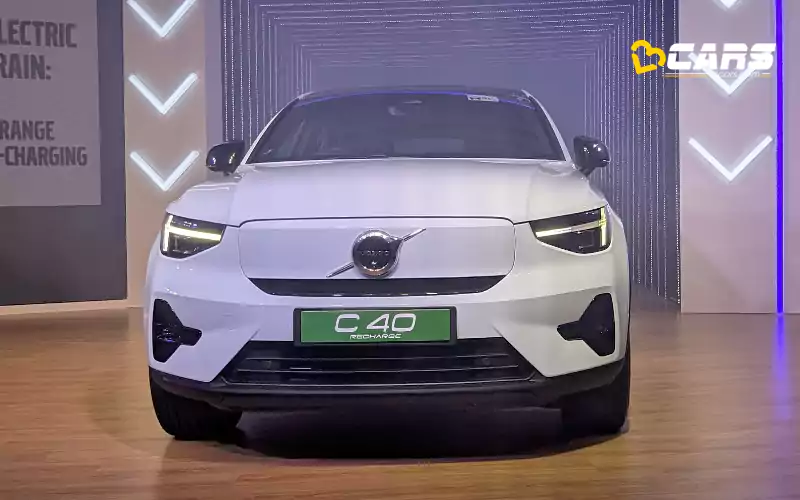
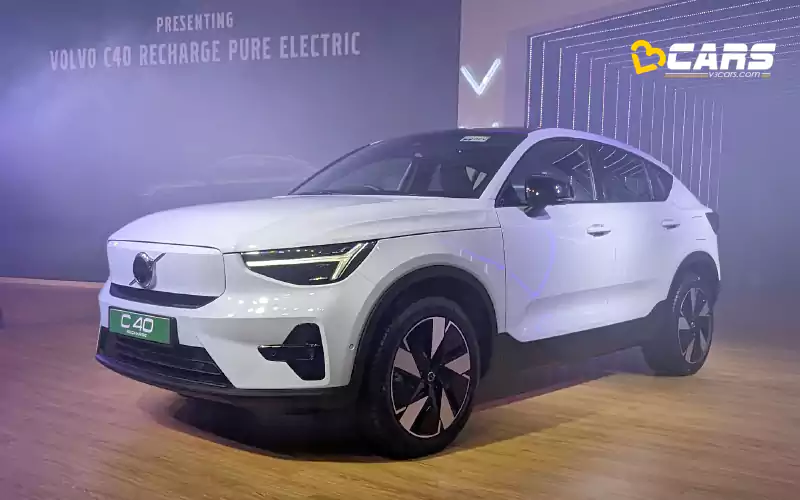
This article will give you details about the dimensions, or length, width, height and wheelbase, of the Volvo C40 Recharge. We’ll also look at the ground clearance, boot space, fuel tank capacity and tyre size of the Volvo C40 Recharge.
The Volvo C40 Recharge is 4440mm long, 2034mm wide and 1591mm tall. Bigger exterior dimensions give a car a stronger road presence. The C40 Recharge has a 2702mm long wheelbase. A longer wheelbase makes the car more stable at high speeds and gives better legroom in the back seat, while a shorter wheelbase makes the car more agile.
VOLVO C40 RECHARGE DIMENSIONS
Length
4440mm
Width
2034mm
Height
1591mm
Wheelbase
2702mm
Ground Clearance
171mm
Boot Space
444L
Wheel Size
255/45 R19
The Volvo C40 Recharge has a boot space measuring 444-litres, including the 31-litres of space in the frunk. The C40 Recharge has a ground clearance of 171mm. The tyre size of the Volvo C40 Recharge base model and the top model is 255/45R19 tyres. Cars running on bigger wheels provide better handling and styling. However, these advantages come at the cost of efficiency. Having bigger wheels means more metal and more rotating mass. Therefore, it adversely impacts your drivability, performance and mileage.
What Are The Dimensions Of Volvo C40 Recharge?
The Volvo C40 Recharge is 4440mm long, 2034mm wide and 1591mm tall.
What Is The Length Of Volvo C40 Recharge?
The Volvo C40 Recharge is 4440mm long. Here’s the length of C40 Recharge in other units like centimetres, metres, feet and inches:
Volvo C40 Recharge Length
Millimetres
4440mm
Centimetres
444cm
Metres
4.44m
Inches
174.8in
Feet
14.57ft
What IsThe Width Of Volvo C40 Recharge?
The Volvo C40 Recharge is 2034mm wide. Here’s the width of C40 Recharge in other units like centimetres, metres, feet and inches:
Volvo C40 Recharge Width
Millimetres
2034mm
Centimetres
203.4cm
Metres
2.034m
Inches
80.08in
Feet
6.67ft
What Is The Height Of Volvo C40 Recharge?
The Volvo C40 Recharge is 1591mm tall. Here’s the height of C40 Recharge in other units like centimetres, metres, feet and inches:
Volvo C40 Recharge Height
Millimetres
1591mm
Centimetres
159.1cm
Metres
1.591m
Inches
62.64in
Feet
5.22ft
What Is The Fuel Tank Capacity Of Volvo C40 Recharge?
The Volvo C40 Recharge is an electrical vehicle and does not have a fuel tank.
What Is The Wheelbase Of Volvo C40 Recharge?
The Volvo C40 Recharge has a wheelbase measuring 2702mm. Here’s the wheelbase of C40 Recharge in other units like centimetres, metres, feet and inches:
Volvo C40 Recharge Wheelbase
Millimetres
2702mm
Centimetres
270.2cm
Metres
2.702m
Inches
106.38in
Feet
8.86ft
What Is The Boot Space Of Volvo C40 Recharge?
The Volvo C40 Recharge has a boot space measuring 444-litres. Here’s the boot space information of C40 Recharge in other units like cubic centimetres, cubic metres, cubic inches and cubic feet:
Volvo C40 Recharge Boot Space
Litres
444L
Cubic Centimetres
444000cm3
Cubic Metres
0.444m3
Cubic Inches
27094.5in3
Cubic Feet
15.6797ft3
What Is The Ground Clearance Of Volvo C40 Recharge?
The Volvo C40 Recharge has a ground clearance of 171mm. Here’s the ground clearance of C40 Recharge in other units like centimetres, metres, feet and inches:
It shares many of its underpinnings with the Apache RR 310, but takes the form of a naked streetfighter.
The TVS Apache RTR 310 has been launched at Rs 2.43 lakh, making it Rs 29,000 more affordable than its sport bike sibling, the Apache RR 310.
It has a 312cc, 35.6hp, 28.7Nm single-cylinder engine
Apache RTR 310 gets a trellis frame, upside down fork, monoshock
It also gets LED headlight and tail-light, a 5.0-inch TFT screen
TVS Apache RTR 310: engine and gearbox
Powering the new Apache RTR 310 is the tried and tested 312cc liquid-cooled single-cylinder engine that has been doing duty in the Apache RR 310 and the BMW 310s. Here, it produces 35.6hp and 28.7Nm, which is 1.6hp and 0.7Nm higher than in is stablemate. The engine comes mated to a 6-speed gearbox via an assist-and-slipper clutch.
TVS Apache RTR 310: underpinnings
Holding everything together is a light-weight, alumnium trellis frame that closely resembles that of the RR 310. The rear subframe, though, is different, but still quite sporty, rising sharply towards the pillion seat and tail section. The RTR is suspended on an upside-down fork/monoshock set-up, with the standard bike featuring only rear preload adjustability. It rolls on 17-inch wheels at both ends wrapped in dual compound radial tyres. The RTR 310 also comes with five riding modes.
TVS Apache RTR 310: features
Fully digital instrumentation is standard on this new TVS, in the form of a landscape-oriented 5.0-inch TFT screen, unlike the portrait-oriented TFT dash on the RR 310. Other features include an LED headlight and tail-light, cruise control, a tyre pressure monitoring system, bi-directional quickshifter, along with heated and cooled seats. The RTR 310 also gets race-tuned dynamic stability control and linear stability control. Many of these features are available as a part of packages under TVS’ Built To Order (BTS) customisation programme along with adjustable suspension.
TVS Apache RTR 310: pricing and rivals
The RTR 310 undercuts all it’s rivals barring one. For reference, the KTM 390 Duke currently costs Rs 2.97 lakh, while the Triumph Speed 400 is priced at Rs 2.33 lakh, and the BMW G 310 R sits between the pair at Rs 2.85 lakh. The RTR’s sport bike cousin, the Apache RR 310, is priced at Rs 2.72 lakh.
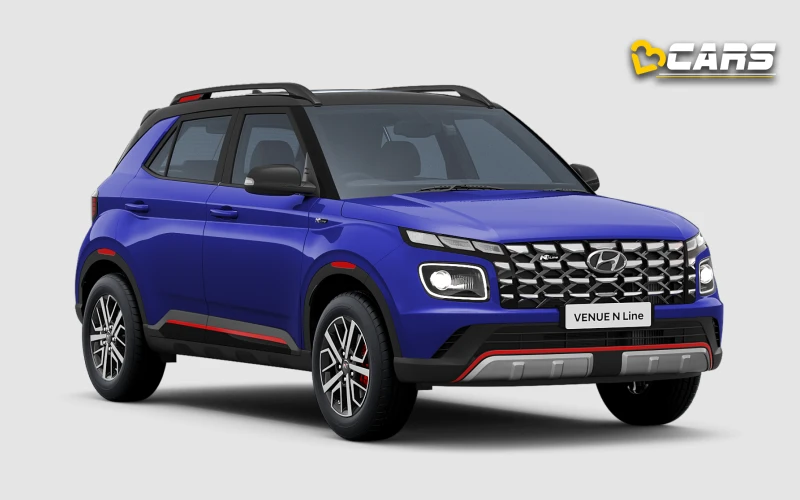
This article will give you a perspective of the engine specs, such as displacement, power, torque, mileage and transmission details, of the Hyundai Venue N Line engine.
Considering the body style, size and price range of the Hyundai Venue N Line, it competes with the following cars:
What Are The Engine Specs Of Hyundai Venue N Line?
HYUNDAI VENUE N LINE | ENGINE SPECS
Engine
1.0L Turbo Petrol
Displacement
998cc
Cylinder
3
Power
120PS @ 6000rpm
Power:Weight
103.99PS/t
Torque
172Nm @ 1500 – 4000rpm
Torque:Weight
149.05Nm/t
Manual
6-speed MT
Automatic
7-speed DCT
The Hyundai Venue N Line only gets a 1.0L turbo petrol engine, which is available with a 6-speed MT and 7-speed DCT automatic transmission. The Venue N Line’s turbo petrol engine makes 120PS of power at 6000rpm and 172Nm of torque between 1500 and 4000rpm.
What Is The Mileage Or Fuel Efficiency Of Hyundai Venue N Line?
HYUNDAI VENUE N LINE | MILEAGE OR FUEL EFFICIENCY
Engine
1.0L Turbo Petrol
Manual FE
17.27kmpl
Automatic FE
17.27kmpl
The Hyundai Venue N Line 1.0L turbo petrol engine has a mileage of 17.27kmpl with the 6-speed MT and 17.27kmpl with the 7-speed DCT transmission.
Read more about how you can get the best mileage or fuel efficiency from your car:
This article will give you a perspective of the engine specs, like displacement, power, torque, mileage and transmission details, of the Hyundai Venue petrol and diesel engines.
Considering the body style, size and price range of the 2023 Hyundai Venue, it competes with the following cars:
What Are The Engine Specs Of Hyundai Venue?
HYUNDAI VENUE | ENGINE SPECS
Engine
1.0L Turbo Petrol
1.2L Normal Petrol
1.5L Turbo Diesel
Displacement
998cc
1197cc
1493cc
Cylinder
3
4
4
Power
120PS @ 6000rpm
83PS @ 6000rpm
115PS @ 4000rpm
Power:Weight
103.99PS/t
76.78PS/t
97.71PS/t
Torque
172Nm @ 1500 – 4000rpm
114Nm @ 4000rpm
250Nm @ 1500 – 2750rpm
Torque:Weight
149.05Nm/t
105.46Nm/t
212.40Nm/t
Manual
6-speed MT
5-speed MT
6-speed MT
Automatic
7-speed DCT
NA
NA
The Hyundai Venue is available with 3 engine options: 1.0L turbo petrol, 1.2L normal petrol, and 1.5L turbo diesel.
The 1.0L turbo petrol engine makes 120PS of power at 6000rpm and 172Nm of torque between 1500rpm and 4000rpm. This engine is available with a 6-speed manual and a 7-speed DCT automatic transmission.
The 1.2L normal petrol engine churns out 83PS of power at 6000rpm and 114Nm of torque at 4000rpm. The 1.2L normal petrol engine only gets a 5-speed manual transmission.
The 1.5L turbo diesel engine is rated to deliver 115PS of power at 4000rpm and 250Nm of torque between 1500rpm and 2750rpm. You can get the 1.5L turbo diesel engine of the Venue with a 6-speed manual transmission.
What Is The Mileage Or Fuel Efficiency Of Hyundai Venue?
HYUNDAI VENUE | MILEAGE OR FUEL EFFICIENCY
Engine
1.0L Turbo Petrol
1.2L Normal Petrol
1.5L Turbo Diesel
Manual FE
18.07kmpl
17.27kmpl
22.70kmpl
Automatic FE
17.99kmpl
NA
NA
The Hyundai Venue 1.0L turbo petrol engine offers a mileage of 18.07kmpl with the 6-speed manual and 17.99kmpl with the 7-speed DCT transmission.
The 1.2L normal petrol engine offers a mileage of 17.27kmpl with the 5-speed MT transmission.
The 1.5L turbo diesel engine offers a mileage of 22.70kmpl with the 6-speed MT transmission.
Read more about how you can get the best mileage or fuel efficiency from your car:
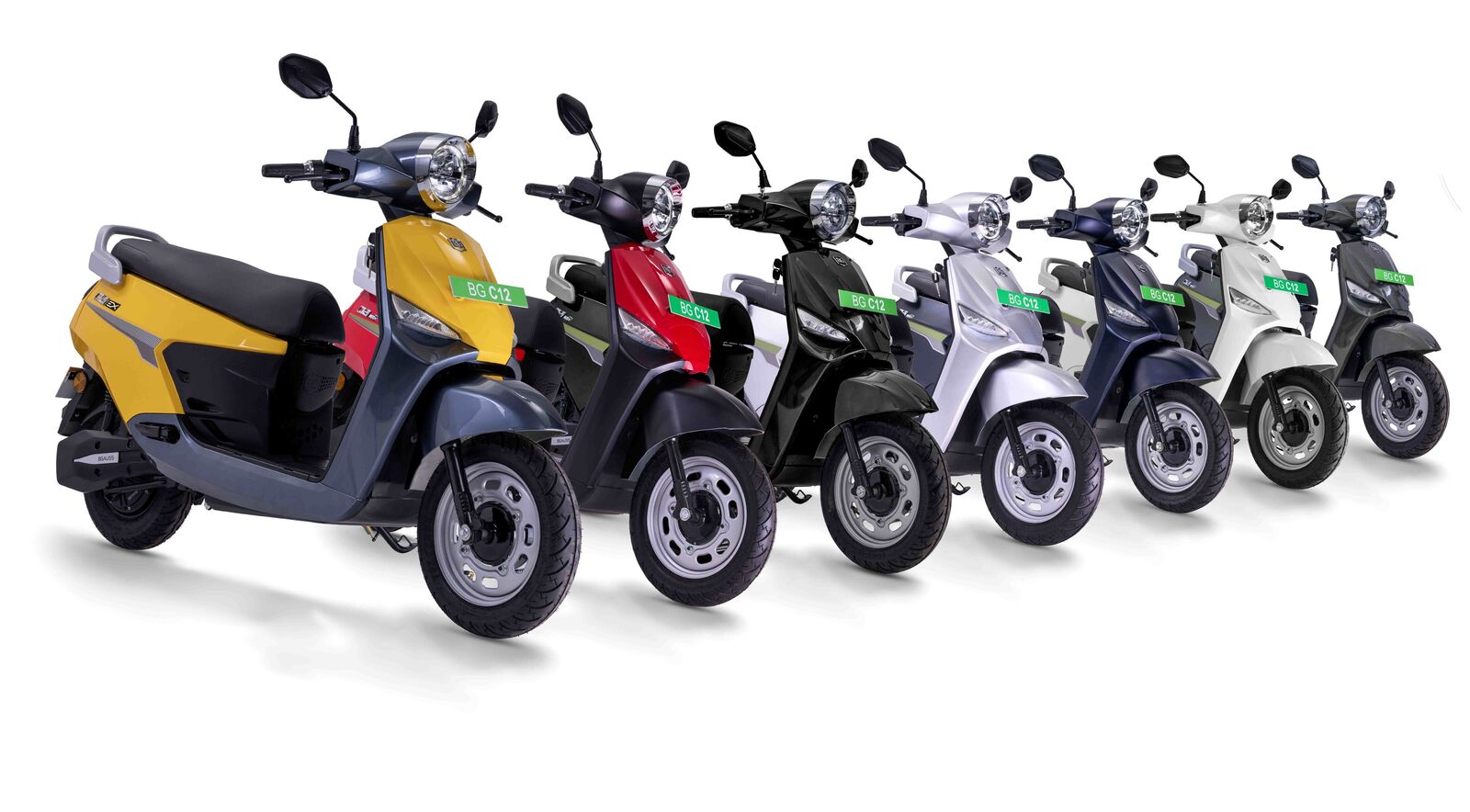
BGAUSS C12i comes with a lithium-ion LFP battery pack that is removable and takes three hours to fully charge. The claimed ARAI-certified range of the electric scooter is 85 km which means that the real-world range would be less. The electric motor and the battery pack are IP 67 rated which means they are water and dustproof. Speaking of motor, it is a 2500-WATT unit mounted in the rear wheel.
Customers can book the latest BGAUSS C12i EX electric scooter from the company website. The manufacturer is offering a 5-year warranty for the C12i EX. They currently have 125 dealerships across India.
Commenting on the launch, Hemant Kabra, Founder and CEO of BGAUSS, stated, “At BGAUSS, we are committed to our mission of providing high-performance, safe, and intelligent electric scooters to be at the forefront of the EV revolution in India. Our unwavering commitment to setting the highest standards in build quality, safety, and performance has brought us to this remarkable moment. The 100% Made in India C12i EX exemplifies our dedication to delivering top-tier electric scooters. The response to our C12i MAX was impressive, and we are thankful to our customers who have shown trust in our green and sustainable mobility solutions. We are hopeful that our latest addition, the C12i EX will also get a positive response from our customers as well. The e-scooter will be available at the introductory price of INR 99,999 until September 19, 2023.”





_1630332145996.jpeg "The Apache RR 310 and Apache RTR 310 will share the same underpinnings.")